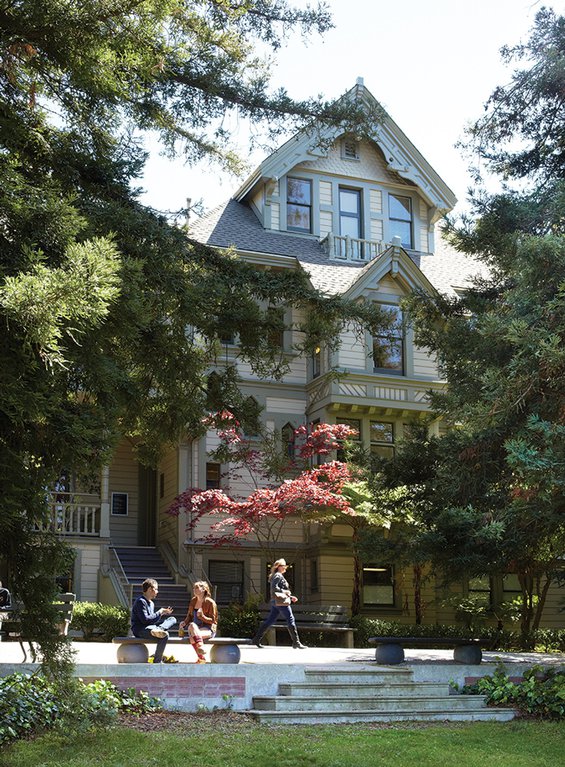
We are here – on time! Berkeley Bill went to CCAC.
John
Anti-Elon Musk group crushes Tesla Model 3 with Sherman tank–with unexpected results
Ironically enough, the group’s video ended up highlighting something very positive for Tesla.

Published 1 day ago
on May 8, 2025

Credit: Led By Donkeys/X
Anti-Elon Musk protesters and critics tend to show their disdain for the CEO in various ways, but a recent video from political action group Led By Donkeys definitely takes the cake when it comes to creativity.
Ironially enough, the group’s video also ended up highlighting something very positive for Tesla.
Tank vs. Tesla
In its video, Led By Donkeys featured Ken Turner, a 98-year-old veteran who served in the British army during World War II. The veteran stated that Elon Musk, the richest man in the world, is “using his immense power to support the far-right in Europe, and his money comes from Tesla cars.”
He also noted that he had a message for the Tesla CEO: “We’ve crushed fascism before and we’ll crush it again.” To emphasize his point, the veteran proceeded to drive a Sherman tank over a blue Tesla Model 3 sedan, which, of course, had a plate that read “Fascism.”
The heavy tank crushed the Model 3’s glass roof and windows, much to the delight of Led By Donkeys’ commenters on its official YouTube channel. But at the end of it all, the aftermath of the anti-Elon Musk demonstration ended up showcasing something positive for the electric vehicle maker.
Tesla Model 3 Tanks the Tank?
As could be seen from the wreckage of the Tesla Model 3 after its Sherman encounter, only the glass roof and windows of the all-electric sedan were crushed. Looking at the wreckage of the Model 3, it seemed like its doors could still be opened, and everything on its lower section looked intact.
Considering that a standard M4 Sherman weighs about 66,800 to 84,000 pounds, the Model 3 actually weathered the tank’s assault really well. Granted, the vehicle’s suspension height before the political action group’s demonstration suggests that the Model 3’s high voltage battery had been removed beforehand. But even if it hadn’t been taken off, it seemed like the vehicle’s battery would have survived the heavy ordeal without much incident.
All the Arts Organizations Impacted by NEA Funding Cuts
The grant cancelations follow Trump’s proposal to eliminate the federal agency.
Margaret Carrigan&Brian BoucherMay 8, 2025 Share This Article
As President Donald Trump advances his proposed elimination of the National Endowment for the Arts (NEA), arts organizations across the U.S. are already feeling the effects.
The best of Artnet News in your inbox.
Sign up for our daily newsletter.
After a sweeping White House budget request released in May that did not include allocations for the federal arts funding agency, dozens of institutions have received abrupt notices that their NEA grant applications were either denied or rescinded. The grantees received termination emails that stated that the NEA was “updating its grantmaking policy priorities to focus funding on projects that reflect the nation’s rich artistic heritage and creativity as prioritized by the President,” according to NPR.
ADVERTISING
In protest of the president’s actions, many senior staff at the agency resigned—including program directors overseeing grants for dance, theater, design, folk and traditional arts, museums, and literary programs—while others have been asked to retire, leaving the agency in disarray.
This isn’t the first time Trump has attempted to defund the NEA and eradicating the agency has been a conservative goal for decades. (During Trump’s first term, Artnet’s art critic Ben Davis published a list of 10 practical reasons why the NEA should continue to receive federal funding.) This recent push comes amid broader federal efforts to reshape and defund cultural agencies, including the Kennedy Center for Performing Arts, the Smithsonian Institution, and the NEA’s sister agency the National Endowment for the Humanities (NEH), which has seen a 70–80 percent reduction in its staff and has canceled more than a thousand grants. Trump has justified the cuts as part of his mission to root out “woke” influence in public life.
Several private organizations, such as the Mellon Foundation and the Helen Frankenthaler and Andy Warhol Foundations, have already launched emergency funding programs to offset the toll that Trump’s funding cuts are taking. But for the countless artists, educators, and community-based organizations that rely on NEA funding, the consequences are immediate and destabilizing. With no clear guidance on what will come next—or whether the NEA will continue to function at all—arts leaders are left scrambling. Below, we’ve compiled a list of organizations that have lost funding or been notified of changes, offering a snapshot of how these policies are already reshaping the nation’s cultural landscape.
This list will be continually updated.
“Jeffrey Gibson: Power Full Because We’re Different” at Mass MoCA

Installation view of “Jeffrey Gibson: Power Full Because We’re Different” at MASS MoCA. Photo: Tony Luong, courtesy of MASS MoCA.
The Massachusetts Museum of Contemporary Art (Mass MoCA), in North Adams, was notified on May 2 that a grant to support an exhibition by Jeffrey Gibson, “Power Full Because We’re Different,” was terminated, according to an announcement from director Kristy Edmunds. The emailed notification said that the grant, awarded in 2024, “falls outside” the focus on funding “projects that reflect the nation’s rich artistic heritage and creativity as prioritized by the President.”
According to the NEA’s website, the grant was in the amount of $50,000. The exhibition remains open through August 2026.
The museum also lost a grant for staff training in technology from the Institute of Museum and Library Services, noted Edmunds, because it “no longer serves the interest of the United States.”
In 2024, Gibson was the first Indigenous artist to represent the U.S. at the Venice Biennale. The U.S. government has opened applications for the 2026 Venice Biennale pavilion with new Trump-era guidelines prioritizing “American values” and “exceptionalism,” while restricting content that promotes Diversity, Equity, and Inclusion.
Art21 series “Art in the 21st Century”
Art21, the New York nonprofit that produces the beloved public television series Art in the 21st Century, lost an $85,000 grant to support the production of seasons 12 and 13 of the program. As the season is still in production, Art21 declined to share the names of participating artists.
The season that launched in April 2023 featured artists including Alex DaCorte, the Guerrilla Girls, Amy Sherald, Rose B. Simpson, and Christine Sun Kim. That fall, for the first time, some episodes hit theaters for a screening at New York’s Metrograph theater.
“It is a tragic day when the NEA shutters,” said executive director Tina Kukielski in an emailed statement. “This devastating news signals a major disruption to small and mid-size organizations, most of whom offer artists a first opportunity to express their voice and serve communities that would not otherwise have access to arts and cultural spaces. But let’s be clear: the arts will endure. Our work will, and must, carry on.”
Shinichi Sawada and the North St. Louis Creative Field Guide at the Contemporary Art Museum St. Louis

North St. Louis Creative Field Guide Working Group members at an excursion to Northside Workshop. Photo: CAM staff.
The Contemporary Art Museum St. Louis, in Missouri, lost two grants totaling $105,000.
A $40,000 grant supported the exhibition “Shinichi Sawada: Agents of Clay,” which was on view through February.
A $65,000 award was given to support the museum’s North St. Louis Creative Field Guide project, which it describes as “a resident- and artist-led initiative that treats the garden as an art studio creating wellbeing, opportunities for community-building, and renewed investment in place.” That program has been underway since November 2024.
“No matter what, we’ll find a way to move forward with this project,” said museum director Lisa Melandri in an emailed statement, “and we’re not going to let this deter us from delivering on our long-term vision.”
“Monuments” at MoCA Los Angeles

Red paint splashed on statue, Confederate Soldiers and Sailors Monument, Mount Royal Avenue, Baltimore, MD. Baltimore Heritage from Baltimore, Maryland, CC0, via Wikimedia Commons. Photo: Eli Pousson, 2017.
The Museum of Contemporary Art Los Angeles lost $65,000 in support for the exhibition “Monuments,” co-organized with the Brick (formerly LAXART), which has been in the works since 2021 and was inspired by the widespread decommissioning of Confederate War memorials. It will bring together a selection of decommissioned Confederate statues with contemporary artworks borrowed and commissioned for the occasion, and will include artists such as Stan Douglas, Leonardo Drew, Nona Faustine, Kahlil Robert Irving, Martin Puryear, Andres Serrano, Hank Willis Thomas, and Kara Walker.
“It’s quite engaging,” Brick director Hamza Walker told Artnet News in an interview in 2021, “to work on something that is unfolding in real time.”
The museum had not spent or received any of the funds, said a spokesperson via email.
Other impacted organizations:
– Shunpike, in Seattle, Wash., lost $65,000 to support its Artists of Color Expo and Symposium. “We have received funding for this program since its inaugural event in 2017, in varying amounts each year, usually in the $20,000–$30,000 range. So of course, we were thrilled when the NEA recognized the impact and true cost of the program with this significant increase,” said executive director Line Sandsmark in an email.
– The Print Center, a New York nonprofit, was notified on Friday that it would lose its $50,000 award for its exhibition “Data Consciousness: Reframing Blackness in Contemporary Print,” just five months before the show was set to open, according to a report in Hyperallergic.

Museum of Contemporary Art Denver. Photo: Shutterstock.
– The Museum of Contemporary Art Denver lost a $40,000 grant to support the exhibition “Movements Toward Freedom,” which ran through February 2 and explored “the power, possibility, and vulnerability of bodily movement in contemporary life through movement’s physical and social dimensions.”
– The Berkeley Art Museum and Pacific Film Archive lost a $40,000 grant to support the exhibition “Routed West: Twentieth-Century African American Quilts in California,” set to run June 8 to November 30. The museum also lost about $230,000 in unspent funds from a $461,000 IMLS grant to support conservation of the quilts, which number in the hundreds.
– The Watershed Center for the Ceramic Arts, in Newcastle, Maine, lost $35,000 to support an artist residency program.
– The Asian Art Museum, San Francisco, lost $30,000 to support an exhibition and associated programming that focuses on contemporary West Asian perspectives.
– The Contemporary Arts Museum Houston lost a $30,000 grant to support the exhibition “Mary Ellen Carroll: How To Talk Dirty and Influence People,” which will be on view May 22–November 1, 2026. The first exhibition to survey the work of the acclaimed multidisciplinary artist surveys four decades of projects, some of which are ongoing and will include new works realized in collaboration with the museum.

Mary Ellen Carroll, No. 9 (My Death is Pending…Because.) Night of Destruction with Fireworks Demolition Derby (2017). Photo: Michele Asselin, courtesy the artist.
– A.I.R. Gallery, in Brooklyn, N.Y., lost a $30,000 grant to support exhibitions of the A.I.R. Fellowship Program for Emerging Artists. “We applied for this funding back in February 2024 and were notified by the NEA that our project was recommended for funding in the amount of $30,000 in November 2024,” said the gallery’s Christian Camacho-Light. “Since that point, our grant remained in the offer stage despite submitting the requisite documents back in December and had not reached the official approval/contracting stage by May 2 despite us having usually cleared this stage in prior years by mid-April.”
– The Pennsylvania Academy of the Fine Arts, in Philadelphia, Pa., lost a $30,000 grant to support the exhibition “William Villalongo: Myths and Migrations,” set to open May 15, that includes two decades’ worth of work “exploring identity, race, and visibility,” according to the museum.

Pennsylvania Academy of Fine Arts. Photo: Shutterstock.
– The Armory Center for the Arts, Pasadena, Ca., lost $30,000 that was going to support the exhibition “From the Ground Up: Nurturing Diversity in Hostile Environments,” which was part of PST Arts: Art and Science Collide.
– The Buffalo Institute of Contemporary Art lost a $30,000 grant to support exhibitions, programming, and publications. “It’s unclear if any of the funds we were awarded last summer will be distributed,” board president Nando Alvarez-Perez said in an email.
– The Bronx Council on the Arts in New York lost a $30,000 grant to support a series of visual arts exhibitions.
– The Visual Arts Center of New Jersey, in Summit, lost $30,000 grant to support exhibitions and honoraria to artists.
– The Civitella Ranieri Foundation, based in New York and the Umbria region of Italy, lost a grant of $30,000 to support a residency program in Umbria for American artists. “We are appealing it, as we hope other organizations in the same situation will do too!” said Michaela Olsen, coordinator of programs and operations in New York, in an email.
– The Bunnell Street Art Center in Homer, Alaska, lost a $25,000 grant to support artist residencies.
– Bomb Magazine, in New York, lost a $20,000 grant to support visual arts interviews, essays, and portfolios in print and online. “Because there was an opportunity to be considered for funding through America250 (the semiquincentennial—quite a mouthful!) in the FY25 application we also proposed an essay series, Constellations, that invites artists to draw from our 44-year archive to make connections between interviews of American artists across time,” said Sheryl Oppenheim, institutional giving manager, by email.
– New York’s Artists Alliance lost $20,000 to support an exhibition at New York venue Cuchifritos.
– ArtWorks for Milwaukee lost a $10,000 Challenge America grant to support its environmental arts internship program, which produces public art related to environmental concerns.
– Dimensions Variable, in Miami, lost $10,000 of a $20,000 grant to support a series of contemporary art exhibitions.
– Los Angeles nonprofit venue JOAN lost $20,000 to support artist residencies and exhibitions for L.A. artists.
– Snug Harbor Cultural Center and Botanical Garden in New York lost $10,000 for a visual arts and storytelling workshop series.
– BOFFO, an LGBTQ-focused nonprofit arts community, organization, and festival in Fire Island Pines, N.Y., lost a $45,000 grant to support its residency program. “Yes, we are definitely under attack. LGBTQ+ rights and diversity efforts are being targeted. Our community is being tested,” executive director and co-founder Faris Al-Shathir said in a statement. “We will not waver in the face of adversity.”
Construction Underway for California College of the Arts Expansion in San Francisco
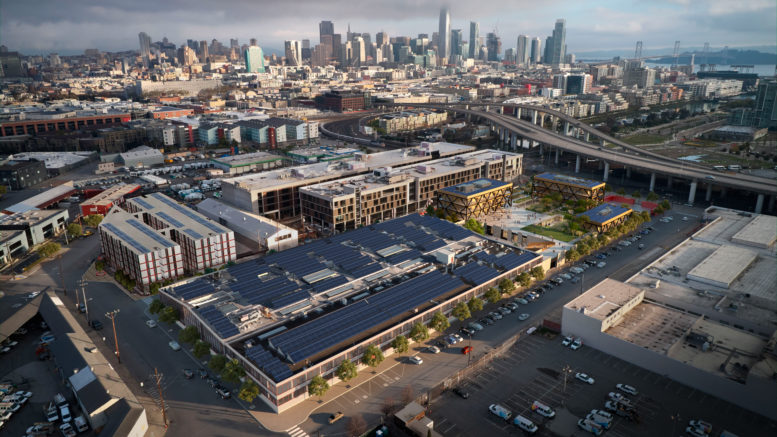 CCA campus aerial view, rendering by Studio Gang and Kilograph
By: Andrew Nelson 5:30 am on March 9, 2023
Steel and wood have started to rise for the California College of the Arts expansion at 1140 7th Street in San Francisco. The new facilities, named Double Ground, allow CCA to close its Oakland campus and consolidate into the Design District neighborhood with a new landmark addition designed by the renowned Chicago-based architecture firm, Studio Gang. The new construction will integrate exposed concrete and mass timber within a new creative complex at the core of the urban campus.
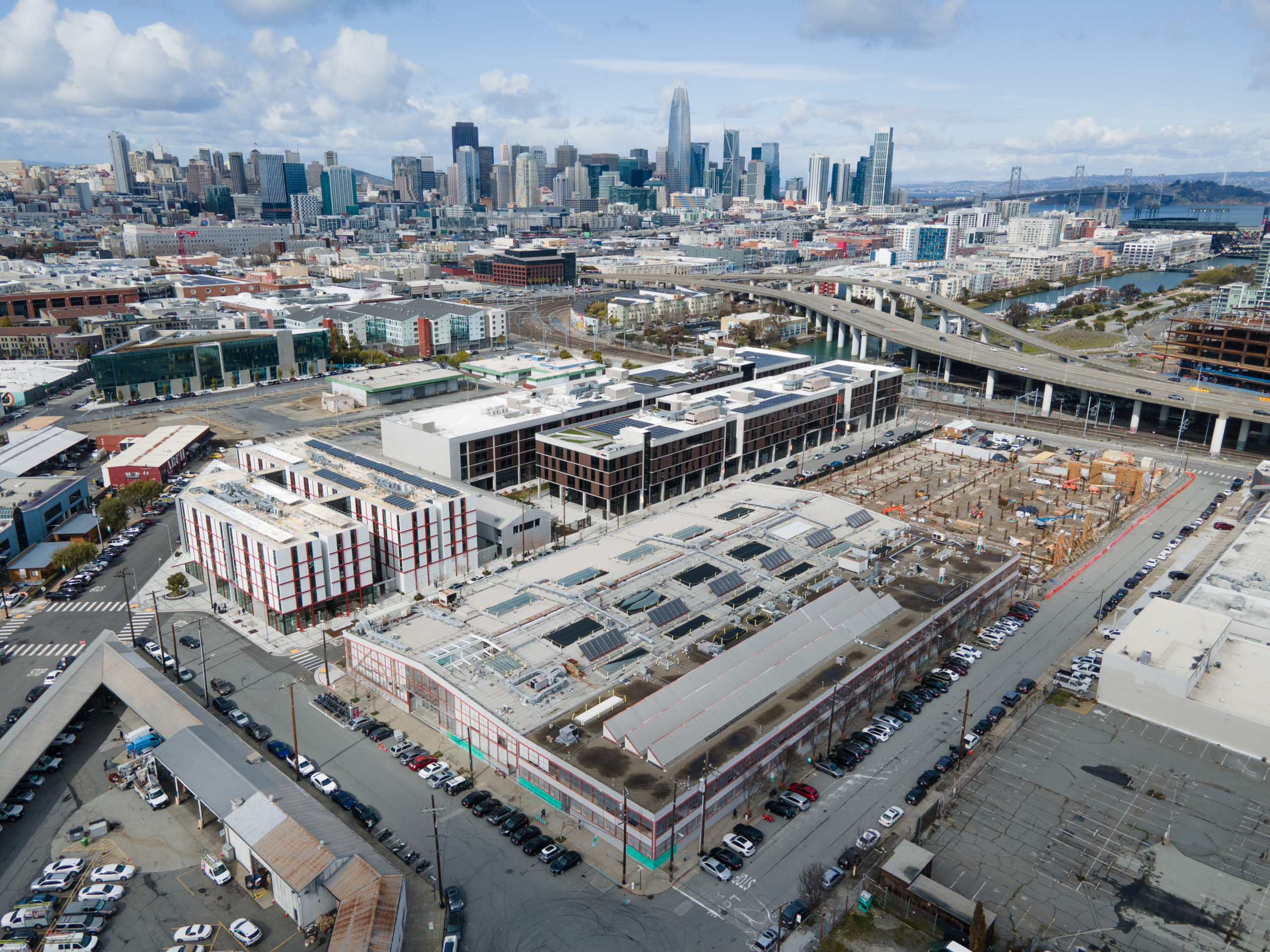
CCA Campus aerial view with the San Francisco skyline in the background
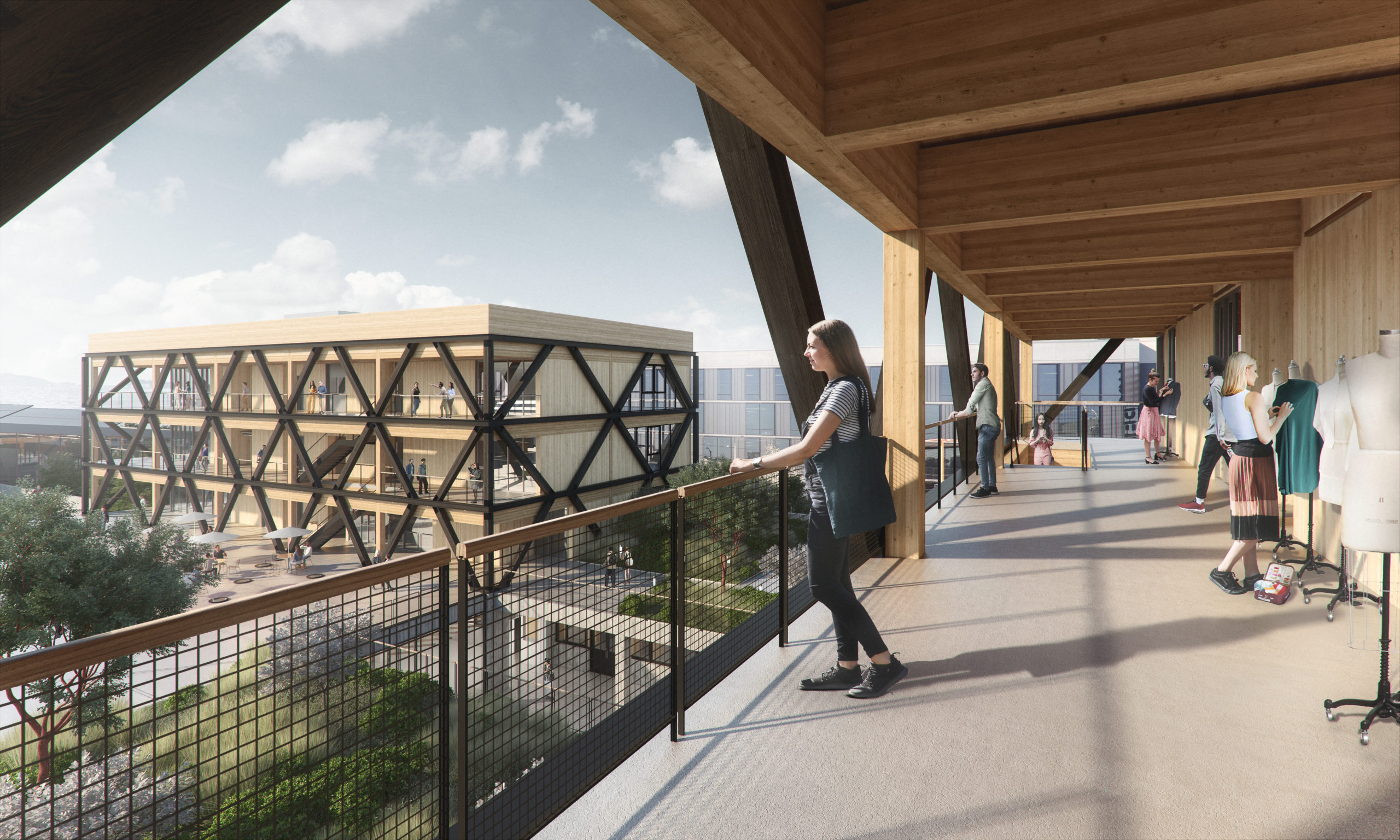
CCA campus mass timber structures seen from the exposed hallways, rendering by Studio Gang and Kilograph
The 2.3-acre expansion will create approximately 96,500 square feet of new floor area, with improvements to sidewalks along Hooper, Irwin, and 8th Street. The new campus will unify CCA’s 22 undergraduate and 11 graduate programs. The tallest buildings will stand 58 feet tall. Parking is included for 68 bicycles.
The facilities aim to be carbon neutral with net-zero energy once running, including a microgrid for the campus to harvest and store clean energy. The buildings emphasize mass timber as the primary structural element, a relatively new construction material with a smaller carbon footprint than traditional materials like concrete and steel.
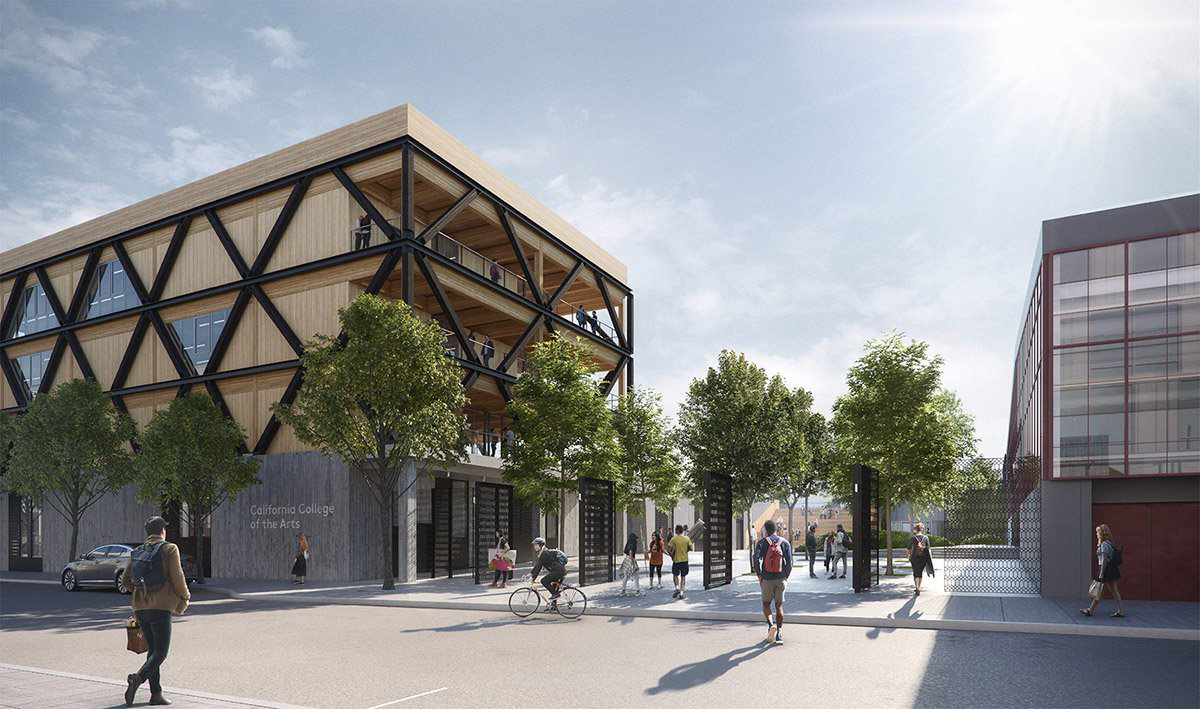
CCA campus entry, rendering by Studio Gang and Kilograph
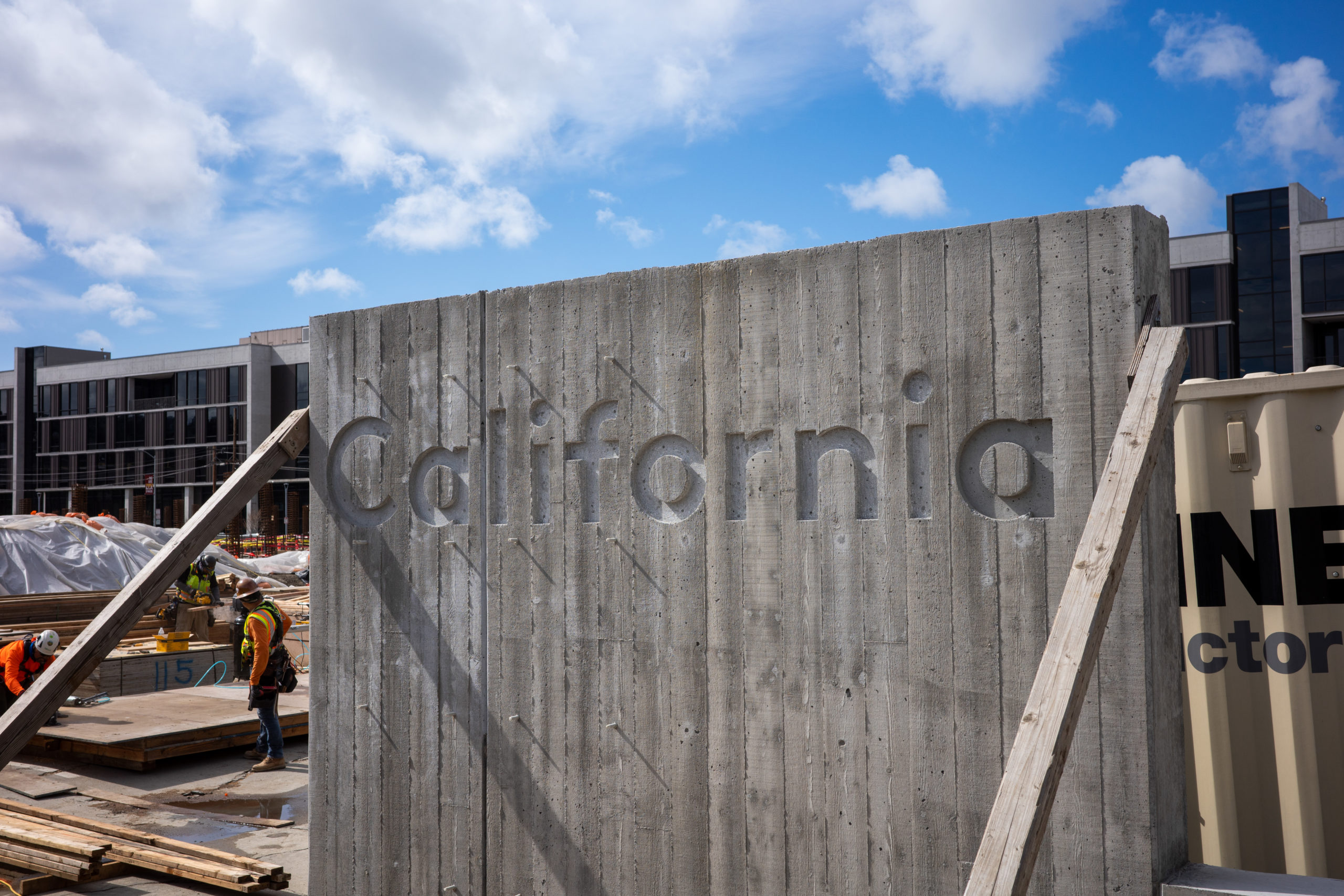
CCA Campus cast-in-place concrete sign already visible
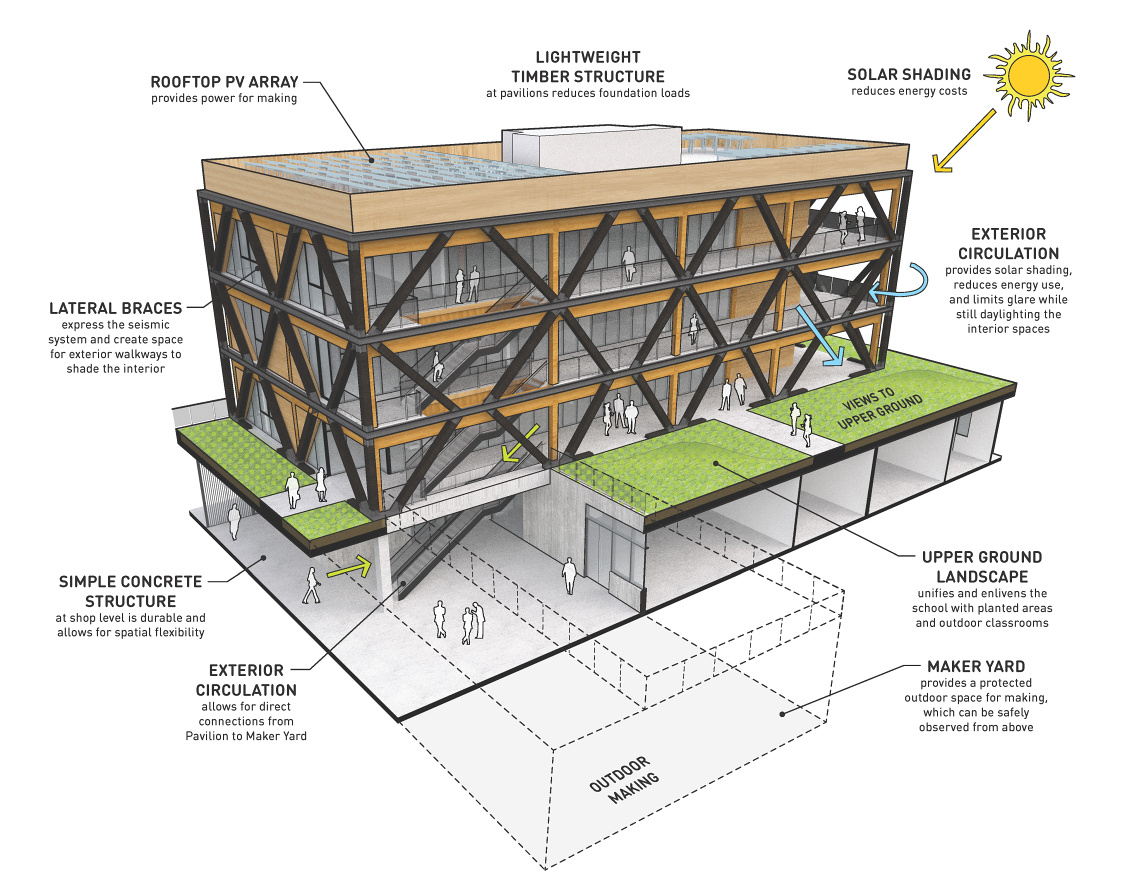
CCA campus cross-section diagram, rendering by Studio Gang
There will be two four-story structures and one two-story mass timber wrapped with wooden lateral braces and deep 11-foot-deep open-air walkways. This simple design across the site at scale will undoubtedly become an iconic landmark for the CCA campus.
Below the three-story buildings, Studio Gang plays with the ground-level and second-level planes for movement, hence the name Double Ground. The wide pathways connecting to various pavilions will serve as student gathering spaces. The plans embrace outdoor space as much as interiors to give students room to study and work. Studio Gang writes that “together, this layered environment functions as a laboratory where students and faculty can explore sustainable materials, processes, and tools.”
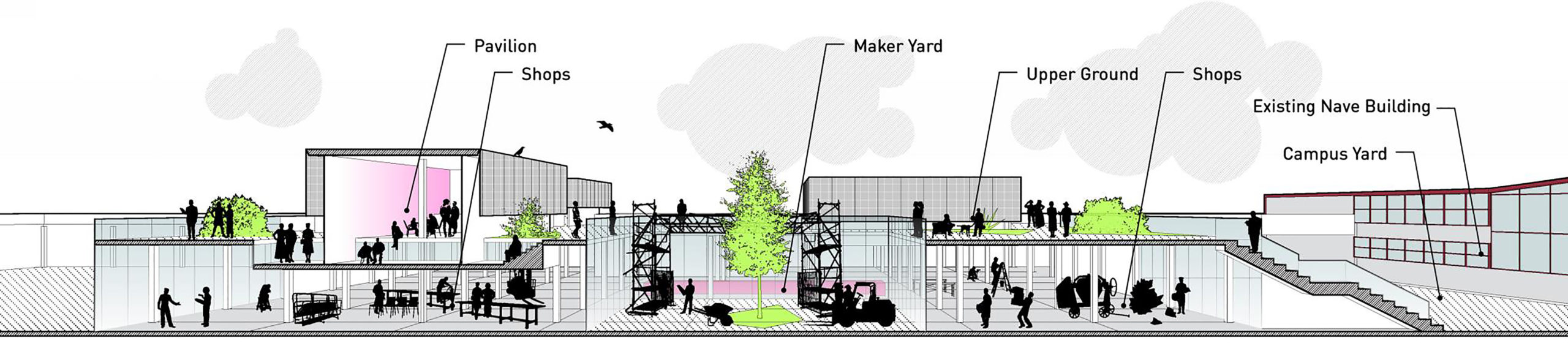
CCA campus vertical cross-section, site view by Studio Gang
The following passage from CCA describes Double Ground site programming:
The “lower ground,” at street level, will house workshops and studios requiring heavy equipment: facilities for ceramics, metal, sculpture, and furniture, among others. Many of these ground-floor spaces open into shared maker yards, and flexible outdoor courtyards that serve as extensions of the surrounding workshops while encouraging interaction among students working in a wide variety of disciplines and media. Ample windows reveal what’s happening inside the adjoining studios, while maximizing the natural light inside. This transparency extends to the “upper ground,” a second main level featuring an outdoor plaza and a park-like garden, with views down into the maker yards below.
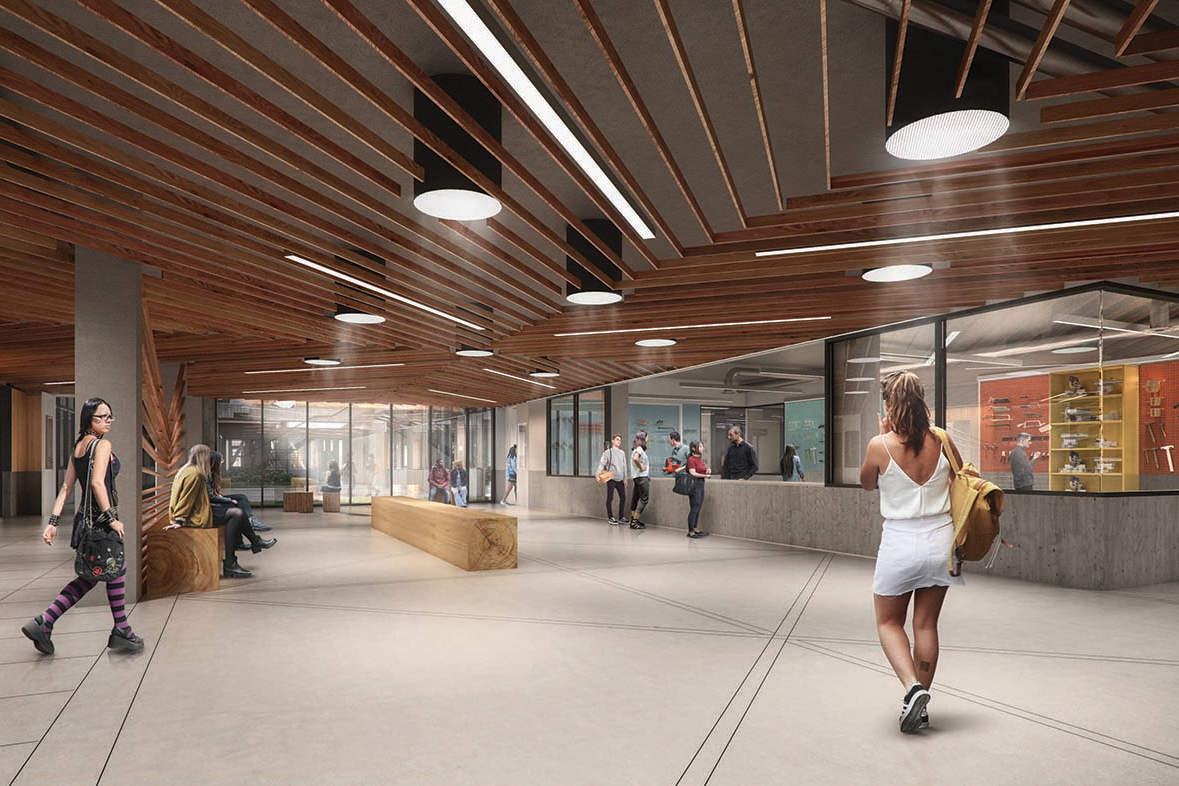
CCA campus interior, rendering by Studio Gang and Kilograph
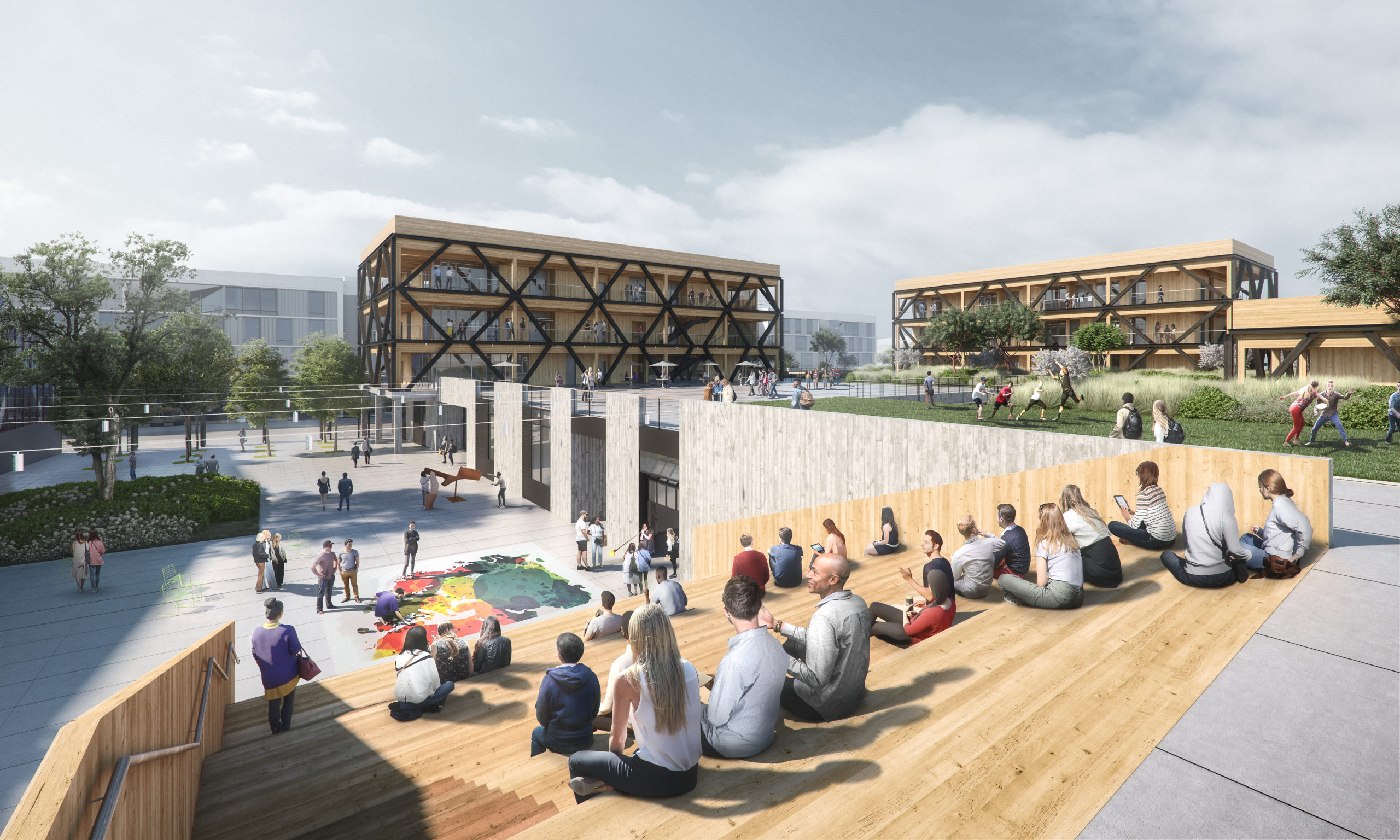
CCA campus student view, rendering by Studio Gang and Kilograph
CCA was founded in 1907 in Berkeley before moving to Oakland in 1922 and San Francisco in 1996. The Oakland Campus was officially closed last year, moving all students to San Francisco. The school has around 1,600 students in undergraduate and graduate programs. The main building on the same block as the expansion was transformed by Leddy Maytum Stacy Architects from a Greyhound maintenance facility for the art school.
The school has recently expanded its student housing capacity in the neighborhood by completing Blattner Hall by Leddy Maytum Stacy Architects in 2018 and Founders Hall by Stanley Saitowitz | Natoma Architects in 2020.

CCA Campus construction site
Hathaway Dinwiddie is the general contractor. Crews have already removed the former surface parking lot, dug the foundation, and started to put up wood walls and steel rebar. Completion for Double Ground is expected next year.
Subscribe to YIMBY’s daily e-mail
Follow YIMBYgram for real-time photo updates
Like YIMBY on Facebook
Follow YIMBY’s Twitter for the latest in YIMBYnews
Dear CCA faculty and staff,
I’m writing to update you on the progress made over the summer regarding long-term plans for the Oakland campus. As you know, in order to improve and strengthen the educational experience at CCA we will unify our programs and operations in San Francisco for the academic year 2021-22. ALL Oakland-based programs and facilities will be relocated to San Francisco.
We recognize that this is a big change for everyone, especially East Bay-based faculty and staff, and that there will be a natural, and necessary, adjustment period. We are committed to providing timely information on the unification process and soliciting your feedback as we move forward.
The future of our Oakland campus remains a key focus in our campus planning efforts. In April we entered into a preliminary agreement with Equity Community Builders and Emerald Fund (ECB/EF) to help us identify a range of opportunities for the campus. Our goal with this agreement was to work in partnership with ECB/EF to explore prospective uses of the Oakland campus that celebrate CCA’s artistic and educational legacy and benefit the greater community.
Through a visioning process conducted with CCA staff and Oakland faculty leadership, the ECB/EF team developed several options for discussion. Options under consideration will preserve key historic campus buildings and landscape, honor our arts legacy, provide affordable artist housing and studios coupled with much-needed market rate housing, and enhance public access to the site.
These options will be presented to CCA’s Board of Trustees at the September 19 meeting for their consideration. Next steps would include a broader community outreach process to neighbors and other interested groups to solicit feedback.
I’d like to thank all the staff and faculty members who participated in the summer visioning sessions. I’m especially grateful to the chairs of the Oakland-based programs for their insight and leadership during this time of
 Rosamond Press
Leave a comment