
President Donald Trump talks to reporters in the Oval Office of the White House in Washington, April 23, 2025.
Samuel Corum/EPA-EFE/Shutterstock
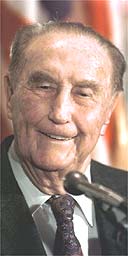
Strom Thurmond. Photograph: Susan Walsh, AP
Donald Trump achieved what Strom Thurman failed to achieve, Trump gleefully did away with the National Endowment of the Arts. Trump also seceded from the Union, and created a new nation that seeks to take in more territory, more land and put to an end the sovereignty of Nations. In this, he is like Charles Quint, Holy Roman Emperor and leader of the Habsburg Empire. Quint was in power when Rome was sacked by fellow Christians, and when the Pope gave the Conquistadors to rape and pillage the new world. The High Renaissance was looted and destroyed, and the Renaissance if tge Aztec and Incans – butchered. All this was done in the name of Jesus.
Five days ago I ended a friendship that was fifty-seven years old. Christine demanded I give her proof Southern Ministers gave PRO-SLAVERY sermons. She had studied theology at Mills College, and became a disciple of Trump, who gave her permission to be a – Catholic again! So add the destructive Civil War to the list of Evil done in the name of Jesus! How about forming a National Fire Brigade, similar to the militias in the South?
“Our souls don’t need saving but our homes and towns do!”
I just watched my local news here in Springfield Oregon and the distress over Fed cuts to fire fighting is – extremely high! We are bid to protest, somehow! Write our elected leaders! Here is a Man of God in deep distress over superior white men having to give up their slaves.
I think the new Pope should appoligise ton Englance for trying to destroy it with Spanish Armadas!
John Presco
Now the preacher turns to the political part of his sermon, justifying secession and portraying the Northern aggressors in negative terms:
We seceded from the Government of which we were once a part, because we felt that under it we no longer had a country. For what is our country? Our country is in its constitution, and its provisions were openly and shamefully violated–our country is in its religion, and its altars were desecrated by infidelity and the vilest fanaticism–our country is in its institutions, and they were threatened with total subversion –our country is in its social life, and that was covered all over with rude abuse and malignant defamation. And shall we, for peace sake, think for a moment of returning to the embrace of such an Union? God forbid! Let us learn at once the stern truth that we have no country until we make one. We can never go back to that whence we came out. We should not recognize it in its present garb of tyranny. We should not discern that once proud Republic under the mask which it now wears, with the oriental despotism that rules over it, and the oriental submission that kisses its feet. In its delirium it has lost all sense of regulated liberty–it remembers only passion and vengeance. Closing its eyes against all truth, and shutting its ears against all wisdom, it is striking at man madly in its rage, and it is cursing God who has placed the bit in its mouth, and is saying to it, “Thus far shalt thou go and no further.”
“The National Endowment for the Arts has always been bigger than life,” Mr. Armey said. “What makes it so big? It is made big by the concerted, well–funded, well–motivated efforts of the arts elite in America who want the focus to be not whether or not there will be funding for the arts but whether or not they will be in control.” (1)
Rep. Dick Armey of Texas, Republican Majority Leader, July 10, 1997
The most recent round of the national debate over funding for the National Endowment for the Arts (NEA) and the National Endowment for the Humanities (NEH) ended one year later, on July 21, 1998. On that day the House of Representatives approved $98 million for the NEA for fiscal 1999 and rejected the conservative Republican position that tax dollars should not be used to support the arts. This is the latest chapter in a concerted assault on the arts — and eventually humanities — that has been raging with more or less ferocity since May 1989 when Sen. Jesse Helms, on information supplied by the conservative Christian American Family Association, condemned Andres Serrano’s “Piss Christ” in an NEA-funded exhibition at the Southeastern Center for Contemporary Art in Winston-Salem, North Carolina.
The philosophical differences between the two sides represent varying views about human nature and its relation to government. Endowments proponents generally hold modern liberal-moderate political views: minimal intrusion on the part of the state in private life combined with confidence in an activist government to guarantee individual rights and broad access to social goods such as economic, educational, and cultural opportunity. This view is opposed by many political opponents of the endowments, but by far the strongest opposition comes from Christian conservatives who advocate elimination of the NEA (and the NEH in the heat of the 1995 funding crisis) as part of their broader social agenda. For them individual rights and free expression, fundamental values in the liberal tradition, are radically at odds with a world view from an older ideology that sees human beings as basically flawed, their capacities for good nurtured only in the strict observance of Christian dogma. A government that fails to enforce these precepts is at odds with their deepest beliefs and must be changed. The Reverend Peter J. Gomes described the fervency of these political convictions in “The New Liberation Theology”:
Within the Christian Coalition are groups adamantly opposed to abortion, homosexual civil rights, and the United Nations. Many are in favor of “creation-science” as an alternative to the theory of evolution; seek some kind of constitutional amendment that permits prayer in the public schools; want government vouchers for private education. Nearly everyone in the Christian Coalition agrees that the coarsening of our culture — through pornography, sexual violence, and the demise of the traditional nuclear family — comprises the greatest threat to our civilization. Their agenda is clear, and they now have the resources to put that agenda before the American people. They are organized, ambitious, and filled with a zeal that contrasts sharply with the tired-out politics and issues of the major parties. They are at war with the powers that be, and with the culture, that have for so long denied them and the legitimacy of their aspirations.(2)
While members of the Christian Right are certainly the most organized and vocal opponents of the endowments, their position also reverberates with those — mostly the politically ambitious — who attack the “eastern Establishment” and “cultural elite” in timeworn but often effective arguments that divide Americans along class and sectional lines.
The States’ Rights Democratic Party (whose members are often called the Dixiecrats), also colloquially referred to as the Dixiecrat Party, was a short-lived segregationist, States’ Rights, and old southern democratic political party in the United States, active primarily in the South. It arose due to a Southern regional split in opposition to the national Democratic Party. After President Harry S. Truman, the leader of the Democratic Party, ordered integration of the military in 1948 and other actions to address civil rights of African Americans, including the first presidential proposal for comprehensive civil and voting rights, many Southern white politicians who objected to this course organized themselves as a breakaway faction. They wished to protect the ability of states to decide on racial segregation.[6] Its members were referred to as “Dixiecrats”, a portmanteau of “Dixie“, referring to the Southern United States, and “Democrat”.
In the 1930s, a political realignment occurred largely due to the New Deal policies of President Franklin D. Roosevelt. While many Democrats in the South supported substantive economic intervention, civil rights for African Americans were not specifically incorporated within the New Deal agenda, due in part to Southern control over many key positions of power within the U.S. Congress.[7] Supporters assumed control of the state Democratic parties in part or in full in several Southern states. They opposed racial integration and wanted to retain Jim Crow laws and other aspects of de jure and de facto racial discrimination. On non-racial issues, they held heterogeneous beliefs. Despite the Dixiecrats’ success in several states, Truman was narrowly re-elected. After the 1948 election, its leaders generally returned to the Democratic Party, at least for a time, although the Dixiecrats weakened Democratic identity among white Southerners. The Dixiecrats’ standard bearer, Senator Strom Thurmond of South Carolina, eventually switched to the Republican Party in 1964, in opposition to national civil rights legislation.[8]


Vatican City, Mar 29, 2019 / 19:01 pm
President Andrés Manuel López Obrador of Mexico this week wrote to Pope Francis and the King of Spain, Felipe VI, asking for an apology for the conquest of Mexico by Spanish Catholics in the 16th century.
His demand for an apology comes at the 500th anniversary of the beginning of the conquest, and the 200th anniversary of Mexico’s independence.
“I have sent a letter to the Spanish king [Felipe VI] and another letter to the Pope so that the abuses can be acknowledged and an apology can be made to the indigenous peoples for the violations of what we now call human rights,” López Obrador said in video comments earlier this week.
“There were massacres…The so-called conquest was done with the sword and the cross. They raised churches on top of temples,” he said.
In revenge speech, Trump compares himself to Al Capone
March 18, 2025 10:27 AM CDT By Mark Gruenberg
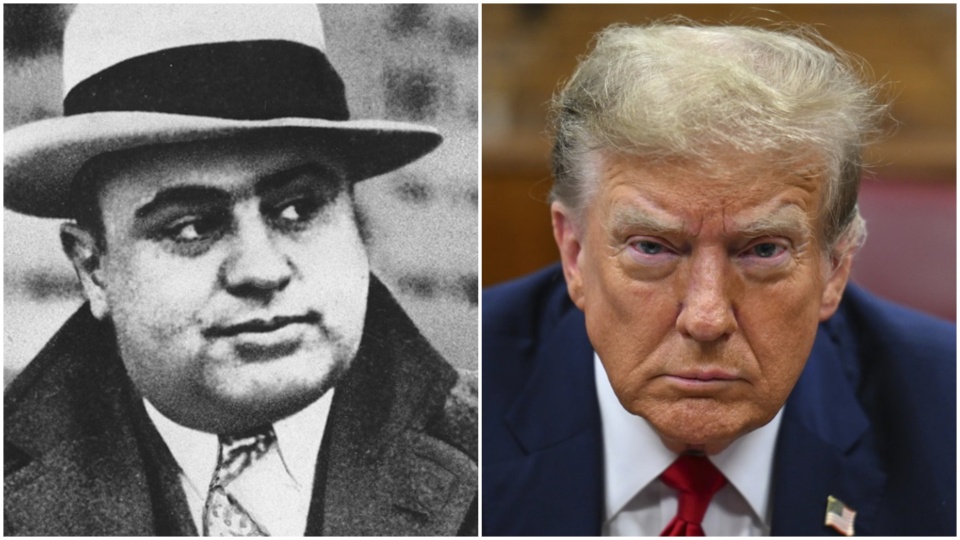
Trump has compared himself to gangster Al Capone. | AP photos
WASHINGTON—For Donald Trump, there’s a mass mainstream media conspiracy out to get him, Joe Biden let “millions of illegal immigrants” into the country to commit crimes, and a politicized Justice Department went after him, just like the FBI did after Al Capone.
And Trump’s Democratic predecessor, Biden, won “a rigged and crooked election” and should go to jail.
Those were among the highlights in a long presidential revenge speech with Trump jumping from topic to topic, on March 13 in the Justice Department auditorium.
The mainstream media characterized the speech as a Trump “enemies list,” à la Richard Nixon more than 50 years ago. It wasn’t. Trump “enemies” were scattered through the speech.
They were also fewer than Nixon’s eventual 220. One Trump foe was Biden. He was joined by former Justice Department Special Counsel Jack Smith, who led the prosecution of Trump for ordering and abetting the Jan. 6, 2021, invasion, insurrection and attempted coup d’état at the U.S. Capitol.
Other Trump enemies included career FBI agents who probed Trump and the invaders, and several New York officials who also prosecuted him. But his main foe, just like on the campaign trail, was migrants. The subtext, of course, was migrants of color coming over the U.S. border with Mexico.
The Capone comparison, which Trump never used before, came after his rant against Biden’s alleged politicization of the Justice Department in pursuing cases against him for property tax evasion and campaign finance fraud—New York state and city cases and convictions—and for the insurrection.
“The great Alphonse Capone, legendary Scarface, was attacked only a tiny fraction of what Trump was attacked, and maybe it worked out well. I don’t know,” Trump mused. “If I had to give it up, I probably wouldn’t, but only because I’ve gone through it. But I wonder what the difference would be.”
One difference: In 1931, the FBI caught and the Justice Department indicted infamous mobster Capone, who ran the Chicago crime syndicate, for income tax evasion. Capone was convicted, and eventually sent to Alcatraz. Another: Trump boasted at the Justice Department about pardoning 1600 indicted or convicted insurrectionists.
The crazy speech reflects, however, the necessity of top Democratic leaders mounting a much more forceful fight against Trump on the economic and political fronts.
The comedian Jon Stewart noted on his show that Democratic Sen. Chuck Schemer declared that Trump’s approval rating has dropped from 52 to 48 percent. He quoted Schumer: “We will keep at it and keep at it and keep at it until it goes below 40 percent and then the Republicans will have to work with us.”
“Keep at it?” Stewart asked. “What is IT? You have to have an IT if you are going to keep at IT. What is the IT Schumer is talking about?”
“We will expel the rogue actors and corrupt forces from our government,” Trump promised in his speech. That includes FBI agents who investigated the invaders and career prosecutors who handled the cases, though Trump didn’t identify those two groups.
“We will expose and very much expose their egregious crimes and severe misconduct of which was levels you’ve never seen anything like it. It’s going to be legendary,” he bragged.
He wasn’t done
Trump wasn’t done. He saved his sharpest and longest vitriol for a common focus for both him and his MAGA legions: Undocumented people, whom he calls “illegal immigrants,” and worse.
“The last administration presided over the worst increase in violent crime in our country in many, many decades,” Trump claimed, a flat-out lie according to crime data. “We had levels of violence and crime and a lot of it had to do with the illegal immigrants that came in. Remember when I used to complain about it, because I knew how tough they were, how mean they were?
“And they”—the Biden administration—“said ‘No, people that come into our country are all wonderful people,’” Trump alleged in another lie. “No, they’re not wonderful. These are stone-cold killers. They make our killers look nice by comparison. They make our killers look nice. These are rough tough people with the tattoos all over their face.”
Crime data again show Trump lied. Migrants, legal and illegal, actually commit crimes at a lower rate than do native-born people, statistics reveal. That didn’t stop Trump’s rant. It also didn’t stop Trump’s anti-migrant czar, Tom Homan, from declaring on March 17 that federal judicial rulings against mass deportations won’t stop him. “I don’t care what the judges think,” Homan stated.
“These are rough, rough killer people and they [the Biden administration] allowed them in by the millions,” Trump charged. “In major cities like New York, Chicago and Washington, mothers can’t walk their children to the park without fear of being shot or killed or raped or anything. Women can’t ride the subway without worrying that a hoodlum will shove them onto the train tracks,” he declared, without evidence.
What Trump didn’t say was that Trumpite Republican Govs. Ron DeSantis of Florida and Greg Abbott of Texas loaded migrants–including those seeking asylum–onto buses and planes and transported them to those three “sanctuary cities” and others. The governors’ agents then dumped the migrants on those cities’ streets, leaving them to fend for themselves and sticking the cities with the bill.
Trump wasn’t done with his enemies, though. He just grouped them.
“My administration stripped the security clearances of the disgraced intelligence agents who lied about Hunter Biden’s laptop from hell. We revoked the clearances of deranged Jack Smith, Alvin Bragg, Letitia James and the crooked law firms that aided their partisan prosecutions. And I went through it. These are state and city courts and the corruption is unbelievable.”
Smith was the Justice Department’s special counsel handling the insurrection case in D.C. Bragg is the Manhattan District Attorney who convicted Trump on charges of campaign contribution fraud. James is the New York state’s Attorney General. She convicted Trump and his firm of state property tax fraud.
“We also terminated the clearances of the Biden crime family and Joe Biden himself,” Trump said. “He didn’t deserve it. In fact, he was essentially found guilty, but they said he was incompetent and therefore, let’s not find him guilty, I guess.”
By contrast with Trump’s enemies list in the Justice Department speech Nixon’s initial “enemies list” in 1971 named 20 individuals. Nixon’s “hatchet man,” infamous aide Charles Colson, expanded the list to 220 individuals and institutions.
Among them: All but one member of the 21-person Congressional Black Caucus, Democratic Sens. Ted Kennedy, George McGovern, Ed Muskie—all on the initial list—and Walter Mondale, plus the Brookings Institution, a leading D.C. think tank.
Initial Nixon list
The initial Nixon list also included United Auto Workers President Leonard Woodcock, AFSCME President Jerry Wurf, anti-Vietnam War activist Allard Lowenstein, Rep. John Conyers, D-Mich., and performers Barbra Streisand, Dick Gregory and Paul Newman. Colson’s additions included eight other union presidents, a top AFL-CIO staffer, and Lane Kirkland, then the AFL-CIO Secretary-Treasurer and later its president. Colson also wanted to “set a little fire,” i.e. arson, at Brookings.
The point of both lists was “to use the government to screw our political enemies,” as then-Nixon Counsel John Dean later testified.
Trump, on the other hand, lumped together major print and broadcast media, including The Washington Post and the New York Times—both also on Nixon’s list—in a massive conspiracy to both get him and to, as he put it, “play” [intimidate] “the ref.”
Others in his conspiracy are “The Wall Street Journal, MSDNC”—his nickname for the cable network MSNBC—“and the fake news, CNN and ABC, CBS and NBC, and they’ll write whatever they say,” Trump declared. His “they” is the Democratic National Committee. Which, ironically, was the initial target of the Nixon’s original Watergate burglars in 1972.
“And what do you do to get rid of it?” the president asked rhetorically. “You convict Trump. All you have to do is be really tough on him and ultimately convict him and they leave you alone. It’s totally illegal what they do. I just hope you can all watch for it, but it’s totally illegal.”
And in this speech, Trump flipped and handed out praise to his staff and his political pals, ranging from a federal judge who let him off in the Mar-a-Lago papers case to Russian President Vladimir Putin.
Trump praised U.S. District Judge Aileen Cannon, a Trump nominee during his first term. The judge squashed the Justice Department’s case against him illegally for taking classified secret documents from the White House after that term ended, and transporting them to Mar-a-Lago. Special Counsel Jack Smith and his staff handled that case, too.
Trump name-checked other supporters, including former campaign consigliere Rudy Giuliani, Texas GOP Attorney General Ken Paxton—who attended the speech—and the late University of Indiana basketball coach Bobby Knight, who endorsed Trump in earlier runs for the White House.
“Rudy Giuliani had to suffer greatly, greatly; the greatest mayor in the history of our country had to suffer greatly,” Trump declared. Giuliani first gained notoriety as U.S. Attorney in Manhattan, then as New York City mayor, where he had police target youths of color and presided over 9/11.
Giuliani was stripped of his law license after being convicted of libeling two Black female ballot counters in Georgia as part of a Trump attempt to overturn the 2020 election results. Biden carried Georgia then, while beating Trump overall. The women successfully sued Giuliani for $148 million and are now trying to collect. The loss of his law license and the conviction and fine are “suffering.”
Paxton is under indictment for rampant corruption and infamous for sending Texas Rangers out against communities of color, especially during elections.
Knight, known for his hair-trigger temper, used it to “play the refs,” Trump said. What he didn’t say is Knight was fired after racist statements and throwing a folding chair onto the court during a basketball tournament in Puerto Rico and, later, choking one of his players during an Indiana team practice.
We hope you appreciated this article. At People’s World, we believe news and information should be free and accessible to all, but we need your help. Our journalism is free of corporate influence and paywalls because we are totally reader-supported. Only you, our readers and supporters, make this possible. If you enjoy reading People’s World and the stories we bring you, please support our work by donating or becoming a monthly sustainer today. Thank you!
After the execution of some 1,000 defenders of the Papal capital and shrines, the pillage began. Churches and monasteries, as well as the palaces of prelates and cardinals, were looted and destroyed. Even pro-Imperial cardinals had to pay to save their properties from the rampaging soldiers as they marauded without regard to the allegiance of their victims. Citizens of Rome of all descriptions were subjected to the carnage – women were raped, hospice patients killed, and many prominent allies of the Imperial cause were not spared. Particular vehemence was displayed by the German Landsknechte, many of whom were Lutheran, towards the Catholic holy sites. Churches were ransacked, relics profaned, and sacred images destroyed. Parodies of Catholic rites were carried out; for example, a prostitute was dressed in priestly vestments and seated on the throne of Saint Peter to the cry of “Vivat Lutherus pontifex!“, and animals were mockingly presented for communion. Violence towards clergy was pointed, with monks being castrated and nuns raped, along with a general targeting of priests for killing.[11] Although Martin Luther himself was against revolt against the Church by “hand and flail,” the actions of German troops were ostensibly fueled by the religious discontent proliferating at the time, and the targeting of Church officials and property was intentionally symbolic.[7] However, most of the pillaging was a means for the troops to compensate themselves monetarily. To that end, prisoners were taken to be held for ransom, with more prominent prisoners making for more profitable ransoms. On 8 May, Cardinal Pompeo Colonna, a personal enemy of Clement VII, entered the city. He was followed by peasants from his fiefs, who had come to avenge the sacks they had suffered at the hands of the Papal armies. Colonna was touched by the pitiful conditions in the city and gave refuge to some Roman citizens in his palace. Colonna attempted to bring some sense of order to the events, and the troops began only gradually to cease pillaging in response to his orders.[12]
The Vatican Library was saved because Philibert had set up his headquarters there.[13] After three days of ravages, Philibert ordered the soldiers to stop pillaging, but few heeded his words, and the plundering continued unabated for five more days.[11] In the meantime, Clement remained a prisoner in Castel Sant’Angelo. Francesco Maria I della Rovere and Michele Antonio of Saluzzo arrived with troops on 1 June in Monterosi, north of the city. Their cautious behaviour prevented them from obtaining an easy victory against the now totally undisciplined imperial troops. On 6 June, Clement VII surrendered, and agreed to pay a ransom of 400,000 ducati in exchange for his life; conditions included the cession of Parma, Piacenza, Civitavecchia, and Modena to the Holy Roman Empire (however, only the last would actually change hands). At the same time Venice took advantage of this situation to conquer Cervia and Ravenna, while Sigismondo Malatesta returned to Rimini. Despite the signing of this treaty, pillaging continued for several more months.[11]
Aftermath and effects

Often cited as the end of the Italian High Renaissance, the Sack of Rome shaped the histories of Europe, Italy, and Christianity, with lasting ripples throughout European culture and politics.[14]
Before the sack, Pope Clement VII opposed the ambitions of Emperor Charles V. Afterward, he lacked the military or financial resources to do so.[2] To avert more warfare, Clement adopted a conciliatory policy toward Charles.[2][15]
The sack had major repercussions for Italian society and culture, and in particular, for Rome. Clement’s War of the League of Cognac would be the last fight of some of the Italian city-states for independence until the nineteenth century.[16] Before the sack, Rome had been a center of Italian High Renaissance culture and patronage, and the main destination for any European artist eager for fame and wealth, thanks to the prestigious commissions of the papal court. In the sack, Rome suffered depopulation and economic collapse, sending artists and writers elsewhere.[17] Lamenting the loot and destruction of many of Rome’s antiquities and artistic treasures, Antonio Tabaldeo wrote, “if you come back, you will find Rome unmade.”[18] The calamity also dealt a grave blow to Rome’s scholarly prestige, as the contents of many of its great libraries – including the Vatican library – were destroyed or sold in the sack. Proponents of humanism especially lamented the destruction of the city’s stores of knowledge, which had come to characterize Rome as a “paradise of learning”; the sack did indeed prove to mark the end of humanism’s favor within Christian thought.[19][2][15] The city’s population dropped from over 55,000 before the attack to 10,000 afterward.[12] An estimated 6,000 to 12,000 people were murdered; it is said that two thousand bodies were disposed of in the Tiber River.[20] Among those who died in the sack were papal secretary Paolo Valdabarini[21] and professor of natural history Augusto Valdo.[22]
The Council of the Indies was constituted in 1524 and the first Audiencia in 1527. In 1535, Charles V the Holy Roman Emperor (who was as the King of Spain known as Charles I), named the Spanish nobleman Don Antonio de Mendoza the first Viceroy of New Spain. Mendoza was entirely loyal to the Spanish crown, unlike the conqueror of Mexico Hernán Cortés, who had demonstrated that he was independent-minded and defied official orders when he threw off the authority of Governor Velázquez in Cuba. The name “New Spain” had been suggested by Cortés and was later confirmed officially by Mendoza.
The Spanish conquerors in Mexico during the early colonial era lived off the labor of the indigenous peoples. Due to some horrifying instances of abuse against the native peoples, Bishop Bartolomé de las Casas suggested importing black slaves to replace them. Las Casas later repented when he saw the even worse treatment given to the black slaves.[109]
The other discovery that perpetuated this system of indigenous forced labor were the extensive silver mines discovered at Potosi, in Higher Peru (now Bolivia) and other places in the Spanish empire in the New World that were worked for hundreds of years by forced native labor and contributed most of the wealth that flowed to Spain.
According to West, “slavery was a well-established institution among the Aztecs and their neighbors.” “During the Conquest, Spaniards legally enslaved large numbers of natives – men, women and children – as booty of warfare, branding each individual on the cheek.” In fact, “Cortés owned several hundred, used mainly in gold placering.” Indian slavery was abolished in 1542 but persisted until the 1550s.[110]
At that moment, they then attacked all the people, stabbing them, spearing them, wounding them with their swords. They struck some from behind, who fell instantly to the ground with their entrails hanging out [of their bodies]. They cut off the heads of some and smashed the heads of others into little pieces.
They struck others in the shoulders and tore their arms from their bodies. They struck some in the thighs and some in the calves. They slashed others in the abdomen and their entrails fell to the earth. There were some who even ran in vain, but their bowels spilled as they ran; they seemed to get their feet entangled with their own entrails. Eager to flee, they found nowhere to go.
More than 600 gentlemen and several lords gathered in the yard of the largest temple; some said there were more than a thousand there. They made a lot of noise with their drums, shells, bugles, and hendidos, which sounded like a loud whistle. Preparing their festival, they were naked, but covered with precious stones, pearls, necklaces, belts, bracelets, many jewels of gold, silver, and mother-of-pearl, wearing very rich feathers on their heads. They performed a dance called the mazeualiztli, which is called that because it is a holiday from work [symbolized by the word for farmer, macehaulli]. . . . They laid mats in the patio of the temple and played drums on them. They danced in circles, holding hands, to the music of the singers, to which they responded.
The songs were sacred, and not profane, and were sung to praise the god honored in the festival, to induce him to provide water and grain, health, and victory, or to thank him for healthy children and other things. And those who knew the language and these ceremonial rites said that when the people danced in the temples, they perform very different from those who danced the netoteliztli, in voice, movement of the body, head, arms, and feet, by which they manifested their concepts of good and evil. The Spaniards called this dance, an areito, a word they brought from the islands of Cuba and Santo Domingo.
AD 1493: The Pope asserts rights to colonize, convert, and enslave
Pope Alexander VI issues a papal bull or decree, “Inter Caetera,” in which he authorizes Spain and Portugal to colonize the Americas and its Native peoples as subjects. The decree asserts the rights of Spain and Portugal to colonize, convert, and enslave. It also justifies the enslavement of Africans.
“… Out of our own sole largess and certain knowledge and out of the fullness of our apostolic power, by the authority of Almighty God conferred upon us in blessed Peter and of the vicarship of Jesus Christ, which we hold on earth, do by tenor of these presents, should any of said islands have been found by your envoys and captains, give, grant, and assign to you and your heirs and successors, kings of Castile and Leon, forever, together with all their dominions, cities, camps, places, and villages, and all rights, jurisdictions, and appurtenances, all islands and mainlands found and to be found, discovered and to be discovered towards the west and south, by drawing and establishing a line from the Arctic pole, namely the north, to the Antarctic pole, namely the south, no matter whether the said mainlands and islands are found and to be found in the direction of India or towards any other quarter, the said line to be distant one hundred leagues towards the west and south from any of the islands commonly known as the Azores and Cape Verde. With this proviso however that none of the islands and mainlands, found and to be found, discovered and to be discovered, beyond that said line towards the west and south, be in the actual possession of any Christian king or prince up to the birthday of our Lord Jesus Christ just past from which the present year one thousand four hundred ninety-three begins. And we make, appoint, and depute you and your said heirs and successors lords of them with full and free power, authority, and jurisdiction of every kind…” —Pope Alexander VI, “Inter Caetera”
 Rosamond Press

Leave a comment