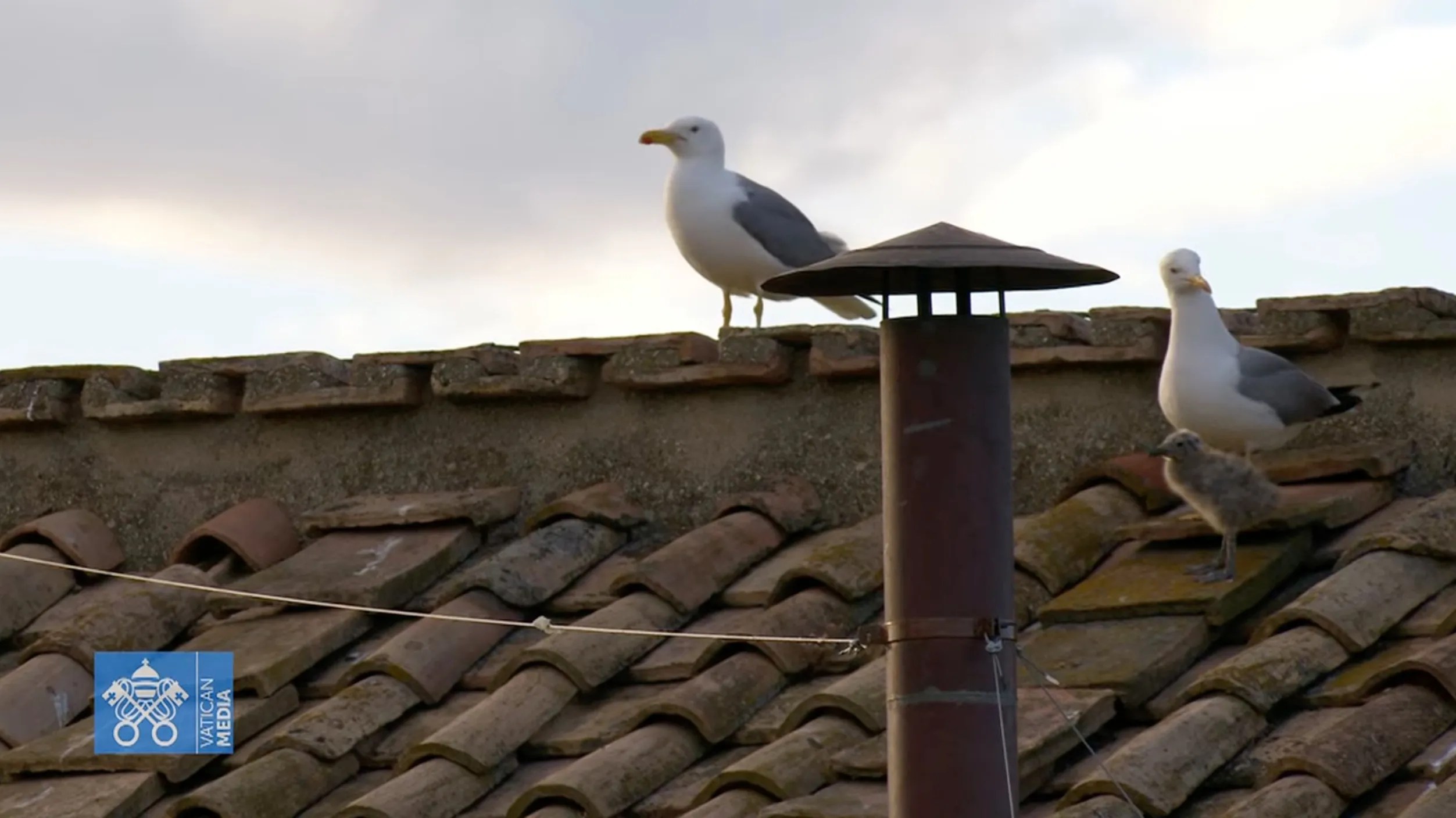

To see parent gulls feeding their baby at the Papa chimney, is full of auspices, that this Augur is busy deciphering.
This suggests a new message will be brought over the sea. There will be a new beginning – and a renewal! All debts – are paid!
The Habsburgs were the Kings of the Romans. They got approval from the Pope to turn South America into a vassal of Spain. Seafull are beautiful scavnegers. The conquestidors were bat-bloodsuckers. In the shadow of the cross, greedy men looked for, and deovured everything of value, then flew home to Spain to regurguates the prescious gifts that belonged to others. This caused secular revolutions.
The young chic has become an adult, and the family born in Rome will cross the sea. They are – the bridge!
It is time to put the crucifixion behind us. Jesus was reborn – and soared like a seagull to a new kingdom. In Italian Seagul is…..GABBIANO. Pope ‘Cabbiano’ is the nickname I apply
John Presco
South America has an area of 17,840,000 square kilometers (6,890,000 sq mi).
(3,930,000 sq mi)
gabbiano
gabbiano https://en.wikipedia.org/wiki/Gull
The Jesuit missions among the Guaraní were a type of settlement for the Guaraní people (“Indians” or “Indios”) in an area straddling the borders of present-day Argentina, Brazil and Paraguay (the triple frontier). The missions were established by the Jesuit Order of the Catholic Church early in the 17th century and ended in the late 18th century after the expulsion of the Jesuit order from the Americas.[1] The missions have been called an experiment in “socialist theocracy” or a rare example of “benign colonialism“. Others have argued that “the Jesuits took away the Indians’ freedom, forced them to radically change their lifestyle, physically abused them, and subjected them to disease”.[2]
The Viceroyalty of Peru (Spanish: Virreinato del Perú), officially known as the Kingdom of Peru (Spanish: Reino del Perú), was a Spanish imperial provincial administrative district, created in 1542, that originally contained modern-day Peru and most of the Spanish Empire in South America, governed from the capital of Lima. Along with the Viceroyalty of New Spain, Peru was one of two Spanish viceroyalties in the Americas from the sixteenth to the eighteenth centuries.
The town of Lima, founded by Pizarro on January 18, 1535, as the “Ciudad de los Reyes” (City of the Kings/Magi), became the seat of the new viceroyalty. As the seat of a viceroy, who had oversight over all of Spanish South America except for Portuguese-dominated Brazil, Lima grew into a powerful city. During the 16th, 17th and most of the 18th centuries, all of the colonial wealth of South America created by the silver mines passed through Lima on its way to the Isthmus of Panama and from there to Seville, Spain. The rest of the viceroyalty dependent upon Lima in administrative matters, in a pattern that persists until today in Peru. By the start of the 18th century, Lima had become a distinguished and aristocratic colonial capital, seat of the 250-year-old Royal and Pontifical University of San Marcos and the chief Spanish stronghold in the Americas.
The university started in the general studies that were offered in the convent of the Rosario of the order of Santo Domingo—the current Basilica and Convent of Santo Domingo—in around 1548. Its official foundation was conceived by Fray Thomas de San Martín on May 12, 1551; with the decree of Emperor Charles I of Spain and V of the Holy Roman Empire. In 1571, it acquired the degree of pontifical granted by Pope Pius V, with which it ended up being named the “Royal and Pontifical University of the City of the Kings of Lima”.[12][13] It is also referred to as the “University of Lima” throughout the Viceroyalty.[14]
In a historic moment for the Catholic Church, Robert Prevost—a missionary-turned-Vatican official who spent much of his career ministering in Peru—was elected the first American pope in the Church’s 2,000-year history on Thursday. The 69-year-old member of the Augustinian religious order chose the papal name Leo XIV.
Appearing for the first time on the loggia of St. Peter’s Basilica, Prevost as dressed in the traditional papal red mozzetta cape—a garment notably rejected by his predecessor, Pope Francis, during his own introduction to the world in 2013. The decision to don the cape marked a symbolic return to tradition, even as Prevost himself embodies the Church’s increasingly global identity.
He spoke in Italian and then switched to Spanish, recalling his many years spent as a missionary and then archbishop of Chiclayo, Peru. The new pope did not address the crowd in English.
In his first words, Pope Leo XIV, said “Peace be with you.” He recalled that he was an Augustinian priest, but a Christian above all, and a bishop, “so we can all walk together.”
 Rosamond Press
Leave a comment