
Capturing Beauty
by
John Presco
How perfect! How – wonderful – to discoverer my late brother-in-law is related to the Muralist, Thomas Hart Benton, and his grandfather, the Senator. Look, there’s a beautiful building in Oregon named after him – and a County! Wait, there are two more counties named after Benton! WOW! I’m in the Ancestry.com Money – and hit the JACKPOT! Wait tell I tell my friends. Won’t they be jealous.
Uh-oh! Hold your horses! I just discovered historian Stacey L. Smith has published about eught books on the subject……ROSES HAVE THORNS! Stacey was given a team of historians at Oregon State to do a job on Benton. She was after another feather in her cap, another notch on her gun. She joins the three authors who wrote about my late sister, the famous artist, Christine Rosamond Benton -Drew’s Mother!
In the last conversation O had with my racist, misogynist brother (who I will not name) he insister I sign the NA a author sent me. He told me Drew, and her half-sister were not going to get any proceeds from Rosamond’s biography, and……THE MOVIE?
Fifteen minutes ago, I discovered Theodore Roosevelt wroth Thomas Hart Benton’s biography. Would he sue Smith – if he were alive?. How about Drew Rosamond Benton? No one made Drew their poster child – after she died, because the two bio and movie script – WERE A BIG FLOPS! Will another outsider come forth and……Harvest the Thorns on our Roses! Who buy the colors – and the scent?
Smith acts like she rediscovered Racism and White Supremacy, and Thomas Hart Benton is the proof it exists. Tom is her cherry on the cake. He was……One Thorny Son of a Bitch!
Smith does not make the case there were times when White, Brown, Red, and Black Supremacy did not exist. Slavery has been a constant. The British wrote and ratified Abolitionist paper. She is an expert on this subject. She went to college? I can’t find her bio. She made me aware Colleges are Book factories! Did Thomas want to make A KILLING writing his autobiography?
A half hour ago I looked at the pic of the urn I paid for at Walmart, to better hold the cremated remain of the child of Christine and Garth. For the first time I noticed the images of the U.S.S. Constitution – that was captained by a great grandfather, Sir Isaac Hull. This ship is docked in Charleston where our ancestor lived when he crossed the Atlantic in the Winthrop fleet. Our kin John Wilson Jr, was in the first graduating class at Harvard.
Having paid for the cremation of my niece (no one else offered any help) I went online to buy a urn, I wanted to buy the cosmic one – with velvet lining. But, it was pricy. I settled for a cheap light blue urn with a etched rose, This is not what I got. I got……The Sinking Titanic! I heard the screams of passengers falling into the icy water. I went into shock. I suffer from PTSD.
I am going to sue Oregon State, and perhaps the University of Oregon. Did Smith find me and my bio on the internet. I sent her two e-mails, and got no response. I’m going to inform the President of the United States of Smith’s EAI Crusade of Thorny Roses. Some folks make a living picking cotton, Smith makes a living – counting thorns! But it is my family who suffered, Is is my family…..that bleeds
I own the largest blog in the world, Royal Rosamond Press. I am about to have my SSI, my Meticais, my Hud, and my food stamps taken from me. I will be cast into the cold streets to die.
I don’t think so. The Lord maketh me to rest in velvet – beyond my allotted days! I am asking to be installed at a honorary professor at OHU, and given free housing. I will write my family history, with redemption in mind. My roses – will have thorns. We will not be shamed – for money! Jesus wore thorns on the cross. I will publish the hideous death of Drew Benton that reads like a crucifixion.
I just noticed the Constitution sits on top of the un-opened box. This isa sign, our Constitution will survive! Our Liberty is as strong as those who want it – and will fight for it. We will….go on!
John Presco
President: Royal Rosamond Press ‘Benton Family Biographer’
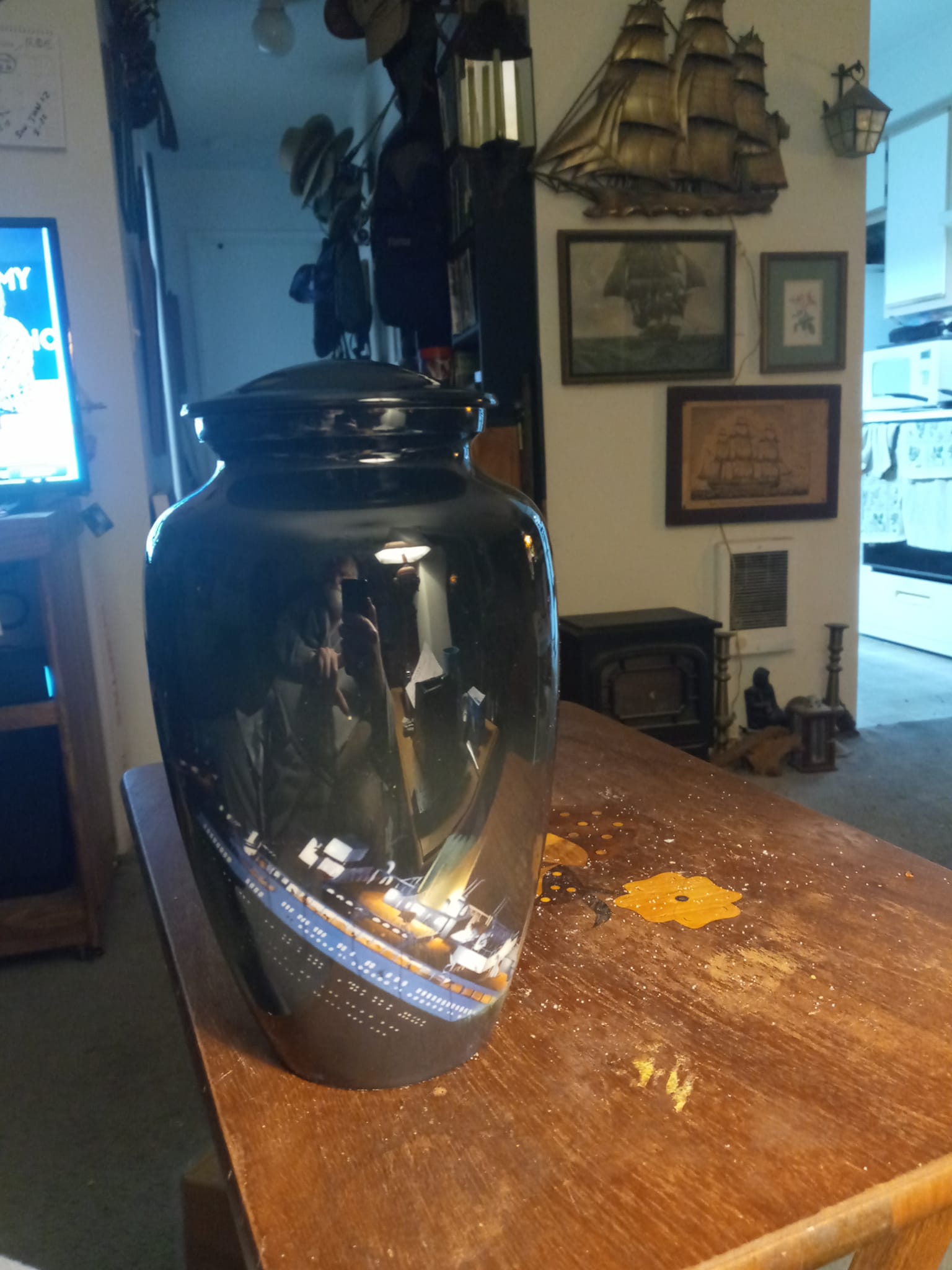

Ruzioon Universe Sky Blue Aluminum Small Cremation Urn, with Velvet Interior
No. EO 14173 does not require companies to stop lawful DEI programs. Many DEI programs remain lawful under existing federal antidiscrimination laws, including mentorship/fellowship/internship programs that do not use race, gender, or other protected characteristics and employee resource groups that are open to all. Companies also must continue to comply with antidiscrimination laws at the federal and state level, so they should continue to review their policies and practices for bias or discriminatory barriers.

“Thomas Hart Benton” by Theodore Roosevelt is a historical account written in the late 19th century. The book explores the life and contributions of Thomas Hart Benton, a significant political figure and senator from Missouri during a transformative period in American history, particularly focusing on the expansionist ethos of the United States. The opening of the work introduces the context of the early Western United States, outlining the fervent movement of pioneers westward after the Revolutionary War and the characteristics of the burgeoning states in the Mississippi basin, such as Kentucky and Tennessee. It emphasizes how these adventurous frontiersmen, forged from diverse backgrounds yet unified by their pioneering spirit, laid the groundwork for a burgeoning America. Roosevelt frames Benton as both a product of and a vital player in this formative era, detailing his early life and political entry against the backdrop of a rapidly changing nation grappling with issues of frontier settlement, governance, and identity.
Manifest Destiny
No subject excited the imagination of Senator Benton as much as the American West.
During his years in Congress Benton became one of the foremost proponents of American
expansion. In the 1820s he envisioned creation of a national road connecting Missouri and Santa
Fe. In 1823 he pushed a resolution through Congress requesting the president to send a military
expedition to claim the North Pacific Coast, but, with no funding, the resolution languished.14
Benton grasped the technological promise of steam and became an ardent advocate of a national
railroad system spanning the continent. He seized the ideas of Asa Whitney, an American trader
in China, who in 1844-45 promoted spanning North America with a railroad to open commerce
directly with Asia.15
In the 1840s Senators Benton and Linn of Missouri became eager backers of the Oregon
Trail explorations of John C. Frémont of the Topographical Engineers. Frémont, married to
Benton’s eldest daughter, Jessie, was soon heralded as the American “Pathfinder,” merging reality
with the fiction of James Fenimore Cooper. Benton and Linn helped secure federal
appropriations for publication of Frémont’s diaries, carefully edited and revised by Jessie Benton
Frémont.
16 In 1845 the government printed the accounts of the several Frémont explorations
accompanied by a series of detailed maps of the Oregon Trail executed by cartographer Charles
Preuss (1803-1854). These were reprinted in 1846 by D. Appleton and Company of New York
Benton Hall and Annex
Thomas Hart Benton and Benton Hall and Annex
- The full historical report(Link downloads document) on Thomas Hart Benton and Benton Hall and Annex
- A recording of the Community Engagement Session(Link is external) regarding Thomas Hart Benton and Benton Hall and Annex held on October 17, 2017
- The presentation provided at the Community Engagement Session(Link downloads document) regarding Thomas Hart Benton and Benton Hall and Annex
Note: The information contained on this page is not comprehensive and is intended only to provide an overview of the building names and namesakes under consideration.
Benton Hall and Annex Building History


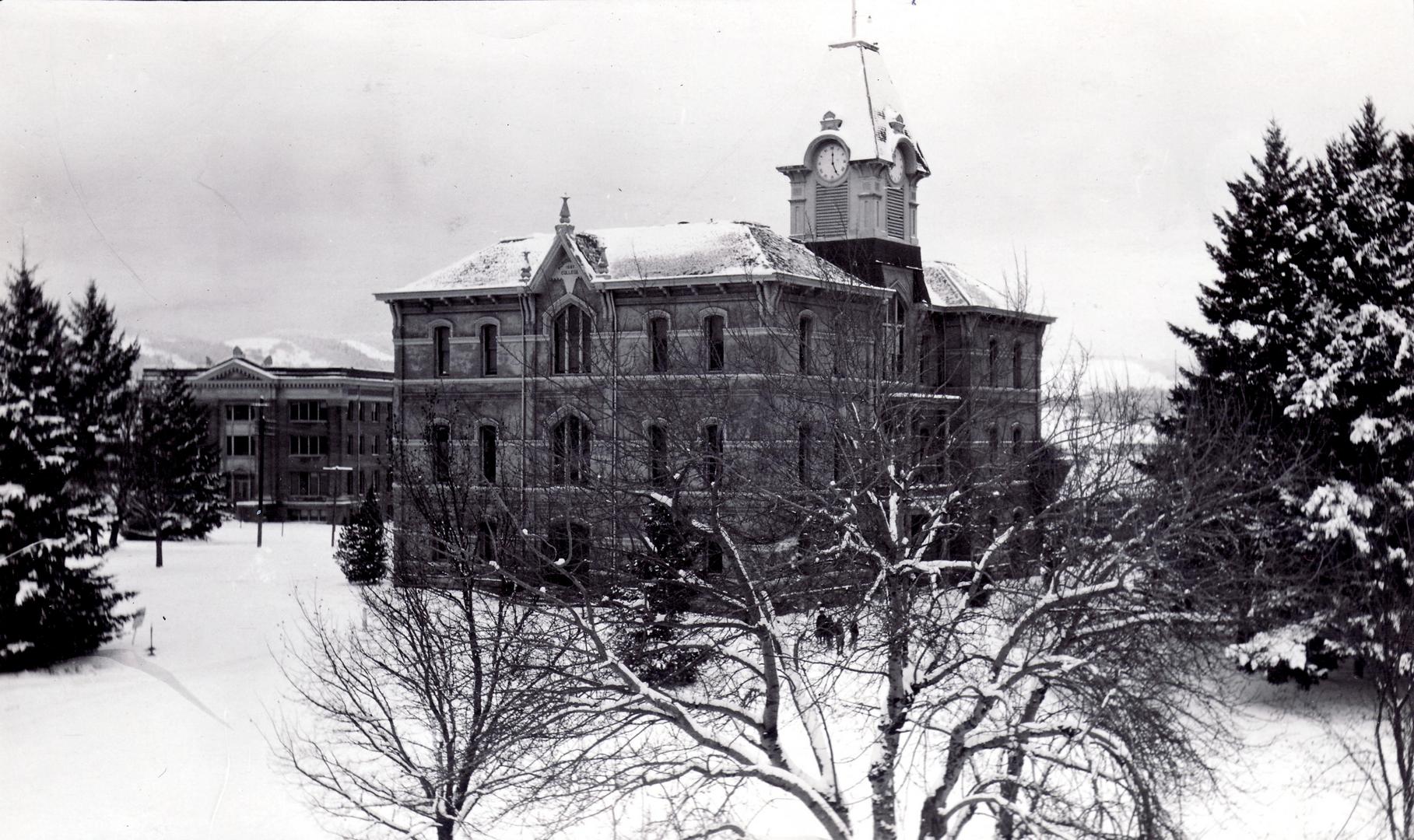
Upon its construction in 1887-1888, the building now known as Benton Hall housed the university’s administrative offices, classes, labs and the president’s office. In 1947, the State Board of Higher Education approved the name change to Benton Hall to honor the Benton County residents who originally raised the money for its construction. Today Benton Hall houses the College of Liberal Arts’ music program. It is located at 1650 S.W. Pioneer Place.
Benton Annex was constructed in 1892, known as the Station Building. It housed the administrative offices and chemistry lab of the Agricultural Experiment Station. From about 1902 to 1972, it served a variety of purposes, including the bookstore, the student health center, and as a paleontology lab. About 1972 it was renamed Benton Annex. The Women’s Center has been located in the building since 1973. It is located at 1700 S.W. Pioneer Place.
Photos: College building (now Benton Hall), 1890 (HC0038), Harriet’s Photograph Collection, Benton Hall photo by University Marketing, Women’s Center (formerly called the Benton Annex), 1976 (P057:Acc 91 156 WC), News and Communication Services Photograph Collection, and Women’s Center, circa 2010s, photo from the Diversity & Cultural Engagement website.
Benton County History
Benton County was created on December 23, 1847, by an act of Oregon’s Provisional Government. The county was created out of lands originally inhabited by the Kalapuya people and used by the Klickitat people as hunting grounds. Its original boundaries extended to the California border on the south, the Pacific Ocean on the west, the Polk County line on the north, and the middle of the Willamette River on the east. It was reduced in size during the second half of the 19th century, and reached its present size in 1893 with the establishment of Lincoln County. There are seven states, including Oregon, with counties named after Benton.
Thomas Hart Benton Brief Biography
Image

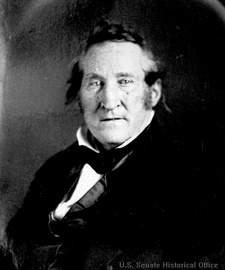
Thomas Hart Benton (1782-1858) was born in Harts Mill, North Carolina. Benton was a U.S. senator from Missouri who served in the chamber from 1821 to 1851. He was a supporter of westward expansion, especially settlement in the Oregon Territory.
Photo: Thomas Hart Benton, from Wikimedia Commons, the free media repository
Reason for Evaluation
The primary reasons for evaluating the name of Benton Hall include Thomas Hart Benton’s advocacy for westward expansionist policies and his belief in the supremacy of the white race.
Resources
The OSU Special Collections & Archives Research Center (SCARC), home to the university’s unique collections of manuscripts, archives, photographs, digital records and books. Included within SCARC collections is documentation of the campus buildings as well as biographical information regarding building namesakes. For more information see the OSU Buildings History – SCARC Archival Resources – Benton Hall and Annex online guide(Link is external). While some materials are available online, the majority are only accessible by an in-person visit to conduct research in SCARC, located in the Valley Library, room 5069.
Historical Report
A team of scholars, consisting of both OSU faculty and an external scholar, is assessing available primary sources and secondary sources regarding the lives and legacies of Benjamin Arnold, Joseph Avery, Thomas Hart Benton and A.T. “Slats” Gill.
Read the historical report(Link downloads document) for Thomas Hart Benton and Benton Hall and Annex.
Whether or not renaming is recommended, the historical information gathered will be used to create ongoing community education and engagement opportunities as recommended by the Building and Place Name Evaluation Workgroup and Architectural Naming Committee.
Benton County is one of the 36 counties in the U.S. state of Oregon. As of the 2020 census, the population was 95,184.[1] Its county seat is Corvallis.[2] The county was named after Thomas Hart Benton, a U.S. Senator who advocated American control over the Oregon Country. Benton County is designated as the Corvallis, OR Metropolitan Statistical Area, which is included in the Portland–Vancouver–Salem, OR–WA Combined Statistical Area. It is in the Willamette Valley.
History
[edit]
Benton County was created on December 23, 1847, by an act of the Provisional Government of Oregon.[3] The county was named after Democratic Senator Thomas Hart Benton of Missouri, an advocate of the doctrine of Manifest Destiny and the belief that the American government should control the whole of the Oregon Country. At the time of its formation the county included all the country west of the Willamette River, south of Polk County and running all the way to the California border in the south and the Pacific Ocean in the west.[4]
The county was created out of lands originally inhabited by the Klickitat, who rented it from the Kalapuyas for use as hunting grounds. All aboriginal claims to land within Benton County were ceded in the Treaty of Dayton in 1855. Portions of Benton County were taken to form Coos, Curry, Douglas, Jackson, Josephine, Lane and Lincoln Counties, leaving Benton County in its present form.
The city of Marysville, later renamed Corvallis, was made the county seat in 1851. The city briefly was the capital of Oregon.[5] In 1862 Corvallis became the site of the Oregon State Agricultural College, known today as Oregon State University.
Geography
[edit]
According to the United States Census Bureau, the county has a total area of 679 square miles (1,760 km2), of which 676 square miles (1,750 km2) is land and 2.7 square miles (7.0 km2) (0.4%) is water.[6] It is the fourth-smallest county in Oregon by land area and third-smallest by total area.
Adjacent counties
[edit]
- Polk County (north)
- Lincoln County (west)
- Linn County (east)
- Lane County (south)
National protected areas
[edit]
2020 census
[edit]
As of the 2020 census, there were 95,184 people, the racial make up of the county was 75.9% non-Hispanic white, 1% African American, 0.6% Native American, 6.7% Asian, 6.1% of two or more races. Residents of Hispanic or Latino ancestry made up 9% of the population.
2010 census
[edit]
As of the 2010 census, there were 85,579 people, 34,317 households, and 19,256 families residing in the county.[12] The population density was 126.6 inhabitants per square mile (48.9 inhabitants/km2). There were 36,245 housing units at an average density of 53.6 units per square mile (20.7 units/km2).[13] The racial makeup of the county was 87.1% white, 5.2% Asian, 0.9% black or African American, 0.7% American Indian, 0.2% Pacific islander, 2.3% from other races, and 3.6% from two or more races. Those of Hispanic or Latino origin made up 6.4% of the population.[12] In terms of ethnicity, 22.6% reported German ancestry, 16.1% English, 13.5% Irish, and 3.6% were American heritage.[14]
Of the 34,317 households, 24.2% had children under the age of 18 living with them, 45.3% were married couples living together, 7.3% had a female householder with no husband present, 43.9% were non-families, and 28.2% of all households were made up of individuals. The average household size was 2.35 and the average family size was 2.87. The median age was 32.1 years.[12]
The median income for a household in the county was $48,012 and the median income for a family was $71,763. Males had a median income of $50,282 versus $35,387 for females. The per capita income for the county was $26,177. About 7.7% of families and 19.1% of the population were below the poverty line, including 13.6% of those under age 18 and 5.5% of those age 65 or over.[15]
2000 census
[edit]
As of the 2000 census, there were 78,153 people, 30,145 households, and 18,237 families residing in the county. The population density was 116 people per square mile (45 people/km2). There were 31,980 housing units at an average density of 47 units per square mile (18/km2). The racial makeup of the county was 89.16% White, 0.84% Black or African American, 0.79% Native American, 4.49% Asian, 0.24% Pacific Islander, 1.92% from other races, and 2.56% from two or more races. 4.66% of the population were Hispanic or Latino of any race. 18.2% were of German, 11.6% English, 8.9% Irish and 7.0% American ancestry. 91.1% spoke English, 4.1% Spanish and 1.0% Chinese as their first language.
There were 30,145 households, out of which 28.40% had children under the age of 18 living with them, 50.40% were married couples living together, 7.20% had a female householder with no husband present, and 39.50% were non-families. 26.10% of all households were made up of individuals, and 6.70% had someone living alone who was 65 years of age or older. The average household size was 2.43 and the average family size was 2.95.
In the county, 21.30% of the population was under the age of 18, 20.20% was from 18 to 24, 26.70% from 25 to 44, 21.40% from 45 to 64, and 10.30% was 65 years of age or older. The median age was 31 years. For every 100 females there were 99.10 males. For every 100 females age 18 and over, there were 97.80 males.
The median income for a household in the county was $41,897, and the median income for a family was $56,319. Males had a median income of $42,018 versus $29,795 for females. The per capita income for the county was $21,868. About 6.80% of families and 14.60% of the population were below the poverty line, including 10.60% of those under age 18 and 4.90% of those age 65 or over.
Benton County has the lowest church attendance per capita of any county in the nation (25% attendance).[16]
Communities
[edit]

Cities
[edit]
- Adair Village
- Albany (part)
- Corvallis (county seat)
- Monroe
- Philomath
Census-designated places
[edit]
Unincorporated communities
[edit]
Politics and government
[edit]
For a long time, Benton County strongly favored the Republican Party due to its significant Yankee influence. In the 1932 presidential election, it was the only county in the state to vote for Herbert Hoover instead of FDR. Along with Riverside County in California, it was one of only two counties in the Pacific States to be held by Hoover that year. As late as 1960,[17] Benton was the most Republican county in the traditionally Republican state of Oregon, which at that point had never supported a Democrat other than FDR for president, except for 1912 when the Republican Party was divided and a very narrow victory in 1868. Up to 1984, Benton County had voted for a Democratic presidential candidate only four times, in the above-mentioned 1868 election plus the national Democratic landslides of 1912, 1936, and 1964. In 1964, Lyndon Johnson became the first Democrat to win an absolute majority of the county’s vote since Horatio Seymour.[18]
The Republican edge in the county narrowed from the 1970s onward, culminating when it swung from a five-point victory for Ronald Reagan in 1984 to a nine-point victory for Michael Dukakis in 1988. Since then, Benton County has become a strongly Democratic county, and is usually the second-strongest Democratic bastion in the state, behind only Multnomah County (Portland). This is largely due to the leanings of Oregon State’s student body and staff, closely tracking with Democratic gains in other counties influenced by college towns. No Republican has come within nine percentage points of carrying Benton County since 1988, and Barack Obama, Hillary Clinton, and Joe Biden have won the county by over thirty percentage points during each of the last four presidential elections. Overall, Benton County is a reliable state bellwether, having voted for Oregon’s statewide winner in every presidential election since 1948, along with Hood River County.
Since 1972, Benton County has been a home rule county, meaning that the citizens have full control over the county charter, rather than using a standard charter issued by the state.[19] The voters have chosen to eliminate the traditional elected county offices of Assessor, Treasurer, Surveyor, Justice of the Peace, and Clerk. Currently, they only elect three County Commissioners and a Sheriff.[20][21]
The three current Benton County Commissioners are Chair Pat Malone, Xanthippe Augerot, and Nancy Wyse. They are all members of the Democratic Party and have served since 2019, 2017, and 2021; respectively. Wyse and Augerot’s current terms expire in January 2025, while Malone’s is up in January 2023.[21][22][23]
The current Benton County Sheriff is Jef Van Arsdall. He was appointed to the office in March 2021 to fill the remainder of the term of retiring sheriff Scott Jackson.[24]
Benton County is currently one of 11 counties in Oregon in which therapeutic psilocybin is legal.
For decades, the building was known only as the “Administration Building.” In 1947, OSU
President August Strand decided that since new administration buildings were going up on
campus, the old Administration Building needed a new name. He proposed renaming it “Benton
Hall” in “recognition of the fact that the building, oldest of the existing campus structures, was
built in 1887 from funds contributed by citizens of Benton County.” The State Board of Higher
Education approved the name.12 In naming the building, Strand likely meant to commemorate a
pivotal moment in the university’s history when local citizens united forces and pooled their
resources to secure the college a permanent home in Corvallis.
Benton Hall is thus indirectly named after Benton County, which is itself named for U.S.
Senator Thomas Hart Benton of Missouri. Oregon’s Provisional Government created Benton
County on December 23, 1847. Many of the white Americans who migrated to the Oregon
Country had resided in Missouri before their departure. Benton spent much of his career in the
U.S. Senate and the House of Representatives promoting the cause of westward expansion and the
interests of these overland migrants. He and his fellow senator from Missouri, Lewis F. Linn, had
both pressed for a federal land law that would bestow large tracts of public land on the white
inhabitants of Oregon. Benton and Linn finally achieved their goal when Congress passed the
Oregon Donation Land Act in 1850. Under this act, each adult white male U.S. citizen could claim
320 of federal land for himself, and, if he was married, an additional 320 acres in the name of his
wife. The adjacent counties of Benton and Linn were thus named in honor of the two Missouri
politicians who had been among the most vocal advocates of white Oregonians’ land interests.13
 Rosamond Press
Leave a comment