Watch the two Facebook videos I just made. Trump defied the Supreme Court, as did the Dictator of Venezuela. Is Rena the rebirth of Lady Justice – who has several names? Will Emperor Trump purge all images of Lady Justice in Amerca, he authoring a new order claiming She is harassing him, giving him a bad name, and is DEI?
In January 2025, President Donald Trump called DEI efforts “illegal and immoral discrimination programs” and “public waste” in his January 20 executive order,[54] rescinded Executive Order 11246 on January 21,[55] demanding that all governmental DEI programs be shut down by January 23, and placed employees on administrative leave and eventual layoff.[56][57]
Early February 2025, a lawsuit was filed against Trump’s executive orders, arguing that they were unconstitutional.[58] In March, the United States Court of Appeals for the Fourth Circuit paused the lower court’s nationwide preliminary injunction and permitted the enforcement of the executive orders pending the outcome of the appeal.[59]
References to women, people of color, and LGBTQ individuals have been scrubbed from federal websites,[60][61] image archives,[62] and physical installations.[63] As described by Brenda Sue Fulton, “[this] administration has hung a sign outside the armed forces saying if you’re not a white male, you are no longer welcome.”[60]
U.S. government departments have ordered probes of organizations that practice DEI, including hospitals, universities, federal contractors,[64][65] and media companies.[66] They have also pressured foreign companies with U.S. government contracts to comply with the order, drawing ire from foreign officials.[67][68][69][70]
From the dawn of civilization, justice has been conceptualized as a divinity linked to the cosmic order, but it is from the Greek and Roman goddesses of Justice that today’s iconic symbol derives. In Greek mythology, the goddesses of justice are Themis and her daughter DikÍ, also known as Astraea. In ancient Rome, DikÍ was known as Justitia and was a civil abstraction rather than a mythological deity.
Myth-making went hand-in-hand with the political propaganda of Renaissance Europe. In the emerging republics, Justitia became a powerful symbol of civil justice, while in the monarchies, Virgil’s vision of the Golden Age reborn and the myth of the return of Astraea gave support to the doctrine of the divine right of kings.
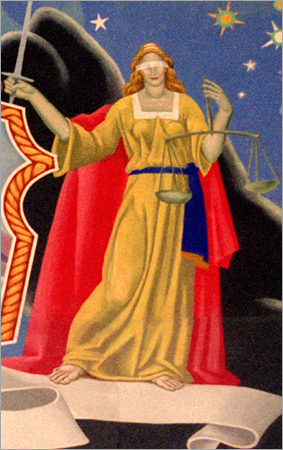
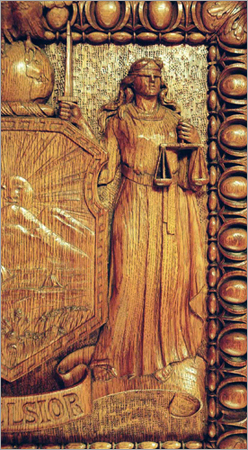
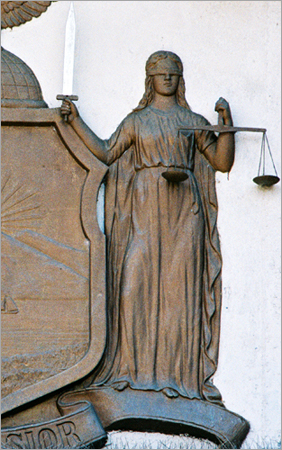
In the 17th century, New York was colonized, first by the Dutch and then by the English. Justitia, emblematic in both cultures, became iconic in the New World too. Following the Revolution, the New York State arms adopted on March 16, 1778, consisted of the State seal surmounted by an eagle on a demi-globe and supported by the figures of Liberty and Justice. Justice wears a gold-colored dress with a blue belt fringed in red. Her unbound hair is decorated with pearls, and there is a narrow band of cloth over her eyes. In her right hand she holds a gold-handled sword, and in her left, the scales.
For over two centuries, courthouses throughout New York have been adorned with portrayals of Lady Justice. The sculptures, carvings and murals, many by renowned artists, are our constant reminder that, in the words of George Washington: the due administration of justice is the firmest pillar of good Government.
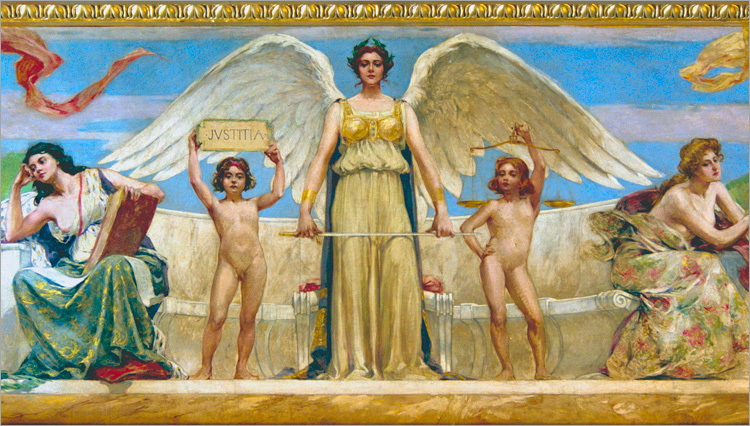
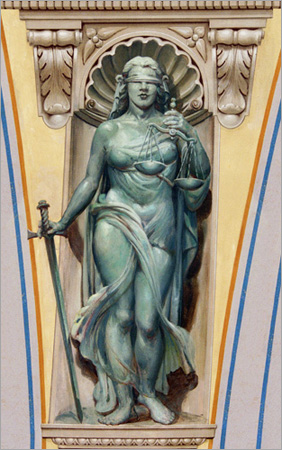
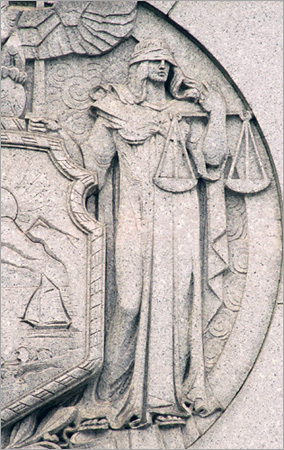
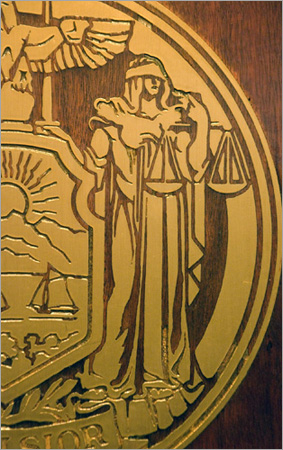
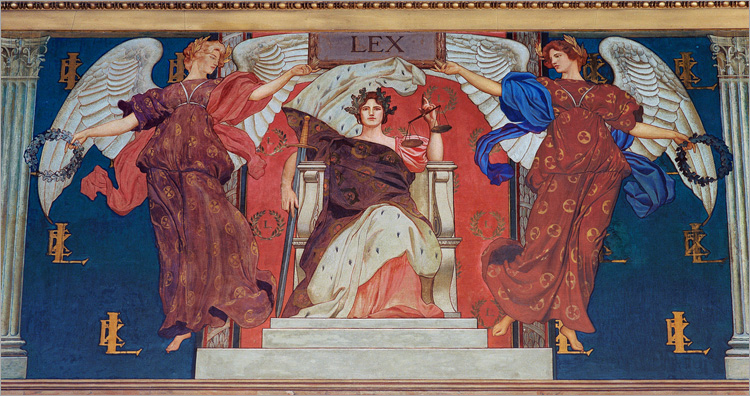
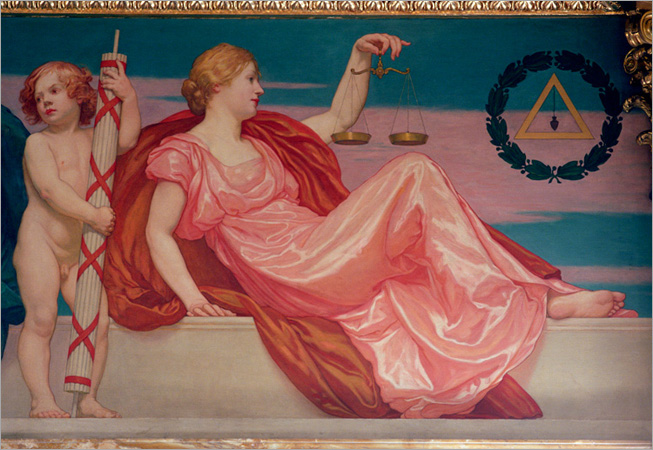
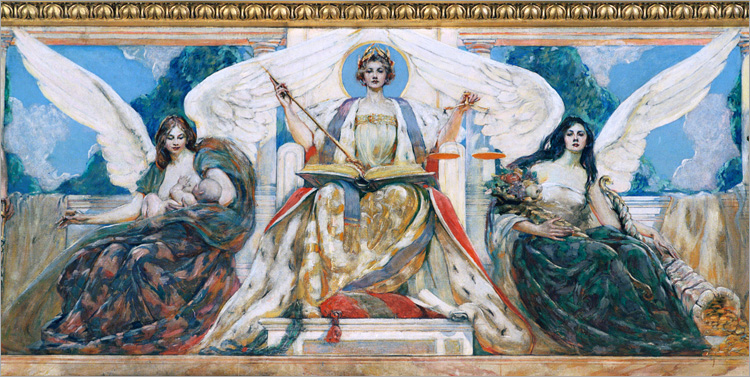
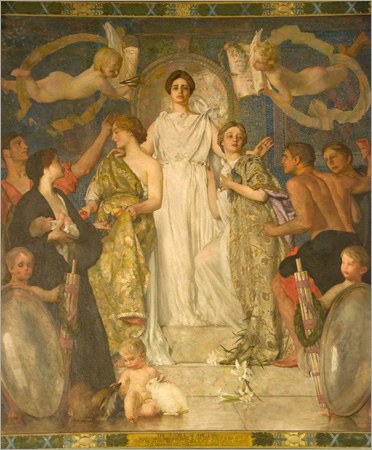
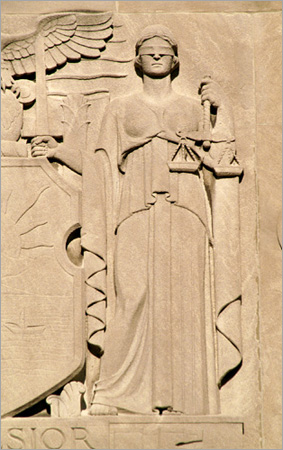
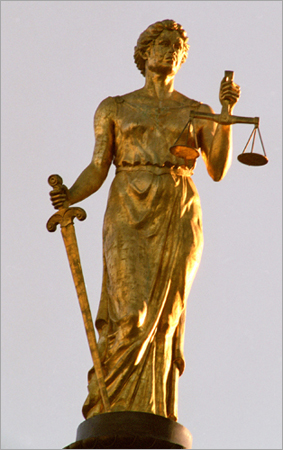
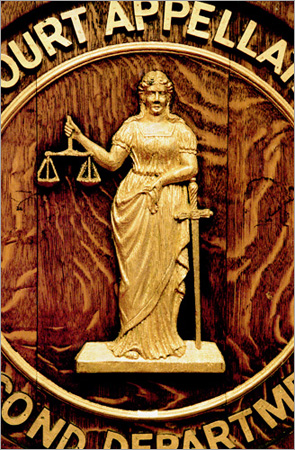
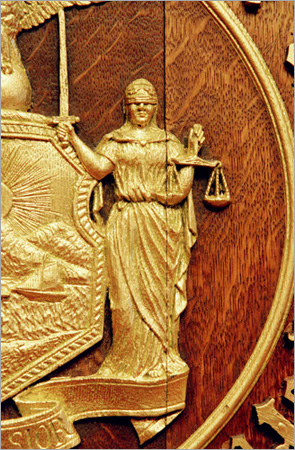
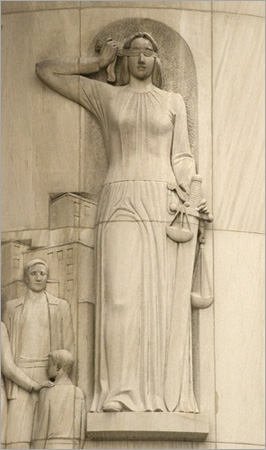
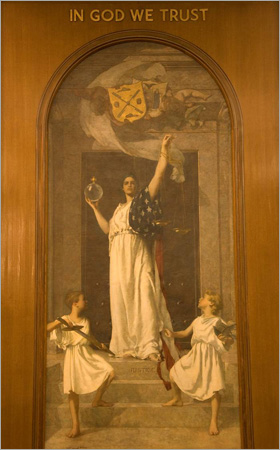
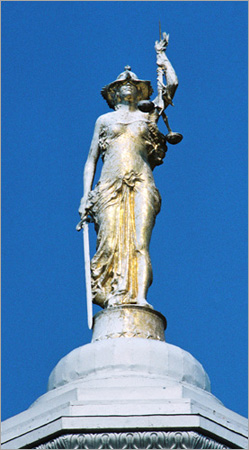
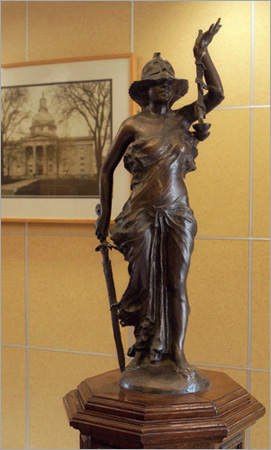
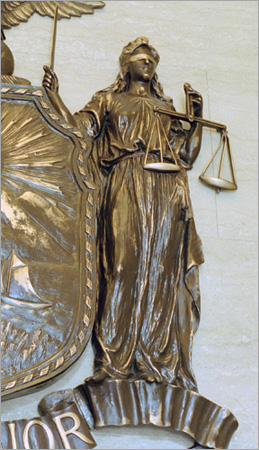
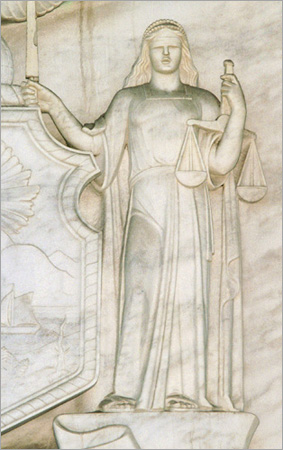
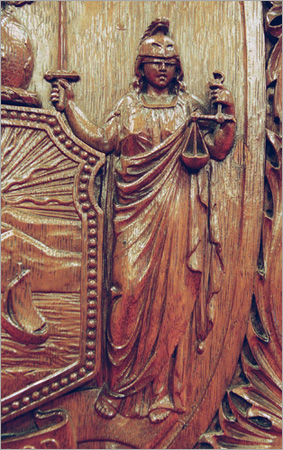
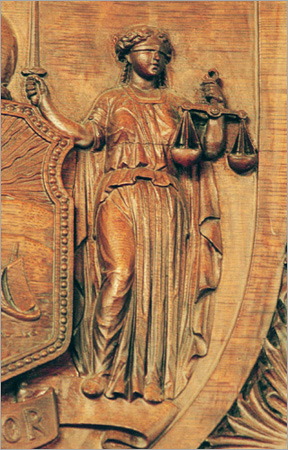
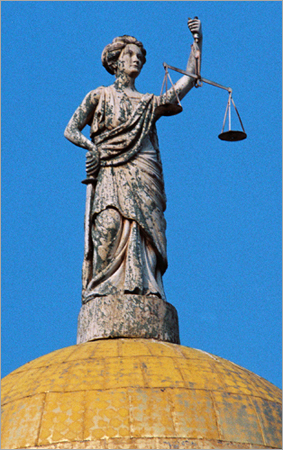
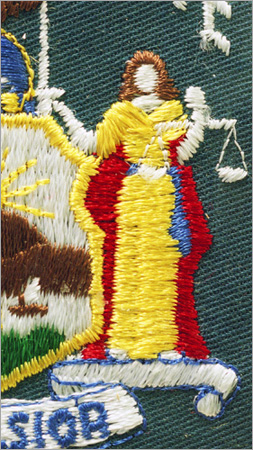
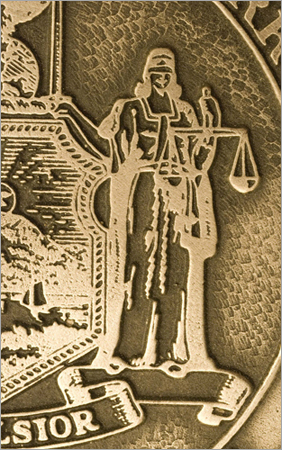
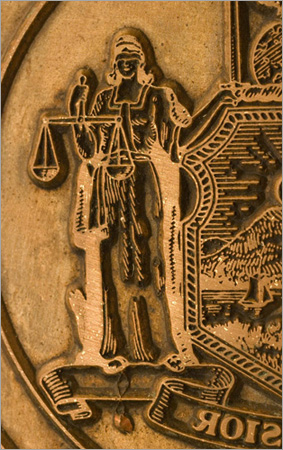
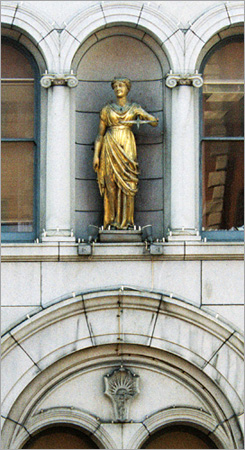
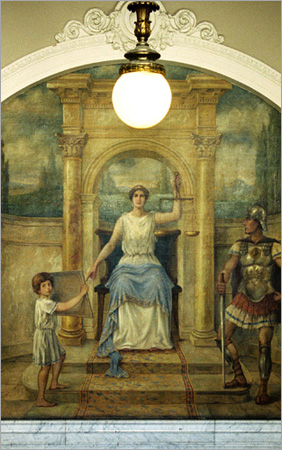
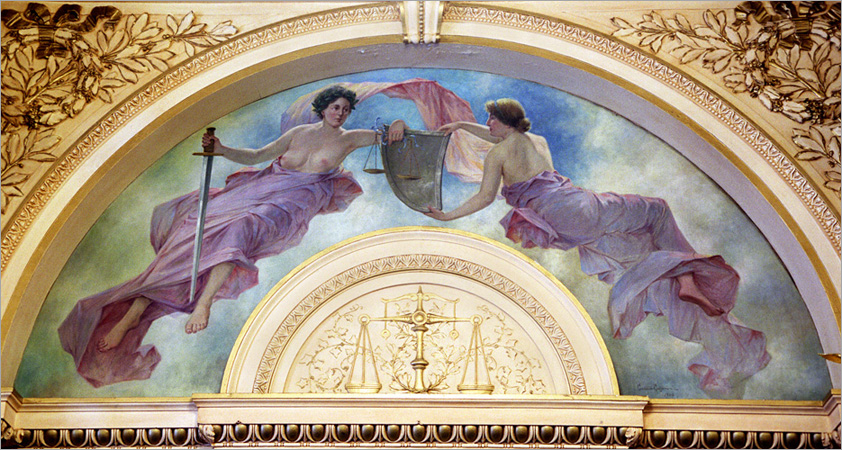
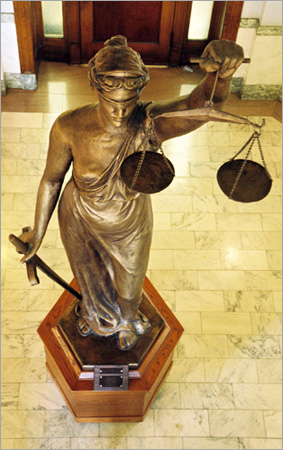
New York County, NY County Courthouse, 60 Centre Street This Lady Justice along with figures depicting Clemency, Authority and Judgement, decorate the pendentives supporting the dome inside the entrance of the courthouse. It opened in 1927, but it was not until 1934 that funding for the building’s murals was provided by the Works Progress Administration (WPA). Attilio Pusterla was retained for the interior art work, including the important mural History of the Law which graces the building’s great dome. A major conservation was completed in the early 1990s, and, thankfully, these significant works of art are once again pristine.New York County, Louis J. Lefkowitz Building, 80 Centre Street This Lady Justice sits above the Worth Street entrance of this building as part of the Great Seal of New York. The building, now a mix of government offices and court facilities, was completed in 1928 and rededicated to former Attorney General Louis J. Lefkowitz in 1984. The Seal, rendered in Art Deco style, includes two figures, Lady Liberty on the left and Lady Justice on the right. Each of the three entrances of the building is flanked by identical reliefs in stone of both the Great Seal of New York and the Seal of New York City.New York County, Louis J. Lefkowitz Building, 80 Centre Street This image of Lady Justice appears in each of the elevators, which are still operated manually, at the 80 Centre Street building. Each of the dark wood ‘cabs’ has at the rear a small rendition of the Great Seal of New York constructed of bronze inlay on the wood surface. The seals are very modest in size, approximately 8 in to 10 in across. They are rendered in a linear style, somewhat abstracted and seemingly in the Art Deco style.Appellate Division, First Dept., 25th and Madison Avenue This central segment of a 62-foot wide mural, The Transmission of the Law, by H. Siddons Mowbray, was completed the same time as Reid’s Justice. This depicted segment, above the elevator in the main lobby of the courthouse, wraps around the encasement, and extends to the staircase walls on either side. The painting tracks the History of the law, starting with Mosaic Law, followed by Egyptian, Greek, Roman, Byzantine, Norman, Common Law, and ending with Modern Law.Appellate Division, First Dept., 25th Street and Madison Avenue This image of a woman balancing scales is strikingly similar to Justice, but is actually Equity. She is included in a four-panel frieze, ‘The Reign of Law,’ by Kenyon Cox, located behind the Justices’ bench in the courtroom. Cox put great thought and effort into the symbolism of his paintings, and the courthouse archive is fortunate to contain letters Cox wrote to his father explaining the meaning of each image.Appellate Division, First Dept., 25th Street and Madison Avenue To the left of the courthouse entrance is a painting of Justice by Willard Leroy Metcalf. The full mural reflects the consequences of defying Justice, here depicted with a sword.Appellate Division, First Dept., 25th Street and Madison To the right of the courthouse entrance is a mural of Justice by Robert Reid. It was completed in 1899 and unveiled on January 2, 1900 when the courthouse was opened. The painting takes its name from the central figure, Justice. To her right is Peace, cradling an infant, and to her left is Prosperity, with a cornucopia, conveying the benefits conferred by Justice. This contrasts with the Willard Leroy Metcalf version of Justice on the opposite wall, demonstrating the consequences of defying Justice.Appellate Division, First Dept.Appellate Division, First Dept., 25th Street and Madison In this mural by Edward Simmons, Justice sits on a pedestal in the center of the composition, surrounded on the lower level by figures of Peace and Plenty. She shields Peace from the male Brute Force. ‘We are reminded that Justice is not always majestic and fearful but has a side wherein she is filled with mercy and kindness, so that she can be easily approached by the most timorous when her protecting arms will fold softly around [them].’ [Source of quote: Bailey Van Hook, Angles of Art 123 (1996)]Bronx County, Bronx County Courthouse This figure of Lady Justice, appearing on the Great Seal of New York, is repeated on all four sides of this courthouse. The courthouse was a Works Progress Administration (WPA) project boldly designed by Max Hausel and Joseph H. Freedlander and completed in 1934. The Herald Tribune called it a prime example of ‘Twentieth Century American style,’ a combination of neoclassical and modern. The courthouse is renowned for the quality and quantity of its sculpture. Its massive form is softened by numerous works both in the round and on friezes.Kings County, Brooklyn Borough Hall When construction of Brooklyn Borough Hall, a Greek Revival structure designed by noted architect Gamaliel King, was completed in 1848, this Lady Justice stood atop the cupola. On February 25, 1895, a fire broke out in the wooden clock and bell tower. The bell fell through the second floor into the rotunda and the statue of Justice tumbled onto the roof where her head was found during the cleanup. In the 1980s, the City engaged in an ambitious effort to restore the exterior which had suffered serious decay over the years, and the restored bronze statue of Lady Justice was finally re-installed atop the cupola.Kings County, Brooklyn Borough Hall These images (see next slide also) of Lady Justice reside in Brooklyn Borough Hall. They are carved depictions appearing on the wooden Judges’ bench of the former courtroom of the Appellate Division, Second Department, housed in Brooklyn Borough Hall until the construction of its new home, the neo-classical Brooklyn Appellate Courthouse built in 1938. The courtroom was originally the Common Council Chamber, no longer needed after consolidation of the five boroughs on January 1, 1898. This former courtroom where these Lady Justices remains is now used by Brooklyn for ceremonies and special events.Kings County, Brooklyn Borough HallKings County, Brooklyn Supreme Courthouse Carved into the stone of the 1958 Kings County courthouse, this Lady Justice graces the limestone and granite building designed by Shreve, Lamb & Harmon, best known as the designers of the Empire State Building.NYC Criminal Court, New York County This picture of Lady Justice painted by Edward Simmons reflects the tremendous change that was taking place in American society in the 19th century. Women were perceived as pillars of stability, ‘repositories of moral and cultural authority.’ Simmons rejected the blindfold, stating that ‘In a glorious democracy [Justice] should be clear eyed.’ He also rejected the imagery of the balanced scales, stating that, ‘[Justice] carried the scales for weighing the facts offered, and as either innocence or guilt must predominate or there is no decision, the pans were uneven.’ [Bailey Van Hook, Angles of Art 123 (1996)]Ontario County, Canandaigua The statue of Lady Justice adorning the dome of the Ontario County courthouse is the third incarnation. The original stood atop the courthouse from 1858 to 1951. However, over time rotting wood stole her looks and posed a hazard. A decade later, William J. Eddy of Geneva incorporated the sword and scales of the original into a wooden replacement. This lasted only three decades before the wood deteriorated. The present statue, crafted of cast aluminum by Dexter M. Benedict, and covered with gold leaf, took her place on the dome in 1983.Ontario County, Canandaigua This bronze statue of Lady Justice was found hidden away in the office building behind the courthouse. She may have been the model for a statue of Lady Justice.Albany County, Albany, the New York Court of Appeals This bronze of Lady Justice now hangs on the marble walls of the main lobby in Court of Appeals Hall. In 1917, when State Hall became Court of Appeals Hall, the bronze coat of arms was installed on the exterior wall over the main entrance. Regrettably, we have no information on the sculptor or the foundry in which it was cast.Albany County, Albany, the New York Court of Appeals This Lady Justice graces the eight-ton Great Seal of New York carved in marble by C. Paul Jennewein. It forms the lintel over the courthouse entrance.Albany County, Albany, the New York Court of Appeals This image of Lady Justice is one of the faces in the Judges’ intricately designed oak bench in the Court of Appeals courtroom and is the work of Capitol artisans to architect H.H. Richardson’s design. (See following descriptions for more detail.)Albany County, Albany, the New York Court of Appeals This image of Lady Justice is carved into the oak paneling above the exquisite marble fireplace that graces the Court of Appeals courtroom, and is the work of Capitol artisans to architect H.H. Richardson’s design. (See following descriptions for more detail.)Albany County, Albany, the New York Court of Appeals In conjunction with the 1958 renovation of Court of Appeals Hall, artist Eugene F. Savage was commissioned to design and paint a mural in the dome over the rotunda. His work depicts ‘the romance of the skies’ emblematic of the three seasons in which the Court sits: Autumn, Winter and Spring. He also rendered the Great Seal of New York and the seal of the New York Court of Appeals. This image of Lady Justice is part of Savage’s depiction of the Great Seal of New York.Albany County, Albany, the New York Court of Appeals In the early 1880s, noted architect H.H. Richardson designed a courtroom on the third floor of the new Capitol for the New York Court of Appeals. The courtroom features wonderful hand-carved furniture wrought to Richardson’s specification in the basement of the Capitol by artisans from around the world. In 1917, old State Hall (built between 1832 and 1842) was renovated and became Court of Appeals Hall. At the Court’s request, its beloved courtroom was moved from the Capitol, piece by piece, and reconstructed in space specially designed to accommodate it in the renovated building.Montgomery County, Fonda After Fonda became its county seat, Montgomery County built a Greek Revival courthouse in 1836 on the site of a former colonial sheriff’s home. In 1910, the county expanded the building, installing an interior staircase and adding the Great Seal of New York to the gable above the entrance. Although the county built a new courthouse in 1892, this building remains the ‘old’ courthouse. It has housed the county’s Department of History and Archives since 1934, and Lady Justice still graces the entrance.Chenango County, Norwich Chenango County built its Greek Revival courthouse in 1837 and crowned the structure with a seven-foot statue of Lady Justice. In 1977, the county began the process of restoring the building to its historic beauty. The white-pine Lady Justice had suffered the ravages of time. Fay Wrubel of Cooperstown undertook the daunting preservation and conservation task. The statue now proudly stands inside a glass case in the courthouse while a replica overlooks the city from atop the dome.NYS Court Officer’s Vintage Patch This image of Lady Justice appeared on a patch worn on the left shoulder of the court officer’s uniform used in the Supreme Courts, New York City, and the Appellate Division, First Department. Our best approximation is that this patch was in use in the 1970s until 1981/1982.Paper Weight This Lady Justice appears on a paper weight created for the New York Court of Appeals. She is made of metal on a marble base, and is part of the New York Court of Appeals Seal.Vintage Printing Plate This Lady Justice, part of the Great Seal of New York, graces a well-worn printing plate that Ted Ermansons found discarded toward the end of the last century!Monroe County, Rochester In 1894, during a Fourth of July celebration, Monroe County began construction of an Italian Renaissance styled courthouse designed by J. Foster Warner. It extends four stories above a high basement and is built of a light-gray New Hampshire granite. On the top floor’s facade stands a wooden Lady Justice, without her blindfold, painted gold. As the story goes, the French sculptor was too proud of his ‘Lady with Scales’ to cover her eyes. In 1964, Monroe County built a Hall of Justice, which now houses all the courts, and the Old Courthouse now functions as the County Office building.Onondaga County, Syracuse Archimedes Russell of Syracuse designed this Beaux Arts Onondaga County courthouse in 1901. The building, inspired by the Rhode Island State Capitol in Providence, was completed in 1907. The firm of Allewelt and Brothers finished the interior and commissioned Gustav Gutgemon to furnish three murals symbolizing the power of law and justice.Onondaga County, Syracuse This beautifully rendered figure of Lady Justice can be found above the bench in the ‘ceremonial courtroom’ of the Onondaga County Courthouse. It is from one of three murals painted by Gustav Gutgemon (see previous).
 Rosamond Press
Leave a comment