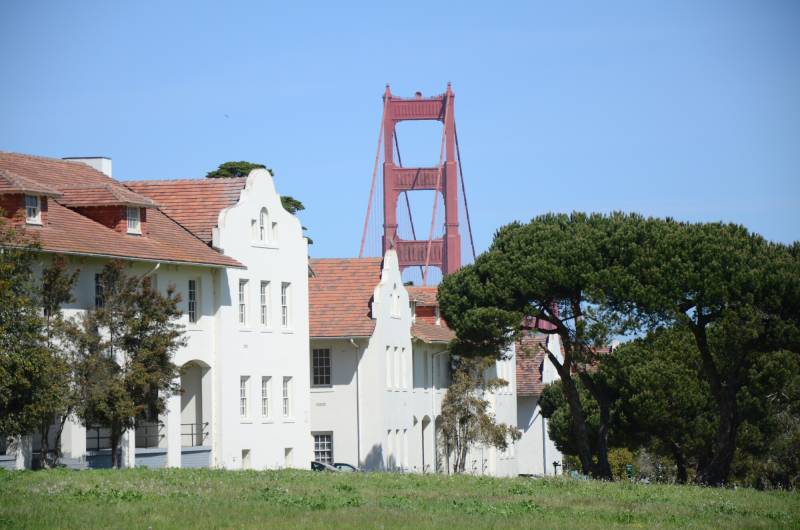
Fort Winfield Scott was an active army base within the Presidio of San Francisco from 1912-1994. San Francisco’s beloved Presidio is targeted in President Trump’s latest executive order, which seeks to all but eliminate agencies that it deems “unnecessary.” (Ryan Levi/KQED)
I am composing a letter to Gavin Newsom. I will ask him to found the Mariposa Mineral Rights of Ukraine Capitol Company of San Francisco, and immediately sell shares in order to help the people of Ukraine, and at the same time help sustain the Presidio Park, as well as build a roundhouse to store the history of John Fremont who lived at Black Point.
I suggest the shares be limited to one share a person The lowest cost will be $20 dollars, the highest $20,000 dollars. Let a board of directors be established immediately so U.S. Citizens will have a say about who gets the right to profit from Ukraine’s vast minerals.
John Presco
I Claim The Mariposa Land Grant
Posted on August 22, 2015 by Royal Rosamond Press


Dea
US President Donald Trump has said that Volodymyr Zelensky and Vladimir Putin need to “get together” to end the war in Ukraine.
Speaking to reporters at the White House this evening, Trump also flagged that a mineral deal with Ukraine was close, while at the same time during his nightly address, Ukraine’s president said the two countries were working on a draft agreement.
The Walt Disney Family Museum (WDFM) is an American museum that features the life and legacy of Walt Disney. The museum is located in The Presidio of San Francisco, part of the Golden Gate National Recreation Area in San Francisco. The museum retrofitted and expanded three existing historic buildings on the Presidio’s Main Post.[1] The principal building, at 104 Montgomery Street, faces the Parade Ground, and opened on October 1, 2009. Additional museum offices, the offices of the Walt Disney Family Foundation, and rotating major exhibitions are housed in the Diane Disney Miller Exhibition Hall at 122 Riley Avenue.[2][3]
That vision appears to be threatened by President Trump, who signed a sweeping executive order Wednesday night to all but eliminate certain federal agencies, including the Presidio Trust.
The trust, which Congress formed in 1996 to manage and protect the historic 1,500-acre park that looks out on the Golden Gate Bridge and San Francisco Bay, is one of four agencies named in the “Reduction of the Federal Bureaucracy” order, which calls for shrinking agencies that the administration deems “unnecessary” to “minimize government waste and abuse.” They have been ordered to eliminate their non-statutory operations “to the maximum extent consistent with applicable law” and reduce their statutory function to the minimum required by law.
Magician’s Tower at Black Point
Posted on June 20, 2023 by Royal Rosamond Press
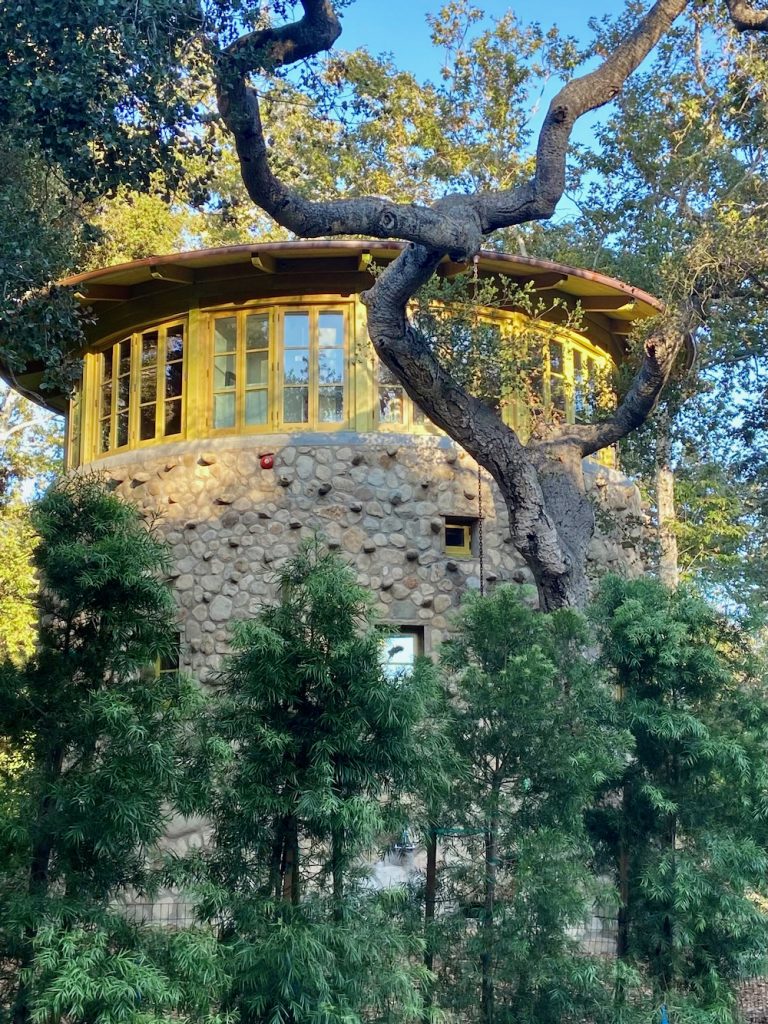
Dear Governor Newsom. Today is June 19th. and I am inspired to make a proposal to you and the people of California, where I was born – during an amazing star-shower! Earlier today I made a proposal to Notre Dame de Namur asking for creative and just sanctuary, after learning more of my ancestors were dug up out their graves – and relocated. This has left me with deep and stressful feeling of impermanence that hurtles beyond the feelings of enlightenment I have enjoyed via literary meditation. I believe I own the largest blog in the world – that needs protection – too.
I m kin to John and Jessen Fremont who authored the first emancipation of slaves. John was the first candidate for the Republicans’ Abolitionist Party. I want to declare my candidacy for Republican President – but I don’t feel safe. I’m too poor to move. There is no room for bodyguards. This is why I’m asking for the immediate construction of a sound stone home like the one I found on the internet. The Fremonts had their Black Point home taken from them by the U.S. Military. There was a court case that compensated most of the offspring of homeowners, but the Fremont home was not one of them.
I would like to see a tower – with large clock – honoring the Forty-Eighters, and the German Turners who went South with the Union Army and helped defeat the Confederacy. I have uncovered some amazing history about the Getty family, that are my kin due to the marriage of Christopher Wilding to Aileen Getty I m kin to Ian Fleming. From this tower I will direct cyber warfare against Putin and his brain. Mark Twain was a frequent visitor to Blackpoint. Consider his story; A Connecticut Yankee at King Author’s Court. I will be the caretaker of the San Francisco Magic in the years I have left. This proposal will be a part of The Great Story.
John Presco
President: Royal Rosamond Press
Copyright 2023
Jessie Benton Fremont at Blackpoint
Historical Essay
by Jo Medrano

Mrs. General Fremont on porch at Black Point, 1863.
Photo: San Francisco History Center, SF Public Library

Mrs. General Fremont on her porch at Black Point, c. 1863.
Photo: Jesse Brown Cook collection, online archive of California

Black Point (now Fort Mason), 1870. Spring Valley Water Co. brought water through the flume that skirts the cliffs. Small farms run down to the shore. Alcatraz is in the distance.
Photo: Private Collection, San Francisco, CA
John C. Fremont bought a farm for his wife Jessie on the north edge of San Francisco, on a small rocky peninsula then known as Blackpoint, about 1860. At the time of purchase, they were living in Bear Valley in the Sierras. In Bear Valley Jessie Fremont developed physical problems due to the intense heat. She wrote that a buried egg would cook in just a few minutes. One account states that it was 106 degrees at sunset–not an uncommon temperature that year. So we can probably imagine her delight when John C. came back from a business trip to San Francisco in 1861, and told her they were moving to the city. Blackpoint was a self-sustaining farm, and Jessie’s favorite home. She had relatives living with her, as well as visits from other relatives in addition to local and national celebrities.

Spring Valley Water Company flume is visible at right; Small farms on the hill above c. 1870
Photo: Private Collection, San Francisco, CA

View southeast from Fremonts’ residence to Pioneer Woolen Mills on site of present Aquatic Park.
Photo: OpenSFHistory.org wnp71.1607
As a matter of fact, a influential San Franciscan, I.W. Raymond, visited the Fremonts in Bear Valley and traveled with them to see the place that wasn’t yet named Yosemite. He was a key person in the 1864 action of President Lincoln which made Yosemite a protected place.
Black Point is described in “Jessie Benton Frémont: A woman who made history” as “a small headland jutting out into the channel entrance of the harbor, in fact directly opposite the Golden Gate, affording an unbroken view westward to the Pacific and eastward toward the mountains of Contra Costa.” Jessie said she “loved this sea home so much that I had joy even in the tolling of the fogbell”. It was here she planned and built her “sunset beach.”
The federal government took over Black Point soon after Jessie and John Fremont went back east to be involved in the civil war. John fought for compensation for the expropriated house and land until the day he died.

Black Point, 1869, Alcatraz in distance.
Photo: Eadweard Muybridge

Original shoreline at Black Point, one of the last places you can see it in San Francisco.
Photo: Chris Carlsson, 2010
The Fremonts moved to Black Point in 1860 and situated their house and grounds on the bluff. Their home, nicknamed Porter’s Lodge, became the center of San Francisco’s intellectual life, where Mrs. Benton invited likeminded writers, spiritual leaders, and artists to engage in lively conversation. When the Civil War broke out, the Union Army summoned John Fremont for active military service and the family moved to the east coast.
What is impermanence?
Everything changes.
This is one of the most fundamental teachings of Buddhism. The Buddha taught that the source of human suffering and discontent is that we crave and cling to the things of this world under the mistaken view that they will last forever. But nothing does.
Impermanence, anitya, or anicca in Pali, is one of the Buddha’s three marks of existence, three conditions that characterize all of life, and are always present. (The other two marks of existence are anatman (Pali: anatta), or not-self, and duhkha (Pali: dukkha), suffering, or dissatisfaction.)
Our bodies decline and decay. Hair and teeth fall out. Mental attitudes also change. Excitement and anger arise, then fade away. Our health and happiness are only temporary; we will eventually sicken, age, and die, as will our friends, enemies, relatives, and strangers. Human life is brief. In the Diamond Sutra, one of the Mahayana tradition’s central scriptures, life is compared to a flash of lightning in a summer cloud, or a bubble floating in a stream.
The world around us may appear solid and unchanging, but even rivers change course, mountains crumble, seas dry up, and stars burn out. The entire universe is in a process of constant flux, arising and falling away. Our brief lives give us the privilege of witnessing this grand procession for just a moment.
Understanding impermanence is key to understanding the chain of dependent origination, the idea of emptiness, and many other important Buddhist concepts. Because all of existence is conditioned by the three marks, Buddhist practices aim to loosen our attachment to the world as it is and help us comprehend impermanence and the way it touches all aspects of our lives. Meditations on death are plentiful: In one of the Buddha’s discourses, the Buddha urged his followers to consider before they go to sleep at night that they may not live until morning, and Tibetan practitioners are instructed to meditate at charnel grounds, where bodies are cremated or left to decompose. Other meditations on impermanence investigate the ever-changing nature of the breath and other bodily sensations, our shifting thoughts, or the passing of the seasons and other transformations in the natural world.
the state of not lasting for ever or not lasting for a long time:
the impermanence and fragility of life
She says that her paintings represent the impermanence of everything.
Related word
Synonym
Fewer examples
- Life is often shaped by impermanence and solitude.
- The impermanence of wood is in contrast to the permanence of stone.
- A sense of impermanence is contrary to the impulse to improve your environment.
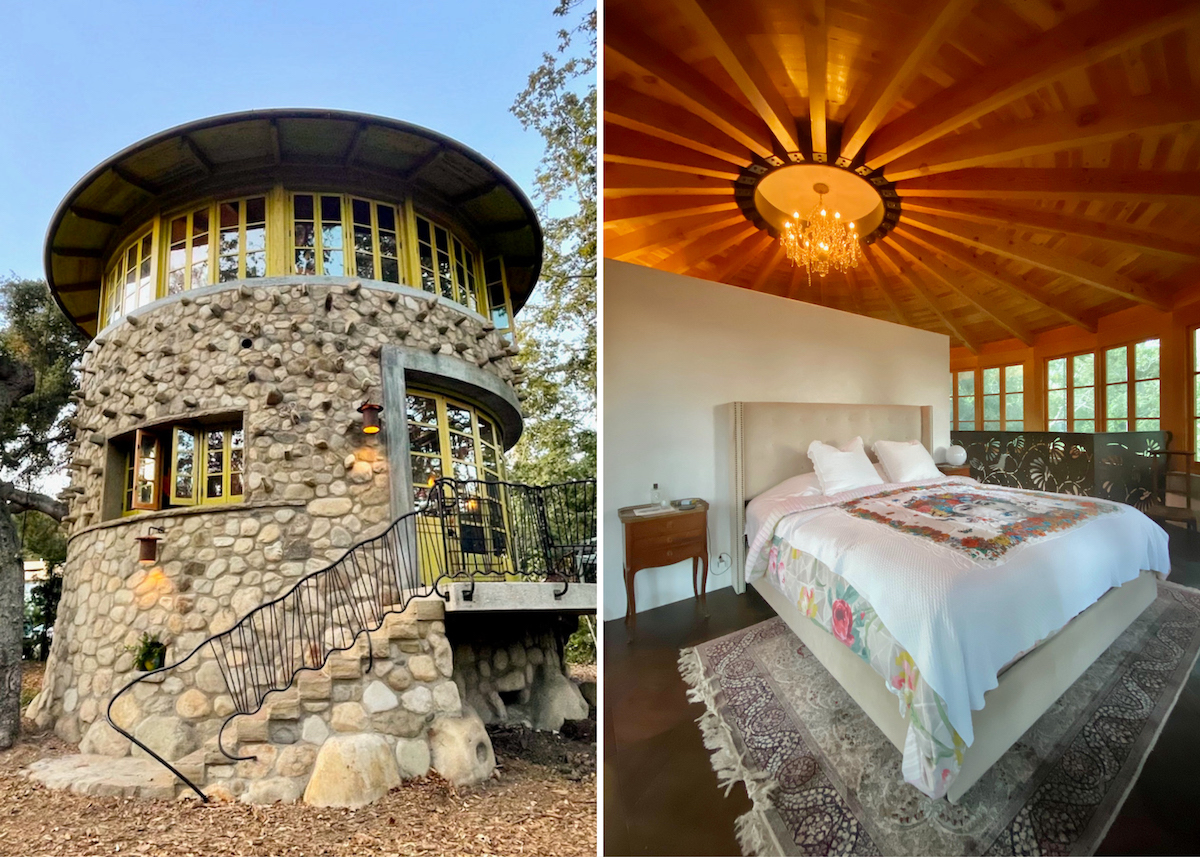
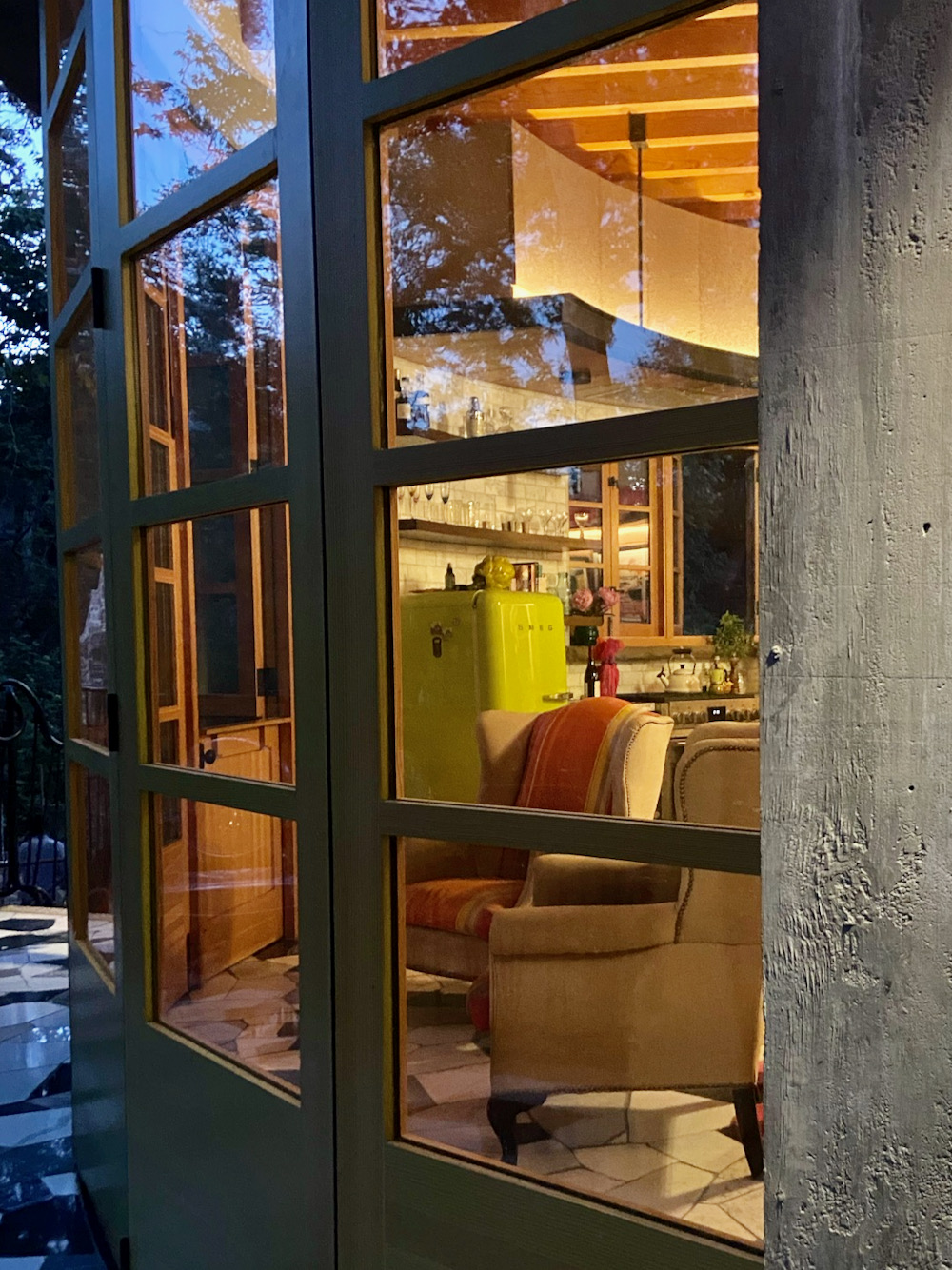
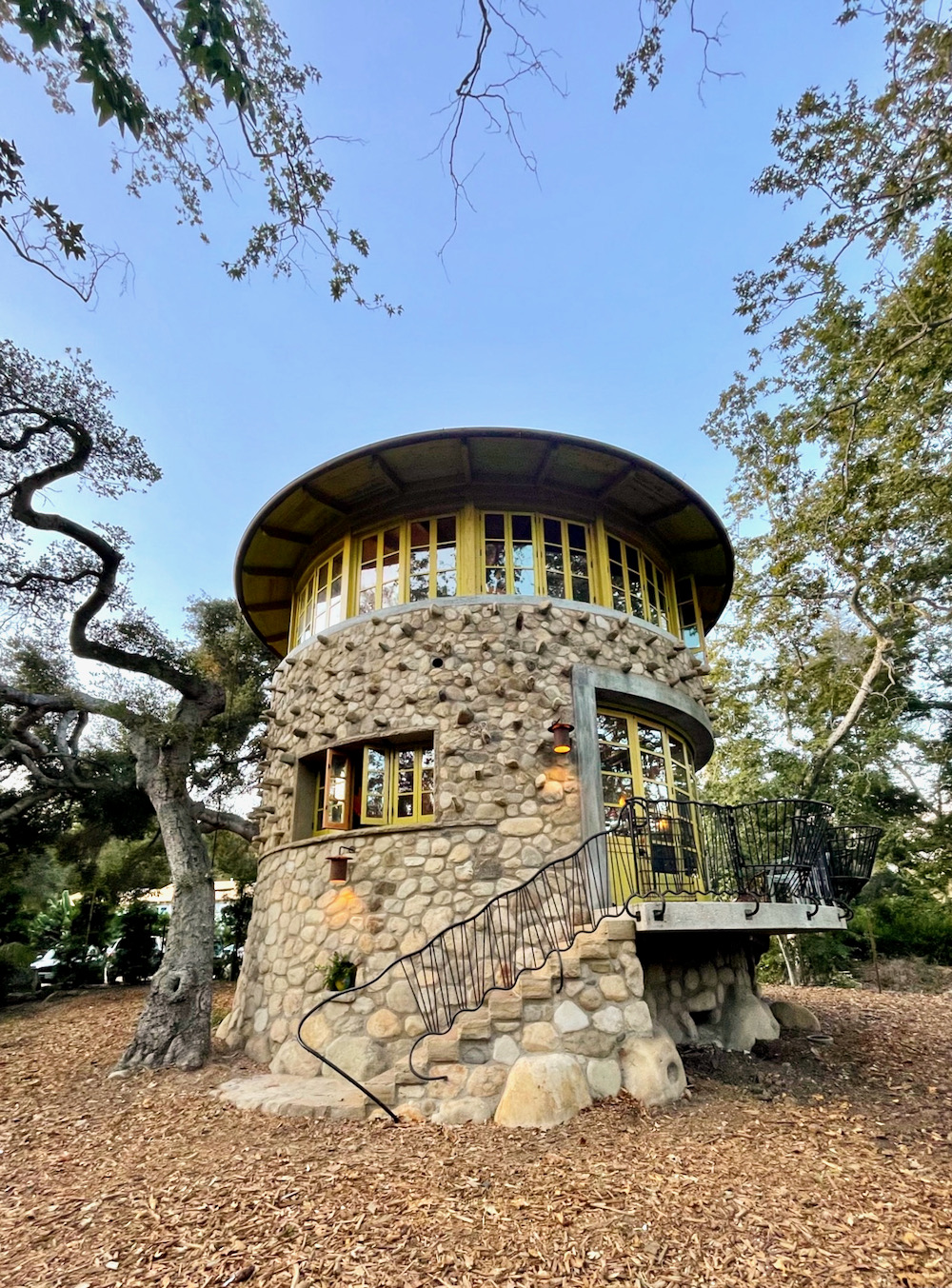
First Look at Montecito’s New Stone Tower House
OCTOBER 20, 2021|BY ERIK TORKELLS
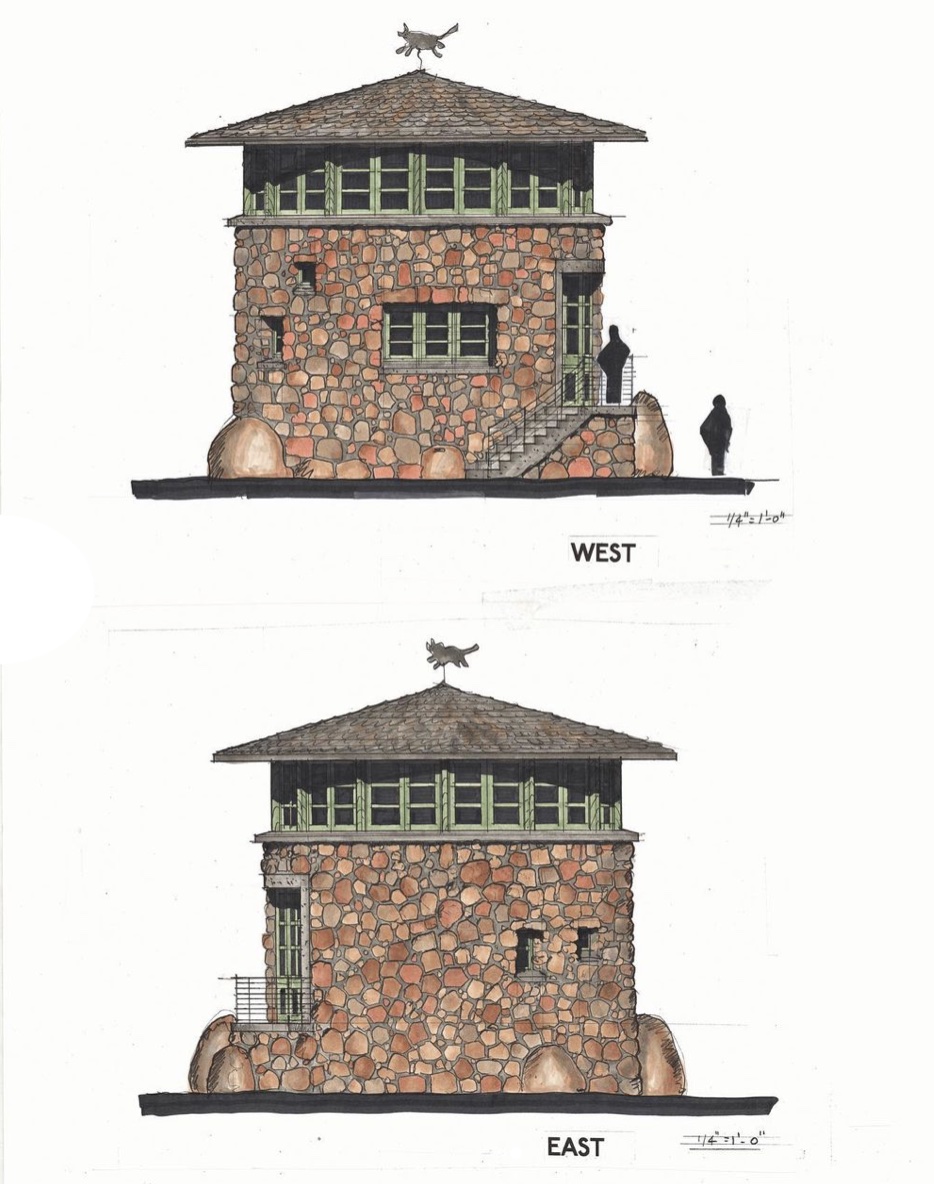
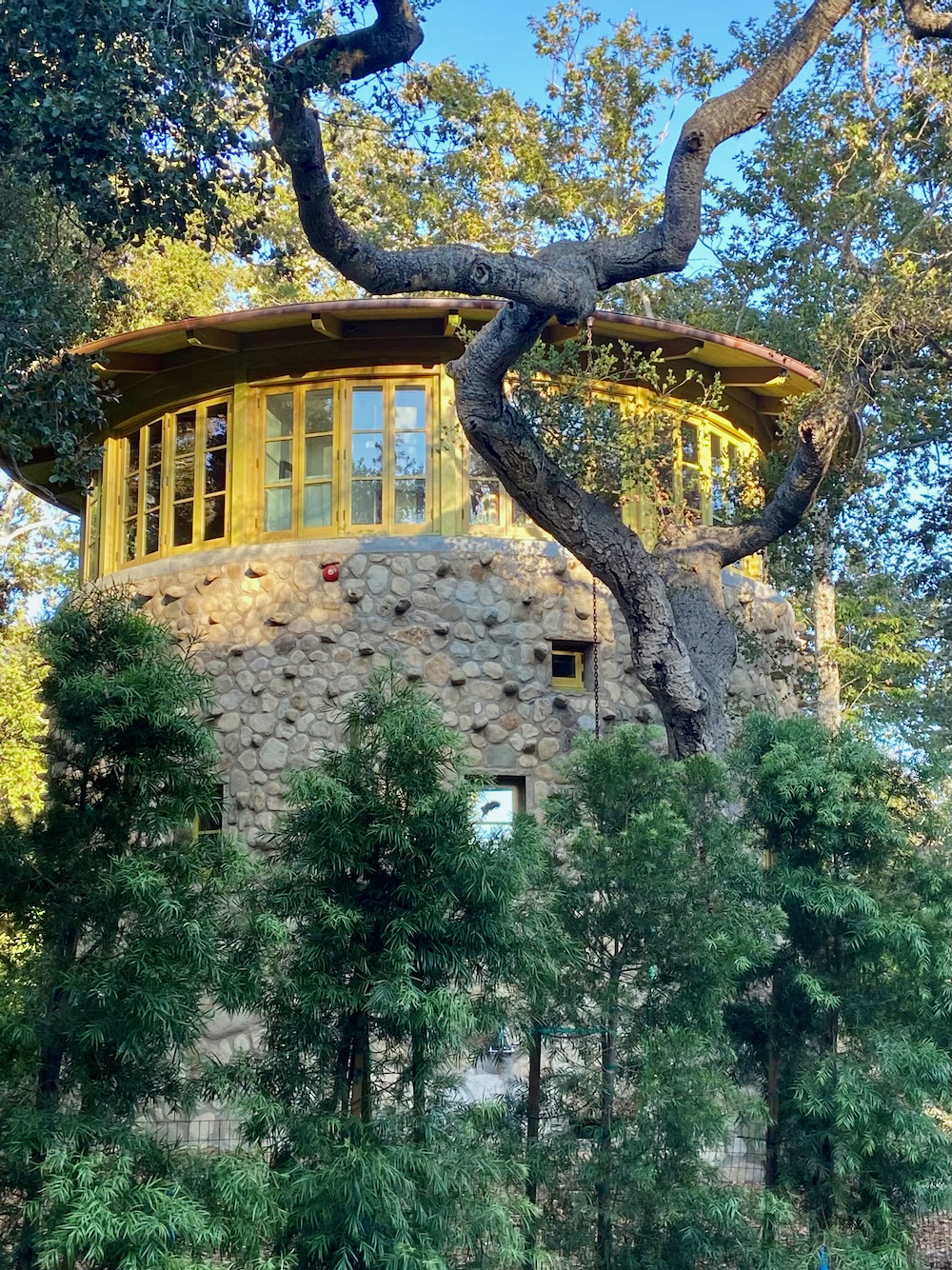
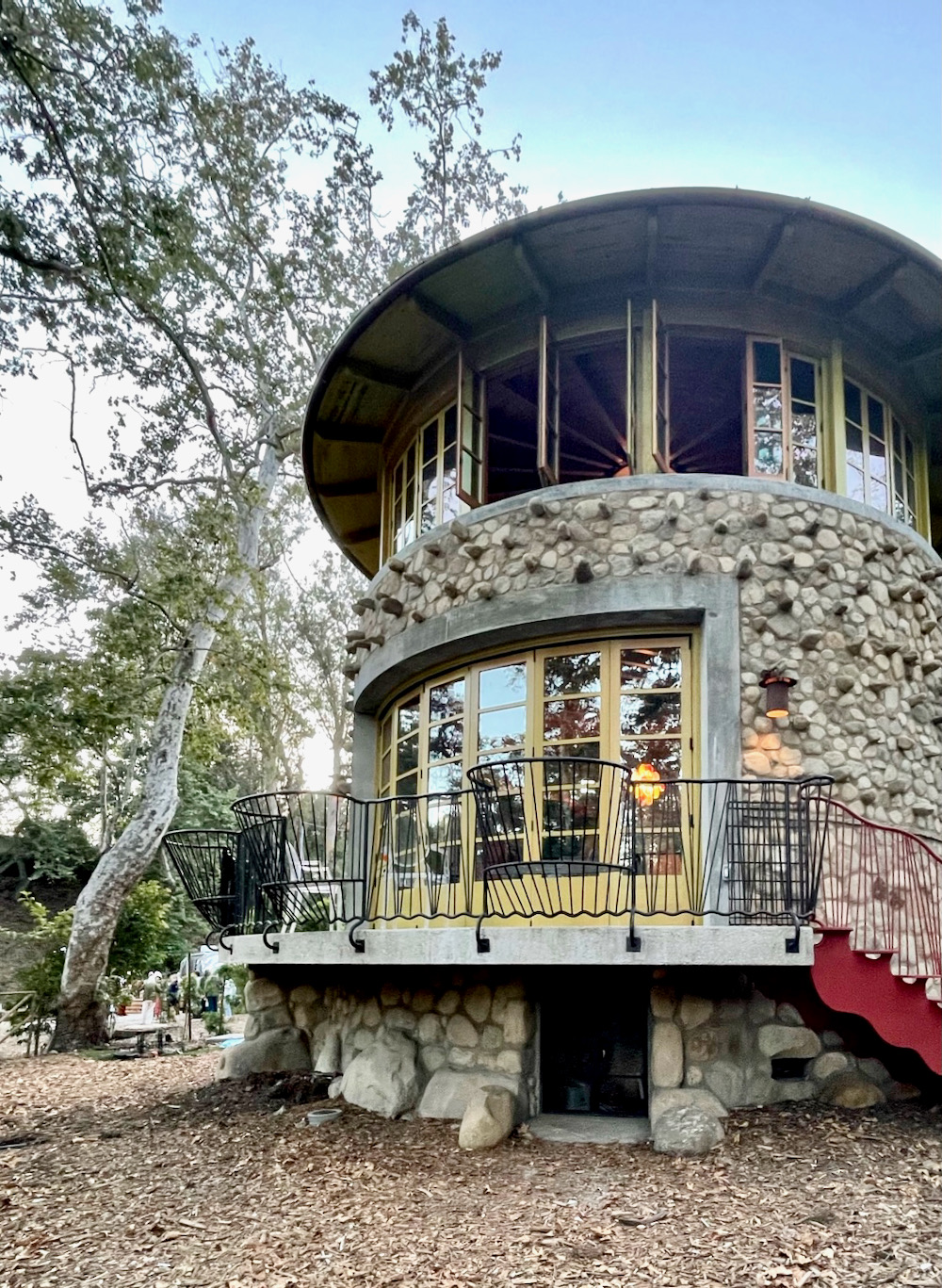
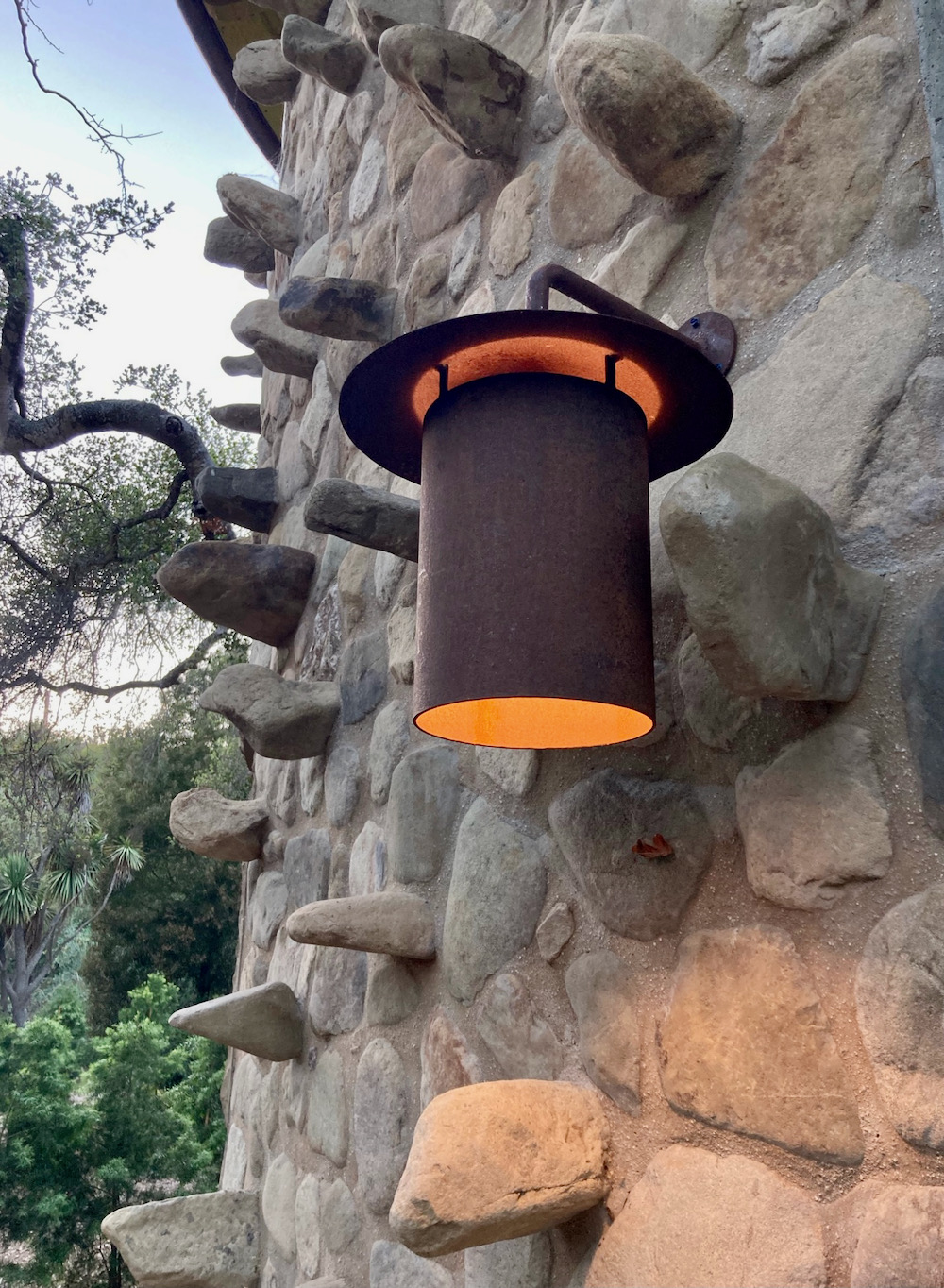
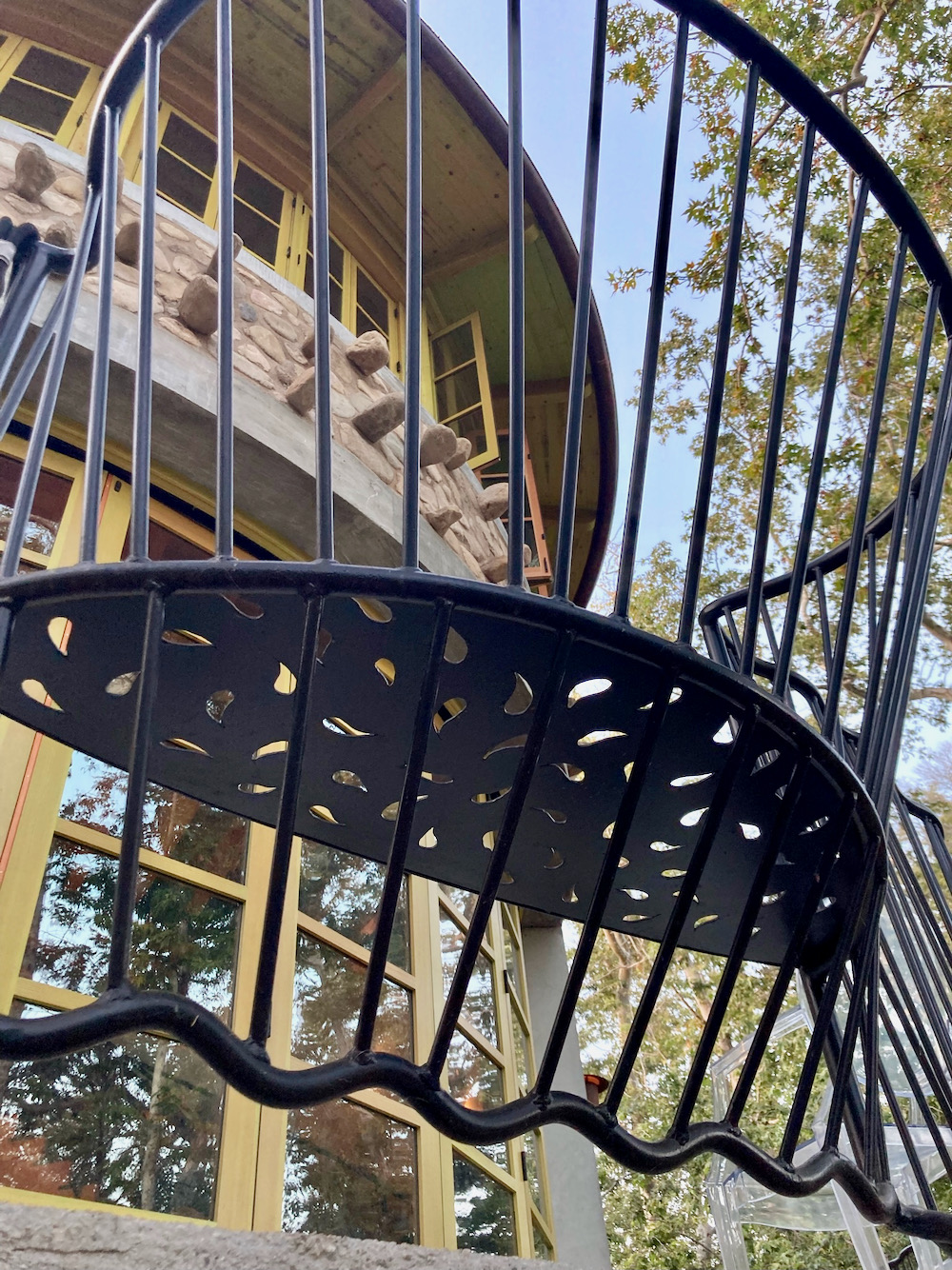
There was a time last year when, while driving on East Valley Road between Hot Springs and Sycamore Canyon, you might have suddenly noticed a cylindrical house under construction. Like a dream upon awakening, it soon disappeared behind vegetation and another new house. Lucky for us, the owner—interior designer Mary Beth Myers—and her architect, local legend Jeff Shelton, agreed to share photos of the completed Stone Tower project and answer a few questions. Let’s start with Shelton:
I understand there was a totally different design before the debris flow. What was it like?
There was already a 700-square-foot dilapidated house on the site, with a lot of charm, no foundation, and a great deal of rot. We designed a two-story house on the same footprint, and got it approved. We were not in the flood plain at that time. The new house that I designed was a simple rusty corrugated shed that fit with the Old Spanish Town vernacular.
Was there any specific inspiration for the Stone Tower design—the shape, the materials, etc.?
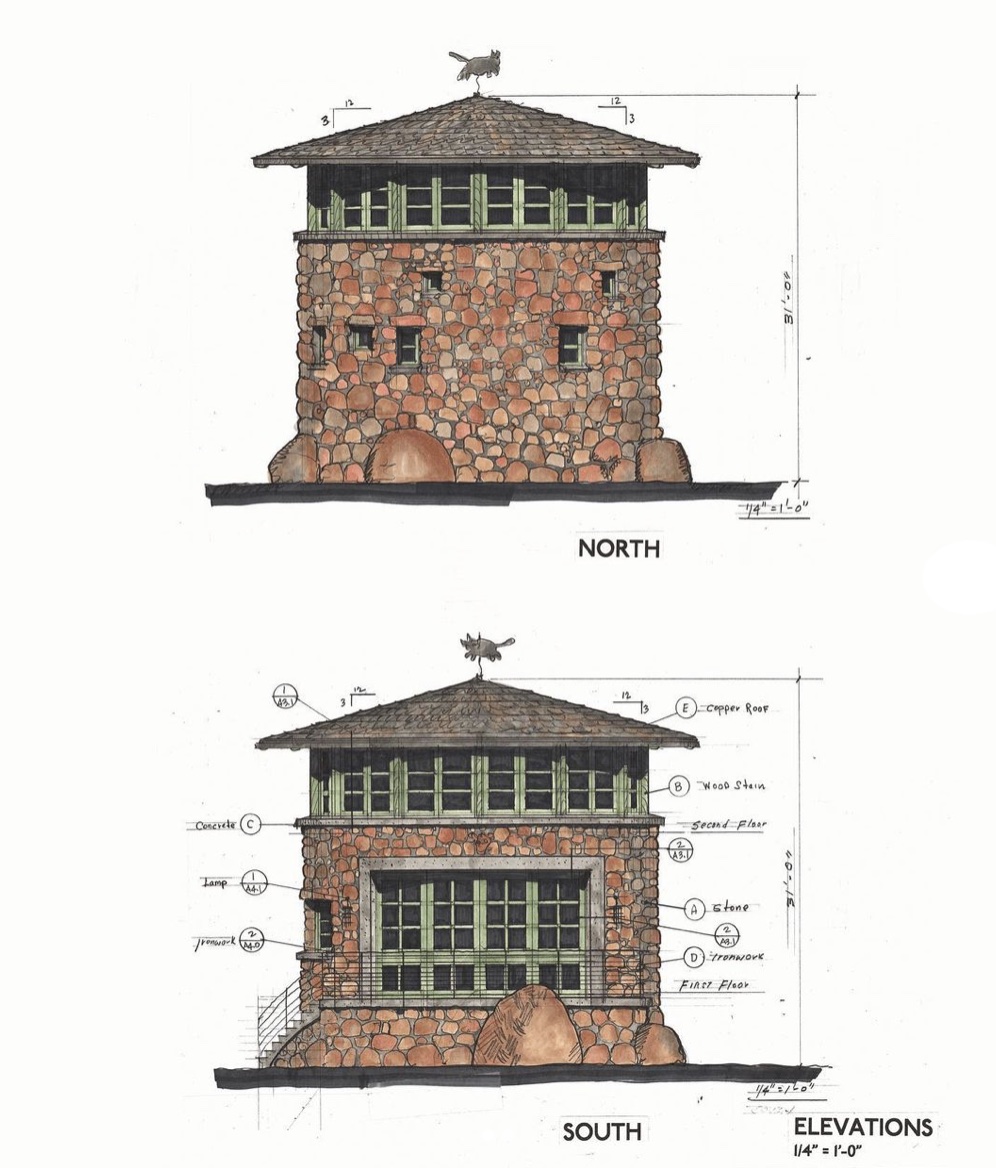
My client had just lost all her neighbors. The inspiration was dealing with the tragic debris flow. The round plan came from looking at islands in rivers. These islands have rounded or pointed ends facing upstream. If we do build back in a flood plain, how can we fit in? We tried to make something strong and small, and not create a dam.
Have you ever built a cylindrical building before? Why did it feel right for this spot?
Funny you say that. In college, they said that we could only design one circular building. They wanted us to understand the gravity of the circle. The circle dominates the entire thought process, and if it is hard to design, it is much harder to build. There is no momentum as the direction keeps changing. If you are a control freak, don’t do it. If you are willing to accept that the circle is your design god, then you just got to kneel.
Why the stone facade? Why the protruding stones?
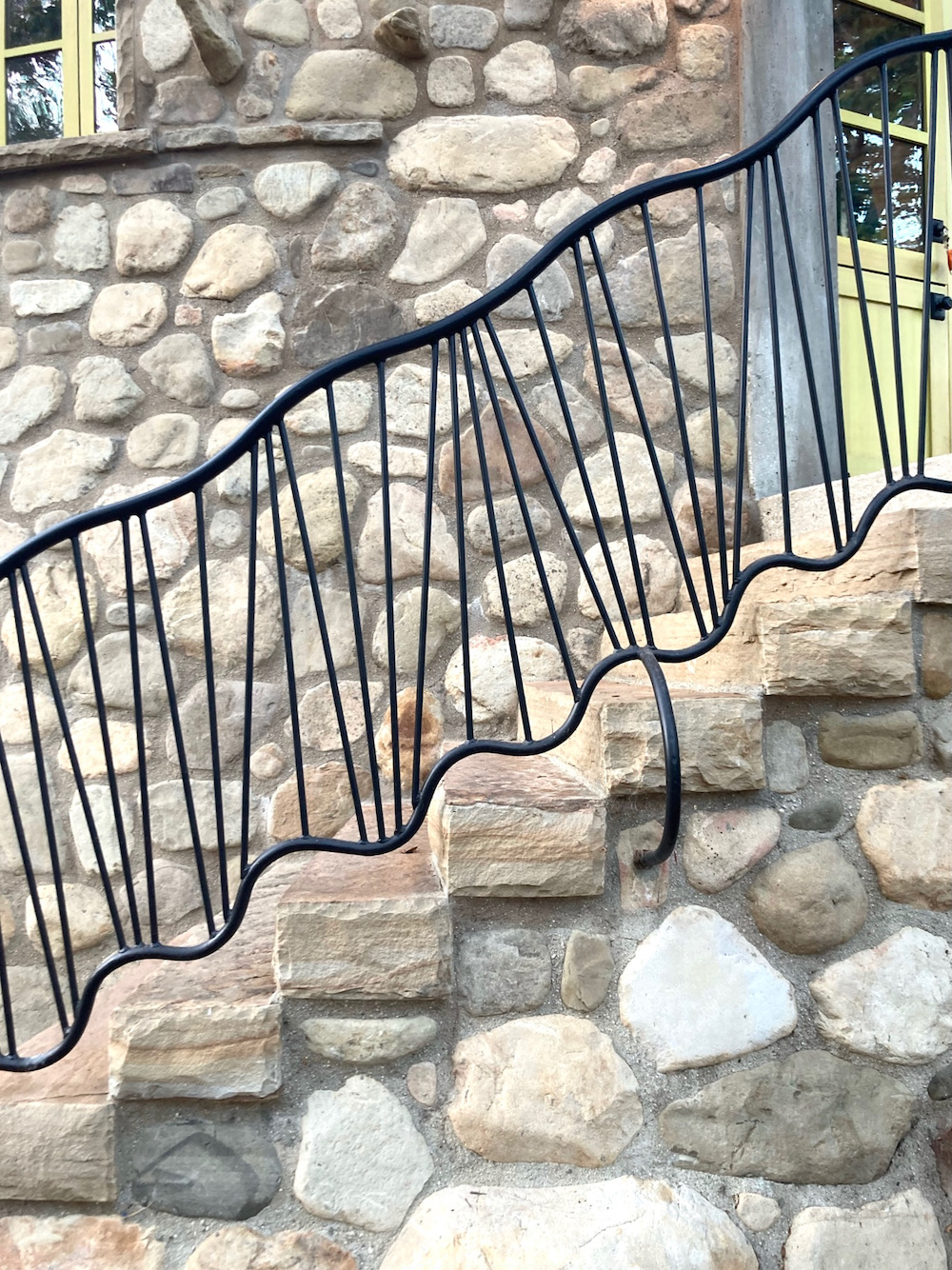
The sandstone from the Santa Ynez Mountains is sacred, and it is why the mountains are still there. Stone is everywhere, and the debris flow brought more down. It is durable, and the color is the natural color in this area, and specifically in the riparian zone. The whole flood plain is built up of sandstones that have washed down the mountains. The stone on this building came from the excavation directly under the footprint of the 28-foot diameter circle—stone wasn’t imported. Sometimes, if you let it, things just work out. With the stone halfway up the sides, my dearest friend Andy Johnson, stone mason extraordinaire, had a heart attack. He is still recovering. Andres Cintura was left to complete the project. I brought in the idea of changing the whole pattern at this juncture, as we couldn’t master Andy’s artistry, and I didn’t even want to try. The protruding stones give the tower great shadows that change throughout the day, like a sundial. I was just trying to have fun at this point, as there was not much to be happy about with Andy being in such a dire condition.
Were there any unexpected challenges during the construction of it?
The miracle is that Mary Beth stayed with this project. There are always issues or problems, and this house had its share. This project was one of the first rebuilds, so we were dealing with rules that seemed to change from day to day. Only people with a grand positive outlook on life, like Mary Beth, can help create projects like this.
Myers, meanwhile, took the questions and—to my delight—ran with them, writing up the following:
It’s a funny back story. Jeff designed two houses for me, the final plans for the first version, a corten steel–clad modern farmhouse, just a few days before the mudslide.
Afterward, and after waiting for surveys and the thumbs-up on being able to build at all, I asked Jeff, “What’s the strongest thing you can build?” His reply: “How do you feel about round?” Being a big fan of old stone homes in Europe, I thought of castles, mills, and lighthouses and said, “Let’s do it!”
Jeff and I worked closely together to make our vision come true. I asked for the moon, with French, Italian, and Japanese influences. The interior layout took a fair amount of thought, and I often considered boat design when figuring out how to have every luxury (in my opinion) tucked into a mere 936 square feet.
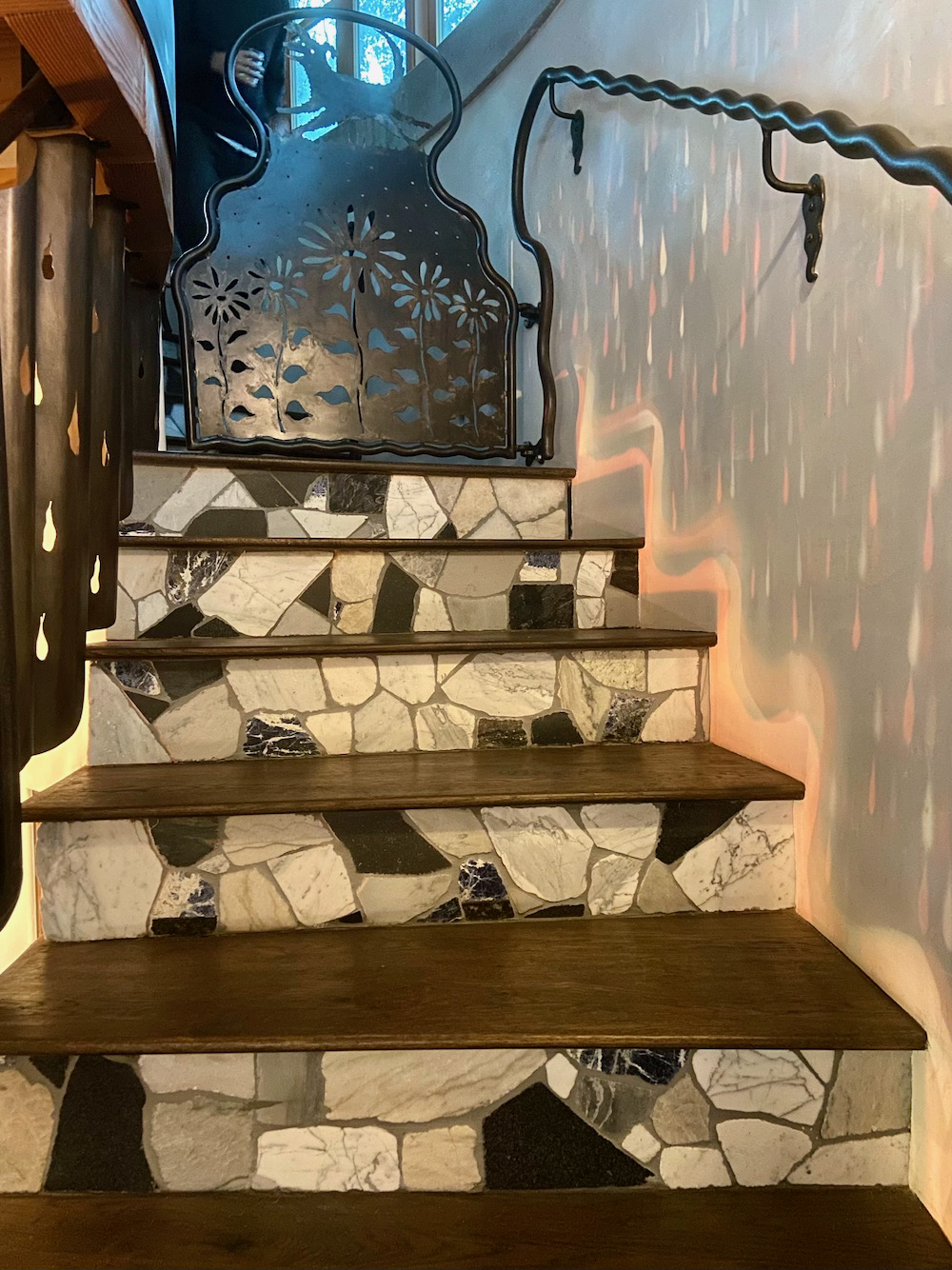
The first floor is a combination of kitchen, dining, and living space. Everything in the house is built on a curve and custom. There is a full tiny bath under the stairs, the kitchen island is on wheels, a Murphy bed and a pair of loft beds too, making it highly functional.
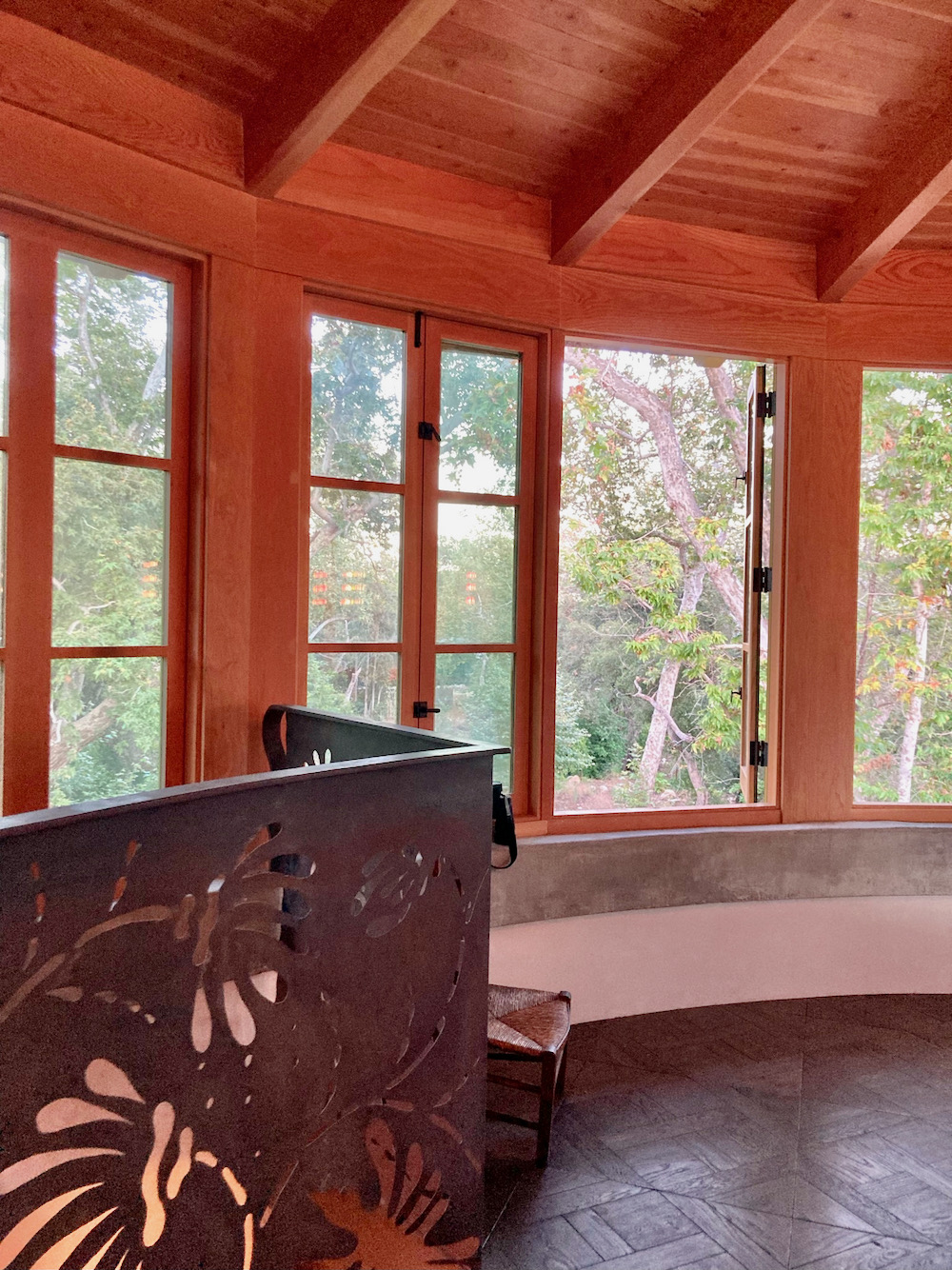
The second floor is the master suite with a floating tub, water closet, plus closet and laundry facilities.
Living in the house is a dream. It is open-air and so connected with nature—the ultimate in glamping. I am so happy and thankful to be in my sweet home after everything.


················
Soaring Souls at Black Point
Posted on July 29, 2021 by Royal Rosamond Press
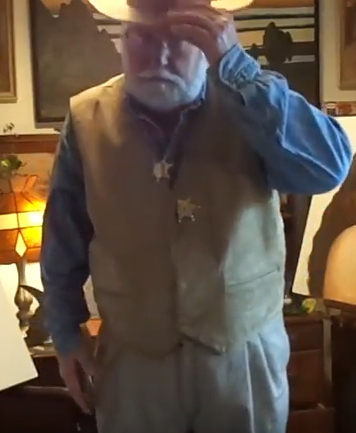
The Republican Party, co-founded by John Fremont – who was the first Presidential candidate for this Abolitionist party – will be making the case THEY ARE NOT RACISTS! This is a ploy to overshadow the inquiry into the evidence the Republican party condones INSURECTIONISTS. This fake noise will allow millions of Evangelical Republicans to declare – THEY ARE NOT RACISTS. Nice try! This newspaper will – kick the slats from under this EVIL PLOY!
I am going to launch a more exciting campaign to become your next Republican President. My enemies, were delighted I announced I was running for President, because they needed proof I am insane to justify their abuse of me – and abuse me some more! Have we forgotten Trump got Covid – and survived? Did this give his followers a message that the Covid was no big deal, and, Democratic Liars are in league with Satan? Two-thirds of Republicans believe Trump won! Half of Americans – are not vaccinated! This is WHOLESALE INSANITY!
John Presco ‘Presidential Candidate’ a.k.a. ‘Sheriff Two Stars’
I Am Candidate For President Again | Rosamond Press
A new poll from The Associated Press-NORC Center for Public Affairs Research captures widespread unease among Republicans over everything from the direction of the country to the state of American democracy and, in particular, President Joe Biden. Just 15% approve of the way Biden is handling his job, and 66% continue to say the Democrat was illegitimately elected, a lie perpetuated by Trump that underscores his persistent grip on GOP voters.
Republicans have plenty of concern about their own party, too. Fewer than half of Republicans, 41%, say they are optimistic about the GOP’s future. Just 13% say they are “very” optimistic. And one third, 33%, say they are pessimistic.
AP-NORC poll: Many Republicans uneasy about party’s future (apnews.com)
We Will Soar At Black Point
Posted on February 19, 2017 by Royal Rosamond Press


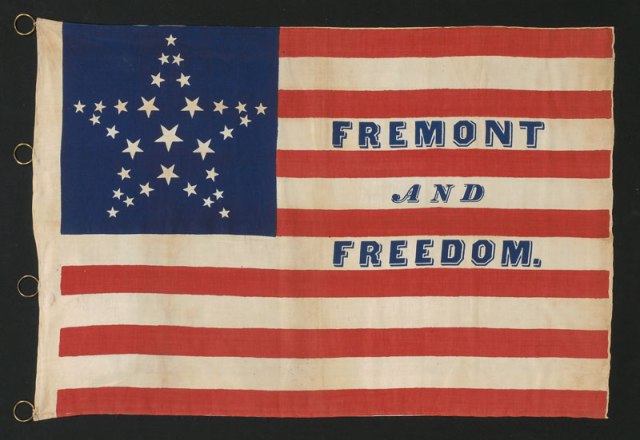
Those with Free Spirits, who know how to be released, and soar, come to Black Point and Fort Mason. Here we will make a stand for Arts and Culture. Here the Nation of California will be born. The epicenter is here. We will put on a lightshow. They will see our light in the sky, and in the bay, playing with whales and dolphins. They will marvel.
Jessie Benton Fremont held a salon at Black Point. Mark Twain was a frequent guest. Rena gave me permission to install her in ‘The Muse Hall of Fame’. If not for the painting I did of Rena, Christine would never have married Garth Benton. I am the official Benton Historian. There is not other.
I just read Carrie Fisher predicted her own death, as did Mark Twain, and, allegedly my sister. Carrie was hired to do a screenplay about Christine. Debbie died the next day.
Join us!
Jon ‘Master of the Rose’

Blunt said, Fisher also had a scary premonition.
“She put a cardboard cutout of herself as Leia outside my room, with her date of birth and date of death on her forehead,” he told the Times. “I’m trying to remember what the date was, because it was around now — and I remember thinking it was too soon.”
JOELY: I’ve been having an out-of-body experience. The world lost Carrie and Debbie, of course, but– and– and Princess Leia and we lost our hero. We lost– our mirror.”
http://abc7chicago.com/entertainment/carrie-fishers-sisters-open-up-about-her-final-moments/1683949/
http://www.militarymuseum.org/BlackPointBty.html
The New York Times, August 10, 1924
MARK TWAIN’S FORMER HOME STILL REMAINS A LANDMARK
Famous Fifth Avenue House Will Be Preserved by Present Owner – Property in Same Family for Two Centuries – Irving Stayed There
By Howard A. Lamb
There is one landmark of Little Old New York that may still laugh at the assaults of time – and apartment house builders. It has been finally decided that the residence at 21 Fifth Avenue, corner of Ninth Street, of world-wide interest because it has been the home of both Washington Irving and Mark Twain, is not going to be torn down – not as long as the present owner, Edward Renwick Whittingham, lawyer, of 2 Rector Street, is alive, and he is still a very young man.
Sentiment is regarded as a rare thing these days, and getting rarer, especially along Fifth Avenue, but it is nothing else but sentiment and family pride that have made Mr. Whittingham cold to the entreaties of hotel and apartment house operators and resolved to make the quaint house his home as long as he lives.
Other old houses in the neighborhood are vanishing almost overnight to make room for towering apartment buildings, but there are enough left to give the Washington Square neighborhood an atmosphere of its own, and Mr. Whittingham would like to see it perpetuated.
Diagonally across the street from Mr. Whittingham’s property, for instance, is the house built by Henry Brevoort. On Feb. 24, 1840, the first masked ball ever given in New York was held there. It was marked by the elopement of Matilda Barclay, daughter of the British Consul, with a South Carolina youth – regarded as a great scandal in that day. The house is now owned by Mrs. George F. Baker Jr., herself a descendant of the Breevorts.
Adjacent to 21 Fifth Avenue is the old home of Dr. E. L. Partridge, with the line of the old Randall farm going through it, from which an underground passage used to lead to the Brevoort Hotel, the first hotel on Fifth Avenue. A block away is the former home of Charles A. Dana of The Sun.
Mr. Whittingham’s property, a part of the old Brevoort farm, has been longer in the hands of one family than any other in New York – 250 years. The young lawyer feels that it would be almost a sacrilege to let it go. He is unmarried, however, and is not occupying it at the present time.
The Brevoort farm belonged originally to Bastian Elliss, who received it Dec. 18, 1667, from Richard Nicolls, first English Governor of New York. It passed from Elliss to his son-in-law, John Hendrik Brevoort, in 1701, and has been in the Brevoort family ever since.
The original owner of the present house was James Renwick, great-grandfather of Mr. Whittingham, for thirty years head of the Natural Science Department of King’s College. He died in 1862. To the Renwick family belongs the honor of establishing the first line of regular sailing vessels between this country and England. William Renwick was interested with Alexander Hamilton and others in founding the Bank of New York in 1784.
Spare Room for Irving
Mrs. James Renwick was Margaret Ann Breevort, daughter of Hendrik Brevoort, the stubborn old Knickerbocker who “put the bend in Broadway” because he would not let it go through his cherry orchard. He also prevented the opening of Eleventh Street through his property because it would run too close to his house, which stood on the present site of Grace Church.
Professor Renwick was a close friend of Washington Irving. He traveled with Irving in England when Irving was writing “Bracebridge Hall,” and also accompanied him on trips over the Continent. It was because of this comradeship that Professor Renwick set aside the middle room on the second floor as a spare bedroom for the author of “Rip Van Winkle” to use whenever he came to town from his home at Sunnyside, up the Hudson.
James A. Renwick, Professor Renwick’s grandson, and his cousin, Mrs. Bessie Whittingham, held the property between them until last August, when Mrs. Whittingham’s son, Edward, obtained sole possession.
The apartment in the basement is now occupied by Dr. Robert H. Kahn, who moved into the building when Mark Twain and his family left, and for many years used the entire premises. He had known the Clemens family for years. At his country home he still keeps the orchestrelle with which Twain entertained himself in the Fifth Avenue house, playing Beethoven’s Fifth Symphony and other compositions of which he was fond.
The house itself, now almost a century old, was designed by the original owner’s son, James Renwick Jr., the architect who drew the plans for several churches n the same neighborhood – the Church of the Ascension, the First Presbyterian Church and Grace Church – as well as some of the buildings at Vassar College and the Smithsonian Institution. There is an ecclesiastical suggestion about the windows of the house, which are gracefully rounded at the top, and the rooms are of stately proportions. It was built shortly after the opening of Fifth Avenue, and was the first one on the block.
Mark Twain moved in during the Fall of 1904 and remained until the Summer of 1908, when he occupied Stormfield, just built for him at Redding, Conn. There he died April 21, 1910, aged 74.
Dictated in Bed
Albert Bigelow Paine, Twain’s biographer, lived in the house for a while to help carry on his work. Mark continued to indulge a weakness for doing his literary work in bed, dictating his biographical notes to Paine’s stenographer as he lay voluptuously under the blankets garbed in “a handsome silk dressing gown of rich Persian pattern, propped against the snowy pillows.”
Clemens was passionately fond of billiards, and when Mrs. H. H. Rogers presented him with a handsome billiard table he converted one of the bedrooms into a billiard room. With Paine he played the game at every opportunity. George Harvey and Peter Finley Dunne were occasional opponents, and Mr. and Mrs. Martin W. Littleton, who lived near by, came over for an occasional three-handed game in the evening. Littleton was then engaged in the defense of Harry Thaw, on trial for the murder of Stanford White, and used to entertain Clemens with interesting sidelights of the day’s developments in court.
Occasionally Clemens was the centre of interest at small dinners given at the Brevoort Hotel, a step from his own door, and his home became the meeting place of some of the shining literary lights of the day. To his dinners came, in addition to George Harvey and Peter Finley Dunne, William Dean Howells, Augustus Thomas, whose play, “The Witching Hour” was then at the height of its success, and Brander Matthews.
Mark Twain was a conspicuous figure in the Washington Square neighborhood. He was a man whose personality naturally dominated the crowd about him. The white suit he always wore and his bushy crown of silver hair would have attracted attention even if he were not famous for other things.
At times he went out for a stroll with General Dan Sickles, then in his eighties and handicapped by a wooden leg, who lived in a mansion across the street. He bought his cigars from Joe Isaacs, who died in New York this Summer. Isaacs kept his store in a corner of Alexander McClelland’s roadhouse at the southeast corner of Sixth Avenue and Eleventh Street, torn down in 1912. Here the braw Scot served fine old musty ale and mutton pies that won him a steady reputation for forty-two years.
Liked Cheap Cigars
McClelland’s was the resort of gentlemen, where men like Chester A. Arthur and William Travers Jerome, out for a cutter ride on a frosty night, might drop in for a nip of spiced rum. Even Theodore Roosevelt, then Police Commissioner and at grips with the saloon power, was obliged to tell “Old Aleck” – who is still hale and hearty, by the way – that he conducted a model drinking place.
Clemens’s taste ran to strong, black cigars, rather than to liquid refreshments, so that he seldom stopped at Aleck’s hospitable place. The cheaper the cigars the better he liked them, but he probably bought so many that Isaacs considered him a welcome customer. It must have been Clemens himself who remarked that he “smoked constantly, loathed exercise and had no other regularity of habits.” He often received presents of the most expensive imported cigars, but never smoked them. He handed them out to his friends and callers. Once he passed an English brier root pipe to Paine and said:
“I’d like to have you smoke that a year or two, and when it gets so you can’t stand it, maybe it will suite me.”
On pleasant days Mark Twain liked to stroll up Fifth Avenue, sometimes as far as he Carnegie home, on Ninety-second Street, and come back on the “electric stage,” from which he could enjoy the panorama while he smoked without interference. At time he turned at Fifty-ninth Street, rested at the Plaza Hotel or sat on a bench in Central Park.
On Sunday mornings he would time his return to se the crowds leaving the churches. He liked the throng. The homage of the multitude was dear to him, not because he loved adulation for its own sake, but because his heart was big enough to fully appreciate the tribute of a people’s affection.
Children Loved Him
“It was the most precious reward of his life, the final harvest,” says Paine, “and he had the courage to claim it.”
Children were as fond of Clemens as he was of them. Frequently on his walks he got no further than Madison Square Park, then the centre of a fine residence section, because the youngsters, sometimes accompanied by their nurses, would beg him to sit down on a bench and tell them stories. This he would do for an hour or two, reading from “Tom Sawyer” or “Huckleberry Finn” or making up tales as he went along. On of the little girls who loved to listen was Margaret McClelland, who is now grown up.
“As I remember Mr. Clemens,” she said the other day, ” he was a strange man, always alone, always thoughtful. We children adored him. The stories he told me became the subject of my dreams. One of them was about a bad little girl named Polly, and he would end it by saying, ‘Are you ever a naughty Polly?’ “
But in spite of brilliant dinners, hosts of friends, material prosperity and the love of people all over the world, the four years Mark Twin lived at 21 Fifth Avenue were some of the loneliest and most miserable of his life. The loss of his wife was an unconsolable sorrow. Bernard Shaw had linked him with Edgar Allan Poe as one of the two outstanding literary geniuses of America and had compared his works from a historical standpoint with those of Voltaire, but Clemens felt that he had accomplished little except to amuse people. He was submerged in a pessimistic philosophy and died a disappointed man.
c
 Rosamond Press
Leave a comment