
Sputnik 1 was launched in 1957 (Sputnik image via Carlos Moreno Rekondo | Wikimedia Commons, background via Kisenok | goodfon.com)

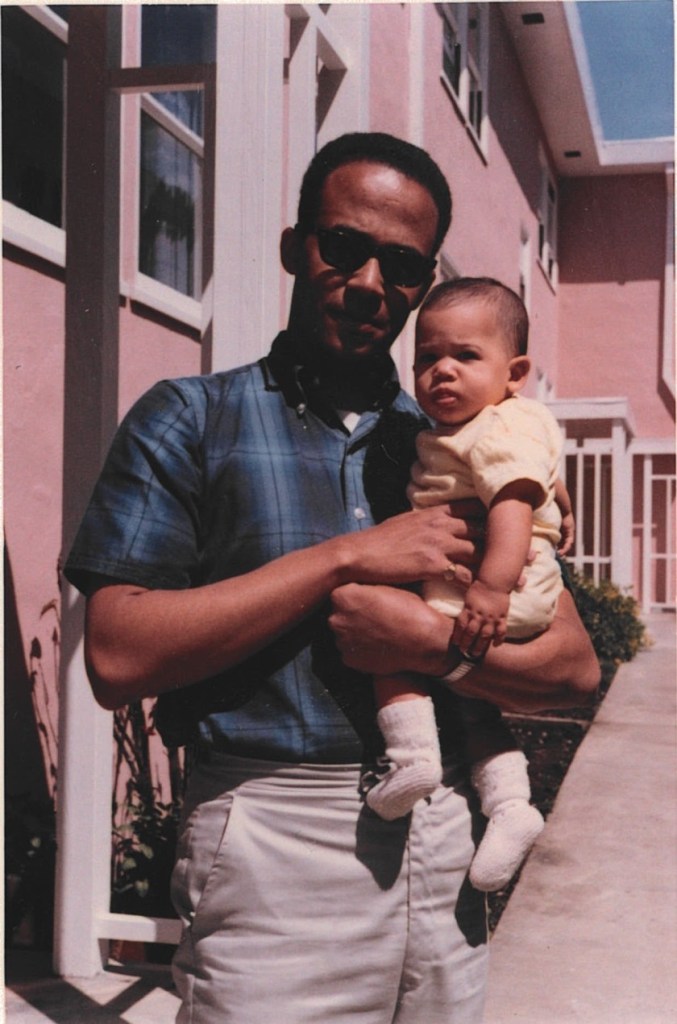
Born In Oakland
by
John Presco
The Story of Kamala Harris and John Presco who were born in Oakland.
ALL RIGHTS RESERVED
I was born in Oakland on October 8, 1946. On October 4, 1957 I walked around the backyard of the home we rented, and fretted about the launch of Sputnik. I was deep in thought. How is my country going to handle this defeat. No weapons had been fired, yet the news was saying this space object put America far behind the Soviet Union who wanted to take over the world – the free world!
Then I am seeing images of the Berlin Wall. Berlin had been divided in twain, and East Berliners were being shot as the ran to the barbed wire.. On Vice President Vance rebuilt that wall when he spoke in Munich. Before he insulted German and European leader, he visiting Dachau concentration camp where he said Europeans did not do enough to save the Jews. Did Putin read all the remarks of Trump’s VP, and do a Russian sword dance at the Moscow White House? Putin correctly surmised President Trump was going to abandon NATO because European Nations abandoned – The Jews! Did Hesketh visit the graves of U.S. Soldier who died in Europe?
I recall my father talked about Stalin as we watched the news on San sebastian Avenue. Vic Presco knew much about World War 2. In 1987, a secretary that worked for my father, titled him ‘Vic The Nazi’ because at lunchtime he would put on War Videos and explain to his three secretaries how Germany could have won the war. If only somehow, The Third Reich would hear his opionions. When I saw Trump moping all over Europe, I beheld Vic’s double. Donald was berating our fallen soldiers. He shamed himself, and our dead. A hundred dasy in ofice, Trump launched another insilting assaud.
THE SHAME ON EUROPE FOR KILLING THE JEWS CAMPAIGN PLAN
My father ‘The Neo-Nazi’ shamed his two sons – every chance he got. You can see my toes are showing in the photograph of me and my playmates. We called ourselves the ‘Cheetah’s; We killed a lot of invisible Nazis together. How about Commies? I believe I am ten. I have been working for Acme Produce in Jack London Square for two year. Vic paid us a dollar a day, and opened a bank account for Mark and I. When Rosemary drove him out of our home, with a steak knife, he went to our bank the next day and stold $400 dollars each of our wages. If Vic ‘The Nazi; paid me by the week, I would have bought a new pair of shoes. My friend’s father noticed the rags I wore. He drove an American tank in Nazi Germany
Kamala Harris war born in Oakland on October 20, 1964. I was a seventeen year old Beat Poet and Artist, hanging our in a Coffee House in West Los Angeles. If Kamala had won, then I had a great book ‘The White Hippie and The Black Radical’. Today, I got a book about a Acidhead in the Oval Office who drove Western Civilization off a cliff – INTO THE TWILIGHT ZONE!
Read these words. X Marks The Spot, where Donald Acidhead shot our reality wod, and blew Western Diplomacy – out the friggen window! Is Britain and France – pretending they are going to send troops to the Ukraine TO FIGHT A COMMON ENEMY? Ian Easton fits in here.
I think Putin gave our President some bad acid, man!
To be contiued
BRUSSELS (AP) — Increasingly alarmed that U.S. security priorities lie elsewhere, a group of European countries has been quietly working on a plan to send troops into Ukraine to help enforce any future peace settlement with Russia.
Britain and France are at the forefront of the effort, though details remain scarce. The countries involved in the discussions are reluctant to tip their hand and give Russian President Vladimir Putin an edge should he agree to negotiate an end to the war he launched three years ago.
What is clear is that Ukraine’s President Volodymyr Zelenskyy needs a guarantee that his country’s security will be assured until peace takes hold. The best protection would be the NATO membership that Ukraine has long been promised, but the U.S. has taken that option off the table.

In a statement to CNN published Monday, Kelly delivered a scathing criticism of former President Donald Trump while confirming reporting in The Atlantic in 2020 that detailed the comments he made during his presidency.
“A person that thinks those who defend their country in uniform, or are shot down or seriously wounded in combat, or spend years being tortured as POWs are all ‘suckers’ because ‘there is nothing in it for them,’” Kelly said of Trump. “A person that did not want to be seen in the presence of military amputees because ‘it doesn’t look good for me.’ A person who demonstrated open contempt for a Gold Star family — for all Gold Star families — on TV during the 2016 campaign, and rants that our most precious heroes who gave their lives in America’s defense are ‘losers’ and wouldn’t visit their graves in France.”
On Saturday, the White House, citing “logistical difficulties caused by the weather,” canceled Trump’s trip to a memorial at Belleau, where 2,000 U.S. Marines died a century ago. It was raining — and Trump opted to remain at the U.S. ambassador’s residence, watching TV and tweeting.
The next day, when other world leaders marched down the Champs-Elysees to the Arc de Triomphe for the centenary of the Armistice ending World War I, Trump instead took his motorcade. The reason this time: security. Once again, it was raining, and Trump stayed dry in his armored limousine.
These were brave decisions, because they meant Trump would have to endure the hurtful images of other world leaders visiting other memorials around France despite the rain, then marching in soggy solidarity without him. His excuses for skipping the war memorial earned ridicule because the cemetery was just an hour’s drive (less than half the time the White House claimed) and Trump had previously boasted about ordering his pilots to fly him despite bad weather — to a campaign rally.
He endured French President Emmanuel Macron’s “very insulting” proposal that Europe build up its own military. He endured a topless woman disrupting his motorcade with the words “fake peacemaker” on her chest. He endured mockery in the French press for confusing the Balkans with the Baltics. He endured Macron’s speech declaring that “nationalism is a betrayal of patriotism.” And he endured the obvious impression that other leaders didn’t want him at their “Peace Forum,” which began as Trump left.

This article is more than 10 years old
The Devils’ Alliance: Hitler’s Pact with Stalin, 1939-1941 – review
This article is more than 10 years old
Was Stalinism really worse than nazism? Richard J Evans takes issue with Roger Moorhouse’s worryingly one-sided account of the consequences of the non-aggression pact
Wed 6 Aug 2014 05.00 EDTShare391
Seventy-five years ago, on 23 August 1939, Hitler’s Germany and Stalin’s Russia stunned the world by announcing that they had concluded a non-aggression pact, committing themselves not to aid each other’s enemies or to engage in hostile acts against one another. Stalin knew the pact would not be popular. “For many years now,” he said, “we have been pouring buckets of shit on each other’s heads, and our propaganda boys could not do enough in that direction. And now, all of a sudden, are we to make our peoples believe that all is forgotten and forgiven? Things don’t work that fast.” Many western European communists, disgusted at this turn of events, left the party at this point in what was probably the largest exodus of members before the Soviet invasion of Hungary in 1956. The front garden of Nazi party headquarters in Munich was quickly filled with party badges and insignia thrown there by party members appalled at the thought of an alliance with the communist enemy they had spent their lives fighting against.
Ludovic Marin/AP
On November 10, 2021, in honor of Armistice and Veterans Day, Vice President Kamala Harris and her husband visited Suresnes American Cemetery, just outside Paris, France, and paid their respects to the American fallen service members from WWI and WWII who are memorialized there.
Image
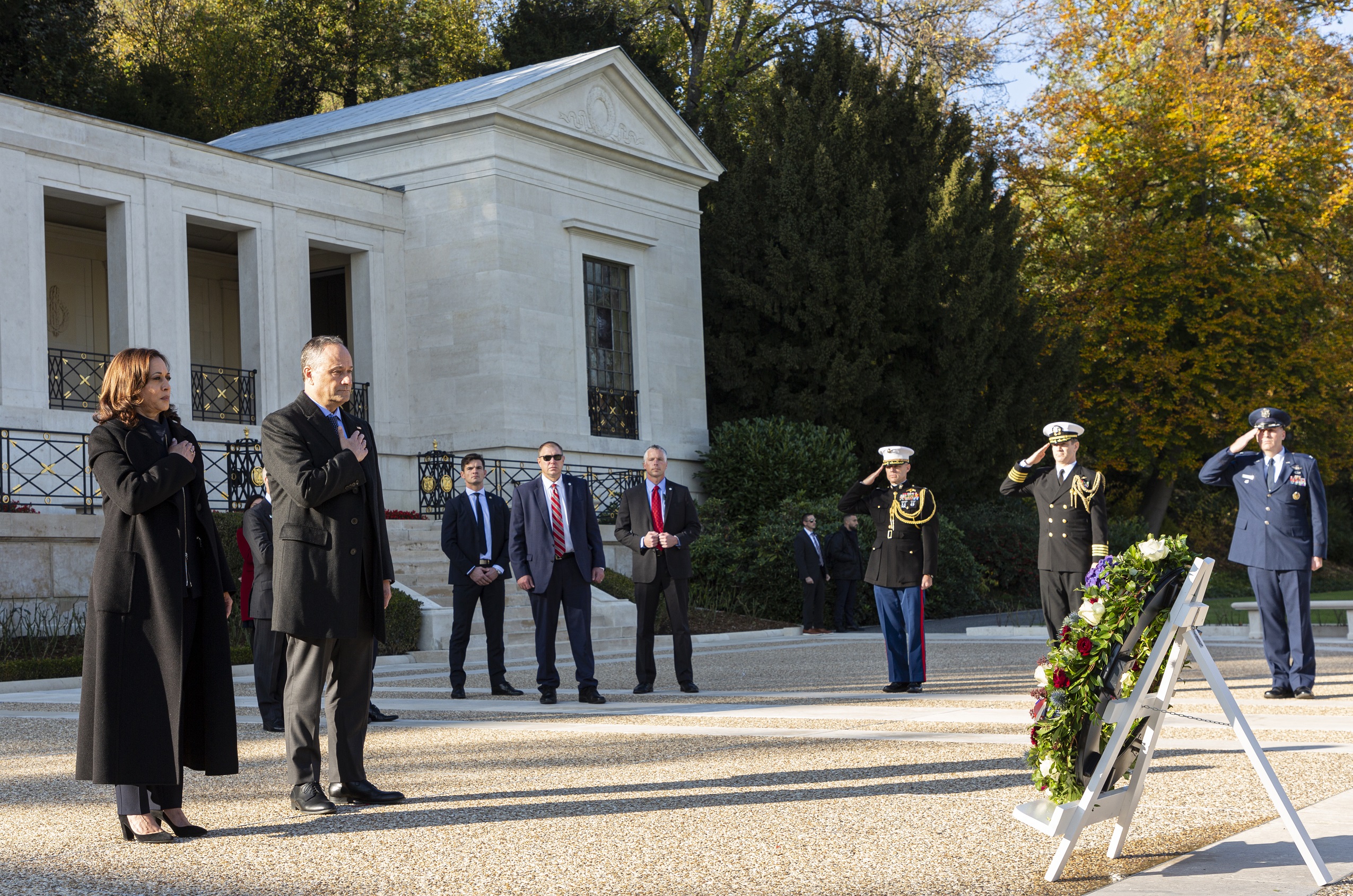
After an intimate wreath laying and playing of Taps, Vice President Harris was greeted by Superintendent Keith Stadler who provided an orientation of the memorial and cemetery grounds. Superintendent Stadler shared with Vice President Harris stories of some of the men and women who gave their lives for our nation. Among them, Inez Ann Murphy Crittenden, one of the 233 “Hello Girls” or telephone operators sent to France during WWI, who proved vital to American success in Europe. After hearing the stories of the servicemen and women who continue to be remembered every day by the work of the American Battle Monuments Commission (ABMC), the Vice President thanked the gathered ABMC staff, including the critical grounds crew who maintain our sites to pristine standards, saying, “Thank you for sharing these stories, for continuing to tell these stories. It is so important. It keeps their memories alive.”
Open Letter To Mr. Roozemond
Posted on September 19, 2019 by Royal Rosamond Press
All day long visions of my novel ‘The Royal Janitor’ overwhelmed me. I am experiencing a flood of creativity and inspiration. I now know what my book is about. I knew it would come to me if I stayed the course and trusted my inspiration. I was shown this opening scene. Turn down volume on first video.
This letter is still be composed.
Dear Roozemond. I was looking at your video today, and for one minute I beheld how great you are. I know your daughter wants to be great, too.
I believe most of the people of the world want to be seen as great. How can we, the people, bring that choice to the multitude……..today?
John Presco
For the first time since Malaysia Airlines flight MH17 was shot down in July 2014, prosecutors have announced charges against suspects in the case.
Three Russians and a Ukrainian have been charged with bringing a missile into the area in eastern Ukraine and with murdering 298 passengers and crew.
The passenger flight was en route from Amsterdam to Kuala Lumpur when it was shot down over conflict-hit Ukraine.
Russia said the accusations against its military were “absolutely threadbare”.
International arrest warrants have been issued for the four suspects and a court case will begin in the Netherlands on 9 March 2020.
The Dutch-led joint investigation team (JIT) named the men as Igor Girkin, Sergei Dubinsky and Oleg Pulatov from Russia, as well as Ukrainian Leonid Kharchenko.
The JIT, which is seeking to try the suspects under Dutch law, had previously said it had a “long list” of persons of interest and appealed again for witnesses as the investigation continued.
Who are the suspects?
The most prominent of the four is Igor Girkin (also known as Strelkov), who prosecutors say is a former colonel in Russia’s FSB intelligence service. He was given the minister of defence title in the rebel-held eastern Ukrainian city of Donetsk.
He is believed to be the highest military officer in the area who was in direct contact with the Russian Federation. In a statement Mr Girkin said: “I can only say that militia did not shoot down the Boeing.”
The others charged are:
- Sergei Dubinsky (known as Khmury), who prosecutors say was employed by Russia’s GRU military intelligence agency, was a deputy of Mr Girkin and in regular contact with Russia
- Oleg Pulatov, known as Giurza, who the JIT says was a former soldier of GRU special forces and deputy head of the intelligence service in Donetsk
- Ukrainian national Leonid Kharchenko, who has no military background but led a combat unit as a commander in eastern Ukraine, according to prosecutors
“These suspects are seen to have played an important role in the death of 298 innocent civilians”, said Dutch chief prosecutor Fred Westerbeke.
“Although they did not push the button themselves, we suspect them of close co-operation to get the [missile launcher] where it was, with the aim to shoot down an aeroplane.”
Investigators, he added, had “evidence showing that Russia provided the missile launcher”.
The investigative website Bellingcat has named 12 people it accuses of being involved in transporting the missile used to down MH17, including the four charged by the JIT.
What is known about flight MH17?
The passenger jet left Amsterdam’s Schiphol Airport at 10:15 GMT on 17 July 2014 and was due to arrive at Kuala Lumpur in Malaysia the following day.
A few hours after take-off, the plane lost contact with air traffic control about 50km (30 miles) from the Russia-Ukraine border.
At the time, an armed conflict was raging on the ground in eastern Ukraine between Russian-backed separatists and Ukrainian government forces, and several government military aircraft had been downed in the previous weeks, while government air strikes were being carried out on rebel-held areas.
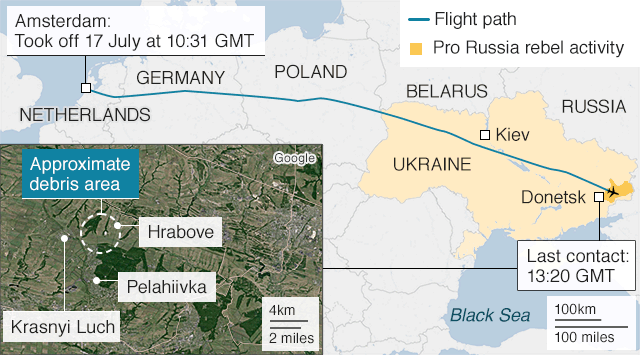
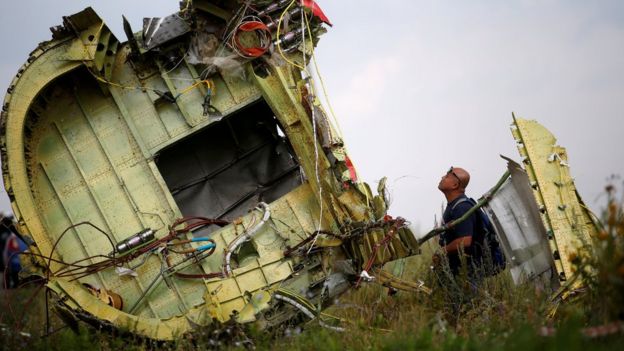
The plane crashed in the Donetsk area, in territory controlled by separatists. Parts of the wreckage were found distributed over an area of about 50 sq km (19 square miles).
In October 2015, the Dutch Safety Board concluded the plane had been hit by a Buk missile, causing it to break apart in mid-air.
The JIT – which includes officials from the Netherlands, Australia, Belgium, Malaysia and Ukraine – concluded in May 2018 that the missile system belonged to the 53rd Anti-Aircraft Missile brigade, based in the western Russian city of Kursk. It produced evidence that it said proved how the missile system had reached eastern Ukraine.Media captionAn animated video from the Dutch Safety Board shows the damage to the plane and how it was caused
Russia responded by denying any of its anti-aircraft missile systems had ever crossed the Ukrainian border.
Australia and the Netherlands have both officially held Russia responsible for the crash.
Will the suspects ever face trial?
US Secretary of State Mike Pompeo called upon Russia to “ensure that any indicted individuals currently in Russia face justice”.
But Russia’s foreign ministry said in a statement that it rejected the findings of the JIT which were “aimed at discrediting the Russian Federation in the eyes of the international community”.
Unnamed Dutch officials have told news agencies that Russia refused to co-operate with the investigation but the foreign ministry denied this, saying Russia had always been interested in establishing the truth.
Russia accused the JIT of using dubious “sources of information”, including evidence “fabricated” by Ukraine, while ignoring evidence offered by Russia.
In July 2015, it vetoed a UN Security Council resolution that sought to set up a special tribunal to prosecute those responsible.
Under Article 61 of Russia’s constitution, no Russian citizen can be extradited to another state.
A former rebel official in Donetsk, Andrei Purgin, said it was “absurd” to accuse the separatists of involvement in downing the plane, Russia’s Interfax news agency reports.
Asked by AFP news agency, Ukrainian security services said they had “no information” on Leonid Kharchenko’s whereabouts or whether he was even still alive.
Who has welcomed the charges?
Ukrainian President Volodymyr Zelensky welcomed the Dutch-led inquiry’s conclusions, Reuters news agency reports. He said he hoped “those who are guilty of this brazen murder of innocent children, woman and men will be put in the dock”.
UK Foreign Secretary Jeremy Hunt said Russia “must co-operate fully with the prosecution and provide any assistance it requests” in accordance with UN Security Council resolution 2166, which was passed in response to the downing of MH17.
“The international community stands together against the impunity of those responsible for the despicable murder of 298 innocent people,” he added.
Nato chief Jens Stoltenberg said the bringing of charges marked an “important milestone in the efforts to uncover the full truth and ensure that justice is done”.
Who were the victims?
A total of 283 passengers, including 80 children, and 15 crew members were killed on the flight.
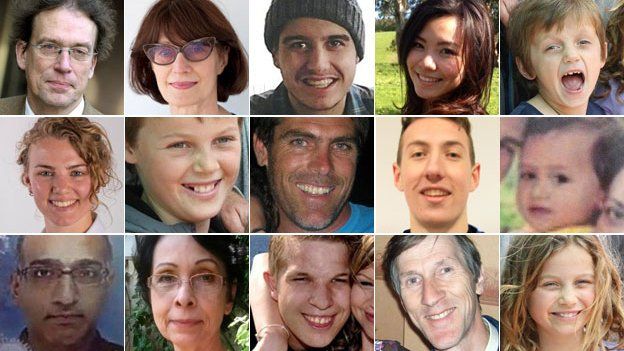
The dead included 193 Dutch nationals, 43 Malaysians, 27 Australians, 12 Indonesians, 10 Britons, four Belgians, four Germans, three Philippine nationals, one New Zealander and one Canadian.
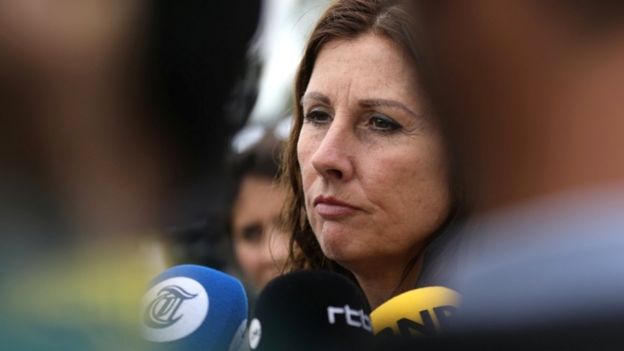
Speaking ahead of Wednesday’s announcement, Silene Fredriksz, who lost her son Bryce, said that in the five years since the downing of MH17, some relatives had died not knowing the truth.
“We all get older… I hope that I will know the truth before I close my eyes,” she said.
Barry Sweeney, father of 28-year-old British victim Liam, said he was still looking for the truth.
“It’s not going to bring anyone back, but if I found out why it happened, it would bring a bit of closure,” he said.
Malaysia Airlines Flight 17 (MH17/MAS17)[b] was a scheduled passenger flight from Amsterdam to Kuala Lumpur that was shot down by Russian-backed forces[4][5][6][7] with a Buk 9M38 surface-to-air missile on 17 July 2014, while flying over eastern Ukraine. All 283 passengers and 15 crew were killed.[8] Contact with the aircraft, a Boeing 777-200ER, was lost when it was about 50 kilometres (31 mi; 27 nmi) from the Ukraine–Russia border, and wreckage from the aircraft landed near Hrabove in Donetsk Oblast, Ukraine, 40 km (25 mi; 22 nmi) from the border.[9] The shoot-down occurred during the war in Donbas over territory controlled by Russian separatist forces.[10]
The responsibility for investigation was delegated to the Dutch Safety Board (DSB) and the Dutch-led joint investigation team (JIT), which in 2016 reported that the aircraft had been downed by a Buk surface-to-air missile launched from pro-Russian separatist-controlled territory in Ukraine.[3][11] The JIT found that the Buk originated from the 53rd Anti-Aircraft Missile Brigade of the Russian Federation[12][13] and had been transported from Russia on the day of the crash, fired from a field in a rebel-controlled area, and that the launch system returned to Russia afterwards.[1][2][12]
In a statement to CNN published Monday, Kelly delivered a scathing criticism of former President Donald Trump while confirming reporting in The Atlantic in 2020 that detailed the comments he made during his presidency.
“A person that thinks those who defend their country in uniform, or are shot down or seriously wounded in combat, or spend years being tortured as POWs are all ‘suckers’ because ‘there is nothing in it for them,’” Kelly said of Trump. “A person that did not want to be seen in the presence of military amputees because ‘it doesn’t look good for me.’ A person who demonstrated open contempt for a Gold Star family — for all Gold Star families — on TV during the 2016 campaign, and rants that our most precious heroes who gave their lives in America’s defense are ‘losers’ and wouldn’t visit their graves in France.”
On Saturday, the White House, citing “logistical difficulties caused by the weather,” canceled Trump’s trip to a memorial at Belleau, where 2,000 U.S. Marines died a century ago. It was raining — and Trump opted to remain at the U.S. ambassador’s residence, watching TV and tweeting.
The next day, when other world leaders marched down the Champs-Elysees to the Arc de Triomphe for the centenary of the Armistice ending World War I, Trump instead took his motorcade. The reason this time: security. Once again, it was raining, and Trump stayed dry in his armored limousine.
These were brave decisions, because they meant Trump would have to endure the hurtful images of other world leaders visiting other memorials around France despite the rain, then marching in soggy solidarity without him. His excuses for skipping the war memorial earned ridicule because the cemetery was just an hour’s drive (less than half the time the White House claimed) and Trump had previously boasted about ordering his pilots to fly him despite bad weather — to a campaign rally.
He endured French President Emmanuel Macron’s “very insulting” proposal that Europe build up its own military. He endured a topless woman disrupting his motorcade with the words “fake peacemaker” on her chest. He endured mockery in the French press for confusing the Balkans with the Baltics. He endured Macron’s speech declaring that “nationalism is a betrayal of patriotism.” And he endured the obvious impression that other leaders didn’t want him at their “Peace Forum,” which began as Trump left.
It commemorates the actions of the 4th Marine Brigade of the U.S. Army’s 2nd Division. The 2nd Division attacked German positions beginning on June 6, 1918. The 4th Marine Brigade liberated Bouresches that day. Its 5th and 6th Marine Regiments fought in Belleau Wood through most of June 1918.
Their gallant actions resulted in the Battle of Belleau Wood ending on June 26. On June 30, 1918, the Commanding General, French 6th Army, officially renamed Belleau Wood as “Wood of the Marine Brigade.”
The 2nd Division sustained casualties of 8,100 officers and men during the intense fighting in this vicinity during June 1918. Vestiges of trenches, shell holes, and relics of the war to include weapons found in the vicinity, may be seen near the marine monument, which was erected by the U.S. Marine Corps.
Attending the 2017 Bastille Day parade at the invitation of President Emmanuel Macron, Trump was dazzled by the soldiers, armored tanks and fighter jets that painted the French sky red, white and blue – and informed high-ranking defense officials upon his return that he wanted a parade of his own in Washington.
Officials scrambled to put something together and set a tentative date of November 11. But when estimates for Trump’s military parade soared to nearly $100 million, officials realized they needed a backup plan to convince Trump a parade was too exorbitant. In the end, they persuaded him that dozens of other world leaders would be in Paris for the commemoration, and he needed to be, too.
But if Trump came to Paris expecting a parade that echoed the one he witnessed last summer, he was disappointed. The events commemorating the 100th anniversary of the end of World War I were solemn and stately, and the wet streets of Paris were largely empty as the procession got underway Sunday.
My ancestors who are buried in that cemetery fought tirelessly for the American ideals we will be entrusted to uphold,” Vance continued in the statement. “It’s both an honor and a privilege that someone with my upbringing can go on to become the Vice President of the United States. America is the only country in the world where a journey like mine is possible, and I look forward to working with President Trump to ensure that this nation continues to be a place where people of humble beginnings can go on to achieve great things.”
On Friday, Vance and Secretary of State Marco Rubio, are set to sit down with Zelenskyy on the sidelines of the Munich Security Conference. They’ll discuss Trump’s intensifying push for Ukraine and Russia to begin negotiations to end Europe’s deadliest conflict since World War II.
Talk of the current conflict followed Vance getting a firsthand look at the memorial demonstrating Nazis’ World War II-era atrocities and the U.S. and Western allies’ slowness to take decisive action to confront Adolf Hitler and the rise of his violent nationalist ideology.
The moment at Dachau gave Vance a chance to reflect on the scourges of war just as Trump is ratcheting up his efforts to end the current conflict between Russia and Ukraine.
Trump on Wednesday spoke separately with Russian President Vladimir Putin and Zelenskyy. Trump said that he and Putin agreed it was time to “start negotiations immediately” to end the war.
And, as Trump announced his agreement on negotiations with Putin, U.S. Defense Secretary Pete Hegseth said that NATO membership for Ukraine was unrealistic and suggested Kyiv should abandon hopes of winning all its territory back from Russia and instead prepare for a negotiated peace settlement to be backed up by international troops.
The United States Hesitated to Protect Europe’s Jews from Nazi Brutality. We’re Not Condemned to Reenact That Error Today.
American politicians and citizens waited too long to try to save Jewish victims of the Nazi Holocaust, as a PBS documentary airing this month demonstrates. We cannot afford to show the same torpor when facing ethnic discrimination or destruction today.
Written By

Michael Abramowitz


Jewish refugees aboard the MS St. Louis attempt to communicate with friends and relatives in Cuba, who were permitted to approach the docked vessel in small boats.
United States Holocaust Memorial Museum, courtesy of National Archives and Records Administration, College Park
When Freedom House was founded 80 years ago, America was in the middle of one of the most tumultuous periods in its history, marked by economic depression, a flirtation with extremist ideologies, and intense isolationism that saw many Americans resist active US involvement in the Second World War.
This period provides the backdrop for a powerful new documentary from Ken Burns, Lynn Novick, and Sarah Botstein, The US and the Holocaust, which premieres September 18 on PBS. The film examines the story of the Holocaust from the perspective of America at the time and asks a painful question: Why was more not done by the United States to stop the unfolding horror in Europe in the 1930s and ‘40s, and to rescue the millions of Jews in harm’s way?
There is no compact or convenient answer, though there was ample warning. As the film documents, Americans became quite aware of the Nazis’ brutality soon after Adolf Hitler took power in 1933. And yet, saving or protecting Europe’s Jews was not a priority for the US government or the public. While President Franklin Delano Roosevelt eventually mustered an alliance that would crush Nazi Germany, the filmmakers painstakingly show how antisemitism, xenophobia, economic calamity, and isolationism limited the American response to the Holocaust.
Burns, Novick, and Botstein spend much of the documentary’s running time on the highly restrictive immigration rules that prevented many Jewish families—including, as memorably told, that of Anne Frank—from escaping to America. In the end, the United States accepted more Jewish refugees than any other country in the world, but hundreds of thousands were stranded and murdered for lacking what anti-Nazi journalist Dorothy Thompson, one of Freedom House’s earliest board members, then described as a “piece of paper with a stamp on it.”
What ailed and still ails us
I was honored to serve as an adviser for the film based on my experience working on an exhibition on the same topic at the US Holocaust Memorial Museum, a project that inspired the filmmakers. I watched the film while considering Freedom House’s ongoing mission to counter threats to freedom and democracy; in that light, it was remarkable how relevant the movie feels, even as it recalls a genocide that took place nearly a century ago.
The filmmakers are unsparing in examining the fragility of democracy. They remind viewers how quickly the Nazis transformed Germany from one of the world’s most vibrant democracies to a one-party state capable of the most inhumane actions against human beings imaginable, including genocide. They are just as explicit when they train their lens on the historical failures of our own democratic order: Jim Crow laws that codified racist treatment towards African Americans served as an inspiration to the Nazis as they formulated their own evil policies.
The film also shows that susceptibility to demagoguery has often been a dangerous feature, not a bug, of US democracy. Figures like antisemitic radio priest Charles Coughlin and Charles Lindbergh, the famed aviator, exerted outsized influence in American life with their bigoted claims against Jews. Lindbergh’s America First movement, which sought to keep the United States out of the war, was no small factor in the formation of Freedom House in 1941.
Two of Freedom House’s founding patrons, First Lady Eleanor Roosevelt and 1940 Republican presidential candidate Wendell Willkie, feature in the film. Eleanor was particularly aggressive in pressing her husband to support refugees. Willkie, meanwhile, is quoted describing one of Lindbergh’s speeches as “the most un-American talk made in my time by any person of national reputation.”
Popular hostility to immigrants, another familiar phenomenon for American viewers, represents a major theme of the film. Polls conducted in the 1930s and 1940s showed consistent opposition to loosening the immigration quotas imposed in 1924, even after the Nazis overran Europe in the late 1930s. The US Congress even rejected making exceptions for refugee children, while the State Department worked diligently to deny visa requests from doomed Jews in Europe. One of the quotes resurrected by Burns, Novick, and Botstein will sound all too current. “If I had my way about it at this hour,” Senator Robert Reynolds said on the Senate floor in 1941, “I would today build a wall about the United States so high and so secure that not a single alien or foreign refugee from any country upon the face of this earth could possibly scale or ascend it.”
In the end, the film underscores a clear lack of imagination among policymakers and ordinary citizens about the threat Nazism represented to democracy and humanity—and the unwillingness and inability of government officials to confront Hitler until it was too late for the 6 million Jews who died in the Holocaust. In that respect, the film highlights how early action, even if difficult, is crucial in preventing dictators’ threats from metastasizing. That point cannot be emphasized enough, as democracies again face potent threats from authoritarian regimes.
“Tyrants will go as far as you will allow them to go,” said Ambassador Deborah Lipstadt, now America’s special envoy to monitor and combat antisemitism and one of several Holocaust experts who provided commentary throughout the film. “They are always testing the waters. ‘Can I go further? Can I push stronger?’ And the America First [forces] and isolationists refused to acknowledge it.”
Then and now
Eleanor Roosevelt is memorably quoted as the film closes. Reflecting on the consequences of American inaction in a 1946 speech, she said, “I have the feeling that we let our consciences realize too late the need of standing up against something that we knew was wrong. We have therefore had to avenge it, but we did nothing to prevent it. I hope that in the future, we are going to remember that there can be no compromise at any point with the things that we know are wrong.”
Those words ring especially true today, as decision-makers and citizens contend with situations they cannot easily reverse but can meaningfully challenge. Consider the Chinese regime’s malicious treatment of Uyghurs, who face internment, forced labor, and forced sterilization. Governments have deported or detained Uyghurs who speak out about their people’s plight from abroad. While the United States has acted in response to this unfolding tragedy—by labeling the Chinese party-state’s treatment of the Uyghurs an act of genocide and by recently implementing the Uyghur Forced Labor Prevention Act, for example—we can do more to ensure that Uyghurs can find safety in America. Uyghurs seeking asylum in the United States have faced years-long processing delays but will hopefully receive more prompt attention and support as they seek freer lives in America.
In that 1946 speech, Eleanor warned, “We cannot live in an island of prosperity in a sea of human misery. It just can’t be done.” Democratic nations, including ours, risk repeating those mistakes by denying the rights of refugees, ignoring ethnic cleansing and genocide, and profiting from victims’ mistreatment. Too many Jewish people encountered awful ends due to indifference and hatred, but we are not condemned to reenact those errors today. As Uyghurs, and many others, look to the United States and other democracies as havens, the time is still right for us to live up to those expectations and to our consciences.
 Rosamond Press
Leave a comment