
JIM WATSON/AFP via Getty Images
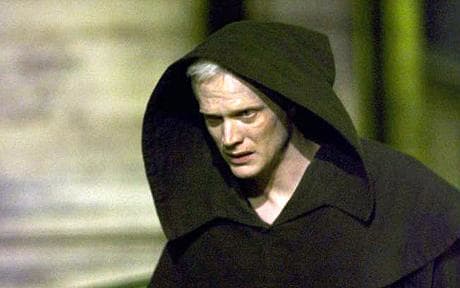


Yesterday on Facebook I read a post by a Christian who prays Trump will be President For Life – because he’s going after LGBTQ people, the mortal enemies of Jesus – and his coming Kingdom. White Christian Women – want the world to end, so Jesus will come back! Does he hate Transgender – and love Billionaires, who get to look in our Treasury and copy our Social Security numbers? If a billionaire Transvestite was doing what Musk is doing, we would got to bed with shrieking – and wake up to shrieking. Thank God Musk is on their side, because he’s on Trump’s side. Elon has God’s Permission to dismantle the Federal Government. The sooner the better. Will Barron take his Dad’s place, when he dies, and Musk will be his Major Domo – IN CHARGE?
John Presco
Jones said the 2024 election once again shows the close allegiance between white Christians and the Republican Party and the divided nature of religion in America. Most faith categories in America — Jews, Muslims, Black Protestants, nonreligious Americans and, until 2024, Hispanic Catholics — have supported the Democratic Party. White Christians, on the other hand, remained tied to Republicans.
A majordomo (US: /ˌmeɪdʒərˈdoʊmoʊ/) is a person who speaks, makes arrangements, or takes charge for another. Typically, this is the highest (major) person of a household (domūs or domicile) staff, a head servant who acts on behalf of the owner of a large or significant residence.
A majordomo may also, more informally, be someone who oversees the day-to-day responsibilities of a business enterprise.[1] Historically, many institutions and governments – monasteries, cathedrals, and cities – as well as noble and royal houses, also had the post of majordomo, who usually was in charge of finances.
White Christians made Donald Trump president — again
White Christians remain an influential force in American culture and politics. Their support, and the support of Hispanic Christians, helped Donald Trump regain the White House.
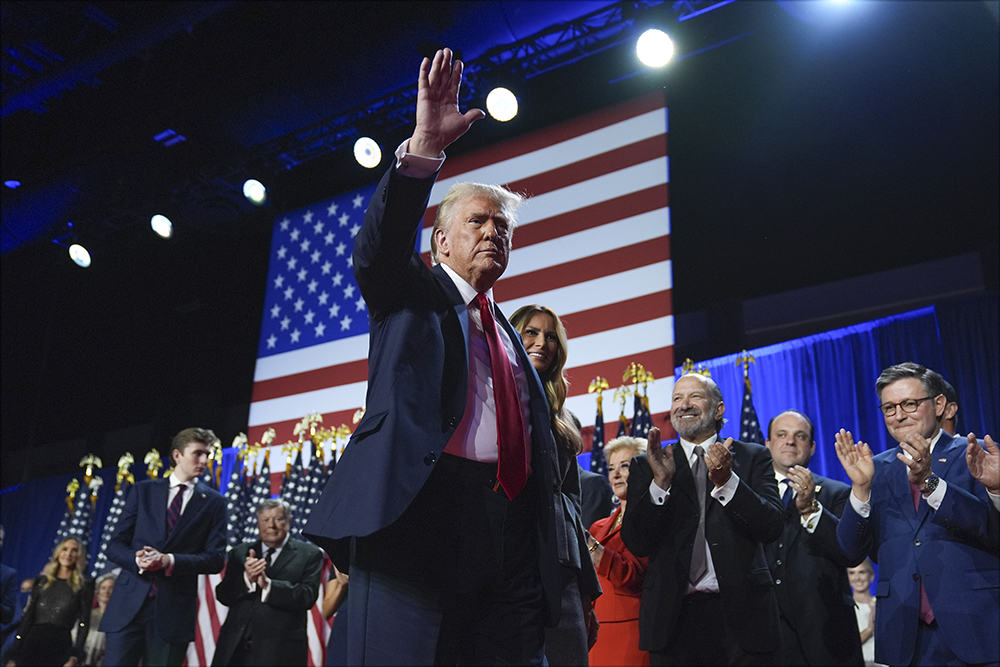
Republican presidential nominee former President Donald Trump waves as he walks with former first lady Melania Trump at an election night watch party at the Palm Beach Convention Center Nov. 6, 2024, in West Palm Beach, Fla. (AP/Evan Vucci)
Bob Smietana
Religion News Service
Join the Conversation
Send your thoughts to Letters to the Editor. Learn more
November 7, 2024
Share on FacebookShare on TwitterEmail to a friendPrint
While the United States has become more religiously diverse in recent decades, white Christians remain the largest religious segment of the country, making up about 42% of the population, according to data from the Public Religion Research Institute. And for Donald Trump, their support has once again proved key to his victory.
Exit poll data from CNN and other news outlets reported that 72% of white Protestants and 61% of white Catholics said they voted for Trump. Among white voters, 81% of those identified as born-again or evangelical supported Trump, up from 76% in 2020 and similar to the 80% of support Trump received in 2016.
Ryan Burge, associate professor of political science at Eastern Illinois University, said that kind of support is hard to overcome, especially in the Rust Belt swing states that helped seal Trump’s victory.
“It’s hard to overcome the white God gap in a place like Pennsylvania, or Michigan and Wisconsin,” he said.
But Trump also won the Christian vote overall: 58% of all Catholics voted for him and 63% of Protestants, according to the early exit polls. If the early exit poll numbers hold steady, that will prove to be a jump in Catholic support for Trump compared with 2020, when 50% of Catholics voted for him.
Some of that may have to do with an increase in Trump support among Hispanic voters. Almost two-thirds of Hispanic Protestant (64%) and just over half of Hispanic Catholic voters (53%) also supported Trump, according to initial CNN exit polls. In the 2020 election, only about a third of Hispanic Catholics voted for Trump.
Jews (78%), other non-Christians (59%) and those with no religious affiliation (71%) supported Kamala Harris, according to the CNN exit poll.
Robert Jones, PRRI’s president, said more data is needed to understand the Hispanic vote in the 2024 election. But he wonders whether economics played a major role in Hispanic support for Trump, more than religion.
“They don’t feel like their situation has improved over the past four years,” he said.
Jones said Trump was able to send two distinct messages during the campaign — one about being tough on immigration and crime, which appealed to white Christians, and the other about the economy, which appealed to Hispanic Christians.
Burge suspects Hispanic Catholics and Protestants are more conservative on social issues, such as abortion and LGBTQ rights, which may also have played a role in the election.
He wonders if the Harris campaign’s support for abortion rights, in particular, may have backfired with Hispanic Christians.
“That’s a hard message for a moderate Hispanic voter,” he said, adding that while voters in a number of states supported abortion rights, that did not carry over to overall support for Harris. Burge also wonders if inflation and other issues about the economy swung the elections. While Trump is known for causing controversy online, Burge said, many voters are paying more attention to day-to-day concerns.
“All they are thinking is, gas is expensive, bread is expensive, milk is expensive,” he said. “Let’s try something else. That’s the story.”
Advertisement
Both white and Hispanic Christians may also be worried about the changing nature of America and the decline of religion’s power in the culture. While few Americans want the nation to have an official Christian religion, many do see Christianity as important or feel a nostalgia for God and country patriotism, rather than a culture where secular values dominate.
And the swing states that decided the election, such as Wisconsin, are places where white Christians — especially white mainline Protestants and white Catholics who supported Trump — are found in large numbers.
Samuel Perry, a University of Oklahoma sociologist who studies Christian nationalism and other religious trends, wonders if the growth of nondenominational and Pentecostal churches in the United States may have played a role in the 2024 races.
Those churches are often multiethnic, he said, but not because white Christians are joining predominantly Black or Hispanic Christians. Instead, he said, Christians of color are joining majority-white churches that often lean Republican. That can affect their voting patterns, he said.
“Their allegiance is not to their ethnic group, who tend to vote Democrat,” he said. “It’s going to be more of a multiethnic conservative, white-dominated Christianity that unequivocally votes Republican.”
Jones said the 2024 election once again shows the close allegiance between white Christians and the Republican Party and the divided nature of religion in America. Most faith categories in America — Jews, Muslims, Black Protestants, nonreligious Americans and, until 2024, Hispanic Catholics — have supported the Democratic Party. White Christians, on the other hand, remained tied to Republicans.
“They have not moved a centimeter,” said Jones. “And they get out and vote.”
This story appears in the Election 2024 feature series. View the full series.
In the event that The King cannot undertake his official duties as Sovereign on a temporary basis due to illness or absence abroad, two or more Counsellors of State are appointed by Letters Patent to act in His Majesty’s place.
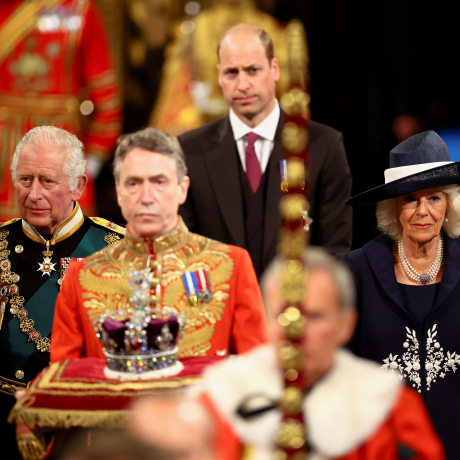
By law, Counsellors of State include the Sovereign’s spouse and the next four people in the line of succession who are over the age of 21. In 2022, the Regency Acts 1937 – 1953 were amended to enable The Princess Royal and The Duke of Edinburgh (then The Earl of Wessex) to serve as Counsellors of State.
Counsellors of State are authorised to carry out most of the official duties of the Sovereign, for example, attending Privy Council meetings, signing routine documents and receiving the credentials of new ambassadors to the United Kingdom. However, there are a number of core constitutional functions that may not be delegated:
- Commonwealth matters
- The dissolving of Parliament, except on His Majesty’s express instruction
- The creation of peers
- Appointing a Prime Minister
History of Counsellors of State
The position of Counsellor of State was provided for in 1937 under the terms of the Regency Act. Prior to 1937, Regency Acts were drafted and passed only in necessity. As such, there had been nine separate Regency Acts to cover various eventualities since 1728. Shortly after George VI came to the throne in 1936, a new Regency Act was passed which provided a rule for all future reigns. It was at this time that the new office of Counsellor of State was created to cover short term absences where a regency would be unnecessary.
Current Counsellors of State
The current Counsellors of State are The Queen, The Prince of Wales, The Princess Royal, The Duke of Edinburgh, The Duke of Sussex, The Duke of York and Princess Beatrice. In practice, only working Members of the Royal Family are called upon to act as Counsellors of State.
 Rosamond Press
Leave a comment