
John Presco reading from The History of the Wilson Family
Harvard University has laid off the staff of its Harvard Slavery Remembrance Program, the unit of its $100 million Harvard & the Legacy of Slavery initiative tasked with identifying the direct descendants of those enslaved by Harvard affiliates.
“Wilson was said to have written a ballad about the event, which was sung by young men around Boston.[61]“
JOHN WILSON, Jr., was born in Windsor, Essex, England, in September 1621. He came with his father to New England in 1630. He graduated from Harvard College in 1642, was ordained and settled in Dorcester, Norfolk, MA, where he was a colleague of Rev. Richard Mather.
Harvard’s first commencement was a solemn affair. There were nine graduates in the class of 1642: Benjamin Woodbridge, George Downing, John Bulkeley, William Hubbard, Samuel Bellingham, John Wilson, Henry Saltonstall, Tobias Barnard, and Nathaniel Brewster.


For years I asked my friends who graduated from Harvard, to help me with my writing. Mark Gall was the head of the Department of Education at the University of Oregon, and Edwin Corbin was a major drop-out of society who built a homestead in Yahachts where he raised three sons. When I admonished Ed for not keeping a detailed log of his Wooded Adventure and submit it to the Archives of Harvard, he knew he missed his calling. Mt. Gall missed his calling by refusing to be my mentor. I run the largest blog in the world named after my grandfather, a self-published author who found Gem Publishing. When I informed my two friends it appears I am a descendant of John Wilson, whose son was the first graduate of Harvard, they distanced themselves from me. They saw me as a INTRUDER trying to sneak in the back door. In their Crimson Eyes, I was a high school drop-out that was great at EA Sports. We played a lot of Tuber Woods Golf. I took care of Ed after he had a stroke, along with taking care of Virginia Hambley. When Jon Gall became gravely ill, I took his to his doctor apartments in my 1977 Toyota Carola I named The Mustard Mobile! Throw in Ed’s Beer Run, and taking four people to the free dinner in Eugene, my breaks and shocks – were shot! Oh, and I was on the bus with Ken Kesey!
Someone can make the case I was The Harvard Slave Boy, who was banished from their midst for my uppity ways. As fate would have it, I AM UP TO BAT with the bases loaded. Thanks to the shake up at Harvard – my genealogical now – WEARS A CROWN! My ninth grandfather, John Wilson, is the alleged co-founder of Harvard, but this allegation is – VANISHING! Why? Well, for one thing he helped hang three Quaker – one of them a woman who was spared, only to be hung a year later. John wrote a ballad about this hanging that was sung by young men in Boston. Mary Dyer has given birth to a monster, that was the subject of the song? I have posted on Wilson inspiring our Constitution is regards to Freedom of Religion and the Right to bare Arms. When did women get the right to vote? When did the first black man cast a vote in the United States? Did, Rev. John Wilson Jr. want to distant himself from…….the song? Did Junior read his father’s poem honoring their kin Joseph Brisco? Was this poem one of the first to be penned in the New World? Why hasn’t Harvard done what I have done – in my FIRST POST on these matters?
Let us do Júnior first. He was born at Windsor Castle. His mother was reluctant to come to America. Who was she close with at the Royal Resident? She was a British Subject in America. Is she related to any of The First Citizens of the United States of America? Consider President Trump’s messing with Citisnedhip Rights – and pasroding Insureectioniist who claim they are on the side of of Jesus. They now have a diploma from Jesus and our Presidient – to damn well what they please, How many read the Bible or went to College?
The Eighth Wonder of the World is why no one has given me a penny in funding. A hundred million dollars was spent on Harvard Slavery Remembrance Program, How much money has Harvard spent on all its programs since it was founded – and they know mi thing about their Founders? Something went wrong. Ed and Mark – hated my genealogical study! Ed is dead,
John Presco
President: Royal Rosamond Press
A federal judge temporarily blocked President Donald Trump’s executive order ending the constitutional guarantee of birthright citizenship for babies born in the United States whose parents are not citizens or lawful permanent residents. U.S. District Judge John C. Coughenour ruled Thursday, Jan. 23, calling the executive order “blatantly unconstitutional.”
On 27 October 1659 three Quakers—Marmaduke Stevenson, William Robinson and Mary Dyer—were led to the Boston gallows from the prison where they had been recently held for their Quaker evangelism, against which Massachusetts had enacted very strict laws. Wilson, now nearly 70, as pastor of the Boston church was on hand as the supervising minister. As the two Quaker men first approached the gallows, wearing hats, Wilson said to Robinson, “Shall such jacks as you come in before authority with your hats on?”[58] Ignoring the barb, Robinson then let forth a barrage of words, to which Wilson angrily responded, “Hold thy tongue, be silent; thou art going to die with a lie in your mouth.”[59] The two Quaker men were then hanged, after which it was Dyer’s turn to ascend the ladder. As the noose was fastened about her neck, and her face covered, a young man came running and shouting, wielding a document which he waved before the authorities. Governor Endecott had stayed her execution.[60] After the two executions had taken place, Wilson was said to have written a ballad about the event, which was sung by young men around Boston.[61]
Before leaving Boston, Mary had given birth to a severely deformed infant that was stillborn. Because of the religious superstitions of the time regarding such a birth, the baby was buried secretly. When the Massachusetts authorities learned of this birth, the ordeal became public, and in the minds of the colony’s ministers and magistrates, the monstrous birth was clearly a result of Mary’s “monstrous” religious opinions. More than a decade later, in late 1651, Mary Dyer boarded a ship for England, and stayed there for over five years, during which time she converted to Quakerism. Because Quakers were considered among the most dangerous of heretics by the Puritans, Massachusetts enacted several laws against them. When Dyer returned to Boston from England, she was immediately imprisoned and then banished. Defying her order of banishment, she was again banished, this time upon pain of death. Deciding that she would die as a martyr if the anti-Quaker laws were not repealed, Dyer once again returned to Boston and was sent to the gallows in 1659, having the rope around her neck when a reprieve was announced. She returned once more to Boston the following year and was then hanged—the third of four Quaker martyrs.

Harvard Outsources Program to Identify Descendants of Those Enslaved by University Affiliates, Lays Off Internal Staff

Harvard University laid off the staff of its Harvard Slavery Remembrance Program, the unit of its $100 million Harvard & the Legacy of Slavery initiative tasked with identifying the direct descendants of those enslaved by Harvard affiliates. By Barbara A. Sheehan
By Neil H. Shah, Crimson Staff Writer
3 days ago
Updated January 23, 2025, at 9:29 p.m.
Harvard University has laid off the staff of its Harvard Slavery Remembrance Program, the unit of its $100 million Harvard & the Legacy of Slavery initiative tasked with identifying the direct descendants of those enslaved by Harvard affiliates.
Instead, the work will be continued by American Ancestors, a New England-based genealogical nonprofit. American Ancestors is currently one of HSRP’s external research partners, and they will now be leading the project in full.
Employees were notified Thursday shortly after 11 a.m. that they had been terminated, effective that day, according to HSRP Director Richard J. Cellini and research fellow Wayne W. Tucker. They were not given any advance notice of the decision or informed that the layoffs were being considered, Cellini and Tucker added. Cellini was notified of his termination less than one hour before the remainder of the team.
The sudden move came just one week after HSRP researchers met with the prime minister and governor general of Antigua and Barbuda to discuss a potential ground research presence in the country. Cellini and his team visited the island nation after HSRP discovered “several hundred people” enslaved by Harvard affiliates in the region between 1660 and 1815.
That number added to the more than 300 individuals enslaved by Harvard affiliates that HSRP had already identified. As of September, the team had also identified more than 100 living descendants.
Staff members were not given a reason for the team’s disbanding, according to three people who were laid off Thursday. HSRP has been front and center amid controversy at the Legacy of Slavery initiative over the last few months. In September, a Crimson investigation reported that Cellini, the director, had accused Vice Provost for Special Projects Sara N. Bleich, who oversees the Legacy of Slavery initiative, of instructing HSRP “not to find too many descendants.”
“I have told officials at the highest level of the University that they only have two options: fire me, or let the HSRP do this work properly,” Cellini wrote in a September statement to The Crimson.
On Thursday, Cellini wrote in a text message: “Today Harvard fired me. So now we know.”
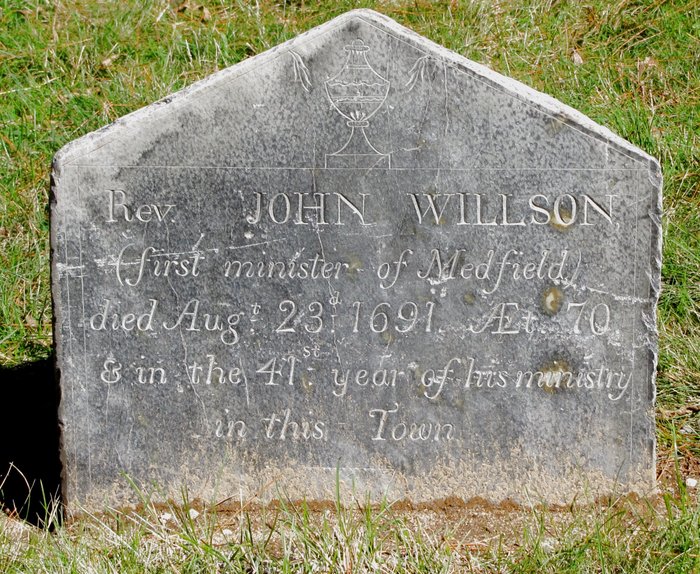
Site of the Homestead of Rev. John Wilson,
First Minister of Medfield.
—1651-1691—
Photographed by Cosmos Mariner, July 7, 2019
1. Site of the Homestead of Rev. John Wilson MarkerInscription.

Graduate of the first class
in Harvard College.
Topics. This historical marker is listed in these topic lists: Churches & Religion • Colonial Era • Education • Settlements & Settlers. A significant historical year for this entry is 1651.
Location. 42° 11.225′ N, 71° 18.304′ W. Marker is in Medfield, Massachusetts, in Norfolk County. It is on Main Street (Massachusetts Route 109) just west of Janes Avenue, on the right when traveling west. Marker is mounted at ground-level on the front facade of the Medfield Town Hall, near the southwest corner of the building. Touch for map. Marker is at or near this postal address: 459 Main Street, Medfield MA 02052, United States of America. Touch for directions.
Other nearby markers. At least 8 other markers are within 4 miles of this marker, measured as the crow flies: Medfield Town Hall (a few steps from this marker); Clarence Meredith Cutler (within shouting distance of this marker); Straw Hat Factory (about 300 feet away, measured in a direct line); John Parcell Ross Jr. (about 300 feet away); First Baptist Church (about 400 feet away); Peak House (approx. half a mile Paid Advertisement
Click on the ad for more information.
Please report objectionable advertising to the Editor.away); Future Performing Arts Center (approx. 2.2 miles away); Old Meeting House Common (approx. 3.9 miles away). Touch for a list and map of all markers in Medfield.
Also see . . .
1. Harvard 1642: America’s First Commencement.
The first university commencement in English America took place in 1642 in Cambridge, Massachusetts, at Harvard College. More than a celebration of hard-working students, Harvard’s first commencement was designed to send a clear message to England that its American colonies were a going concern. Harvard’s first commencement was a solemn affair. There were nine graduates in the class of 1642: Benjamin Woodbridge, George Downing, John Bulkeley, William Hubbard, Samuel Bellingham, John Wilson, Henry Saltonstall, Tobias Barnard, and Nathaniel Brewster.
(Submitted on March 29, 2023, by Cosmos Mariner of Cape Canaveral, Florida.)
2. Reverend John Wilson (Find A Grave).
(Vine Lake Cemetery, Medfield, Norfolk County, Massachusetts)
Rev John Wilson, Jr. was born on 1 September 1621, in London, England. He came with his father to New England in 1630. He graduated from Harvard College in 1642 and was ordained and settled at Dorchester. In 1651 he removed to Medfield, Mass., where he became a famous preacher, andPhotographed by Cosmos Mariner, July 7, 2019
2. Medfield Town Hall (southwest/front elevation)(marker is at ground-level on the front facade, between window bays on the left/west side)
remained there until his death in 1691.
(Submitted on March 29, 2023, by Cosmos Mariner of Cape Canaveral, Florida.)
He married Sarah Hooker in 1647, in Medfield, Suffolk, Massachusetts Bay Colony, British Colonial America. They were the parents of at least 4 sons and 4 daughters. In 1652, at the age of 31, his occupation is listed as ordained pastor and continued for forty years. He died on 23 August 1691, in Medfield, Suffolk, Massachusetts Bay Colony, British Colonial America, at the age of 69.
First minister of Medfield.
The Belcher Families, Vol. 60, Family History Library, The Belcher Families in New England by Joseph Gardner Bartlett, Esq., page 134: First pastor of the First Church in Boston.
A daughter of Rev. Thomas and Susannah Hooker of Hartford, Colony of Conn., born at Little Baddow (a suburb of Chelmsford, Essex, England), 1629 (or 1630); m. Rev. John Wilson, Jr., of Dorchester, Mass., son of Rev. John Wilson of the First Church of Boston, and Elizabeth (Mansfield) Wilson, his wife. They were not married when Rev. Thomas Hooker died in 1647, but preparations were then being made for it, and they were married soon afterward and settled in Dorchester, Mass., where Mr. Wilson was a colleague of Rev. Richard Mather.
Rev. John Wilson was born in London, England, Sept. 1621, and came with his father to New England in 1630. He from Harvard College in 1642, and was ordained and settled with Mr. Mather at Dorchester. In 1651 he removed to Medfield, Mass., where he became a famous preacher, and remained there until his death in 1691. He died at Medfield, Mass., Aug. 23, 1691. She died at Braintree, Mass., Aug. 20,1725.
Source: The Great Migration Begins: Immigrants to New England, 1620-1633
Birth
Dec 1588
Windsor, Windsor and Maidenhead Royal Borough, Berkshire, England
Death
7 Aug 1667 (aged 78)
Boston, Suffolk County, Massachusetts, USA
Burial
Boston, Suffolk County, Massachusetts, USAAdd to Map
Memorial ID
7140837 · View Source
~ Reverend John Wilson ~
Birth: December 1588
Birthplace: Windsor, Berkshire, England
Death: 7 August 1667
Buria: King’s Chapel, Boston, Suffolk, Massachusetts
Occupation: Canon of Windsor, Clergyman, Merchant Tailor, English Puritan Reverend.
Memo:
Note previous carving, some of which is still visible: “…THE BODY OF MR JOHN WIL___/ ___OD HERE TO FORE RECTOR OF ___________/ HERE LIETH BURIED ELIZABETH WILSON/THE WIFE LATELY FOR 45 YEARS TOGETHER/ JOHN WILSON IN THE SAME PLAT OR ___/HEARE TO THE BODY OF ISAAC JOHNSON _____/____SH OF BLESSED MEMORIE WAITING ___/____SSED APPEARANCE OF OUR LORD____/ ______OF 3______.” John Wilson was one of the earliest settlers in Boston, minister of the First Congregational Church. He died in 1667. Issac Johnson was one of the Puritan leaders. He died in Boston in the fall of 1630 and was buried in his garden plot, the first burial in what went on to become King’s Chapel Burying Ground.
You can go to website to view memorial marker:
http://farber.davidrumsey.com/luna/servlet/detail/FBC~100~1~1363~211434:Newbery,-Walter?sort=Name%2CDates&qvq=q:wilson;sort:Name%2CDates;lc:FBC~100~1&mi=0&trs=18
This slate stone may have been rejected by the carver, William Mumford, and reused for Walter Newbery in Newport. It is the only stone that I know of that references Rev. John Wilson, his wife Elizabeth, and Isaac Johnson.
~~~~~~~~~~~~~~*
Parents:
Father
Reverend William Wilson, D.D.
Birth: 1542
Birthplace: Wellsbourne, Lincolnshire, England
Death: 15 May 1615
Windsor, Berkshire, England
Place of Burial: Windsor, Berkshire, England
Mother
Isabel Alice (Woodhall) Wilson
Birth: 1546
Birthplace: Waldon, Devon, England
Death: 1615
Rochester, Medway, England, United Kingdom
…Daughter of John Woodhall, of Walden and Elizabeth Grindall, who was the sister of Edmund Grindal, Archbishop of Canterbury under Elizabeth I.
~~~~~~~~~~~~~~~*
Spouse:
Biography for spouse: Elizabeth ( Mansfield) Wilson
Birth: 3 December 1592 Henley-on-Thames Oxfordshire, England
Death: 1658 Boston Suffolk County, Massachusetts, USA.
~~~~~~~~~~~~~*
Elizabeth (Mansfield) Wilson was the daughter of John (1553 – 1601) and Elizabeth Isabel (Leigh) Mansfield,(1570 – 1634) she was baptized 3 December 1592 at Henley-on-Thames, Oxford. She married the Rev. John Wilson about 1617, She died about 1658. She did not accompany her husband to Massachusetts Bay in 1630, and her unwillingness to come to New England was the subject of several letters from Margaret Winthrop to her son John in May 1631; she first reported that “Mr. Wilson is now in London and promised me to come and see you. He cannot yet persuade his wife to go, for all he hath taken this pains to come and fetch her. I marvel what mettle she is made on. Sure she will yield at last, or else we shall want him exceedingly in New England.” In her second letter she noted that WILLIAM CODDINGTON “is gone to Sudbury to Mr. Wilson,” and in her third letter that “if he go it must be without his wife’s consent, for she is more averse than ever she was.” John Wilson’s wife did return with him in 1632, however, for they had a child born and baptized in Boston in 1633. When John Wilson made a second trip to England in 1634, she was “at first very much affected with her husband’s departure, but she is now well pacified” They had four children: Edmund, John, Elizabeth Rogers, and Mary (Wilson) Danforth Rock. Elizabeth Wilson was sister of JOHN MANSFIELD {1635, Boston} & of Anne (Mansfield) Keayne, wife of ROBERT KEAYNE {1635, Boston}. Her husband was uncle of EDWARD RAWSON {1637, Newbury} & of Dorothy (Sheafe) Whitfield, wife of Henry WHITFIELD (1639, Guilford), and related in some way to Simon BIRD (1635, Boston). Source: Anderson’s Winthrop Fleet.
Biography by direct descendant Ro§e❈
~~~~~~~~~~~~~~~*
Biography for Rev. John Wilson:
WILSON, John, clergyman, born in Windsor, England, in 1588; died in Boston, Massachusetts, 7 August 1667. Young Wilson was educated at Eton and at Cambridge, where he was graduated about 1606. He studied law for three years at one of the inns of court, and took orders in the Church of England, but soon became conspicuous for his Puritanical leanings, he preached at Mortlake, Henley, Bumstead, Stoke, Clare, and Candish, and for several years was minister of Sudbury, Essex, where he was repeatedly suspended or silenced by the bishop’s court for his opinions, but was befriended by Robert Rich, Earl of Warwick. Becoming interested in the colonization of Massachusetts, he and many of his neighbors embarked on 8 April 1630, in the great fleet with John Winthrop and his associates of the Massachusetts company. He landed at Salem on 12 June, and soon afterward removed to Charlestown, where he preached under a tree, and on 30 July organized what was subsequently the 1st church in Boston, to which place the majority of the members soon removed. He was ordained teacher of the church on 27 August by the imposition of hands by the several communicants. In 1631 he sailed for England, where he remained until May 1632 and was ordained pastor in November of the latter year. He again visited England in the autumn of 1634 and remained absent a year. Soon after his return, the Antinomian controversy arose in his congregation, and Governor Winthrop and Wilson fought stoutly against the faction that was led by Anne Hutchinson. While this discussion was pending, an expedition was sent against the Pequots, and Mr. Wilson was selected by lot as its chaplain. He outlived two colleagues in the ministry, John Cotton and John Norton, and was left at the age of seventy-six with the entire charge of his congregation on his hands. He continued in the active discharge of his duties until finally disabled by a fatal disease.
~~~~~~~~~~~~~~~~~~~~~~~~*
There is a stone that is attributed to carver William Mumford that has carving for Rev. John Wilson on it however the stone is for Walter Newbery (1647-1697 Memorial #31866577). 90 degrees to the carving for Walter Newbery is the other carving. “…THE BODY OF MR JOHN WIL___/ ___OD HERE TO FORE RECTOR OF ___________/ HERE LIETH BURIED ELIZABETH WILSON/THE WIFE LATELY FOR 45 YEARS TOGETHER/ JOHN WILSON IN THE SAME PLAT OR ___/HEARE TO THE BODY OF ISAAC JOHNSON _____/____SH OF BLESSED MEMORIE WAITING ___/____SSED APPEARANCE OF OUR LORD____/ ______OF 3______.” Perhaps Mumford was carving Wilson’s stone and for some unknown reason, he decided to scrap that, rotate the stone, and use it for someone else.
Added by: Contributor: Sarah D. ( 48106166 )
Put simply, Step 5 is the point in the process in which one will speak openly and honestly about their struggles with addiction, with focus on how they harmed themselves and others through their actions and behaviors. This confession should be honest, and can begin in a written form and evolve into conversations.
Upon his second return to the Massachusetts Bay Colony in 1635, Anne Hutchinson was first exposed to his preaching, and found an unhappy difference between his theology and that of her mentor, John Cotton, who was the other Boston minister. The theologically astute, sharp-minded, and outspoken Hutchinson, who had been hosting large groups of followers in her home, began to criticize Wilson, and the divide erupted into the Antinomian Controversy. Hutchinson was eventually tried and banished from the colony, as was her brother-in-law, Reverend John Wheelwright.
Following the controversy, Wilson and Cotton were able to work together to heal the divisions within the Boston church, but after Cotton’s death, more controversy befell Boston as the Quakers began to infiltrate the orthodox colony with their evangelists. Greatly opposed to their theology, Wilson supported the actions taken against them, and supervised the execution of his former parishioner, Mary Dyer in 1660. He died in 1667, the longest-lived of the early ministers in the Boston area, and his passing was lamented by those who knew him and worked with him, but he is also remembered for the roles he played in the persecution of those who did not embrace the Puritan orthodoxy.
About Rev. John Wilson
John “had the benefit of joining the church of his father 3 Mar. 1644, but was not freeman until 1647, ordained as colleague with Rev. Richard Mather at Dorchester in 1649, but contined only two years and was then setted at Medfield.”12
ca 1647 John married Sarah Hooker, daughter of Rev. Thomas Hooker (ca 1586-7 Jul 1647) & Susanna Garbrand (1593-17 May 1676). Born ca 1630 in Essex, England.19 Sarah died on 20 Aug 1725 in Braintree, MA.49
JOHN WILSON, Jr., was born in Windsor, Essex, England, in September 1621. He came with his father to New England in 1630. He graduated from Harvard College in 1642, was ordained and settled in Dorcester, Norfolk, MA, where he was a colleague of Rev. Richard Mather.
SARAH HOOKER was born in the Little Baddow section of Chelmsford, Essex, England, in 1629. She came to America with her father. She was planning her wedding when her father, the Rev. THOMAS HOOKER, died suddenly. She and JOHN married shortly thereafter.
In 1651, they removed to Medfield, Norfolk, MA, where Rev. JOHN WILSON, Jr., was the first minister of that town, and he remained there until his death, Aug. 23, 1691.
SARAH moved to Braintree, Middlesex, MA, and died there, Aug. 8, 1725
Rev John Wilson’s burial: Vine Lake Cemetery, Medfield, Norfolk County, Massachusetts
——————————————–
Sources:
The New England Historical and Genealogical Register, Vol. LXI, 1907, p. 128.
Rev John Wilson memorial – https://www.findagrave.com/memorial/17210616/john-wilson
William was the son of The Rev. Guy and Mary (Wilson) Briscowe. William Bristow was the son of the rector, “Guy Bristow,” M.A., who entered his rectorship offically on 16 April 1583. He was previously the rector of High Halstow, beginning on 19 April 1677 and concluding on 21 July 1583, an overlap with his Sundridge duties. He died 2 April 1795.[1] William was named in his father’s will, probated March 1594. [2]
WILLIAM BRISCOE / BRISTOW was baptised at St. Mary’s Church in Sundridge, co. Kent on 29 June 1591.[3]
In 1633, William was named as a beneficiary in the last will and testament of his cousin, Edmund Wilson, M.D.[4]
It is likely that after the death of his father, William settled in Watford, Hertfordshire, the home of one of his father’s cousins. Austin W. Spencer has published a fascinating article about the family that provides evidence relating to William, his wife, children, and his subsequent move to the Colonies. [5]
William married Jane (maiden name unknown), probably by 1617, when Thomas the son of Wm Brisco was baptised at St. Mary in Watford. William’s first wife, Jane, was buried at St. Mary in Watford on 03 May 1637.
The article includes the parish records for Watford show the following children born to William Briscowe:
Baptisms:
“1619 October, Daniel son of wm Brisco and Jane his wife 20th day.
1621 Aprill, Nathaniel, sonn of wm Briscoe and Jane his wife, 8.
1623 October, John, Son of Williã Brischoe & Jane his wife—27.
1624 October, William, sonne of W.m & Jane Briscoe—24.
1625/6 March, Elizabeth, daughter of Wm [interlined: &.] Jane Briscoe— 5.
1627 August, Joseph, Sonne of William and Jane Briscoe—19
1629 Aprill, Beniamin, sonne of William and Jane Briscoe—19
1631/2 February, Lidia daughter of William and Jane Brisco—26
1639 Aprill, Ezekiell sonne of Willyam & Sislee Bisco[8]—i6″
According to the book The Ancestry and Descendants of Rev. John Wilson, William, born 1590, “emigrated to New England in 1639, and settled in Boston, leaving, with other issue, a son Benjamin.”[6]
“William Briscoe, taylor, is Allowed to be an Inhabitant, and to have a great Lott, for eight heads, at the mount.” This marks the first appearance of William Briscoe in the records of New England, at Boston, 24 February 1639.[7]
William likely died before 1677, as William is not mentioned in the will of his cousin, Rev. John Wilson, though his son, Benjamin, is mentioned. In 1677, the Rev. John Wilson of Boston named his cousin, Benjamin Briscowe, as a beneficiary of his last will and testament.[8]
Note, in Colonial records, the last name is spelled “Briscoe.”
A copy of verses made by that reverend man of God Mr. John Wilson, pastor to the first church in Boston on the sudden death of Mr. Joseph Brisco, who was translated from earth to heaven Jan. 1, 1657
Joseph Brisco/Briscoe
Joseph was born in Boston in August 1658. He was the son of Joseph Briscoe and Abigail Compton. His father died by drowning several months before Joseph (Jr) was born. His mother remarried, to Abraham Busby in September, 1659.[1]
Joseph inherited a few things from his maternal grandmother, Susannah Compton, who left a will (proved 12 November 1664) in which she left everything to “my little grandchild Joseph Brisco.”[1].
Origin
Joseph was born in Boston in August 1658. He was the son of Joseph Briscoe and Abigail Compton. His father died by drowning several months before Joseph (Jr) was born. His mother remarried, to Abraham Busby in September, 1659.[1]
Joseph inherited a few things from his maternal grandmother, Susannah Compton, who left a will (proved 12 November 1664) in which she left everything to “my little grandchild Joseph Brisco.”[1].
https://www.thegospelcoalition.org/themelios/article/why-we-need-the-puritans/ Now it is here, on the pastoral front, that today’s evangelical Christians most need help. Our numbers, it seems, have increased in recent years, and a new interest in the old paths of evangelical theology has grown. For this we should thank God. But not all evangelical zeal is according to knowledge, nor do the virtues and values of the biblical Christian life always come together as they should, and three groups in particular in today’s evangelical world seem very obviously to need help of a kind that the Puritans, as we meet them in their writings, are uniquely qualified to give. These I call restless experientialists, entrenched intellectualists, and disaffected deviationists. They are not, of course, organized bodies of opinion, but individual persons with characteristic mentalities that one meets over and over again. Take them, now
Harvard University Expands Partnership with American Ancestors in Support of Slavery Remembrance Program
Harvard University has expanded its existing partnership with American Ancestors, a national center for family history, heritage, and culture, and the oldest genealogical nonprofit in America. As part of the next phase of the Harvard & the Legacy of Slavery Initiative, American Ancestors – which has been conducting the genealogical research on behalf of the University to identify those who were enslaved by Harvard leadership, faculty, or staff, and those who are their direct descendants – will now take the lead role in advancing the work of the initiative’s Harvard Slavery Remembrance Program.
American Ancestors’ partnership on the Remembrance Program research was established in 2022 following the release of the report and recommendations of the Presidential Committee on Harvard & the Legacy of Slavery. The University accepted the recommendations and began the work to “identify the direct descendants of enslaved individuals who labored on Harvard’s campus and of those who were enslaved by Harvard leadership, faculty, or staff.”
“American Ancestors is recognized globally for the thoughtfulness and rigor of its research efforts, and we are excited to expand what has been a strong collaboration in support of our goals,” Harvard University President Alan M. Garber said. “Over the last two and a half years, we have made important progress toward fulfilling the recommendations of the Presidential Committee, and we look forward to the expertise and skill with which American Ancestors will continue to build on the foundation we laid in 2022.”
Building on the important groundwork laid by the Harvard Slavery Remembrance Program, American Ancestors will continue the program’s work of identifying Harvard leaders, faculty, or staff who enslaved others and will significantly expand its own ongoing work of identifying the individuals who were enslaved and perform genealogical research to locate their living direct descendants. As this research moves forward, the University is positioning itself to be able to engage with direct descendants identified through these efforts.
Records of family lineage created from this work will also be used to engage with descendant communities and will help inform other aspects of the Initiative’s ongoing work. The University will also donate these records to the 10 Million Names project, a collaborative initiative led by American Ancestors that is dedicated to recovering the names of the estimated 10 million men, women, and children of African descent who were enslaved in pre- and post-colonial America.
“In this expanded role, American Ancestors is dedicated to upholding the highest standards of professional genealogical research to uncover the identities of individuals enslaved by Harvard leadership, faculty, or staff, and to document their descendants,” said Ryan J. Woods, President and CEO of American Ancestors. “We understand from our extensive experience that tracing families descended from enslaved individuals is a complex, time-intensive process filled with significant challenges. We are committed to advancing this critical research to help Harvard establish meaningful connections and engagement with living descendants.”
“Thanks to the extensive work they have already done on the genealogies of enslaved people, American Ancestors brings an exceptional ability to scale the enormous effort the university has ahead of it,” said Henry Louis Gates, Jr., Harvard & the Legacy of Slavery Advisory Council member, director of the Hutchins Center for African and African American Studies, and the Alphonse Fletcher University Professor at Harvard University, who also serves as an Honorary Trustee of American Ancestors and a member of the Advisory Board for 10 Million Names. “The University takes seriously the thoughtfulness and care that will go into engaging with living direct descendants, and that engagement will be based around rigorous and thorough research this partnership will advance in literally rebuilding family histories.”
The expansion of the partnership with American Ancestors coincides with other steps Harvard has taken as it looks to the next phase of the overall work of the Harvard & the Legacy of Slavery Initiative. Over the last two years, the Initiative has established partnerships and programs driven by the recommendations outlined in the report. In September, the Initiative announced the appointment of a new Advisory Council, made up of faculty, including eminent historians, from across the University and local leaders that are helping guide the next phase of implementation.
“In just over two years, we have taken significant steps to advance the mission of the Harvard & the Legacy of Slavery Initiative,” said Sara Bleich, vice provost for special projects and the leader of the Harvard & the Legacy of Slavery Initiative. “Our partnership with American Ancestors has been and will continue to be absolutely critical to this progress, and we are thrilled that they are taking on this expanded role to advance the research.”
Since establishing the Remembrance Program under the leadership of Richard Cellini, an attorney and researcher, the University has been able to lay a foundation and build the initial infrastructure to make important progress on the research and work. With this expanded partnership, American Ancestors will now build on this foundation as work moves forward into the next phase.
“Richard Cellini’s superb efforts launched us on our way on this historically important mission, and now it is time for American Ancestors to take the lead in what will be a systematic, scholarly sustained effort to establish the facts about this dark chapter in our university’s history, and begin the long journey of healing,” said Professor Gates. “We are indebted to Richard for his early guidance and his ambitious leadership.”
American Ancestors is a national center dedicated to the study of family history, heritage, and culture that serves 433,000 members and subscribers, and hosts a website featuring 1.4 billion searchable family names. The nonprofit organization’s Boston-based headquarters are home to the Brim-DeForest Library, the Wyner Family Jewish Heritage Center, and the Family Heritage Experience, an exhibit-based journey of discovery that will open in April 2025.
More information on the Harvard & the Legacy of Slavery Initiative can be found on the H&LS webpage.
The History & Ancestry of the Bulkeley Family
The Bulkeley Family History Exhibit is generously sponsored by the Bulkeley Endowment Fund.
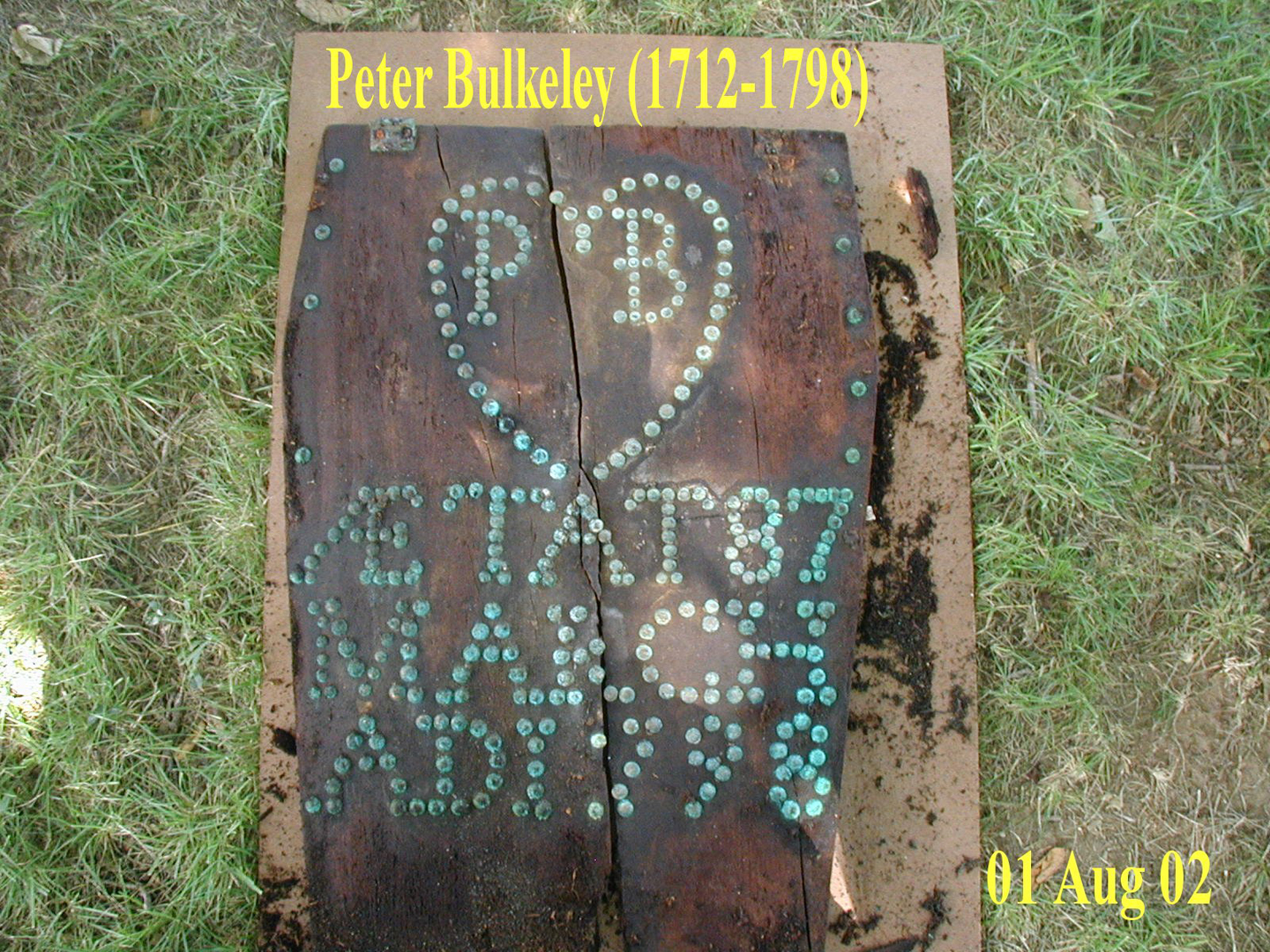 Reverend Peter Bulkeley
The Bulkeley Family traces its English roots to the town of Bulkeley in the County of Chester, where around 1200 Robert de Bulkileh was the Lord of the Manor. In 1583 Peter was born to the Reverend Edward and Olive Bulekely. Following his education, in 1608 Peter was ordained and succeeded his father as Rector of All Saints Church in Odell in Bedfordshire in 1610. The Reverend Peter Bulkeley was attracted to the Puritan ideals and in 1635, to escape persecution by the Church of England hierarchy, the Reverend, his wife Grace and their three young sons fled England for the New World. The passage was slow, with the family arriving in Boston in mid-summer of 1635. The family soon settled in Concord, Massachusetts, a town they help found. Grace gave birth to a son, Gershom, a few months later.
 Gershom Bulkeley
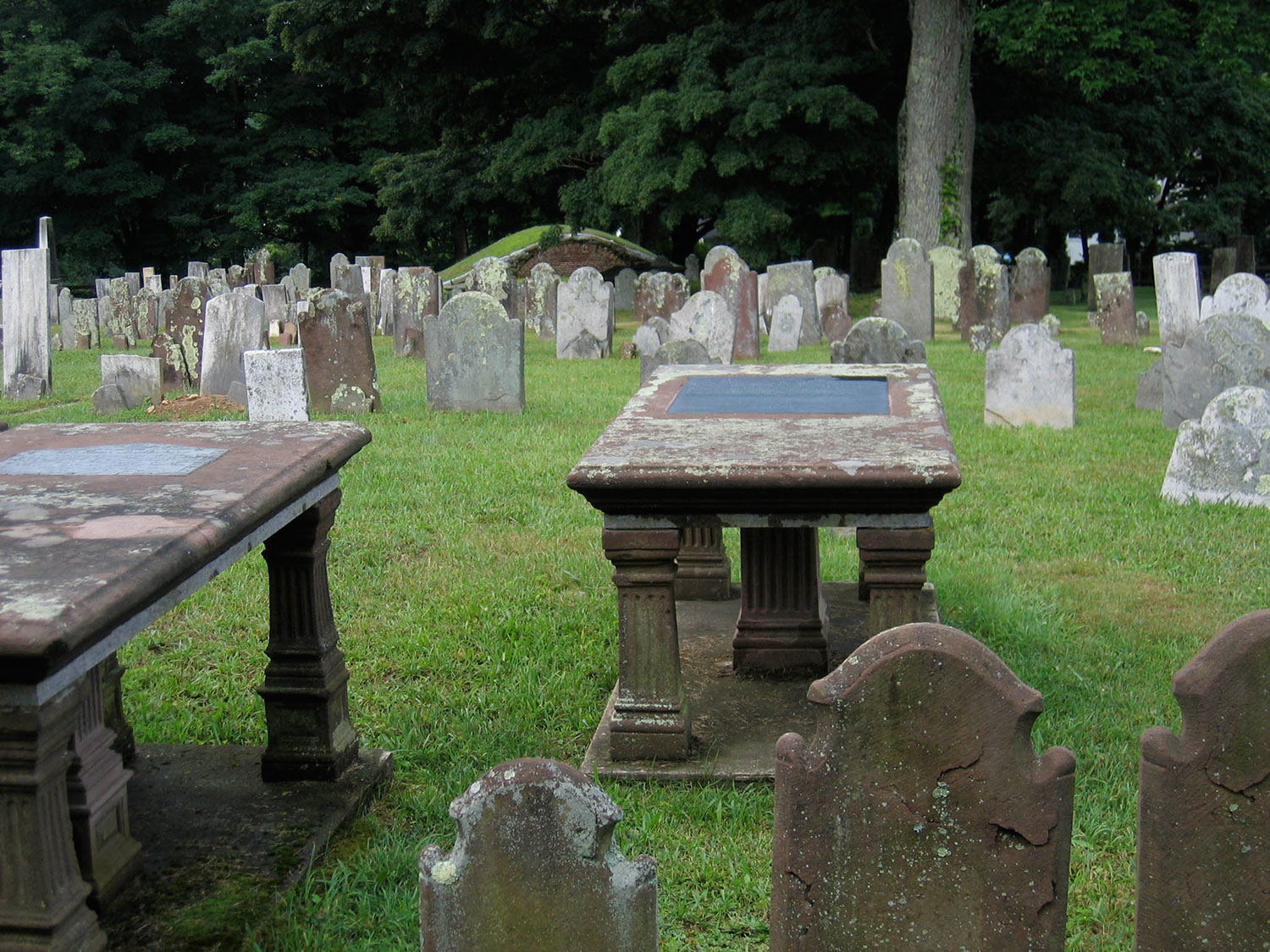
Gershom Bulkeley graduated from Harvard, married the daughter of Harvard’s president and sailed to New London, Connecticut in 1660. Gershom served as minister in New London until 1666 when he was invited to lead the ministry in the town of Wethersfield. He remained there until 1677 when he moved to Glastonbury to practice medicine, surgery and politics. Gershom died in 1713 at the age of 77 and is buried in the old Wethersfield burial ground under a fine tablestone.
Reverend John Bulkeley
Gershom and Sara Bulkeley’s son, John, became the first minister of the first church in Colchester in 1703. The Reverend John Bulkeley’s original meetinghouse was located on Old Hebron Road and was replaced by a more centrally located church in 1714. In 1771 a replica of the Old South Church is Boston was built facing Linwood Avenue. Around 1839 this structure was torn down and was replaced by the present building. In 1949 the Colchester Federated Church was established when the congregation merged with the Baptist Church.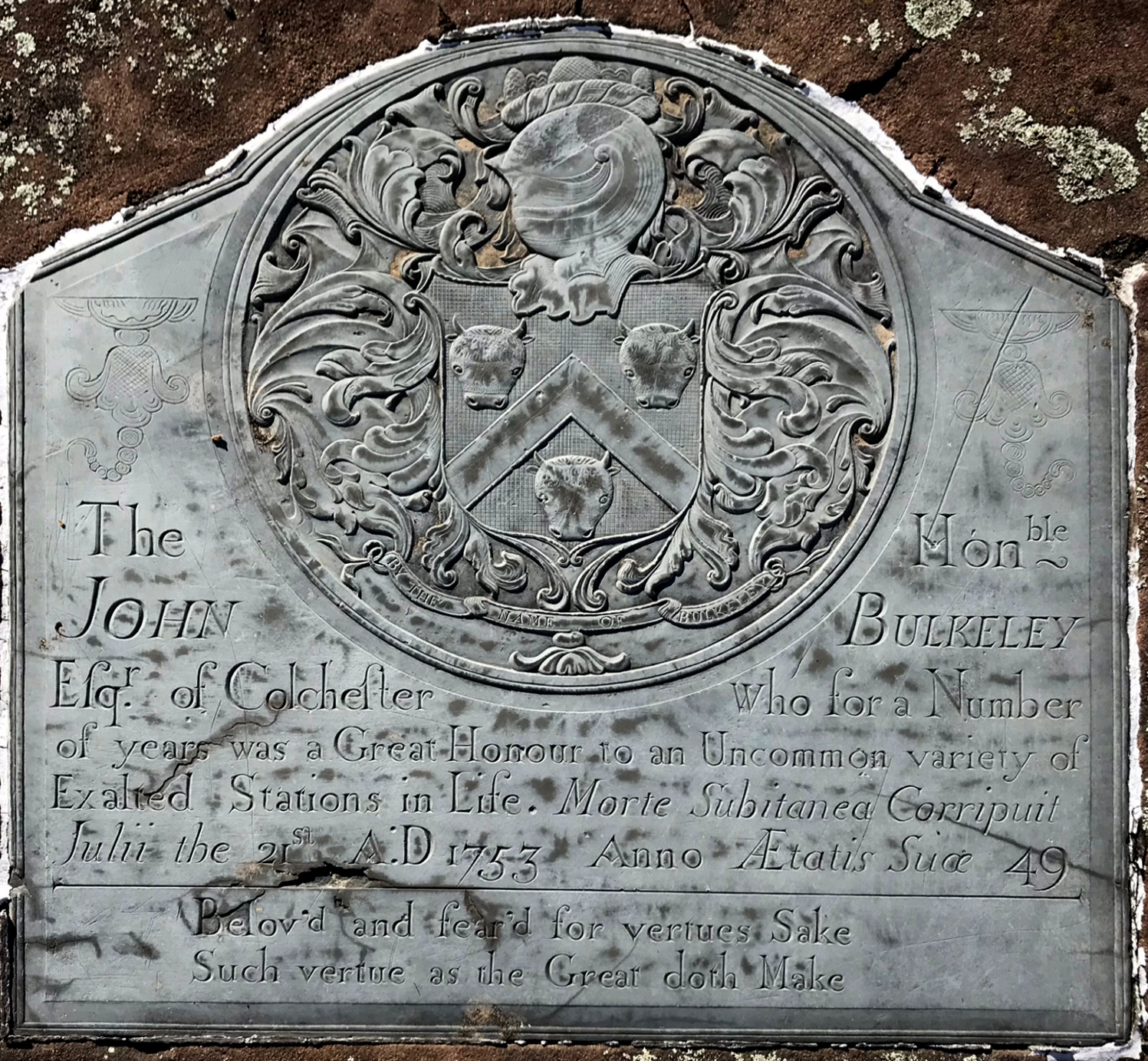
Eliphalet Bulkeley
One hundred years after the arrival of the Reverend John Bulkeley, Eliphalet Adams Bulkeley was born in 1803, the fifth generation of Bulkeleys to live in Colchester. Eliphalet graduated from Bacon Academy in 1820 and Yale University in 1824. He practiced law in Lebanon, Connecticut, later becoming the first President of the East Haddam Bank and in 1834 was elected Representative in the Connecticut State Legislature. He moved with his family to Hartford in 1847 and was again elected to the State Legislature, becoming Speaker of the House. He founded Aetna Life Insurance Company in 1853 and remained until his death in 1872.
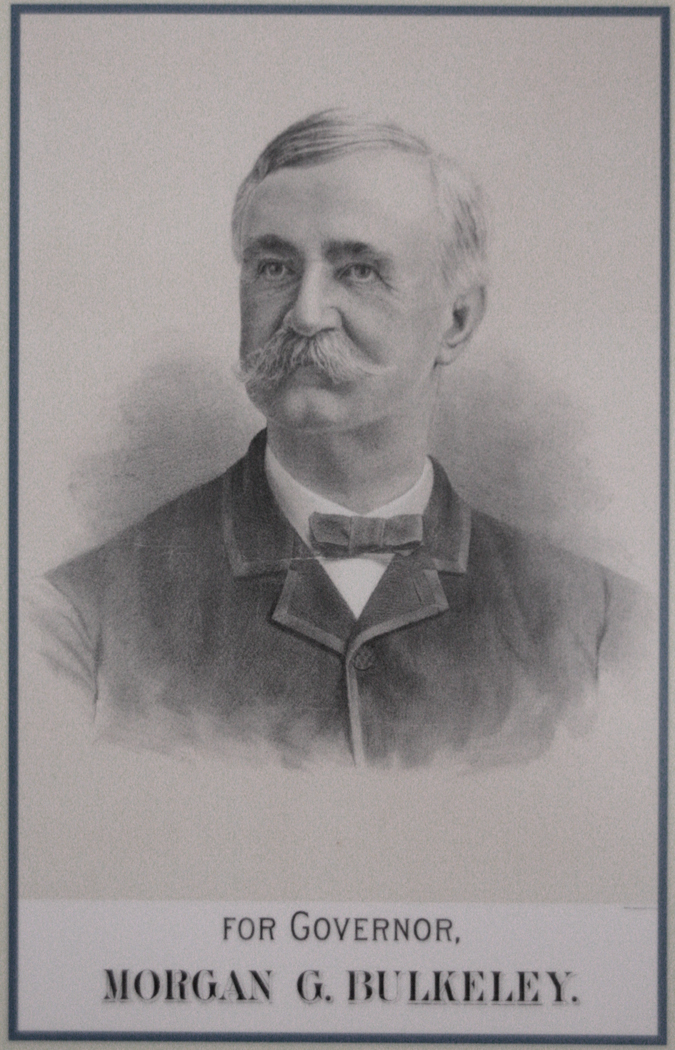 Morgan Bulkeley
Morgan Gardner Bulkeley was born to Eliphalet and Lydia Bulkeley in 1837 in East Haddam, Connecticut but spent much of his time with family members in Colchester. At the age of 14 he worked in this uncle’s store in Brooklyn, New York, becoming a business partner at 21. He returned to Hartford in 1872 after his father’s death eventually becoming President of Aetna Life Insurance Company until his death in 1922. While in Hartford he was elected Mayor in 1880 and was elected Governor of Connecticut in 1888. In 1896 he was an unsuccessful candidate for Vice President of the United States on the McKinley ticket but in 1905 he was elected to the US Senate. An avid sports fan, he became part of the first class elected to the Baseball Hall of Fame in 1937, having served as president of the National Baseball League in 1876.
Learn about the Tomb of Gershom Bulkeley and his descendants.
 Rosamond Press
Leave a comment