
I went to bed last night debating whether to involve AA in my chapter ‘Starfish Takes a Meeting’. This morning I watched a video where Pam Hemphill says she applied the Twelve Steps in AA in turning down Trump’s pardon. In AA we read from a piece of paper the Twelve Traditions. No.10 reads;
“Alcoholics Anonymous has no opinion on outside issues; hence the AA name ought never be drawn into public controversy.”
Pam refers to Step No.2 – that leads to other steps.
- Made a searching and fearless moral inventory of ourselves.
- Admitted to God, to ourselves, and to another human being the exact nature of our wrongs.
- Were entirely ready to have God remove all these defects of character.
- Humbly asked Him to remove our shortcomings.
- Made a list of all persons we had harmed, and became willing to make amends to them all.
- Made direct amends to such people wherever possible, except when to do so would injure them or others.
In my James Bond book, Starfish is admitting she has done her husband wrong, and heads for an AA meeting. She wants proof she is willing to change – in a hurry – so together they can save the world. At the meeting, she learns getting, and staying sober, is the only directive. She listens to a brother confess he declined Jury Duty because he was still a sick alcoholic that basely knows right from wrong!
“I own twenty-four years sobriety, and it was all I could do to stop myself from flying to the ‘Stop The Steal Rally’ at the White House! I have trouble going to Walmart to buy groceries! I have been a suspicious person most of my life! Everyone is up to no good….if you ask me!”
Convicted US Capitol rioter turns down Trump pardon
3 days agoShareSave
Robert Plummer
BBC News
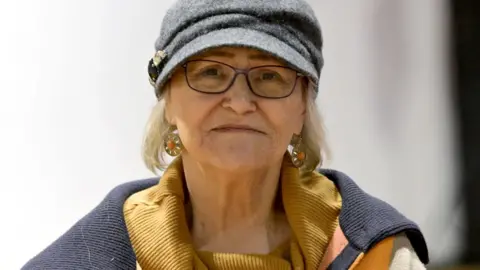
One of the people who served jail time for taking part in the US Capitol riot four years ago has refused a pardon from President Donald Trump, saying: “We were wrong that day.”
Pamela Hemphill, who pleaded guilty and was sentenced to 60 days in prison, told the BBC that there should be no pardons for the riot on 6 January 2021.
“Accepting a pardon would only insult the Capitol police officers, rule of law and, of course, our nation,” she said.
“I pleaded guilty because I was guilty, and accepting a pardon also would serve to contribute to their gaslighting and false narrative.”
Advertisement
Hemphill, who was nicknamed the “Maga granny” by social media users – in reference to Trump’s “make America great again” slogan – said she saw the Trump government as trying to “rewrite history and I don’t want to be part of that”.
“We were wrong that day, we broke the law – there should be no pardons,” she told the BBC World Service’s Newsday programme.
- Proud Boys and Oath Keepers among those pardoned over riot
- What are presidential pardons and how do they work?
Trump’s decision to pardon or commute the sentences of nearly 1,600 people involved in the attempt to violently overturn the 2020 election came just hours into his presidency.
In a news conference on Tuesday at the White House, he said: “These people have already served years in prison, and they’ve served them viciously.
“It’s a disgusting prison. It’s been horrible. It’s inhumane. It’s been a terrible, terrible thing.”
However, the move has drawn an uneasy reaction from some Republican politicians.
Senator Thom Tillis, from North Carolina, said he “just can’t agree” with the move, adding that it “raises legitimate safety issues on Capitol Hill”.
Another Republican US senator, James Lankford from Oklahoma, told CNN: “I think we need to continue to say we are a party of law and order.”
He added: “I think if you attack a police officer, that’s a very serious issue and they should pay a price for that.”

0:27Watch: Jacob Chansley gives his reaction to being pardoned by President Trump
Advertisement
This is not the first instance of someone refusing a pardon and it is within an individual’s right to refuse under the US Constitution, the supreme Court previously ruled, according to Cornell Law School.
Also among those pardoned was one of the riot’s most recognisable figures, Jacob Chansley, the self-styled QAnon Shaman, who was released from jail in 2023 after serving 27 months of his 41-month jail sentence.
He told the BBC that he heard the news from his lawyer while he was at the gym.
He added: “I walked outside and I screamed ‘freedom’ at the top of my lungs and then gave a good Native American war cry.”
What Are the 12 Traditions of AA?
The following are the traditions that serve as a guideline or manual that defines the internal operations of the 12-step programs.1
- Our common welfare should come first; personal recovery depends upon AA unity.
- For our group purpose, there is but one ultimate authority—a loving God as He may express Himself in our group conscience. Our leaders are but trusted servants; they do not govern.
- The only requirement for AA membership is a desire to stop drinking.
- Each group should be autonomous, except in matters affecting other groups or AA as a whole.
- Each group has but one primary purpose: to carry its message to the alcoholic who still suffers.
- An AA group ought never endorse, finance, or lend the AA name to any related facility or outside enterprise, lest problems of money, property, and prestige divert us from our primary purpose.
- Every AA group ought to be fully self-supporting, declining outside contributions.
- Alcoholics Anonymous should remain forever non-professional, but our service centers may employ special workers.
- AA, as such, ought never be organized; but we may create service boards or committees directly responsible to those they serve.
- Alcoholics Anonymous has no opinion on outside issues; hence the AA name ought never be drawn into public controversy.
- Our public relations policy is based on attraction rather than promotion; we need always maintain personal anonymity at the level of press, radio, and films.
- Anonymity is the spiritual foundation of all our traditions, ever reminding us to place principles above personalities.
The Twelve Steps of AA
The relative success of the AA program seems to be due to the fact that an alcoholic who no longer drinks has an exceptional faculty for “reaching” and helping an uncontrolled drinker.
In simplest form, the AA program operates when a recovered alcoholic passes along the story of his or her own problem drinking, describes the sobriety he or she has found in AA, and invites people who are new to AA to join the informal Fellowship.
The heart of the suggested program of personal recovery is contained in Twelve Steps describing the experience of the earliest members of the Society:
- We admitted we were powerless over alcohol—that our lives had become unmanageable.
- Came to believe that a Power greater than ourselves could restore us to sanity.
- Made a decision to turn our will and our lives over to the care of God as we understood Him.
- Made a searching and fearless moral inventory of ourselves.
- Admitted to God, to ourselves, and to another human being the exact nature of our wrongs.
- Were entirely ready to have God remove all these defects of character.
- Humbly asked Him to remove our shortcomings.
- Made a list of all persons we had harmed, and became willing to make amends to them all.
- Made direct amends to such people wherever possible, except when to do so would injure them or others.
- Continued to take personal inventory and when we were wrong promptly admitted it.
- Sought through prayer and meditation to improve our conscious contact with God as we understood Him, praying only for knowledge of His will for us and the power to carry that out.
- Having had a spiritual awakening as the result of these steps, we tried to carry this message to alcoholics and to practice these principles in all our affairs.
People who are new to AA are not asked to accept or follow these Twelve Steps in their entirety if they feel unwilling or unable to do so.
They will usually be asked to keep an open mind, to attend meetings at which recovered alcoholics describe their personal experiences in achieving sobriety, and to read AA literature describing and interpreting the AA program.
AA members will usually emphasise to people who are new to AA that only problem drinkers themselves, individually, can determine whether or not they are in fact alcoholics.
At the same time, it will be pointed out that all available medical testimony indicates that alcoholism is a progressive illness, that it cannot be cured in the ordinary sense of the term, but that it can be arrested through total abstinence from alcohol in any form.
Starfish Gets Drunk at The Bum’s Rush
Posted on June 6, 2021 by Royal Rosamond Press

You don’t ever want to get on the dark side of Starfish. Victoria had seen it on the day she was interviewed for the job of being her bodyguard. This, scariness, was a good thing, but, now that they were lovers, she had second thoughts – especially after Miriam got shit-faced on one Zig Zag Beer. What the fuck!
Starfish Takes a Meeting
Posted on January 25, 2025 by Royal Rosamond Press


 Rosamond Press
Leave a comment