My Dead Have Been Taken Hostage
Posted on October 11, 2023 by Royal Rosamond Press

On this day, December 29, 2024, I John Presco found the College of Bohemianism on the land designated the final resting place of my third grandfather, Carl Janke, the founder of Belmont, that may have one time been call Carlmont. In the spirit of Charles (Carl) Ignatious Pfaff, I made the Belmont Historical Society aware of my Janke and Stuttmeister ancestors, and my desire to move to Belmont. I found a home for sale there, and was asking for backers of my newspaper, Royal Rosamond Press. This desire was utterly ignored, as was I – for five days! I was greeted with hostility.
Today I read about the drinking establishment that Plaff placed in New York a block from were I went to work via Manpower Inc. I was seventeen. I lived nine blocks away at the Saint George Hotel in 1964 that was in the Village.
John Presco
President: Royal Rosamond Press
Pfaff’s was a drinking establishment in Manhattan, New York City, known for its literary and artistic clientele.
Description
[edit]
Opened in 1855 by Charles Ignatious Pfaff, the original Pfaff’s was modeled after the German Rathskellers that were popular in Europe at the time. Charles Pfaff’s beer cellar was located on Broadway near Bleecker Street (before 1862, Pfaff’s address was given as 647 Broadway; after 1865, its location was advertised as 653 Broadway) in Greenwich Village, New York City. To enter the beer cellar—which was actually a vaulted ceiling bar and restaurant—its patrons had to go down a set of stairs.
From the mid-1850s to the late 1860s, Pfaff’s was the center of New York’s revolutionary culture. As writer Allan Gurganus has said, “Pfaff’s was the Andy Warhol factory, the Studio 54, the Algonquin Round Table all rolled into one.”[1]
Habitués included journalist and social critic Henry Clapp, Jr., Walt Whitman, author and actress Ada Clare, poet and actress Adah Isaacs Menken, playwright John Brougham, artist Elihu Vedder, pianist and composer Louis Moreau Gottschalk (who also had an affair with Ada Clare), actor Edwin Booth, author Fitz Hugh Ludlow, and humorist Artemus Ward.[2] Whitman called Charlie Pfaff “a generous German restaurateur, silent, stout, jolly,” as well as “the best selector of champagne in America.”[3] Whitman also wrote an unfinished poem about Pfaff’s called “The Two Vaults,” which included the lines:
…The vault at Pfaffs where the drinkers and laughers meet to eat and drink and carouse
While on the walk immediately overhead pass the myriad feet of Broadway…
Writer Fitz James O’Brien also wrote an ode to Pfaff’s and to the clientele; an annotated copy of these lyrics titled At Pfaff’s was pasted by Thomas Butler Gunn into his 1860 diary and can be seen at The Vault at Pfaff’s website.[4]
Clapp, considered by many the “King of Bohemia”, founded The Saturday Press as New York’s answer to the Atlantic Monthly. Started as a literary magazine, The Saturday Press eventually became a countercultural zine “with a mix of poetry, stories, radical politics, and an enthusiastic spirit of personal freedom and sexual openness. Before it folded in 1868, it published numerous poems by Whitman and a short story by Mark Twain. The Saturday Press championed Leaves of Grass, a move that many view as a significant factor in the success of the 1860 edition.”[1]
In 1870, Charles Pfaff moved his business up to midtown. Whitman wrote about Pfaff’s in Specimen Days after a visit to the restaurateur’s newer location many years later:
An hour’s fresh stimulation, coming down ten miles of Manhattan Island by railroad and 8 o’clock stage. Then an excellent breakfast at Pfaff’s restaurant, 24th Street. Our host himself, an old friend of mine, quickly appear’d on the scene to welcome me and bring up the news, and, first opening a big fat bottle of the best wine in the cellar, talk about ante-bellum times, ’59 and ’60, and the jovial suppers at his Broadway place, near Bleecker Street.
Ah, the friends and names and frequenters, those times, that place. Most are dead – Ada Clare, Wilkins, Daisy Sheppard, O’Brien, Henry Clapp, Stanley, Mullin, Wood, Brougham, Arnold – all gone.
And there Pfaff and I, sitting opposite each other at the little table, gave a remembrance to them in a style they would have themselves fully confirm’d, namely, big, brimming, fill’d-up champagne-glasses, drain’d in abstracted silence, very leisurely, to the last drop.”[3]
Current status
[edit]
The original location at 653 Broadway eventually became an envelope factory. In 1975, it became a disco called Infinity, which was destroyed by fire in 1979. Today, the location is home to a few shops.
In the spring of 2011, a restaurant and bar using the name The Vault at Pfaff’s opened at 643 Broadway, near the original Pfaff’s location. It too was accessed by descending a set of stairs, which led into a refurbished cellar.[5] The Vault at Pfaff’s has since closed. However, in 2024 a new establishment opened, Delmonico’s sister establishment TUCCI- New York by Max Tucci. The restaurant serves modern Italian cuisine in an elegant atmosphere with hints of Gilded Age days.
The Saturday Press was a literary weekly newspaper, published in New York City from 1858 to 1860 and again from 1865 to 1866, edited by Henry Clapp Jr.[1]
Clapp, nicknamed the “King of Bohemia” and credited with importing the term “bohemianism” to the U.S, was a central part of the antebellum New York literary and art scene. Today he is perhaps best known for his spotlighting of Walt Whitman, Fitz-James O’Brien, and Ada Clare – all habitués of the bohemian watering hole named Pfaff’s beer cellar – in The Saturday Press.[1] Clapp intended the Press to be New York’s answer to The Atlantic Monthly. The Press was constantly troubled by financial problems, and Clapp died in poverty and obscurity.[2]
Mark Twain‘s first short story, “The Celebrated Jumping Frog of Calaveras County“, was first published under the title “Jim Smiley and His Jumping Frog” in The Saturday Press in 1865.[3][4]
Ratskeller (German: “council’s cellar“, pl. Ratskeller, historically Rathskeller) is a name in German-speaking countries for a bar or restaurant located in the basement of a city hall (Rathaus) or nearby. Many taverns, nightclubs, bars and similar establishments throughout the world use the term.
Notable examples
[edit]
Germany
[edit]

The Bremen Ratskeller, erected in 1405, has one of the oldest wine cellars in Germany and was a centre of the wine trade in Bremen.
The Ratskeller in Lübeck is one of the oldest in northern Germany, with parts dating from the Romanesque era. The earliest documented use for wine storage dates from circa 1220.
North America
[edit]

The Athenæum (Das Deutsche Haus) Ratskeller restaurant in Indianapolis, known as the Athenaeum, received historic landmark status and has served Bavarian cuisine since 1894.[1]
The California Hall (formerly Das Deutches Haus) was built in 1912 in San Francisco and had a Rathskeller restaurant in the basement.[2]
The Rathskeller in Boston was a famous rock and roll club from 1974 to 1997, a locus of Boston’s alternative rock scene, hosting local bands like The Cars and Pixies as well as many other bands such as The Police and Metallica before they achieved breakthrough fame.
California Hall, originally named Das Deutsche Haus[3] (English: The German House, sometimes also referred to in incorrect German as Das Deutsches Haus), is a historic commercial building and event venue built in 1912, located in the Polk Gulch/Tenderloin neighborhood in San Francisco, California.[4]
It started as a German social meeting hall.[1] In 1965, it was the location of a fundraiser event for gay charities that brought trouble with the police and an ensuing legal battle. This event has been described a turning point in gay rights in the west coast.[5]
I Copyrighted Carl Janke of Belmont
Posted on June 23, 2023 by Royal Rosamond Press
It is time to look for a great attorney!
John Saint John
Summoning The Muse of Sir Sterling London Joaquin Lord de Rosemond
Posted on January 21, 2014 by Royal Rosamond Press
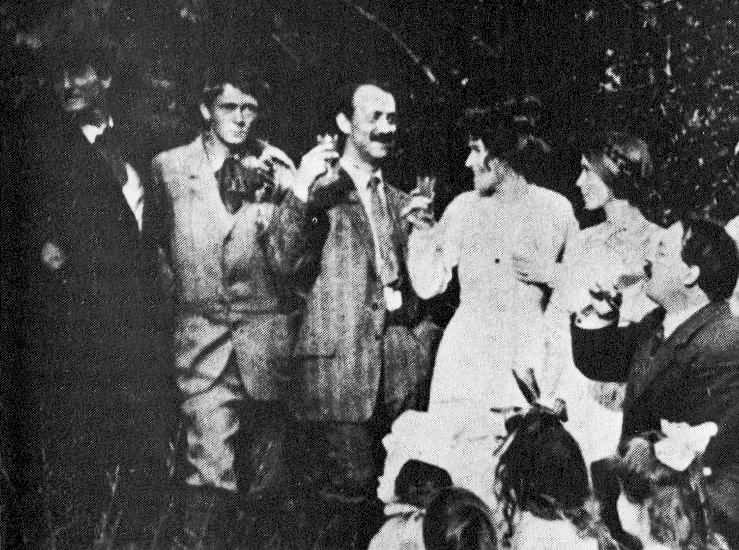

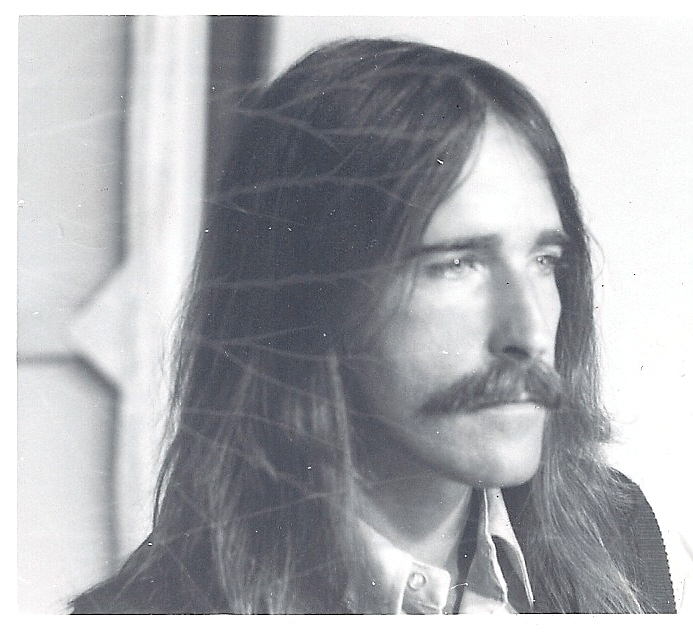

During the Summer of Love, and the renewal of Bohemian activity in the Bat Area on a grand scale, only I seemed to be aware of Sterling, London, and Joaquin ‘The Trail Blazers’ who had gone before us into the wilderness, and carved out Bohemian Sanctuaries, groves, wherein we worshipped the Queen of Druids – our Grand Bohemian Muse!
“Hail Brother Bohemians – Lovers of the Grand Beloved Muse!”
With the return of the Muse that Bill and I followed, and who rendered my late sister a world famous artist, can the re-capture of the Creative Spirit that has fallen into hands of the Un-Creative of the World – commence!
In discovering that my great grandfather, Carl Janke, was the first to build a Bohemian Community and Retreat in Belmont California – that he co-founded – put my family history next door to the Bohemian Grove in Monte Rio.
Five years ago after learning Rena Easton was married to a Commodore, and lived in the Isle of Wight, I had fantasies of what happened after we met. After my friend Bryan drops us off in Oakland – after he tried to kidnap Rena on Pismo Beach – I drive her down to the Oakland Estuary where my seventy foot yacht is moored. WE are now all alone down in the industrial train yards. There is not a soul around. I take her hand and guide her aboard. We go down below where I perform a superb removal of her apprehension. Why shouldn’t she be leery of this dark sailor man, this Hermit of the Sea.
Above is a photo of my small sailboat that I lived on. I was a tad ashamed to show it, until Rena told me in her letter about her small dwelling.
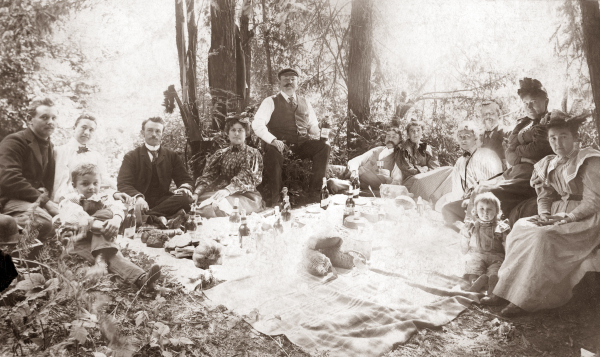
When Rosemary was showing us the family photos, her children perked up when we beheld these antique people having a picnic in the Oakland Redwoods where we used to have picnics.
“Who are these people, mother?”
“Those are your father’s people, the Bohunks.”
“Bohunks!” We exclaimed. “What’s a Bohunk?”
“Bohunks are Bohemians.” our mother answered with some concern.
What harm could it do these innocent children to know they have Bohunk blood in their veins? As long as they never learn my father was a Hillbilly, smitten by a Redneck Muse that he named ‘Ravola of Thunder Mountain’.
I am a very Lucky Man!
Jon Presco
Copyright 2014
http://en.wikipedia.org/wiki/Oyster_pirate
http://en.wikipedia.org/wiki/Jack_London_Square
http://en.wikipedia.org/wiki/Jack_London
There were old growth redwood trees near Belmont and Redwood city that were harvested. Carl Janke built his theme park on Belmont Creek a watershed that came down from the hills. This was an ideal habitation for giant redwoods that could be seen by sailors on the bay. It must have been an incredible and beautiful sight that would have appealed to a German who traitinally love the forests.
“In the hundred years since the Huddart Park area was logged, a new forest of redwoods and other trees have grown, covering much of the evidence of this early logging activity. However, still visible are large stumps of the virgin redwoods and “skid roads” over with the teams of oxen dragged logs to the sawmills.
If Janke brought his six portable houses around the Cape on a Clipper in 1848, instead of 1849 as some say, then Carl did not do so to sell them to gold miners who struck it rich, but to create a utopian city and haven for people all over the world who would come to behold these giant redwoods. Were the founders of Bohemian Grove inspired by Janke’s Turnverien free-thinker dream? Jack London, George Sterling, and Joaquin Miller, were members of the Bohemian Grove. Miller knew the Stuttmeisters who had a farm down the hill from ‘The Heights’ where artists and poets met. Miller wrote ‘City Beautiful’ . Above are photos of the Stuttmeisters and Brodericks having a picnic in the redwoods. Miller planted trees all over the Oakland Hills. The Stuttmeisters built forty home in Fruit Vale on streets they named after trees. Here are your Hobbits, your Gandalf’s, your Magical Men that made California a Mecca for those who use their mind, believe thinking is the best way to travel.
Dr. William O. Stuttmesiter is the gentleman with white hair and dark mustache. He played violen for the Oakland Symphony.
Jon Presco
Copyright 2012
Janke’s park offered all the necessary provisions for an outdoor holiday, which included a dance pavilion to accommodate 300 large glassless windows, a conical roof and a dance floor situated around a large spreading tree. The pavilion was also equipped with a bar, an ice cream parlor and a restaurant.
Months after my sister’s death I went to the Sacramento Library and looked at microfish about a legal battle between the heirs of Carl Janke’s estate in Belmont that appeared in the San Francisco Call. I lost the copy I made of that article that I am certain mentioned William O. Stuttmeister, and the sisters of Augusta Stuttmeister-Janke. Carl’s sons did not want Minni and Cornillia, to have anything, and one brother (or cousin) took their side, and was cut out. This has to be William, or W. JANKE. “The bride was attended by Miss Alice Stuttmeister, a sister of the groom, and Miss Minnie Janke, a sister of the bride, as bridesmaids, and Dr. Muldownado and Wm. Janke, a cousin of the bride, were groomsmen.” When Victor Presco turned twenty-one, the the Janke spinsters offered him a moving company in San Francesco. Apparently they saw him as the heir to the Stuttmiester legacy, and the Hope of a return to former glory because they had no children. How about their brother, William? Rosemary said this; “Your father was a made man.” Two days ago, in an e-mail, my cousin Daryl Bulkley confirmed my suspicions that ‘Stuttmeister’ was not the original name of the folks from Berlin. I suspect they were a branch of the Glucksburg family who became Calvinist Evangelicals, and perhaps Rosicrucians. In the top photo we see Minni and Corniallia Janke in the family vault that William Stuttmeister purchased for $10,000 dollars to put the reains of the Jankes and Stuttmeisters in after they were evicted from the Oddfellow cemetery. That William Ralston was a Oddfellow that put up a large sum of money to establish the Oddfellows in Germany – and perhaps elsewhere – makes me wonder about his alleged suicide by plunging into the bay. I am reading articles on the internet about the Oddfellows being the founders of the Welfare State in America, where being charitable to the poor, the infirmed, and the widows, was paramount. They also paid much attention to burying their dead, which suggests they believed in a different hereafter. As a theologian I have pointed out the strange raising of the dead in Matthew 27:53 at the very moment of Jesus’ alleged death.
I suspect Judas was given thirty pieces of silver to purchase Jesus’ tomb, and Jesus was about to practice the ancient Judaic ritual called of the RESUSCITATION, where the soul of the diseased enters the body of another. I believe this is why those who take the Nazarite Vow are bid to keep their distance from the dead. That the Oddfellows titled women as Rebekahs, suggests they are Rechabites, who have been associated with the Nazarites who composed the first Christian church called “The Church of God”. That Jesus came to be seen as God “the Father” is a usurption that began with Paul of Tarsus. That the fall of the Oddfellows in the Bay Area happened overnight, and all traces of their demise, all but disappeared, tells me there was a real Judas and purge. That Daryl pointed out in her research that we knew next to nothing about the Stuttmeisters, whose tomb was lost until seven years ago, tells me William Stuttmeister retired to the Geronimo Valley a disillusioned man, who played a rare violin, and left his Stuttmeister-Janke legacy to his housekeeper. And then he is dead, his remains put in the vault that I went to visit with my daughter and grandson. Before I left for California I told my friend Joy Gall, that I wanted a AA coin to put in this tomb in honor of Christine Rosamond Benton whose funeral fell on he first sober birthday in AA. As I lined up to view my sister in her casket, I did consider the Nazarite Vow I took in 1989. As fate would have it, I ended up putting this coin in William Oltman Stuttmeisters crypt because there was an opening made by the earthquake of 1989.
On this coin is an Angel. In 1992 I began a biography of my family called ‘Bonds With Angels’. It begins with an account of the Blue Angel that appear at the foot of Christine’s bed that woke her and Vicki, who crawled into Christine’s bed and beheld her. Vicki was six years of age, and is clean and sober this day. The Nazarite Vow bids one to not ingest alcohol, not get drunk, so that the Holy Spirit may speak through you, use you as a Horn of Power to broadcast the Word of God. When I entered the tomb of my ancestors and sat down on the marble bench, I noticed the letter A made of brass lying behind the faux fern plant. I picked it up. It was the A in JANKE that had come lose in the earthquake. I looked up at the stained glass window and read; “In loving memory of my beloved wife, Augusta Stutteister,” Was Augusta the Angel that came to visit my sisters? May our bonds with Angels continue – forever more! Amen! Jon Presco Daily Alta California, Volume 42, Number 14175, 24 June 1888 STUTTMEISTER-JANKE. One of the most enjoyable weddings of the past week took place at Belmont, Wednesday morning last, the contracting parties being Miss Augusta Janke, daughter of Mr. and Mrs. August Janke of Belmont,
and Dr. Wm. Stuttmeister of San Francisco. The house was handsomely decorated with a rich profusion of ferns and flowers, and at the appointed hour was filled with the relatives and intimate friends
of the contracting parties. At 11 o’clock the wedding march was played and the bridal party entered the parlor. The bride was attended by Miss Alice Stuttmeister, a sister of the groom, and Miss Minnie Janke, a sister of the bride, as bridesmaids, and Dr. Muldownado and Wm. Janke, a cousin of the bride, were groomsmen. The Rev. A. L. Brewer
of San Mateo performed the beautiful and impressive ceremony under an arch composed of flowers and greens very prettily arranged, after which the guests pressed forward and offered their congratulations. The bride was attired in a very pretty and becoming costume of the crushed strawberry shade, and wore a corsage bouquet of orange
blossoms. She carried a handsome bouquet of white flowers. After the guests had paid their compliments the bride and groom led the way to the dining-room, where the wedding dinner was served and the health
of the newly married pair was pledged. The feast over, the guests joined in the dance, and the hours sped right merrily, interspersed with music singing and recitations, until the bride and groom took their departure amid a shower of rice and good wishes. Many beautiful presents were received. Dr. and Mrs. Stuttmeister left Thursday morning for Santa Cruz and Monterey, where they will spend the honeymoon. On their return they will make their home in Belmont. 1911: Dr. Willian O. Stuttmeister was practicing dentistry in Redwood City, CA. (Reference: University of California, Directory of Graduates,
1864-1910, page 133).
Records from Tombstones in Laurel Hill Cemetery, 1853-1927 – Janke
– Stuttmeister
Mina Maria Janke, daughter of William A, & Cornelia Janke, born
February 2, 1869, died March 1902.
William August Janke, native of Hamburg, Germany, born Dec. 25,
1642, died Nov. 22, 1902, son of Carl August & Dorette Catherine Janke. Frederick William R. Stuttmeister, native of Berlin, Germany, born
1612, died January 29, 1877.
Mrs. Matilda Stuttmeister, wife of Frederick W.R. Stuttmeister, born
1829, died March 17, 1875, native of New York.
Victor Rudolph Stuttmeister, son of Frederick W.R. & Matilda
Stuttmeister, born May 29, 1846, died Jan. 19, 1893, native of New
York.
http://www.ebooksread.com/authors-eng/daughters-of-the-americanrevolution- california-s/records-from-tombstones-in-laurel-hill-cemetery- 1853-1927-gua/page-6-records-from-tombstones-in-laurel-hillcemetery- 1853-1927-gua.shtml Copyright 2011
 Rosamond Press
Leave a comment