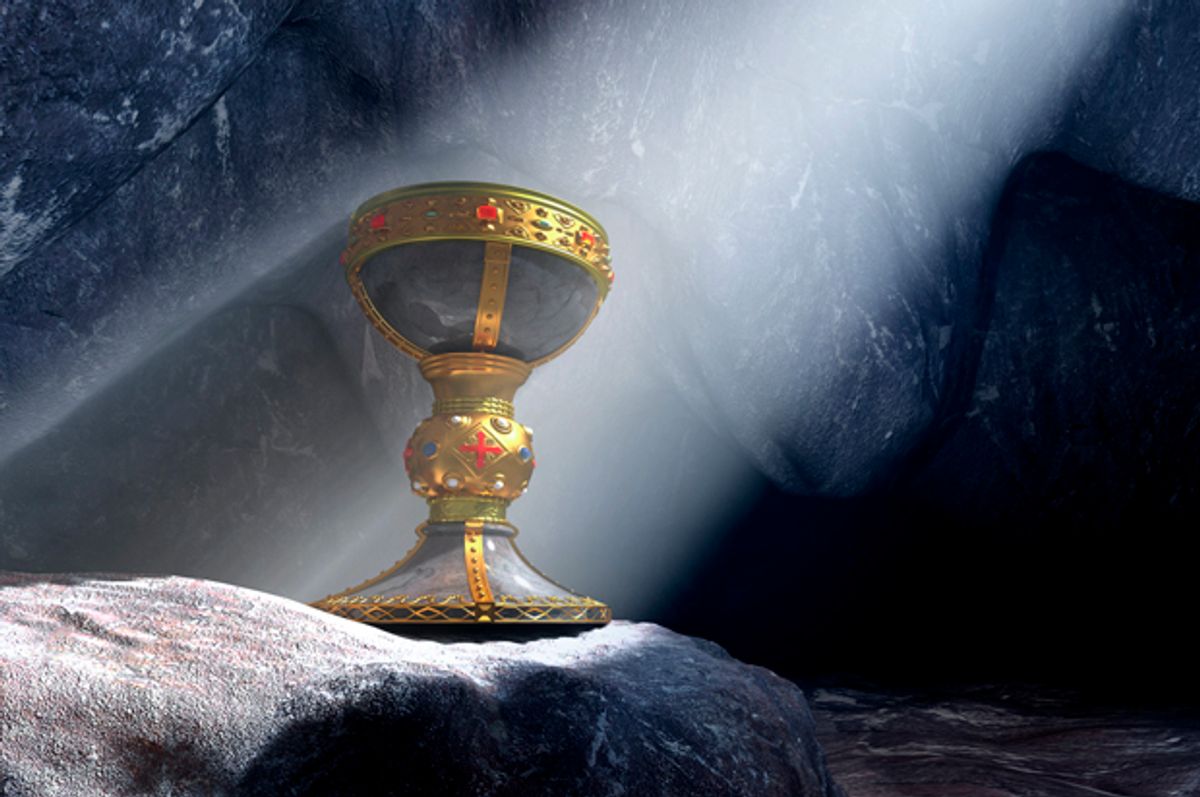
(Getty Images/ estt)
Rachel The Nazarite
by
John Presco
From: Notes of a New Nazarite
Ten days ago I discovered that Rachel took the Vow of the Nazarite so that God would open her closed womb, and she would conceive. Taking this vow, worked, and she gave birth to Joseph who was hidden by his brother in a well, then sold into slavery in Egypt. There he became a co-ruler of some rank, He wore the Coat of Many Colors, and was a Cup Bearer to the Pharoah whose fortune he told. Near the end of his life, Joseph put a cup in a bag of grain so his younger brother, Benjamin could carry it back to the land of the House of Benjamin that included the Threshing Floor where met Ruth and Boaz begot the House of David. I will show you this is a usurpation, aimed at destroying the House of Benjamin that was rule by a Linage of Nazarites who were The Judges. There was no King. There was no need for a king. Saul was no King. He was….Samuel The Nazarite!
The story of Boaz and Ruth – the Moabite – supplants the story of Jacob and Rachel, the parents of Joseph, who is supplanted again in the nativity of Mary, the alleged mother of Jesus, whose grandmother took the Vow of The Nazarite. Alas….
I AM JOSEPH THE NAZARITE
‘An Aramean would have destroyed my father, and he went down to Egypt and he became there a nation, great, mighty and populous.’
TO BE CONTINUED

On Christmas Eve my groceries were placed in front of the door of My Enemy. My food disappeared. I did the genealogy of this woman’s parents and discovered they went to school with Drew Benton’s father. I gave this woman the slanderous biography of Drew’s mother, Christine Rosamond Benton nee’ Presco, who was a world famous female artist. I did not know this woman desired me. I suspect her family talked about us getting married. Armed with this idea, and my family biography, she tried to supplant my family history, by inserting her family history – even though there is not blood ties. But, what if we go married – and had a child? When I got my family book back from her, some of he pages were dogeared. She said she did not do that – and denied reading the Rosamond’s book. I never desire this woman, nor did I have a sexual relationship. She stalked me. She owned covert designs on my body, soul, and linage. I can not invent a more preposterous lie. Of course her mother wanted to read this book. When you catch someone in a lie, they want to destroy you. This woman found my enemies, and their outrageous slander that came with death threats. How……Biblical?
The story of Leban and his two daughters, is extremely twisted. Leah is said to have “weak and tender eyes” but not Rachal? How can that be? We have learned hence, having blues eyes in a genetic freak. What we are reading is the attempt to erase Caucasian people from the Torah of the Semitic Jews that took control of the narrative and priesthood then slowly closed the religion of the Jews that was sustained by the Kings of Judah, that fought a civil war with the other tribes, that were mixed race. The depiction of Jesus with “pale-weak” eyes, is not impossible. How about John the Baptist, who was a Nazarite For Life?
I was named after John. In 1988 I wrote on a piece of paper “I am a Nazarite”. I then emersed myself in the McKenzie River. Again…..my life was never the same! How did the Jews receive John?
Christmas Breakfast With a Nazarite
Ruth 4:13-17 The Message (MSG)
Boaz married Ruth. She became his wife. Boaz slept with her. By GOD’s gracious gift she conceived and had a son. The town women said to Naomi, “Blessed be GOD! He didn’t leave you without family to carry on your life. May this baby grow up to be famous in Israel! He’ll make you young again! He’ll take care of you in old age. And this daughter-in-law who has brought him into the world and loves you so much, why, she’s worth more to you than seven sons!” Naomi took the baby and held him in her arms, cuddling him, cooing over him, waiting on him hand and foot. The neighborhood women started calling him “Naomi’s baby boy!” But his real name was Obed. Obed was the father of Jesse, and Jesse the father of David. * * *
Laban promised his younger daughter Rachel to Jacob in return for seven years’ service, only to trick him into marrying his elder daughter Leah instead. Jacob then served another seven years in exchange for the right to marry his choice, Rachel, as well (Genesis 29). Laban’s flocks and fortunes increased under Jacob’s skilled care, but there was much further trickery between them. Six years after his promised service has ended, Jacob, having prospered largely by proving more cunning than his father-in-law, finally left. Laban pursued him, but they eventually parted on good terms (Genesis 31).
Laban and Passover
[edit]
Laban is referenced significantly in the Passover Haggadah, in the context of the answer to the traditional child’s question, “Why is this night different from all other nights?” The prescribed answer begins with a quote from Deuteronomy 26:5: “arami oved avi“: normally translated as “a wandering Aramean was my father”, alluding either to Abram or Jacob, but here interpreted unusually as “ibbed Arami et-avi“, “an Aramean destroyed my father”, as made clear by the rabbinical exegesis read in the Seder:
Come and learn what Laban the Aramean sought to do our father Jacob. For Pharaoh issued his edict against only the males, but Laban sought to uproot all, as it is said, ‘An Aramean would have destroyed my father, and he went down to Egypt and he became there a nation, great, mighty and populous.’
There may also be a play on words here, using arami in two senses – as both arami, “an Aramean”, and rama′i, “a deceiver”, since Laban cheated Jacob (Genesis Rabbah 70:19). In this interpretation, arami personifies the Israelite peoples’ bitter enemy.[6]
Rabbi Azriel Hildesheimer explains in his Hukkat HaPesach that Laban was, in fact, the driving force of the entire Exile and Exodus saga. Rachel was Jacob’s divinely intended wife and could hypothetically have given birth to Joseph as Jacob’s firstborn with rights of primogeniture. In this counterfactual, Jacob’s favoring Joseph’s succession as the leader of the fledgling nation of Israel would have been seen as perfectly normal and fitting, given the customs of the time. No older brothers would have felt cheated and jealous, and Joseph would not have been sold into slavery. Thus, there would have been no need for Jacob’s family to be sent to Egypt to unite with Joseph.
Devora Steinmetz, assistant professor of Talmud at the Jewish Theological Seminary of America, says that the story of Jacob and Laban also resonates with the covenant with Abraham, more frequently interpreted as applying to the Exodus: “your seed shall be a stranger in a land that is not theirs, and shall serve them and they shall afflict them … Afterward they shall come out with great wealth” (Genesis 15:13–16). Jacob lived in the strange land of Aram, served Laban, and was afflicted by him; then he left with great wealth and returned to the Promised Land. The story thus serves to reinforce one of the central messages of the Passover Haggadah; that the Old Testament cycle of exile, persecution and return recurs again and again, and links the observant Jew in the Diaspora to the Land of Israel.
The scene shows an episode from the Old Testament. Rachel stole sacred figurines, ‘the household gods’, from the house of her father, Laban, and hid them in a camel’s pack. Here she is concealing them from him by protesting her inability to get up due to it being her time of the month. Both she and her older sister, Leah, were married to Jacob. He was finally escaping to Canaan after 14 years of labour, undertaken as payment for marrying Rachel. After Laban discovers the theft he sets out in pursuit and soon catches up with them. Meanwhile, his servants are searching a chest and Jacob is pointing out that he does not have the idols.
Throwing Jesus Off The Cliff
John the Baptist – A Jewish Preacher Recast as the Herald of Jesus
The historical John, יוחנן, was a thoroughly Jewish religious preacher, who had little if any relation to Jesus and his movement. Here is the story of how John and his central rite, baptism, became part of Christianity.

In the third and fourth decade of the first century C.E., a charismatic Jewish teacher in the Jordan Valley took on the mantle of prophecy, and attracted the attention of a sizable audience. The preacher’s name was יוחנן, Yohannan, transliterated in Latin as “Johannes,” hence the English name “John.” People referred to him as “the immerser” or “the baptizer” since he requested people to immerse in the water of the Jordan as a sign of repentance and conversion to God.
John the Baptist plays an important role in Christian historiography, but it is important to remember that John was not Christian—there was no such thing at the time—and his “baptism” was not the same thing as the later Christian ritual of initiation. Instead, it was a variation on the popular Jewish practice at the time to immerse in water to achieve ritual purification.[1]
The earliest extant source about him is preserved in the New Testament’s Gospel of Mark (early 70s C.E.):
Mark 1:4 John baptized in the wilderness and preached the baptism of repentance for the forgiveness of sins. 1:5 The whole Judean countryside and all the people of Jerusalem went out to him. Confessing their sins, they were baptized by him in the Jordan River. 1:6 John wore [a garment made of] camel’s hair, with a leather belt around his waist, and he ate locusts and wild honey. (NIV adjusted)[2]
John’s appearance is reminiscent of the description of prophets in the book of Zechariah:[3]
זכריה יג:ד וְהָיָה בַּיּוֹם הַהוּא יֵבֹשׁוּ הַנְּבִיאִים אִישׁ מֵחֶזְיֹנוֹ בְּהִנָּבְאֹתוֹ וְלֹא יִלְבְּשׁוּ אַדֶּרֶת שֵׂעָר לְמַעַן כַּחֵשׁ. יג:ה וְאָמַר לֹא נָבִיא אָנֹכִי אִישׁ עֹבֵד אֲדָמָה אָנֹכִי כִּי אָדָם הִקְנַנִי מִנְּעוּרָי.
Zech 13:4 On that day every prophet will be ashamed of their prophetic vision. They will not put on a prophet’s hairy mantle in order to deceive. 13:5 Each will say, “I am not a prophet. I am a farmer; the land has been my livelihood since my youth.” (NIV adjusted)
This verse attests that prophets could be identified by a special article of clothing that was made of hair.[4]
The mantel, and especially the leather belt, is associated with the prophet Elijah. When the King of Samaria wishes to learn the identity of the man who sent him a prophetic message, he asks the messengers what he looked like:
מלכים ב א:ח וַיֹּאמְרוּ אֵלָיו אִישׁ בַּעַל שֵׂעָר וְאֵזוֹר עוֹר אָזוּר בְּמָתְנָיו וַיֹּאמַר אֵלִיָּה הַתִּשְׁבִּי הוּא.
2 Kgs 1:8 They replied, “He is a hairy man, and had a leather belt around his waist.” The king said, “That was Elijah the Tishbite.”
Elsewhere, Elijah is described as wearing a mantle, referred to as אַדֶּרֶת אֵלִיָּהוּ, “Elijah’s Mantle” (2 Kgs 2:12–13), though it is unclear if it was “hairy.” John’s unusual clothing reflected his prophetic status and may have been reminiscent of Elijah.
John the Baptist in the Context of Second Temple Judaism
John’s teachings were summarized by the Hellenistic Jewish historian Josephus Flavius, as follows:
[T]his good man, who commanded the Jews to exercise virtue, righteousness towards one another and piety towards God. For only thus, in John’s opinion, would the baptism he administered be acceptable to God, namely, if they used it to obtain not pardon for some sins but rather the cleansing of their bodies, inasmuch as it was taken for granted that their souls had already been purified by justice. Now many people came in crowds to him, for they were greatly moved by his words.[5]
Yohannan’s use of immersion in water (“baptism”) as a symbol of purification of sins occurs in the sectarian literature found in the caves around Qumran.[6] For example, in the Serech HaYachad, or Community Rule, we are told that ritual immersion is part of a person’s spiritual cleansing (1QS 3:6–9):
כיא ברוח עצת אמת אל דרכי איש יכופרו כול עוונותו להביט באור החיים וברוח קדושה ליחד באמתו יטהר מכול עוונותו וברוח יושר וענו{ת}ה תכופר חטתו ובענות נפשו לכול חוקי אל יטהר בשרו להזות במי נדה ולהתקדש במי דוכי
For it is by the spirit of the true counsel of God that are atoned the paths of man, all his iniquities, so that he can look at the light of life. And it is by the holy spirit of the community, in its truth, that he is cleansed of all his iniquities. And by the spirit of uprightness and of humility his sin is atoned. And by the compliance of his soul with all the laws of God his flesh is cleansed by being sprinkled with cleansing waters and being made holy with the waters of repentance.[7]
John the Baptist and the Dead Sea sectarians share the use of water immersion for purification of the spirit. John may have been a member of the sect who went off on his own;[8] alternately, John may never have been part of the Essenes community, and this idea of spiritual purification through immersion was more widely known among Judeans during the late Second Temple period.
John’s Downfall: Crossing Herod Antipas
John’s growing popularity contributed to his downfall. He was active on the east bank of the Jordan, called Peraea, and perhaps in the Galilee. These territories were not under direct Roman administration but were governed by Herod Antipas, one of the sons of Herod the Great.[9]
Herod Antipas feared that John’s movement would eventually develop into an uprising, and had him arrested and executed. Our main source for this is Josephus:
Herod [Antipas], who feared that the great influence John had over the masses might put them into his power and enable him to raise a rebellion (for they seemed ready to do anything he should advise), thought it best to put him to death. In this way, he might prevent any mischief John might cause, and not bring himself into difficulties by sparing a man who might make him repent of it when it would be too late. Accordingly, John was sent as a prisoner, out of Herod’s suspicious temper, to Machaerus, the castle I already mentioned, and was put to death.[10]
The gospels, however, suggest a different reason that Herod Antipas had John killed.
John the Baptist’s Death According to Mark and Matthew
According to the Gospels of Mark and Matthew, John objected to the fact that Herod Antipas married Herodias, his brother’s former wife:
Mark 6:17 For Herod himself had given orders to have John arrested, and he had him bound and put in prison. He did this because of Herodias, his brother Philip’s wife, whom he had married. 6:18 For John had been saying to Herod, “It is not lawful for you to have your brother’s wife.”[11]
Josephus Flavius confirms the information that Antipas married Herodias, which he describes thus (Ant. 18.135–136, LCL trans.):
…Herodias, taking it into her head to flout the way of our fathers, married Herod [Antipas], her husband’s brother by the same father, who was tetrarch of Galilee. To do this, she parted from a living husband.
Josephus is more critical of Herodias than Antipas, but the situation and the problem is the same: marrying the ex-wife of one’s brother violates a Torah prohibition (see Lev 18:16, 20:21).[12] Josephus’s opposition to the marriage likely reflects what most tradition-minded Jews of the time would have thought, and it seems likely that John would have reacted similarly, and that the story preserves some historical truth.
Herodias’ Grudge
The Gospel of Mark continues with a colorful story of how John met his end. The arrest of John is not sufficient for Herodias, who bides her time until an opportunity comes to get her husband, who respected the prophet, to have him executed.[13]
Mark 6:21 Finally the opportune time came. On his birthday Herod gave a banquet for his high officials and military commanders and the leading men of Galilee. 6:22 When the daughter of Herodias came in and danced, she pleased Herod and his dinner guests. The king said to the girl, “Ask me for anything you want, and I’ll give it to you.” 6:23 And he promised her with an oath, “Whatever you ask I will give you, up to half my kingdom.”[14]
This final verse has Herod Antipas echoing the words of Ahasuerus to Esther (Esth 5:6; 7:2) when speaking to his step-daughter. This offer is the death-knell for John:
Mark 6:24 She went out and said to her mother, “What shall I ask for?” “The head of John the Baptist,” she answered. 6:25 At once the girl hurried in to the king with the request: “I want you to give me right now the head of John the Baptist on a platter.”[15]
Herod Antipas is cornered:
Mark 6:26 The king was greatly distressed, but because of his oaths and his dinner guests, he did not want to refuse her. 6:27 So he immediately sent an executioner with orders to bring John’s head. The man went, beheaded John in the prison, 6:28 and brought back his head on a platter. He presented it to the girl, and she gave it to her mother.[16]
The story ends with John’s burial:
Mark 6:29 On hearing of this, John’s disciples came and took his body and laid it in a tomb.[17]
This story does not appear in Josephus, and some of the details may be legendary, but it is likely that John criticized Herod Antipas for transgressing the laws of incest, and that this contributed to his finding himself on Herod Antipas’ bad side. This concern for incest alongside Herod Antipas’ concern that John was becoming a seditious leader, contributed to the elimination of this troublesome prophet.
Interpreting the Prophet’s Death
The untimely death of a prophet or religious leader often brings about a crisis for his (or her) followers. Was his death a sign of divine disfavor? Was he a false prophet? Did he sin? The circumstances that followed on the heels of John’s execution offered an answer to these questions. To understand the point, we need to look briefly at the sequence of events involving Herod Antipas’ controversial marriage.
Josephus relates (Ant. 18.109–115) that on a trip to Rome, Herod Antipas fell in love with his half-brother’s wife, Herodias. The two of them decided to marry, but since Herod Antipas was already married, Herodias insisted that he must divorce his wife first, which he did. This wife, however, was the daughter of the Nabatean king Aretas, and the king, who already had territorial disputes with his son-in-law, treated the divorce as casus belli.
The Nabatean army roundly defeated that of Herod Antipas, whose troops were effectively annihilated. Having lost the first major battle, Herod Antipas asked for Roman help, and Emperor Tiberius ordered his legate Vitellius, the Roman governor of Syria, to lead troops against the Nabateans to support Herod Antipas.
Although Vitellius did begin preparations for the campaign, Tiberius died before the Roman troops were ready to engage. Since Vitellius’s mandate as the emperor’s legate automatically ended upon the death of his patron, military preparations were cancelled, leaving Herod Antipas unsupported in his conflict with the Nabateans.
Reflecting on Herod Antipas’ spectacular defeat, Josephus wrote (Ant. 18:116):
Now some of the Jews thought that the destruction of Herod’s army came from God as a just punishment of what Herod had done against John, who was called the Baptist.
As New Testament scholar Wolfgang Schenk points out, the humiliation of Herod Antipas rehabilitated John: God was not displeased with John at all—on the contrary, God avenged his death![18] The military disaster proved that John was indeed sent by God.[19]
John’s popularity among Jews is attested in Mark (11:32), “everybody believed that he [John the Baptist] was really a prophet.” This could not have been written about Jesus of Nazareth!
Before you continue…
TheTorah.com needs your support. A generous friend has offered to match end-of-year donations. Every contribution makes a difference.
John the Baptist in Christianity
The first followers of Jesus were eager to connect their master to the legacy of the widely respected John the Baptist. Thus, in the gospel of Luke (11:1–4), the disciples ask Jesus, “Lord, teach us to pray, just as John taught his disciples!”[20] In reply, Jesus teaches them the Lord’s Prayer:
Luke 11:2 Father, hallowed be your name, your kingdom come.
Give us each day our daily bread.
Forgive us our sins, for we also forgive everyone who sins against us.
And lead us not into temptation.[21]
While no independent source preserves John the Baptist’s prayer, the Gospel here states explicitly that Jesus is praying as John did. And this is only one of the possible examples of Jesus traditions adopting those of John. In fact, according to Clare K. Rothschild, many of the sayings that are attributed to Jesus in the gospels may have been said originally by John the Baptist.[22]
A Forerunner of Jesus
Instead of viewing John the Baptist as a prophet with his own mission, the Gospels see him as the herald of Jesus, making use of the imagery in (Deutero-)Isaiah of a voice calling in the wilderness (see Mark 1:2–4, Matthew 3:1–3, Luke 3:4–7):
ישעיה מ:ג קוֹל קוֹרֵא בַּמִּדְבָּר פַּנּוּ דֶּרֶךְ יְ־הוָה יַשְּׁרוּ בָּעֲרָבָה מְסִלָּה לֵאלֹהֵינוּ.
Isa 40:3 A voice of one calling: “In the wilderness prepare the way for YHWH; make straight in the desert a highway for our God.”[23]
Jesus Learns He Is the One John Predicted (Mark)—According to the Gospel of Mark, when baptizing people, John predicted that someone greater than he would follow him, to accomplish the work of salvation:
Mark 1:7 And this was his message: “After me comes the one more powerful than I, the straps of whose sandals I am not worthy to stoop down and untie. 1:8 I baptize you with water, but he will baptize you with the Holy Spirit.”[24]
When Jesus himself comes to John to be baptized, he (Jesus) learns that the prophecy about “the one more powerful than I” refers specifically to him:
Mark 1:9 At that time Jesus came from Nazareth in Galilee and was baptized by John in the Jordan. 1:10 Just as Jesus was coming up out of the water, he saw heaven being torn open and the Spirit descending on him like a dove. 1:11 And a voice came from heaven: “You are my Son, whom I love; with you I am well pleased.”[25]
John Knows that Jesus Is the One He Predicted (Matthew)—The story is further embellished in the gospel of Matthew, which had Mark as its source. In Matthew 3, both Jesus and John already know that Jesus is the predicted savior:
Matthew 3:13 Then Jesus came from Galilee to the Jordan to be baptized by John. 3:14 But John tried to deter him, saying, “I need to be baptized by you, and do you come to me?” 3:15 Jesus replied, “Let it be so now; it is proper for us to do this to fulfill all righteousness.” Then John consented.[26]
John Is Jesus’ Elijah (Luke)— Luke is the only Gospel to add a birth narrative for John the Baptist. In that story, an angel told John’s father that his son “will go on before the Lord, in the spirit and power of Elijah, to turn the hearts of the parents to their children and the disobedient to the wisdom of the righteous” (Luke 1:17).[27]
This is based on the conclusion of Malachi:
מלאכי ג:כג הִנֵּה אָנֹכִי שֹׁלֵחַ לָכֶם אֵת אֵלִיָּה הַנָּבִיא לִפְנֵי בּוֹא יוֹם יְ־הוָה הַגָּדוֹל וְהַנּוֹרָא. ג:כד וְהֵשִׁיב לֵב אָבוֹת עַל בָּנִים וְלֵב בָּנִים עַל אֲבוֹתָם פֶּן אָבוֹא וְהִכֵּיתִי אֶת הָאָרֶץ חֵרֶם.
Mal 3:23 [4:5] See, I will send the prophet Elijah to you before that great and dreadful day of YHWH comes. 3:24 [4:6] He will turn the hearts of the parents to their children, and the hearts of the children to their parents; or else I will come and strike the land with total destruction.
In Luke’s exegesis, the day of YHWH refers to the coming of Jesus, and thus the person preparing Israel for this day, Elijah according to Malachi, is none other than the prophet John the Baptist, who, as we noted, dressed the part.
John the Baptist’s Mission Was to Find Jesus (John)—According to the Gospel of John, John the Baptist’s entire mission was to use baptism to help him identify the savior and announce him to the world. In the Gospel of John, John the Baptist describes himself as a witness of Jesus the Messiah (Christ):
John 1:29 The next day John saw Jesus coming toward him and said, “Look, the Lamb of God,[28] who takes away the sin of the world! 1:30 This is the one I meant when I said, ‘A man who comes after me has surpassed me because he was before me.’ 1:31 I myself did not know him, but the reason I came baptizing with water was that he might be revealed to Israel.”[29]
Yet, none of the gospels says that John the Baptist became a follower of Jesus.
Why Didn’t John Join the Jesus Movement?
In all likelihood, it was a well-known fact among those living in the first-century C.E. that John remained an independent spiritual leader until his violent death. He never submitted himself to the authority of Jesus or anyone else. This left the Christian narrative about John open to a challenge: If John’s prophecies indeed announced the coming of Jesus, why didn’t the Baptist himself join the Jesus movement?
The author of the gospel of Mark offers a simple but elegant solution to this problem: the Baptist was executed before Jesus began his public mission. Thus, John simply lacked the opportunity to join Jesus’ movement. Similarly, although Matthew and Luke assume that John was still alive at the beginning of Jesus’ ministry,[30] they too have John executed before Jesus’ crucifixion, thus also implying the John didn’t have the opportunity to join the movement that he otherwise certainly would have.[31]
Historical evidence, however, suggests that John the Baptist lived about five years after Jesus was executed.
Dating the Executions of John and Jesus
John’s execution must postdate Herod Antipas’ marrying Herodias and pre-date Herod Antipas’ loss in battle to King Aretas of Nabatea. Given that the death of Tiberius on 16 March, 37 C.E. put an end to the preparations for a second battle, we can assume that the original battle was fought not long before this, in 36 C.E., and that John was executed shortly before that, say in 35 C.E.[32]
Jesus was sentenced to death by Pontius Pilate, who was the governor of Judea between ca. 26 C.E. and 36 C.E. Hints in the gospels as well as in the Pauline Epistles strongly suggest that Jesus’ mission and passion took place in the middle of this period, sometime in the late 20s or early 30s.[33]
In other words, Jesus’ public mission and violent death took place several years before the Baptist died. Thus, we must discount the explanations in Mark, Matthew, and Luke for why John didn’t join the Jesus movement: John was alive and well in this period, and his attack on Herod Antipas’ marriage hadn’t even occurred yet.
Remaking John the Baptist as Connected to Jesus
The historical John the Baptist had little if any relation to the historical Jesus and his movement; indeed, the contemporaneous Josephus Flavius, who discusses both John the Baptist and Jesus of Nazareth, never connects the two in any way.
Jesus may indeed have met John the Baptist at the beginning of his ministry. He may have been baptized by John and inspired by him. But John does not appear to have recognized Jesus, nor did he have any special beliefs about him. John had his own ministry and teachings, completely independent of those of Jesus.
The idea that John was a forerunner of Jesus, first attested in the Gospel of Mark, originated in the Jesus movement, probably in the late 60s or early 70s C.E., several decades after both had died.[34] Having John the Baptist die first helps to explain why he never actively joined the group of Jesus’ disciples, allowing the earliest Christ-believing historiographers an opportunity to create a strong bond between the two Galilean charismatic masters. This made their savior more appealing to the many Jews who venerated John the Baptist, and probably paved the way for John’s former disciples to join the Jesus movement.[35]
The posthumous incorporation of John the Baptist and his teachings into the Jesus movement brought with it his central ritual: baptism, and John’s baptism of Jesus in the waters of Jordan is widely considered as the prototype of baptism as a central rite of Christianity. Though it sounds paradoxical, a thoroughly Jewish religious teacher eventually became a central saint of Christianity.
VIII.-The Testament of Naphtali Concerning Natural Goodness.
PREVIOUSVII.-The Testament of Dan Concerning Anger and Lying.NEXTIX.-The Testament of Gad Concerning Hatred.
VIII.-The Testament of Naphtali Concerning Natural Goodness.
1. The record of the testament of Naphtali, what things he ordained at the time of his death in the hundred and thirty-second year of his life. When his sons were gathered together in the seventh month, the fourth day of the month, he, being yet in good health, made them a feast and good cheer. And after he was awake in the morning, he said to them, I am dying; and they believed him not. And he blessed the Lord; and affirmed that after yesterday’s feast he should die. He began then to say to his sons: Hear, my children; ye sons of Naphtali, hear the words of your father. I was born from Bilhah; and because Rachel dealt craftily, and gave Bilhah in place of herself to Jacob, and she bore me upon Rachel’s lap, therefore was I called Naphtali.(1) And Rachel loved me because I was born upon her lap; and when I was of young and tender form, she was wont to kiss me, and say, Would that I might see a brother of thine from my own womb, like unto thee: whence also Joseph was like unto me in all things, according to the prayers of Rachel. Now my mother was Bilhah, daughter of Rotheus the brother of Deborah, Rebecca’s nurse, and she was born on one and the self-same day with Rachel. And Rotheus was of the family of Abraham, a Chaldean, fearing God, free-born and noble; and he was taken captive, and was bought by Laban; and he gave him Aena his handmaid to wife, and she bore a daughter, and called her Zilpah, after the name of the village in which he had been taken captive. And next she bore Bilhah, saying, My daughter is eager after what is new, for immediately that she was born she was eager for the breast.
2. And since I was swift on my feet like a deer, my father Jacob appointed me for all errands and messages, and as a deer(2) did he give me his blessing. For as the potter knoweth the vessel, what it containeth, and bringeth clay thereto, so also doth the Lord make the body in accordance with the spirit, and according to the capacity of the body doth He implant the spirit, and the one is not deficient from the other by a third part of a hair; for by weight, and measure, and rule is every creature of the Most High.(3) And as the potter knoweth the use of each vessel, whereto it sufficeth, so also doth the Lord know the body, how far it is capable for goodness, and when it beginneth in evil; for there is no created thing and no thought which the Lord knoweth not, for He created every man after His own image. As man’s strength, so also is his work; and as his mind, so also is his work; and as his purpose, so also is his doing; as his heart, so also is his mouth; as his eye, so also is his sleep; as his soul, so also is his word, either in the law of the Lord or in the law of Beliar. And as there is a division between light and darkness, between seeing and hearing, so also is there a division between man and man, and between woman and woman; neither is it to be said that there is any superiority in anything, either of the face or of other like things.(4) For God made all things good in their order, the five senses in the head, and He joineth on the neck to the head, the hair also for comeliness, the heart moreover for understanding, the belly for the dividing of the stomach, the calamus(5) for health, the liver for wrath, the gall for bitterness. the spleen for laughter, the reins for craftiness, the loins for power, the ribs for containing, the back for strength, and so forth. So then, my children, be ye orderly unto good things in the fear of God, and do nothing disorderly in scorn or out of its due season. For if thou bid the eye to hear, it cannot; so neither in darkness can ye do the works of light.
3. Be ye not therefore eager to corrupt your doings through excess, or with empty words to deceive your souls; because if ye keep silence in purity of heart, ye shall be able to hold fast the will of God, and to cast away the will of the devil. Sun and moon and stars change not their order; so also ye shall not change the law of God in the disorderliness of your doings. Nations went astray, and forsook the Lord, and changed their order, and followed stones and stocks, following after spirits of error. But ye shall not be so, my children, recognising in the firmament, in the earth, and in the sea, and in all created things, the Lord who made them all, that ye become not as Sodom, which changed the order of its nature. in like manner also the Watchers(6) changed the order of their nature, whom also the Lord cursed at the flood, and for their sakes made desolate the earth, that it should be uninhabited and fruitless.
4. These things I say, my children, for I have read in the holy writing of Enoch that ye yourselves also will depart from the Lord, walking according to all wickedness of the Gentiles, and ye will do according to all the iniquity of Sodom. And the Lord will bring captivity upon you, and there shall ye serve your enemies, and ye shall be covered with all affliction and tribulation, until the Lord shall have consumed you all. And after that ye shall have been diminished and made few, ye will return and acknowledge the Lord your God; and He will bring you back into your own land, according to His abundant mercy. And it shall be, after that they shall come into the land of their fathers, they will again forget the Lord and deal wickedly; and the Lord shall scatter them upon the face of all the earth, until the compassion of the Lord shall come, a Man working righteousness and showing mercy unto all them that are afar off, and them that are near.
5. For in the fortieth year of my life, I saw in a vision that the sun and the moon were standing still on the Mount of Olives, at the east of Jerusalem. And behold Isaac, the father of my father, saith to us, Run and lay hold of them, each one according to his strength; and he that seizeth them, his shall be the sun and the moon. And we all of us ran together, and Levi laid hold of the sun, and Judah outstripped the others and seized the moon, and they were both of them lifted up with them. And when Levi became as a sun, a certain young man gave to him twelve branches of palm; and Judah was bright as the moon, and under his feet were twelve rays. And Levi and Judah ran, and laid hold each of the other. And, lo, a bull upon the earth, having two great horns, and an eagle’s wings upon his back; and we wished to seize him, but could not. For Joseph outstripped us, and took him, and ascended up with him on high. And I saw, for I was there, and behold a holy writing appeared to us saying: Assyrians, Medes, Persians, Elamites, Gelachaeans, Chaldeans, Syrians, shall possess in captivity the twelve tribes of Israel.
6. And again, after seven months, I saw our father Jacob standing by the sea of Jamnia, and we his sons were with him. And, behold, there came a ship sailing by, full of dried flesh, without sailors or pilot: and there was written upon the ship, Jacob. And our father saith to us, Let us embark on our ship. And when we had gone on board, there arose a vehement storm, and a tempest of mighty wind; and our father, who was holding the helm, flew away from us. And we, being tost with the tempest, were borne along over the: sea; and the ship was filled with water and beaten about with a mighty wave, so that it was well-nigh broken in pieces. And Joseph fled away upon a little boat, and we all were divided upon twelve boards, and Levi and Judah were together. We therefore all were scattered even unto afar off. Then Levi, girt about with sackcloth, prayed for us all unto the Lord. And when the storm ceased, immediately the ship reached the land, as though in peace. And, lo, Jacob our father came, and we rejoiced with one accord.
7. These two dreams I told to my father; and he said to me, These things must be fulfilled in their season, after that Israel hath endured many things. Then my father saith unto me, I believe that Joseph liveth, for I see always that the Lord numbereth him with you. And he said, weeping, Thou livest, Joseph, my child, and I behold thee not, and thou seest not Jacob that begat thee. And he caused us also to weep at these words of his, and I burned in my heart to declare that he had been sold, but I feared my brethren.
8. Behold, my children, I have shown unto you the last times, that all shall come to pass in Israel. Do ye also therefore charge your children that they be united to Levi and to Judah. For through Judah shall salvation arise unto Israel, and in Him shall Jacob be blessed. For through his tribe shall God be seen dwelling among men on the earth, to save the race of Israel, and He shall gather together the righteous from the Gentiles. If ye work that which is good, my children, both men and angels will bless you; and God will be glorified through you among the Gentiles, and the devil will flee from you, and the wild beasts will fear you, and the angels will cleave to you. For as if a man rear up a child well, he hath a kindly remembrance thereof; so also for a good work there is a good remembrance with God. But him who doeth not that which is good, men and angels shall curse and God will be dishonoured among the heathen through him, and the devil maketh him his own as his peculiar instrument, and every wild beast shall master him, and the Lord will hate him. For the commandments of the law are twofold, and through prudence must they be fulfilled. For there is a season for a man to embrace his wife, and a season to abstain therefrom(7) for his prayer. So then there are two commandments; and unless they be done in due order, they bring about sin. So also is it with the other commandments. Be ye therefore wise in God, and prudent, understanding the order of the commandments. and the laws of every work, that the Lord may love you.
9. And when he had charged them with many such words, he exhorted them that they should remove his bones to Hebron, and should bury him with his fathers. And when he had eaten and drunken with a merry heart, he covered his face and died. And his sons did according to all things whatsoever Napthtali their father had charged them.
 Rosamond Press
Leave a comment