
Dang! What we got here is a Real Family Feud! Yeeeeehaw!
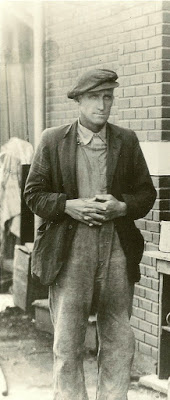
I called up the South Carolina Historic Society today to get information on my great grandfather and his brother. Above is the progenitor of the Lawhern Clan, who is as small in stature, as the caliber of his gun. Those are the tiniest legs I ever saw on a man. You never mind! His offspring have a way with words. This family made a whole bunch of words in telling about their contribution to history.
Johnny Waterfront
https://www.findagrave.com/memorial/140785231/elmer_bradley_lawhern
The Moonshiner Murders
Posted on March 22, 2017 by Royal Rosamond Press
Above is a picture of Yates Standridge. He was one bad man. He killed Sam Rosamond’s father, and blew his wife’s arm off with a shotgun. Look at the size of his hands. You don’t want them lethal weapons clamped on your neck like an old greasy vice in a machine shop. He killed a man in jail. He escaped from jail. The Rosamond boys tried to bushwhack him, but shot the wrong man. Some fled to the oil fields of Oklahoma. Did they eventually…..get their man?
http://3sistershistory.blogspot.com/2015/12/divena-mae-dixon-and-yates-standridge.html
Birth28 Aug 1902
Frankford, Pike County, Missouri, USADeath24 Mar 1995 (aged 92)
Belmont, San Mateo County, California, USABurial
Adamsville, McNairy County, Tennessee, USAAdd to MapMemorial ID140785231 · View Source
Elmer Lawhern was a man with a long life of many diverse experiences, an interesting tale always ready to be told, and a charming little twinkle in his eye. He was a hard working and resourceful person, adapting his skills to the work available, as he supported himself and his family in many places, in many situations, and through many tough times. He lived just 7 years short of experiencing the entire 20th Century.
Elmer Bradley Lawhern was born in Mark Twain country, not far from Hannibal, Missouri. Pat’s father Schuyler and his mother Annie lived there on a farm she had inherited, and Schuyler operated a lumber mill. Schuyler also acquired real estate and became a landlord.
Elmer learned quite young how to care for horses, and left school early to work in the family businesses during an extended illness of his father, often driving the horse-drawn delivery wagons. When he was 14, with World War I raging, the family moved to Gallup, New Mexico, for his father’s health. Elmer again drove delivery wagons and cleaned stables and saloons. As his father’s health improved, Schuyler returned to building furniture and also drove a taxi cab he had acquired and refurbished. Working with horses and wood, transporting people and goods, and being landlords were themes of this father-and-son’s lives.
Elmer turned 16 a few months before the end of World War I, and joined the National Guard, serving in the horse artillery assisting to suppress bandits in the Guadeloupe Mountains, until he was shot in the leg and released. He worked again at driving wagons, and the new Model-T trucks, hauling explosives to area mines. He apprenticed at a funeral home, learning the art of embalming, and driving the hearse, which doubled as an ambulance, requiring him to also learn first aid.
In the early “roaring” 1920’s Elmer followed his parents and little brother, Robert, to Los Angeles. In the quickly growing city, he became a carpenter, and met 23-year-old Violet from Michigan. They were soon married, and had 3 sons in just over 3 years, followed just two weeks later by the beginning of the Great Depression. Elmer kept the family afloat by painting house numbers on curbs, working in a shoe store, a hardware store (one of his very favorite jobs in his lifetime), and a bakery. He and his little family, along with his parents, moved to Palo Alto, California, at this time.
Sadly, late in the term of her 4th pregnancy, Violet seriously injured her abdomen, and her 4th boy died the day after he was born, followed by Violet just 6 days later. With work so hard to come by, and at the urging of close friends, the second son, Paul, was adopted by a nearby-family, and the youngest surviving son, Don, was adopted by a family in Phoenix, Arizona. Art was moved often from home to home among various family members until he turned 16 and went to work at the Mare Island Shipyards, then joined the Navy. Elmer would not see his son Don again for a couple of decades.
In his grief, Elmer followed the California crops to work picking them, eventually ending up in Los Angeles again where he married Abbie, an old friend and the sister of his brother’s wife. In less than 3 years Elmer would have 2 more sons, however the marriage crumbled around the time of the birth of the second child. The older son, Dow, would develop serious brain injuries related to epilepsy and eventually live in group care the rest of his 64 years. The younger son, Densel, was raised by his maternal grandparents until they passed away, then would live in foster care until he enlisted in the Air Force at 17. When Elmer and Abbie split up, Elmer returned north to Cupertino to work in a cement plant, his father died in a car accident, and America was rocked by the attack on Pearl Harbor, all in rapid succession.
War-effort work was plentiful in the Bay Area, and Elmer built cabinets for a new military hospital and helped build ships at a South San Francisco ship yard. The 40-year-old soon married again, to Ollie Mae, a 25-year-old who had just recently arrived to California from Tennessee. Around that time he adopted the nickname “Pat,” which he was exclusively known by the rest of his life. After 2 sad miscarriages, one of them of twins, Pat and Ollie had a son, Richard, less than 2 years after they were married.
Pat would go on to raise Richard, to build his skills in cabinet making and carpentry, to become a landlord, eventually to be reunited with all his sons, and to be married to Ollie Mae for 48 years. He would have 14 blood-line grandchildren born with 3 different last names. In retirement Pat and Ollie would live in Maryville, Tennessee, and Atascadero, California, and this couple would eventually be buried together in Leapwood, Tennessee, in the same cemetery with Ollie’s grandmother, parents, brothers, and several aunts and uncles and cousins.
Birth24 Aug 1864
Clinton County, Kentucky, USADeath20 Sep 1941 (aged 77)
San Mateo County, California, USABurial
Santa Clara, Santa Clara County, California, USA Show MapGPS-Latitude: 37.3352203, Longitude: -121.9537277PlotSection K-3, No. 37Memorial ID143813274 · View Source
Schulyer Lawhern, son of Dee Chestaner and Matilda C. Wilson Lawhern, left Clinton County, Kentucky, in 1878, at the age of 14 and went out West, never to be heard of by his family again. They assumed that he had been killed by Indians. Actually, he had gone to Pike County, Missouri, where he met and married Annie Alice Fishback, daughter of Elias E. Fishback and Mary Ann Davis, in 1899, when he was 41 years old. No one ever knew what happened to Schuyler until 1978, when Richard Lawhern, a grandson of Schulyer, happened to find Bill Lawhern, his second cousin, in a Southern California phone book. Richard and his parents visited Bill, and were immediately sure they must be related because of their similar looks.
Schuyler appears in the 1910 census as a farmer in Peno, Pike County, Missouri, in the 1920 census in Roswell, New Mexico, in the 1930 census as a taxi cab chauffeur in Los Angeles, California, and in the 1940 census as a cabinet maker in Palo Alto, California. Schulyer and Annie had 3 sons, Elmer Bradley, Gibbs, and Robert Lee. Son Gibbs Lawhern, born 20 March 1904, died in Los Angeles on 24 March 1913, at age 9. The other 2 sons are linked below.
Schuyler owned a cabinet shop at 901 High St. Palo Alto, CA. At 67 Schuyler was killed in a car accident at Howard and El Camino in San Carlos, California. After his death, his son Elmer Lawhern took over the business.
**********
Thanks to Amanda B for invaluable help in enhancing this record.
Birth7 Feb 1927
Hollywood, Los Angeles County, California, USADeath24 Nov 2017 (aged 90)
Austin, Travis County, Texas, USABurial
Driftwood, Hays County, Texas, USA Show MapGPS-Latitude: 30.1226651, Longitude: -98.0306691PlotRow 27 #15Memorial ID195444290 · View Source
Arthur Elmer Lawhern, the first child of Violet Amanda Petersen and Elmer Bradley “Pat” Lawhern, was born in Hollywood on the memorable date of 2-7-1927. Soon after, his family moved to Palo Alto, and his childhood was thrown into chaos when his mother died following the birth and death of her fourth son, leaving behind three boys less than five years old. Art’s brothers were put up for adoption. One brother grew up in a near-by home and they became best friends again in high school, but the youngest was sent far away and they were not reunited for many years. His father would marry two more times, giving Art two step-mothers and three half-brothers over the next 13 years.
Art rarely lived in one place more than a year at a time, as his father, grandparents, and other family members and friends tried to care for him during the Great Depression. At times he went with his father to Central California to pick cantaloupes. Later his father and grandfather would start a cabinet shop, where Art worked until he left home to care for himself at 16. Art left school at 17 to work in the war effort. He installed electrical wiring in war ships at the Mare Island Naval Shipyard and trained for Radio Repair.
On his 18th birthday in 1945, just days after the Battle of Luzon, the liberation of Auschwitz, and the Battle of The Bulge, he left California for the Naval Station Great Lakes facility near Chicago to train to serve his country. The following day he contracted rheumatic fever, which permanently damaged his heart, and after recuperating for 17 months in 4 different Naval hospitals, he was honorably discharged from the US Naval Hospital in Dublin, Georgia and awarded his high school diploma. He came back to the Bay Area to work a wide variety of jobs, including driving a taxi, buying parts for the development of new Hiller Helicopters, running a final test and shipping department for a marine radio manufacturer, performing quality assurance on transformers, and managing a Zack Radio store near Stanford in Palo Alto, where he met many pioneers of the Silicon Valley. He learned fine machining skills and helped design manufacturing processes for early electronics parts.
After Arthur’s marriage at 30 to Elizabeth Scott, and the birth of their daughter, Amanda, the couple sought to leave the 1960’s-era social unrest in nearby San Francisco and Berkley, and bought a lot to build on in Quincy, in the Sierra mountains. They lived in a one-room cabin for nine years, while Art worked two or three jobs at a time, and in his spare time designed and built by himself a lovely home. Art ran a machine shop in his back yard to repair auto parts, helped maintain gravel crushing equipment for a friend’s business, and worked over 20 years as a diesel mechanic for the Plumas County Road Department, retiring as the manager of the repair shop there. Art learned to fly, and built part of a single-engine airplane.
In retirement, Art and his wife, known as “Scottie,” enjoyed enhancing their 3-acre lot with award-winning Japanese style landscaping, traveling along the Pacific Coastal states, and visiting family. Then, in 2004, they left their beloved Quincy and moved to Austin, Texas, to live next door to their daughter and their two grandchildren, whom they deeply adored.
Throughout life, Art found in himself the ability to rise above adversity and maintain a positive outlook and a contagious smile. He was an avid reader and a deep and logical thinker, and taught himself many skills. He was a very careful, precise mechanic, machinist and craftsman, determined to do a perfect job. Art was conservative, with strong opinions and convictions on politics, religion, history and economics, and a great desire to debate those topics. He was thrifty with himself, generous with others, and completely devoted to his wife. He loved his country, and his Lord Jesus Christ.
Death19 Apr 2017 (aged 87)
McKinley County, New Mexico, USABurial
Cremated. Specifically: Buried at Creamer Residence, Jamestown, McKinley County, New Mexico, United StatesAdd to MapMemorial ID179024277 · View Source
Donald Dean Creamer was born Donald Eugene Lawhern on August 10, 1929, just weeks before the start of the historic Great Depression, to a family in Los Angeles that quickly became destitute, and things went from bad to worse when Don’s mother died when he was just 2 years old. He was adopted by dentist Dr. Robert Dean Creamer and his wife Mary Jane [Clegg] of Phoenix and raised in that area, spending his summers at a family vacation cabin in Prescott.
Don received a Bachelor of Science in Humanities from Trinity University in San Antonio, Texas, where he met and married his first wife, Barbara Bratton. Together they went to work for the a Presbyterian Mission school for orphans in Haines, Alaska. After their return to the lower 48 states, Don achieved a Bachelor of Divinity from the Dubuque Presbyterian Seminary in Iowa. He was a Presbyterian Minister for 13 years, with pastorates at LaPorte Presbyterian Church in Fort Collins, Colorado, at the Trinity Presbyterian Church on the Yavapai Reservation in Prescott, Arizona, and at the First Presbyterian Church in Plano, Texas. He and Barbara had 5 children before they parted ways.
Don went on to study Educational Psychology at Arizona State, Tempe, where he worked as a Consultant in the Indian Community Action Program with the Tribal Headstart Program. It was on the Salt River Pima reservation that he first met Mary Helen Taptto, a Navajo woman who was the Headstart Director there.
After the death of Mary’s husband in a car accident, Mary went to Harvard University to earn her Masters Degree, and Don followed her to become a Cottage Director and then an Administrator of the Spaulding Youth Center for emotionally disturbed boys in nearby Tilton, New Hampshire. Don and Mary Helen were married, and after Mary’s graduation, they moved to Borrego Pass, New Mexico, to both work in the Bureau of Indian Affairs school system there, Mary as the Principal and Executive Director, and Don as the Vice Principal and Auxiliary Programs Director and Proposal Writer. While there, the couple had one child, and Don adopted Mary’s two children from her previous marriage.
Don and Mary were among the originators of the “Community Controlled School” movement on the Navajo Reservation, working with tribal schools nationwide to lobby the US Congress to get more sufficient, more reliable, more equitable funding. Don personally went to Congress and helped with the passage of two important laws which greatly affected the future of schools for the Navajo Nation. He also fought for the preservation of teaching the Navajo language in area schools.
The couple then moved to Alamo, New Mexico, where Don worked as a Special Projects Director for Special Tribal Projects of the Navajo nation, and Mary as the Director of the Alamo Community Health Program. Don became the Director of Personnel. While there, they also took their grandson into their home and raised him. Next, the family moved to Chuska, New Mexico. Don worked as the initial Executive Director of the Ch’ooshgai Community School, securing the necessary grant, staffing the entire administrative management system, and operating the school for its first three years. Together the couple started summer school programs.
After his retirement at 70, Don delighted in his beautiful property in Jamestown, New Mexico, where he loved to care for his trees, cut firewood, putter in his shop, observe the wildlife, read for 2-3 hours a day, and care for all the family living with him, and be cared for by them. At the time of his death, at 87, just 6 months after Mary Helen’s death, Don had 3 generations of descendants living with him.
Donald Creamer was articulate, industrious, energetic, practical, frugal yet generous, and resourceful. He could be very serious, deep in thought, but he had a dry sense of humor, and when he suddenly smiled, it lit up the whole room. He had a passion to make a difference in life by serving underserved communities, and his contributions to improving the education system of the Navajo Nation will have long lasting effects. He was embraced and loved by the Navajo community, and he loved them back.
Birth12 Apr 1940
Los Angeles County, California, USADeath8 Mar 2022 (aged 81)
Belmont, San Mateo County, California, USABurial
San Mateo, San Mateo County, California, USAAdd to MapMemorial ID237451467 · View Source
Densel Lynn Lawhern, known to all as Denny, was a man who turned a troubled childhood into the source of a deep inner strength for the benefit of others. He was a strong optimist who tried to look for the blessings in each day, and not pass up a chance to love others. His bright smile was infectious, and his heart was genuinely kind. His door was always opened to those who needed a place to stay, including foster children, international students, a younger sister and her family, his aged father, and many others who depended on him. One rarely meets a man so compassionate and giving of himself. He labored tirelessly for not just his family, but also for his community.
Denny was born in Los Angeles on April 12, 1940, just days after Nazi Germany invaded Denmark and Norway. His parents were “Pat” Lawhern and Abby Summers, who separated before he was born, so he grew up with various family members and partly under foster care. He moved around from Los Angeles to Henderson, Nevada, to San Bernardino, California, then to the Delhi/Turlock/Merced region, as well as to Palo Alto, and his frequent moves left him with a deep longing for “roots.” He would spend his lifetime dedicated to growing “roots” ever deeper for his family, and in his community.
In 1957, as a 17-year-old Junior in high school, Densel joined the US Air Force and served his country at George Air Force Base, Victorville, California, where he completed high school at night. Then he went on to be stationed in Anchorage, Alaska. He was in the regular Air Force for four years, and in the reserves for two. He was a patriot of his country all his life, and a strong supporter of our troops.
On November 10, 1962, Densel married Toni Lee Lowe in Turlock, California, where he was working as an auto mechanic for Farish-Herzog Pontiac. A few years later, they moved to Belmont, California, to raise their family. Both became active members of their community, soon buying a home. Denny started work as an auto technician at Superior Body Shop in San Carlos, retiring 58 years later as a Manager/Estimator. In support of his work there, he received an Associate of Arts degree in Automotive Technology/Management from College of San Mateo, in 1982.
Denny earned his Private Pilot’s license in the 1970’s, and enjoyed flying for many years, with his wife as his co-pilot. One of his avid hobbies was studying aviation history.
As Denny set down his “roots” in Belmont, he did it with all his might. He served 12 years on the Belmont Planning Commission, where he helped direct some of Belmont’s largest projects, including Island Park, San Juan Hill Plan, Western Hills Plan and the Downtown Plan. He was the President of the Sterling Downs Neighborhood Association, Vice-President of the Nesbit School PTA, a member of the Ralston and Harbor Grade Separation Task Force, the Emmett Store Preservation Committee, the Twin Pines Bond Committee, chairperson of the Historical Buildings Review Task Force, a member of the Belmont School Facilities Committee, and of the Heritage Tree Committee. He also was a Boy Scout leader and volunteered with the YMCA and the Red Cross. For twenty years he served as Santa Claus for the fire department. In 1997 he received The Belmont Chamber of Commerce William Chapman Ralston Award for his outstanding community service.
In 1987 Denny was a founding member of the Belmont Historical Society. For 37 years Denny served as the City Historian and for 14 years was President of the Board of Directors. He was Curator of the Belmont History Room at The Manor House, 10 Twin Pines Lane. The society has helped to establish many of the city’s buildings as historical landmarks. He worked diligently in a volunteer capacity to collect, catalog, archive, digitize, meticulously organize and display the history of his beloved city, scouring old newspapers and estate sales for source material and artifacts. He uncovered a wealth of information on local history, became an oft-quoted resource, and spoke frequently to citizen groups, schools, scouting clubs, and senior care facilities around the area, using several 30-minute slide shows that he created. He would bring with him historical objects that he encouraged people to hold in their hands and “feel” the history, and he operated the museum with this interactivity goal as well. His desire was to help others find their “roots” in Belmont, just as he had. For his work Denny received the 2019 Community Service Award from the city.
To put down “roots” in another manner, Denny became the family genealogist and historian, compiling a massive family tree. He did original research around the country, united two branches of his Lawhern tree that had lost each other a few generations ago, and even travelled to Britain to accomplish some research there. He traced his Lawhern line back to an orphan in London who was indentured to a sailing ship as a teenager, eventually putting down “roots” in Virginia before the year 1700.
In his free time, Denny extensively travelled the backroads of California and the West Coast to take nature hikes, photograph the area, and visit small museums. One of his favorite places to visit was Yosemite, where he took many stunning photographs over the years. He owned an RV and travelled the USA in the company of his sister Abbie after the untimely death of his wife. One long driving trip was to Alaska, and two times they travelled all the way around the US, visiting distant cousins, family history sites, and most of our National Parks.
On these trips, Denny developed his skills as an outstanding photographer. A show of his wildlife photography from Alaska was mounted in August, 2009, by the Belmont Arts Council at Twin Pines Park. If was named “Denny Gone Wild.”
Denny lovingly cared for his home in Belmont for 55 years. In recent years he worked diligently to make it energy efficient, and carefully renovated and cultivated his yards to make them an oasis for his family’s enjoyment. Throughout his life he loved using his home for family reunions and gatherings, and one of his greatest joys was to have as many family members at his extended dining table as possible. He even created a special art room for younger members of the family to come play in.
Denny was a survivor against many medical hardships, including a heart attack and surgery, kidney cancer and skin cancer. He worked hard in his later years to constantly improve his diet and exercise. However, time took its toll, and Denny passed away at his home on March 8, 2022, after a life well-lived. He was interred at Skylawn Cemetery, Half-Moon Bay, alongside the ashes of Toni, his beloved and painfully missed wife of 43 years, who preceded him in death in 2006.
Densel Lawhern was also preceded in death by brothers Ernest, Dow, and Arthur Lawhern, Don Creamer and Paul Smith, and their wives. He is survived by his brother Richard (Maren) Lawhern and his daughter Helene (Paul) Kocher; sister Glenda (David) Laird and their daughter Michelle (Ryan) Dudley; sister Abbie (Richard Vaught) Hull and her son Matt (Veronica) Hull, and their daughter Melissa Vaught; daughter Toni Lynn (Michael) Charlesworth; foster son Dwight (Valerie) Pedersen and their daughter Madison; and son Jason Lawhern, as well as his Lawhern cousins. Particularly close to Denny were Abbie’s children Melissa and Matt, and his daughters Camila and Viviana, who Denny considered his grandchildren, along with Dwight’s daughter Madison. His niece Helene and her children Sophie and Eric were also very close. Denny was Uncle to 17 nieces and nephews, and their many children and grandchildren. He will be sorely missed and long remembered by his family, and the thousands of volunteers and citizens of the city of Belmont that he interacted with and faithfully served.
Indentured Servant from 1600’s England

The following was written by Rebekah Jackson after interviewing her friend Denny Lawhern about his own investigation into his family history. It focuses on Denny’s 8th Great Grandfather, (1607 – 1692), Thomas Doggett who came to the colonies in 1637.
PART I-
Thomas Doggett was born in Wendover, Buckinghamshire England July 4th 1607. In May 1637 at age 30, Thomas Doggett sailed aboard the ship the “Mary Anne” with William Goose as Master. Thomas came as an indentured servant to Thomas Oliver, a Calinder (English title), age 36, of Norwich.
The Mary Anne sailed out of the little Village of Norwich on the East coast of England On May 1635 arriving in Boston, Massachusetts, June 20, 1637.
Thomas settled in the American Colonies in the area of Concord with the Thomas Oliver family. Thomas Doggett serviced off his indentured obligations for Thomas Oliver for about a year.
Thomas Doggett continued to live in the Concord, MA area and met his first wife there. They had one child, John Doggett, born 1642 in Concord. However, tragically Thomas’s first wife died in childbirth.
Thomas Doggett and his first son John Doggett would then move to the Weymouth, MA area where Thomas would meet his second wife, the widow Elizabeth Fry (maiden name Humphrey) and her two children, both girls. They were married in Weymouth, MA. Thomas and Elizabeth would have one child together, Samuel Doggett, born 1652 in Weymouth, Ma. Tragically, Thomas Doggett’s second wife Elizabeth would also die in childbirth, leaving Thomas Doggett a widow with four children- his two boys, John and Samuel, and the two girls from his first marriage.

In 1653 Thomas Doggett at age 45, and with four young children, would move to Marshfield, Ma. There he would meet the widow Joan Chillingsworth (maiden name Hampton) and her two children and they were married May 17 1654. They would have four children together: Rebecca, Jemima, Patience and Martha, bringing the total to ten children between the two of them.
Thomas Doggett would purchase a 120- acre farm in 1659 in Marshfield to help support the big family. He was a master craftsman of all trades and could build or fix anything. Thomas was also very active in the little village of Marshfield serving as the town Constable, Surveyor, Selectman, Grand juryman, Coroners Jury and Tax collector.
-Thomas and Joan had a good 30 years farming and raising their families together. Joan passed away on Sept 4th, 1684 in Marshfield Ma at the age of 68. Thomas Doggett would live to the age of 85, passing away in Marshfield, Ma. They are both buried in the Winslow Cemetery, in Marshfield, MA.

When Thomas Doggett immigrated to the colonies over 400 years ago he probably could never have imagined that his “family” tree would grow to over 15,000 relatives today.
PART II-
Interview Commentary by descendant, Denny Lawhern:
My friend, Denny began researching his family tree over ten years ago and discovered Thomas Doggett and his journey to the British Colonies- being the earliest relative he found to be an immigrant to what would become the USA. Denny utilized Ancestry.com and through submitting a DNA sample would learn of a multitude of relatives- many of whom he would interview for the creation of his family tree. He also located several documents pertaining to his relative Thomas Doggett and visited the town of Marshfield, MA in 2017 to research his relative.
Denny remarked that through his research about his relative, Thomas Doggett, that “(He) never met the gentleman, but (he) ‘talked’ to him through all of the documentation.” Denny says he “…can visualize him.”
Denny learned that in Thomas’s day it was common for a widower to marry a widow- a young woman’s family might not find a widower, especially with children, a suitable match for their young daughter. It was typical to blend the families of widower and widow with the widower “adopting” the children of the widow and continuing to care for them as family even if their mother passed away.
Thomas’s Indenturor, Calinder Thomas Oliver was married twice and lost both wives to charges of “witchery” in Massachusetts. They were shockingly both burned at the stake.
Denny also located Thomas’s actual Will- the distribution of his worldly goods that included land, animals, furniture, clothing, items made of pewter, brass and iron, farming items and books.
The Will.
Of note is that Thomas’s third wife, Joan Chillingsworth’s first husband and his father were co-founders of the town of Marshfield, MA along with a few other families. In Thomas’s day there were about 50 families in the area, and it is not far from Plymouth, MA where the pilgrims landed.
Thomas’s grave at the Winslow Cemetery is marked by a large boulder- Denny has a photo. The burial grounds have several boulders, approximately 20-30. Of note is that Daniel Webster, of Webster’s Dictionary fame, is buried in the same cemetery.
Denny visited the town of Marshfield in 2017 and viewed documents pertaining to Thomas Doggett at the Town Center- the documents are housed in a vault. He has copies of several documents and includes here a drawing of the ship the “Mary Anne” that brought Thomas to the colonies, his Will and the present-day Marshfield, MA town sign.
Denny feels that his strong drive for volunteerism and community service, as well as his love and passion for craftsmen work, has been passed down from his 17th century relative Thomas Doggett- who was a farmer, a family man and wore many hats in service to his community.
Reflection from Rebekah:
What changed for me was realizing that every person’s journey as an immigrant is both unique to that person and yet similar to others taking the same leap at the same time in history. Their reasons could be opportunity, escape, religious, political, economic, safety, persecution, both legal and illegal rationales, etc., and these reasons don’t seem to change over history nor geography. I could see the inter-connectedness with the past and how globalization includes emigration/immigration both spatially and over time on our planet encompassing the present day and into the future. No matter how government and political entities might try, you can’t stop people moving from area to area, from region to region- it is a global force unto itself.
This interview and narrative were written by Rebekah Jackson, a student at Foothill College.
 Rosamond Press

Leave a comment