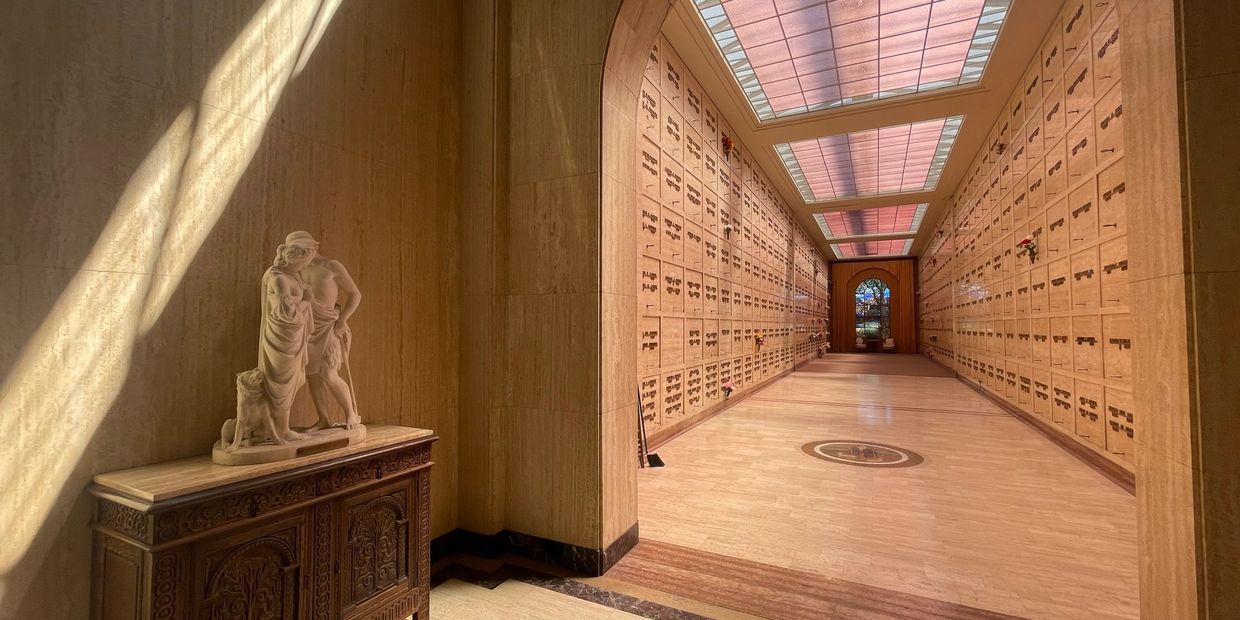
Established in 1927 by Arthur F. Edwards, Sr.
An extraordinary museum like historic everlasting Mausoleum.
I called and texted the Golden Gate Mausoleum and found a cluster of four of my JANKE kinfolk, buried together. They sent me a photograph by text, but my phone did not allow me to see where they are. I will post when I get some of the images.
Below is some of the testimony of Belmont citizens. One of them is the granddaughter of Carl Janke, Doris Vannier. I hereby copyright this account of the history my family made. The word “historic” is applied to what we see when our loved one are honored – forever! The City of Belmont should move my relatives to this beautiful and historic place of rest.
John Presco


https://www.findagrave.com/cemetery/2184911/golden-gate-mausoleum-and-columbaria
https://www.findagrave.com/memorial/32414406/william-august-janke
https://www.findagrave.com/memorial/251033431/rose_hannah_lindsey
MRS. ROSE H. LINDSEY OBITUARY
SONORA, June 22- Final rites for Mrs. Rose Hannah Lindsey, 90, of Twain Harte will be held at 2 p.m. tomorrow in the Terzich-Wilson Funeral Home Chapel.
The Rev. Russell Peters of Twain Harte Community Church will officiate. Burial will be Monday at 2 p.m. at the Sunset View Cemetery in Berkeley.
Mrs. Lindsey died in a local hospital Thursday after an extended illness. She was a native Californian born at Belmont, San Mateo County, California and moved to Twain Harte 17 years ago. She was the wife of the late John Bachelder Lindsey who preceded her in death in 1914.
Suvivors include a daughter, Mrs. Ruby Hall of Twain Harte, a granddaughter Dorothy of Sacramento and two great-grandchildren.
William August Janke
Birth 17 Jan 1866 San Francisco, San Francisco County, California, USA Death13 Jul 1948 (aged 82) Contra Costa County, California, USA BurialGolden Gate Mausoleum and Columbaria Kensington, Contra Costa County, California, USAAdd to MapMemorial ID32414406 · View Source
Share
Save to
Toggle Dropdown
Sponsor this memorial with an exclusive premium layout and no ads.Sponsor this page
Family Members


https://www.findagrave.com/memorial/32414178/earl_ferdinand_janke
https://www.findagrave.com/memorial/32414274/maude_alice_janke
The two sisters, Adelia and Edna had homes on Ralston Ave. across from the present Twin Pines of today . Edna McGowan also was a member of many of the local organizations .
Between Emmet St. and Waltermire St. on the present site of Safeway, I remember a very large home and grounds. That old house was torn down a few years later.
On the N.W. corner had been an open field until a gas station opened there . Next to it was a small building called ” Shady Inn ,” a coffee shop and sandwich shop . It was owned and run by Mr. and Mrs. MacDonald and Mrs. Morser- nothing very elegant but just a place to drop in for a bite and a chat. Then came the lane, Janke Lane , shaded by many huge trees, mostly cypress and very pretty . It could have been called “Shady Lane” . Across the lane was a neatly fenced-in home with weedless, spotless , beautiful gardens . The fences along the lane and on Ralston Ave. were covered with honeysuckle and roses , which were often picked as people passed by. In that place lived the wife and daughter of Charlie Janke. For some unknown reason Louisa Janke was known as ” Old Fat” -probably from her younger days when she was more plump. Her daughter Dora Craig and she maintained one of the neatest places in town . They could be seen weeding or sweeping walks and spots between plants. The inside of the house was spotless too. They were reported to be excellent cooks . Louisa has helped cook and serve food in the Belmont Picnic Grounds in the earlier days. Next to the J:rnke place was a small white cottage. Many families lived there, over many years . One of the early families was the Matt O’Neills: the former Jane Barre , who remarried after the death of her husband and became Mrs. Jane Welde . Next came the home of Charlie and Emily Rich whose daughter was Dorothy and mostly called “Dolly ” , her father’s favorite name for her . Their home was a large two-story shingled house with a nice porch across the front and some bricks toward the foundation. It had a circular drive in front of the home, a piece of lawn originally in the circle and later the lawn replaced by a mound covered with small plants . Emily Rich spent many hours on that porch , her hands always busy with embroidery or crocheting or any kind of hand work. She was very artistic, as was her daughter . Charlie Rich had worked at the “pump works” between Belmont and San Carlos on the eastern side of El Camino Real.
The two sisters, Adelia and Edna had homes on Ralston Ave. across from the present Twin Pines of today . Edna McGowan also was a member of many of the local organizations .
Between Emmet St. and Waltermire St. on the present site of Safeway, I remember a very large home and grounds. That old house was torn down a few years later.
On the N.W. corner had been an open field until a gas station opened there . Next to it was a small building called ” Shady Inn ,” a coffee shop and sandwich shop . It was owned and run by Mr. and Mrs. MacDonald and Mrs. Morser- nothing very elegant but just a place to drop in for a bite and a chat. Then came the lane, Janke Lane , shaded by many huge trees, mostly cypress and very pretty . It could have been called “Shady Lane” . Across the lane was a neatly fenced-in home with weedless, spotless , beautiful gardens . The fences along the lane and on Ralston Ave. were covered with honeysuckle and roses , which were often picked as people passed by. In that place lived the wife and daughter of Charlie Janke. For some unknown reason Louisa Janke was known as ” Old Fat” -probably from her younger days when she was more plump. Her daughter Dora Craig and she maintained one of the neatest places in town . They could be seen weeding or sweeping walks and spots between plants. The inside of the house was spotless too. They were reported to be excellent cooks . Louisa has helped cook and serve food in the Belmont Picnic Grounds in the earlier days. Next to the J:rnke place was a small white cottage. Many families lived there, over many years . One of the early families was the Matt O’Neills: the former Jane Barre , who remarried after the death of her husband and became Mrs. Jane Welde . Next came the home of Charlie and Emily Rich whose daughter was Dorothy and mostly called “Dolly ” , her father’s favorite name for her . Their home was a large two-story shingled house with a nice porch across the front and some bricks toward the foundation. It had a circular drive in front of the home, a piece of lawn originally in the circle and later the lawn replaced by a mound covered with small plants . Emily Rich spent many hours on that porch , her hands always busy with embroidery or crocheting or any kind of hand work. She was very artistic, as was her daughter . Charlie Rich had worked at the “pump works” between Belmont and San Carlos on the eastern side of El Camino Real.
with white trimming. One was the home of Sophie Hacquette and her two sons, John and Ernie. The homes remained there until crowded out by Perkins apartments, later owned by Dr. Pope and family and the other homes replaced by stores etc. along El Camino Real.
BUILDING AND PEOPLE By Doris Vannier
One of Belmont’s most prominent buildings today has an interesting background. It is the pink building on the north side of Ralston between Old County Road and the railroad tracks. According to records from the then San Mateo Times and Gazette, in the late 1860s, Edward Waltermire and a Mr. Clark erected the building, and commenced merchandising. By 1872 after both original owners had passed away it was owned by H. Carstens and C.F. Janke. By 1873 C.F. Janke and H. Carstens had a flourishing business both wholesale and retail in groceries and general merchandise. In 1876 there was another building added to the store to be used for the manufacture of soda water. By 1880 Alfred W. Emmett had purchased the merchandise store and also had taken over the Post Office located there. Mr. Emmett and his family operated the store for many years. It had everything country people could want. As you walked in from Ralston Ave. on the right side inside thebay window was a counter which contained various 11 items, especially cigars and daily news papers. Mrs. Emmett spent much time in that area. Behind it on the corner of Old County Road and Ralston Avenue was a small area walled in for the Post Office . Either Mr. or Mrs. Emmett took care of that. There was a door nearby that opened onto Old County Road. Opposite these two areas was another bay window. Between them was the main entrance from Ralston. In that area was a miscellaneous collection of many things. Continuing up the west side of the building along the railroad track side were shelves with everything you could think of. Bolts of material with sewing needs were plentiful, and neatly shelved in boxes were ladies corsets-name it-It was there-Some where were shoes and boots. The center of the store had odds and ends of this and that. The most important part was the grocery store-backed on Old County Road side. There were cans packed on shelves, huge cheeses on the counter ready to be cut the size desired. Finally , cheese cloth covered the cheese because flies came and went! The doors were always open. There was a large door opening on that side. People could come across from the butcher shop where the red barn building is now. That shop had had many butchers over the years. Probably George Neal or Charlie Lambert being among the first ones: later it was owned by Mr. Main. Back to Emmett’s store: across from the grocery counter were barrels , pickles, pickled fish etc. Behind the main building the coal and coal oil was stored. It was not uncommon for the son, Walter, to come in from there , hands still dirty from that sale. He’d give them a “swipe ” on apron or cloth and proceed to cut the cheese or dive into the barrel for fish etc. No one seemed to object! They were nice people to deal with and families charged their purchases. The tags were put on a file on the wall and paid off when convenient. Many never were paid. Sometime about 1930 Emmett gave up the store. Mr. Main, who had had the butcher shop on Old County Road, took over the store. He had his butcher shop there. Mr. Manzoni had the grocery and vegetable departments. later, Mr. Main moved to a building on Ralston-(where Santa Barbara Savings is now). He had the butcher shop on one side while the main part was a grocery and vegetable store . For some time Emmett’s store was empty until it was used during WW-2 as a Hospitality House. The soldiers based where Sterling Downs homes are now came up and were served refreshments and talked with the Belmont women who were hostesses. After the war it was closed, and has since been the furniture store now painted pink , by the railroad tracks. The Emmett family, Mr. and Mrs. Emmett and daughter Laura lived across the highway. The big house next to the present oil station on the south-west corner of Ralston was their home. It was considered a real nice home with a neat and pretty garden in front. It had some of the most beautiful hydrangeas grown.
With the widening of Ralston most of the garden was taken. The inside of the house was spacious, especially for such a small family . Both Mr. and Mrs. Emmett were rather small in size and a little on the “plump” side. Both were friendly refined people whom you could see walking back anf forth from store to home. That building has changed hands several times. It had been remodeled for small apartments and rooms upstairs and outside stairs etc. added on the oil-station side. At present it is used for antiques and art objects . The interests and hobbies of some of our former Belmonters varies-but we had them. Before autos were used so commonly men traveled to work each day by train. To while away time they met in little groups, played cards, and exchanged ideas in general. One of those ideas was the forming of San Mateo County Poultry Association. Families specialized in certain varieties of chickens. L. C. Vannier was always a good organizer so before the group had raised their choice birds (or chickens) and were showing them not only on the peninsula but all over California and even to the east-“Madison Square Garden” in New York, in competition. It was a serious matter. L. C. Vannier first showed White Rocks-a beautiful large fluffy chicken. Each one was carefully washed and dried and powdered and then each scale on the legs had to be very carefully cleaned with a wooden toothpick. To break a scale or feather would almost disaualifv said entrv. From there on the hen or rooster was crated with labels of instructions for feeding and watering and to be kept out of a draft on way to destination. While on the train each crate was to be kept a distance from another or the chickens would poke their heads out and fight each other thus becoming a scarred up mess for entry.
After the White Rocks, came the Plymouth Rocks, hens and roosters same preparation, and finally the more beautiful specimen the Silver lace Wyandotte. The price of eggs for raising was five dollars for fifteen eggs. The Vannier basement became the hatchery, using kerosene incubators at first and later electricity. Of course they were small , holding about one or two dozen eggs that had to be hand turned regularly. Hens were too heavy and clumsy to trust with expensive eggs. All this enthusiasm took place in the early 1912-1913 times, and continued until the first World War in 1918. They won ribbons and trophies which were proudly treasured. Even now his family has stationary with pictures of a prize rooster on envelopes and paper. Also there is a trophy cup engraved on one side: ” Presented by H. C. Caldwell, Belmont Hotel, For Best Display of Silver Laced Wyandottes , and on the other side, San Mateo County Poultry Assn. Dec. 5-7, 1913.” The many ribbons ” Specialty “, Best of Show, First, Second, or Third prize ” have long ago been discarded but at that time were for Prize Winners .
sometime , were removed and the shopping center spread out with the parking lot facing Ralston and Bay View Savings rebuilt on Kate Williams’ property , with a driveway around Bay View Savings, coming out to Ralston on what was “Alf Elms” property.
In the second block of Ralston west side there were fewer homes. After “Al Hansens ” , were empty lots with grape
vines, and quince trees through-out. For years the next house was the home of Robert and Edna McGowan , and
daughter Ruth. Robert was an attorney in San Francisco a~d Belmont. He also was a postmaster appointed by Pres.
Woodrow Wilson in 1914. His wife was Edna Johnson ; grand-daughter of Carl and Dorothea Janke. She followed
her husband as postmaster, appointed by Pres. Herbert Hoover.
They later sold the property and moved up to 1801 Ralston near the Carlmont Shopping center. The large pink
3
building now the Margarite Apts. opposite Twin Pines entrance was built on that property.
At one time earlier there had been a house built and occupied by Willard and Barbara Harry , just before the
McGowan home , but it had been removed and put over in Bay View Heights on 6th Ave ., once more leaving an
empty lot.
In recent years those empty lots had office building built there across from the Wells Fargo bank . That white
building with green slanting roof was an eye-sore to the town until townspeople got used to it. The building is
presently named “Woodlake”.
On the west side of McGowan ‘s home was a large lot. It had a small building ,just adequate for weekend picnics in
the country. The owners seldom used it. Across the front were locust and pine trees.
The field had grapevines and just grass, plus a few fruit trees that died from lack of care .
The McGowans’ goats and chickens sometimes roamed there , and later Ruth ‘s famous old race horse ” Heroaca “
exercised there. That property remained empty until about WW-2 when Mrs. Peterson , with her two sons and three
daughters built their home there. There were no children; just grown-up young people and their mother . After
then it was sold several times and finally Rupert Taylor Real Estate offices are using it today.
Then came the home of Lewis and Adelia Vannier and their three children , Doris , Florence and Ernest. Adelia
was a sister of Edna McGowan.
The Vannier home was a shingled bungalow type, with a small basement. In the front yard was a miniature of
every kind of flowers , anything that would grow in adobe. Also there was an almond tree in center front yard , an
apricot tree, which son Ernest said his mother killed by cutting off small branches for ” switches “. Never-the-less it
lived for many years and gave few but delicious fruit. Across from the kitchen was a group of lilac tree bushes, very
fragrant. They were especially loved because they came from Adelia ‘s child-hood home, which was where El
Camino and Hill Street are now.
/The house was on the side of a hill so the back yard was a few feet higher . It had several fig trees that supplied
friends and neighbors with plenty of figs . Also there was an almond , another apricot and a plum . Beyond that were
the chicken yards that went up to South Road. Lew Vannier had a hobby before WW-1 . that was raising prizewinning chickens and sending them all over the United States for show and in competition . They were hatched in
incubators in the small basement under the front of the house. When he entered the service at Camp Fremont in
WW-1 his wife Adelia decided to end the hobby , which resulted in delicious chicken dinners.
From then on any egg laying and good eating chickens occupied the yards.
During WW-2 while son Ernest was overseas, Bantams, a few large chickens and an attempt at raising turkeys took
place . The forty some chickens did fine, but the turkeys were a trial and experience and seldom reached the dinner
table.
When the family moved from there in 1957 the house was sold and stood empty for sometime. The property is
now a parking lot for the Rupert Taylor real estate company .
The hous~ west of the Vannier ‘s was a larger home built about 1909 by a Mr . Roussell, brother of George Roussell.
He was the stepfather of Inez Kelley, who became our Belmont and Bi-Centennial Queen in 1976.
During that year of the new house the Vannier family had moved to San Diego where Mrs. Vannier’s brother,
Amasa Johnson II and family lived. The Vannier house was rented to a Kelly family with many children .
The Roussell house spread across a large lot and was a two-story place with large glass windows and glass doors. It
seemed more elegant than most of the others although plain and practical , long and narrow .
A family by name of Levi son lived there. There was one small son. That property extended from Ralston through
to South Road, some of it at the foot of the now Holly Road. There were nice plain gardens front and back. Also
there was a small building near the middle and on the Vannier side. Behind that , closer to South road , was a stable
and a huge water storage tank above on a platform. To reach the water tank there was a ladder leading from the
barn- the floor covered with straw with strong odor of horses. On the wall near the ladder were hanging pieces of
old harnesses etc. needed for horses. That water tank was high above the ground and a temptation for children to
explore .
After the Levi family moved other families had the place; one the Voorhes. Mrs. Voorhes’ brother and young
daughter lived there for awhile. Later Dr. Gottbraith and his wife bought the place. It was rather large for two
people.
Dr. Gottbraith by that time had acquired the George Center home across the street , the present manor building in
Twin Pines. It was used as his medical office and business, a forerunner of the Sanitarium , Dr. William Rebec
operated .
When Dr. Gottbraith and his wife left , their Ralston hime was acquired as part of Rebec’s Sanitarium. The barn
vanished with the water tank , and the little house was enlarged to serve as rooms for the nurses. The rooms were
very small , just big enough for a single bed , dresser and chair and a little privacy. They all opened onto one larger
room used as a living room . Meals were served across the street. When a nurse was ill or not on duty another nurse
was often seen bringing over a tray of food.
Beneath the front of the nurses’ home was space for the men cooks and helpers. They were the Phillipino boys; a
happy bunch usually singing or giggling. Sometimes there were musical instruments to add to the musical

 Rosamond Press
Leave a comment