I implore Governor Newson send in U.S. Marshalls and seize the records of the Belmont Historic Society. I believe Denny Lawhern knew about the extensive influence of Germans in the exploration of the Bay Area and California.
John Presco
Early California
Heinrich Lichtenstein. Beitrag zur ornithologischen Fauna von Californien nebst Bemerkungen über die Artkennzeichen der Pelicane und über einige Vögel von den Sandwich-InselnBerlin: 1838
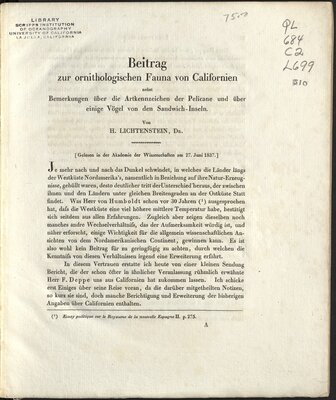
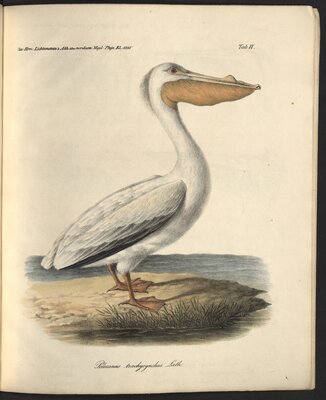
The majestic white Pelican and other Pacific birds caught the attention of zoologists and explorers like Martin Heinrich Karl Lichtenstein (b. 1780 Hamburg, d. 1857 at sea). Lichtenstein was named the Director of the Berlin Zoological Museum in 1713 and later became the Director of the Berlin Zoological Gardens, which were created at his initiative. This volume offers an introduction to the birds of California and the Sandwich Islands, the name given by Captain James Cook to the Hawaiian Islands.
Paul Alexander. Kalifornien: nach eigenen Beobachtungen und Erfahrungen: unter Benutzung der besten QuellenLeipzig: 1883
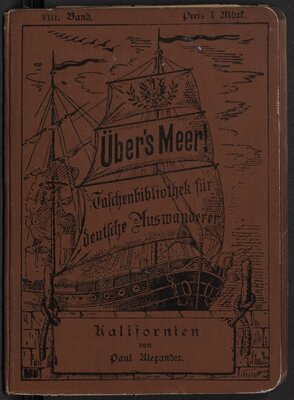
California drew many German immigrants to its coast during and long after the Gold Rush. One such man, Paul Alexander, recounted his experiences and offered his views on California and its peoples in print. This volume of helpful information for prospective travelers and immigrants appeared in a series of handbooks pitched to Germans for one mark per volume. Earlier volumes included guides to Wisconsin, Argentina, and Canada, and an introduction to the English language. The Pacific coast was the new frontier. Accordingly, Alexander’s account of California was followed with a book on Oregon. The volume was small enough for a traveler to carry on his person.
Georg Heinrich Langsdorff. Bemerkungen auf einer Reise um die Welt in den Jahren 1803 bis 1807Frankfurt am Main: 1812
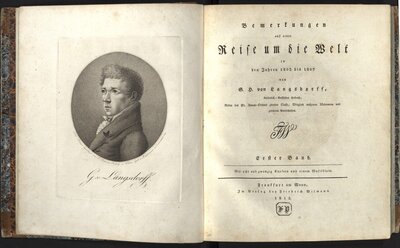
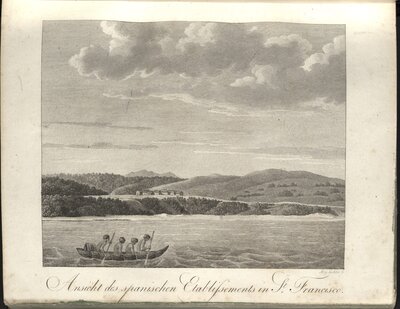
This sketch portrays San Francisco as it was seen by Georg Heinrich Langsdorff and his Russian traveling companions in 1806. As the inscription beside the picture notes, San Francisco was still a Spanish settlement at that time. Their visit paved the way for an increased Russian presence along the California coast in following years.
Jakob Baegert. Nachrichten von der Amerikanischen Halbinsel Californien: mit einem zweyfachen Anhang falscher NachrichtenManheim: 1772
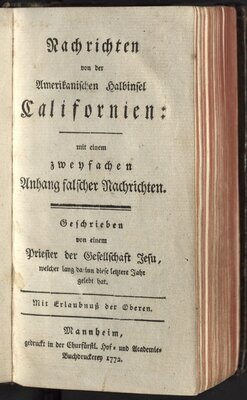
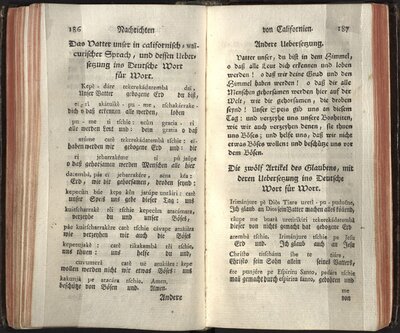
Jakob Baegert (b. 1717 Schlettstadt, d. 1772 Neustadt) was a Jesuit missionary in Baja California from 1749 until the Spanish king expelled the Jesuits in 1767. He spent eight months in a Spanish prison before he was able to return to Germany. While working as a priest and teacher at the Jesuit College in Neustadt, Baegert wrote an account of his experiences in California, including ethnographic and linguistic information about its indigenous population. This is a copy of the second edition of the work (the first appeared in 1771). The text was subsequently printed in English and Spanish, and it remains an important source of information for the early history of California. This page features a translation of the Lord’s Prayer from the Guaycura language into German.
Ignacio Tirsch. Scenes of Baja California
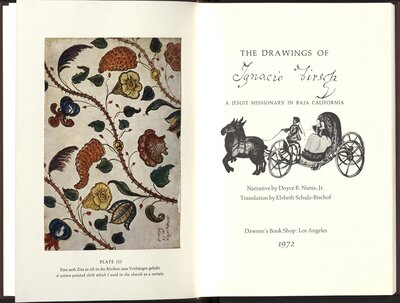
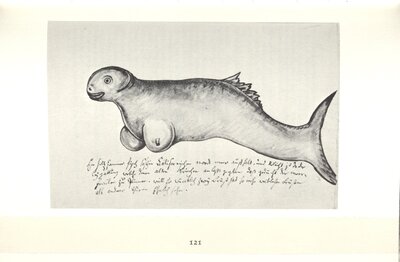
There are few personal records about the Jesuit Ignacio Tirsch (b. in Böhmen in 1733). He served as a missionary in Baja California until the expulsion of 1767, and was imprisoned in Spain before he escaped to Belgium in 1769, where his traces disappear. Yet Tirsch left the most vivid images of eighteenth-century Baja California, depicting its varied landscape, diverse inhabitants, and colorful fauna and flora, including marvelous creatures like the sketch of ‘a strange fish’ on display.
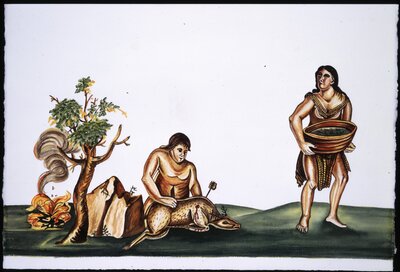
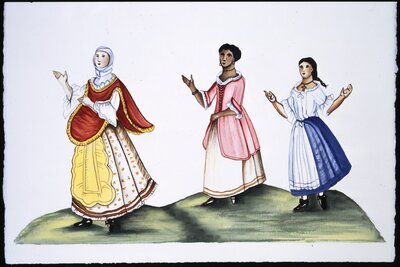
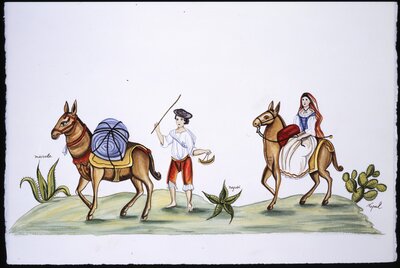
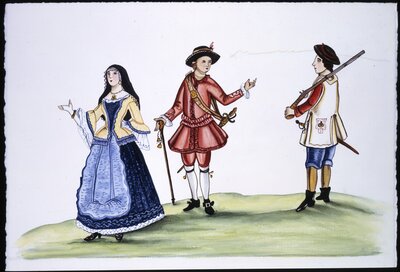
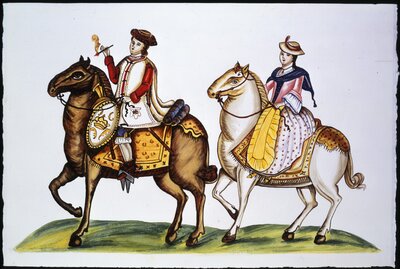
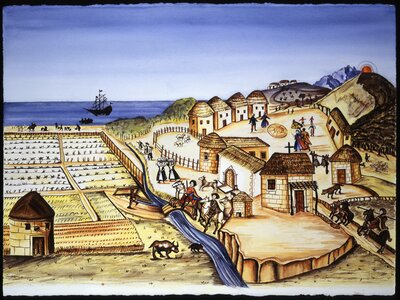
These six faithful modern renderings, in watercolor, of Tirsch’s beautiful oil paintings are by the artist Joanne Haskell Crosby and were completed in 1993-1994. Her interests and depictions of Baja California connect her work to that of her husband Harry W. Crosby, the well-known La Jolla-based photographer and author.
Eusebio Kino. Tabula Californiae, anno 1702San Francisco: c. 1925
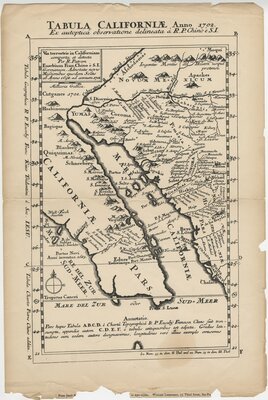
Eusebius Kino (or Kühn; b. 1644 in Welschtirol, d. 1711) was a famous Jesuit who established many missions across what is now California, Southern Arizona, and Sonora, Mexico. Kino’s detailed reports and cartographical sketches of California provided Europeans with precious information about an otherwise largely unknown part of the world. He went on a daring overland expedition from Sonora to California to confirm that Baja California was a peninsula rather than an island. An expert in mathematics and cartography, Kino produced the first accurate European maps of the state. This is a copy of his 1702 map of California, which clearly outlines the Baja peninsula.
Georg Heinrich Freiherr[1] von Langsdorff (8 April 1774 – 9 June 1852) was a German naturalist and explorer, as well as a Russian diplomat, better known by his Russian name, Grigori Ivanovich Langsdorf.
He was a naturalist and physician on the First Russian circumnavigation from 1803 to 1805. Later Langsdorff was nominated consul general of Russia in Rio de Janeiro, Brazil. From there he organized expeditions to Minas Gerais (1813 to 1820) and the Langsdorff Expedition to the Amazon rainforest, which lasted from 1825 to 1829.
Life
[edit]
Georg Heinrich Langsdorff was born in April 1774 at Wöllstein, in the Electoral Palatinate, Holy Roman Empire. He studied medicine and natural history at the University of Göttingen, Germany, under Johann Friedrich Blumenbach and graduated with a doctorate in medicine and surgery in 1797.[2]
That same year he accompanied Christian August, Prince of Waldeck and Pyrmont, Field Marshal of the Portuguese land army, to Lisbon. However, after Prince Christian died in 1798, he set up a private medical practice, and subsequently accepted the post of surgeon to English troops in Portugal. After the Treaty of Amiens he visited London and Paris, and returned to Göttingen.[3]
He was appointed a member and correspondent of the Russian Imperial Academy of Sciences on 29 January 1803. He requested to join the scientific crew of the First Russian voyage of circumnavigation but received a polite rejection letter; the expedition’s ships would take on board the official naturalist at Copenhagen. The day he received the letter he left Göttingen and reached Copenhagen in seven days, where the Russian ships were still docked. He implored with ambassador to Japan Nikolai Rezanov, and supported by Captain Adam Johann von Krusenstern, his petition to join the expedition was granted.[3]
Russian Voyage of Circumnavigation
[edit]
Main article: First Russian circumnavigation

Langsdorff participated as a naturalist and physician in Krusenstern’s Russian expedition from 1803 to 1805. On this journey he visited Falmouth in England, Tenerife in the Canary Islands, Santa Catarina Island in Brazil, Nuku Hiva, the Hawaiian Islands, Kamchatka and Japan.
When the expedition returned to Kamchatka he left with ambassador Nikolai Rezanov and headed to the northwest coast of North America. He explored the Aleutians, Kodiak and Sitka. At Sitka he met and befriended the American maritime fur trader John DeWolf, who sold the RAC his ship Juno. Langsdorff and Rezanov traveled sailed Juno to San Francisco to acquire food for Sitka. From Sitka, Langsdorff and DeWolf sailed to Petropavlovsk, then Okhotsk. From there both traveled overland across Siberia separately making their way to Saint Petersburg, where Langsdorff arrived in 1808.
He encountered various problems on his journey. For example, in Brazil the humidity caused the botanical samples to rot, and ants came and ate his insect collections. On his way back to Saint Petersburg he lost part of his herbarium collection in the Lena between Yakutsk and Irkutsk. However he was able to publish his findings in books such as Plantes recueilles pendant le voyage des Russes autour du monde: expédition dirigée par M. de Krusenstern. (Plants colleted during the Russians’ voyage around the world: expedition led by Mr. Krusenstern), published in 1810.[4]
Brazil
[edit]
In 1813 Langsdorff was nominated consul general of Russia in Rio de Janeiro, Brazil. He acquired a farm (named “Mandioca”, or manioc) in the north of Rio and collected plants, animals and minerals. He hosted and entertained foreign naturalists and scientists, such as Johann Baptist von Spix (1781-1826) and Carl Friedrich Philipp von Martius (1794-1868), and explored the flora, fauna and geography of the province of Minas Gerais with French naturalist Augustin Saint-Hilaire from 1813 to 1820.
The Langsdorff Expedition
[edit]

In 1821 he proposed to the Tsar Alexander I and to the Academy of Sciences to lead an ambitious exploratory and scientific expedition from São Paulo to Pará, in the Amazon, via a fluvial route. In March 1822, he returned to Rio in the company of scientists Édouard Ménétries (1802-1861), Ludwig Riedel (1761-1861), Christian Hasse and Nester Rubtsov [pt] (1799-1874), who would take care of zoological, botanical, astronomical and cartographical observations during the expedition. With the aim of illustrating and documenting his findings, the Baron hired painters Hércules Florence, Johann Moritz Rugendas and Adrien Taunay. The inventor of the bicycle Karl von Drais was also a participant in the expedition.

After extensive preparations, the Langsdorff Expedition departed with 40 people and 7 boats from Porto Feliz, by the Tietê river on 22 June 1826 and reached Cuiabá, in Mato Grosso on 30 January 1827. The expedition was then divided into two groups: the first one, with Langsdorff and Florence, was able to reach Santarém on the Amazon River on 1 July 1828, with enormous difficulties and suffering. Most of the members of the expedition became ill with tropical fevers (most probably yellow fever), including the Baron de Langsdorff. As a consequence of the febrile attacks, he became insane at the Juruena River in May 1828. Adrien Taunay died by drowning in the Guaporé River and Rugendas abandoned the expedition before its fluvial phase. Therefore, only Florence remained during the whole expedition. The expedition was joined again in Belém and returned by ship to Rio de Janeiro, arriving on 13 March 1829, almost three years and 6,000 km after its departure.
Huge scientific collections were deposited into Kunstkamera and later formed basis for South American collections of Russian museums. However, the rich scientific records of the expedition, comprising many descriptions and discoveries in zoology, botany, mineralogy, medicine, linguistics and ethnography, that were sent to Saint Petersburg by the expedition, were not published and were lost in the archives for a century. They were found again by Soviet researchers in funds of the USSR Academy of Sciences archive in 1930.[5] Due to the travel’s hardships, Langsdorff team was unable to collect many biological specimens or study them in detail, so most of their account is geographic and ethnographic, being particularly interesting on the many indigenous people of Brazil they met, many of which became extinct. Today, a large part of the material has been recovered and is in the Ethographic Museum, the Zoological Museum and in the repositories of the Academy of Sciences of St. Petersburg.
Langsdorff returned to Europe shortly after the Langsdorff Expedition to the Amazon, and died in Freiburg, Germany, of typhus, in 1852.
A recent study found that Langsdorff has 1,500 descendants in Brazil, among them the most famous is Luma de Oliveira, a Brazilian carnival queen.[6]
Legacy
[edit]
A species of venomous South American coral snake, Micrurus langsdorffi, is named in his honor.[7]
The standard author abbreviation Langsd. is used to indicate this person as the author when citing a botanical name.[8]
Media
[edit]
A film documentary, featuring Adriana Florence, a great-great-granddaughter of Hércules Florence living in Campinas, Brazil, has been made by the Discovery Channel and retraces part of the expedition’s itinerary. It also visited St. Petersburg’s Langsdorff museum collections. The director was Mauricio Dias.
 Rosamond Press
Leave a comment