
Wahl Building exterior.
San Sebastian Avenue
by
John Presco
ALL RIGHTS RESERVED
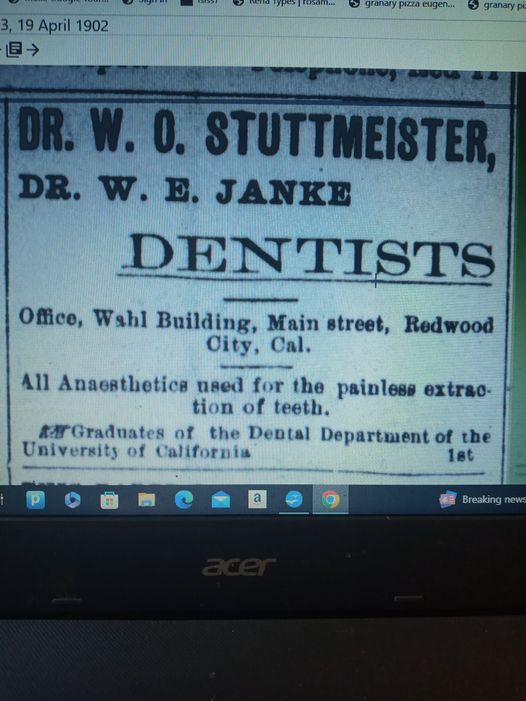
What a red letter day! I fuund two newspaper items that join the Janke and Stuttmeister family. William Stuttmeister and William Janke graduated from the University of California School of Dentistry (at the same time?) and Stuttmeister may have met Augustus Janke through her brother. They got married in Ralston Hall, and took the Janke stagecoach to honeymoon in Halfmoon Bay. The two Williams grads, then opened a dental office in the Wahl Building. How ideal! This is a far cry from the newspaper accounts that slime the Janke family, that may have caused them to be dug out of their grave in the middle of the night. Alas I find a article in the Times Gazzette – that tells the truth! They were good and honest people, who ran Belmont Park – AND OWNED A LOT OF LAND! Alas – the motive!
How perfect! You got the hardware store, the drug store, the bar, and upstairs , the dentist office. I can’t use my magnifying glass. Is it possible the family names are on the window?
What could go wrong? How about the war with Germany? I suspect there was anti-German sentiments in the area. There looks like a lot of vandalism at the Union cemetery. I’m going to ask the Governor and the heads of Archeology at UC Berkeley and Stanford should do a complete study – along with Israel! We have to put an end to the hatred. We got another Hitler on our hands who is selling Lost Heritage. I am reminded of John Steinbeck. We now know William Augustus Janke owned Belmont Park and do a records search. Did her leave lot of money to his daughter Augusts who bought eight track of land in Woodcare? Where else? Did William get dug out of his grave at the Oddfellows cemetery in SF?
I should have been encouraged to bring my newspaper to Belmont – and make a new Belmont Soda! Is there a soda fountain in Ryan’s Drug Store – with ice-cream floats? I was denied my American Heritage by hostile members of the Belmont Historical Society!
John Presco
President: Royal Rosamond Press
EXTRA! On July 21, 2024, I found an article in the Redwood Gazzette Times about the court battle over the legacy of Pioneer Carl A. Janke. Finding out his father was dying, William A, Janke CHARTERED a locomotive in San Francisco and sped to Belmont in or get there before Carl died. What is interesting, Elizabeth Johnson is claiming FIVE ACRES near the center of Belmont. She is the mother of Doris Vannier who said Elizabeth told her the Janke grave was dug up in the middle of th night. This is evidence a LAND FIGHT took place! Is the BHS aware of this article – and fight – that I copyright!
John Presco
Copyright 2024
JANKE’S JOURNEY. The Big Belmont Stake in Course of Probate. Twe«l) .r»,r Mllr,’ Itldr .n . 1 mm. live-1 hr Lrgnl Srarrh for • MflsaiKK
Text
Why may this text contain mistakes?
JANKE’S JOURNEY. The Big Belmont Stake in Course of Probate. Twe«l) .r»,r Mllr,’ Itldr .n . 1 mm. live-1 hr Lrgnl Srarrh for • MflsaiKK
On the 13th of Sup ten; her last) Carl Augnst Janke, of Belmont, died of the disuast) Known as diabetes, leaving three surviving children, and considerable projierty. His will has been tiled fur probate in the Super* ior Court at Redwood City, ami for the past three weeks, a protracted legal contest between the heirs has been going on. The litigation is being conducted by Fox & Ross, of Redwood, representing the contestan s, and Kincaid & Fitzpatrick, with Charles F. U Hanlon, an enterprising young advocate uf San Francisco fur the will The costs uf the suit are rapidly roiling up. Extended short hand notes of the testimony are being taken, and medical experts Lum a distance, including the distinguished Dr. Shurtlefl* of the Napa State asylum, are prolonging the issue, to the eminent satisfaction of the legal luminaries engaged in the trial. From the mass of material already extracted from the mouths of willing and unwilling witnesses, and from other information the interesting particulars which follow are extracted.
At the time of the last illness of the deceased, William August Janke, the secund son,who occupied a store in a Belmont building belonging to his father was in San Francisco. Upon receiving the news that his parent just lingered in he shadows of the unknown and the hereafter, he hastened like a dutiful son to his bedside. Chartering a locomotive he reached the bed of the dying not long before death closed around the aged man. A notary was brought from Redw‘»od, and the will was prepared and witnessed some 36 hours before the eyelids of the deceased closed on Earth forever. By the terms of the testament, the picnic grounds and resort known as Belmont park, valued all the way from twenty to thirty thousand dollars, was bequeathed to Charles F. and William A., his two sons to share alike. A sum of 53.500 in in money was left, one third each to his three children, (the two sons aforesaid, and his daughter Elizabeth the wife of a resident of Belmont named Johnson,) all of whom are residents of this county. A store in Belmont owned by the testator, was left to Mrs Johnson, together with a tive acre lot which it is claimed already belonged to her husband. The land on which this siore is, was left to the two sons, and all the personal property to the son William August Janke.
Thu contest is made on the ground of mental incapacity of the Accused, and undue influence. It is sought to be proven, that the disease from which the old man suffered, was so painful and severe that his mmd was affected. Diabetes is said by the books to be an affection of the urinary organa, and is excruciating in the extreme. Irregularity in the making of the will is also endeavored to be shown. The whereabouts of a sum of $50,000, which the dead man had from the sale of real estate in San Francisco, is a matter of great interest and anxiety to counsel. Thus far it has not been found, and if discovered, and the will is sustained as the personal property of the estate, it would add materially to the legacy of the son William August. The events surrounding the drafting of the will, substantially are, as the contestants expect to prove them, that upon the return of William A. by express, ho had an interview with his father in the sick chamber, and that the rest of the family were directed to leave the room. A witness named Schmoll translated the contents of the will to the father and children, the whole conversation being conducted in the German language. ‘ These are the principal points of contention between the lawyers, and as usual in an extended trial over an important stake they are conducting the case with vigor, and occasionally indulging themselves in a little humorous relaxation. The eminent, but juvenile jurist from San Francisco, is conducting his case with much enthusiasm. During the trial he seems to have determined to put a certain question, not only agaiqst the objection of opposing counsel, but his associates as well. Judge Kincaid thereupon retorted on him with the sarcasm—“As Senior counsel in this case your Honor I withdraw that question.” The young man submitted.
https://anthropology.berkeley.edu/graduate-program/anthropology-phd/archaeology
Wahl Building exterior (c.1915). The Wahl Building on Main Street was built in 1883 by William Wahl, a native of Germay. The building housed small businesses on the ground floor and professional offices on the second floor. The Wahl Building was torn down in 1928 when Broadway was extended through Main Street.


EXTRA! EXTRA!
I just found a Masque Ball with Janke members in it, and a Hull. This is a dream com tru in regrds to my daughter, Heather Hanon, coming into my life when she was sixteen. We has dinner with Nancy Hmren, Hether wanted me to promote her as a singer!
John Presco
Copyright 2024
https://en.wikipedia.org/wiki/California_Hall_(San_Francisco,_California)
https://en.wikipedia.org/wiki/Don_Carlos_(play)
THE MASQUERADE BALL. A Very Successful Carnival in Germania Hall. The Hook and Ladder Company Pleased With Their Hall. Henutlfiil Costume*.
Text
Why may this text contain mistakes?
THE MASQUERADE BALL. A Very Successful Carnival in Germania Hall. The Hook and Ladder Company Pleased With Their Hall. Henutlfiil Costume*.
“ Is she a man.” “•No, I think she is a girl.” The band was playing a lively air and all the gaily decked masquers with their strange, fanciful and pretty costumes were in motion. The jovial jester, the sober monk, “ legrande dame,” ‘‘la Espanola Scnora,” the Mexican hidalgo, Italian nobleman and American gentleman were all there. A boot-black jostled against the Spaniard and Tojtsy against the dude; the ghost walked into the pumpkin and his Satanic majesty found Night to be a pleasant companion. A Chinaman tried to strike up a conversation with a couple of Southerland sisters, the representatives of the regular army got stranded near the Five Points, while the Grand Army man and several American Hug girls seemed intuitively attracted toward each other, and clowns, Italians, sailors, last year beauties, Indians, cowboys, Irishmen,, plump arms, tapir limbs, sable faces and a thousand and one gauzy, gaudy and gilded beings with filmy laces aud fairy-like dresses, floated here and there to the tinkle of bells and a tambourine, the ripple of laughtet and whispered joke, and wound in and out, up and down in a maze of delicious figures, tints and colors. It was the night of the annual masquerade ball given by the Hook and Ladder Company. Every fellow who had one had brought his sweetheart, lost her and then enjoyed the privilege of trying to find her. A clasp of the hand, a whispered word and then they recognized each other and were already for the evening’s pleasure. The fellow who did not have a sweetheart turned clown or something else and punched the fellow in the ribs who had one. Some three hundred people and over came for the privilege of sitting down, keeping still and watching other people’s fun for the two hours proceeding 11 o’clock, when every body had a chance to dance.
Many of the costumes were very pretty and those who assumed special characters were generally quite successful in carrying them out. Excellent music added to the enjoyment. The general management of the ball was good and reflected credit on the firemen in charge, who all appeared in the regulation red shirt. The decorations were harmonious and effective. Upon the right bands of red, white and blue were stretched along the side wall with groups of fans in the loupes. Fire axes were crossed and a central wreath encircled a fireman’s hat. Similar colored cloth on the left was arranged in graceful forms between the windows and emblematic ladders were hung near the tnlddfe. Kvergreen ropes rtretchetf from the four corners to the center of the room and below hung a huge wreath with a silver ladder within. Claude Fox, C. A. Jacobus, C. E. Knights, Miss Frye and Miss Minnie Stalter were appointed a committee to award the various prizes offered. Shortly before 11 o’clock they awarded them as follows: For the best sustained lady costume, “ Topsy,” Mies Gertrude Lindsey of Belmont. For the most original lady character, “Money Costume,” Miss Lulu Janke of Belmont. For the prettiest lady costume, “Fancy Dress,” Miss Frankie Morris of San Francisco. A . For the best sustained gentleman character, “ Chinaman,” James Moscow of Redwood City. For the most original gentleman costume, “Five Points,” Phil Steinhaimer of Redwood City. For the prettiest gentleman costume, “Don Carlos,” Wm. Janke. Mr. Thompson was Floor Manager and Dan Daly, P. Genochio, W. Havey and T. Thompson the Floor Committee. Antone Genochio, Dan Mullen and H. Mourot constituted the Committee of Arrangements. The Reception Committee consisted of O. Dodge, J. Daly, L. Bettannier, M. Boyd, R. Badie, J. Metes, A. Hanson, Geo. Whooton, L. Genochio and Jos. Kussell. The supper was served at Price’s Hotel, where the large dining hall had been nicely decorated with evergreen. Three tables were arranged the entire length of the room and presented a pretty Scene previous to the supper, with the crystal ware reflecting the colors of numerous bouquets. Supper was served 280 people, 140 being seated at one time.
The following persons appeared In costumes: LADIES. Miss A. E, Bowan, washerwoman; May Nolen of Menlo Park. Night and Day; EmmaG. Hwift, Five O’clock Tea; Mamie Deiuhuiit, Morning; Mrs.Solen, red domino; Mollie Leinls, fancy dress; Mary F. Hull of San Carlos, fancy dress; Af. E. Whooten, butter cup; Hallie Nelson, Stare and stripes; Lizzie Minner of San Francisco, Kate Castleton; Mrs. Snow, peasant girl; Addle Underhill, sea foam; Belle Crowe, Greek; Mrs. J. F. Johnston, pearls; Rose Janke of Belmont, Christmas; Jennie Bady, egg shells; Mrs. H. W. Schaberg, Grecian; Gertrude Lindsey of Belmont, Topsey;Ella Williamson, tin queen; E. Heiner, Venetian fishermaid; Fannie Lovie, Venetian flshermald; Marie Hefner; lire lassie; Mrs. Hornberger, Italian organ Srlnder: Emma Grimmenstoin, domino; irs.Grimmenstein, domino; Alice Lathrop Irish washwoman; Mrs. Gray-Moore, Italian match peddler; Carrie Wlnfree, lace peddler; Mrs.lndig, domino; Mamie Grlmmenstein, domino; Annie Grimmensteln, domino; Aggie Wbooton, Goddess of Liberty; Alice Claffv, Ivy loaves; NellieClaffy, autumn; Lucy Bottgor, fancy dress; Kato Claffy; Christmas; Mainie Nealon, Italian vegetable woman; Lizzie Groner, girl of tho forest; Mollie Betzold, domino; Martha Shafer, flower girl; Lizzie Bowell of Belmont, domino; Maud Beeson, fancy dress; Bertha Plump, fancy dress; Lizzie Krumlinde, market woman: F. D.,Klng of Mountain Brow, pink domino; Mario Clarendon of Nan Francisco, page: Minnie Hooper of Han Francisco, Topsy; L. King, pink domino; Frankie Morris of Han Francisco, fancy dress; Mrs. Berry, pink domino; Grace Thompson, Gipsy fortune teller;
Mrs. C. Lovle, old maid; Lizzie King, chrysanthemum; Mrs. Townsend, domino; Lillian Lipp, The Midnight Girl; Mary Levy, card girl; Mrs. Bennet, domino; Anne Sahiberg, lace girl, Fannie Miller, fancy dress; Nettle Ashley, fancy dress; A. Murphy, Red Riding Hood; Annie Cook, spring: Ixiulse MHz, the American Dollar; Salma Sahllierg, domino; Hllnut Sahiberg, domino; Lillie Dahlgreen, flower mill; Klttie Murphy, domino; Lizzie Kelly of Woodside, twin sisters:BailieKreiss.Woodslde, twin sisters; Emma Harvey, morning; Aunle O’Brien, Cinderella; Delia Murray, ribbons; Mrs. C. H. Davis, fancy dress; Mamie Heaney, domino; Mamie Clifford, Night, Lulu Janke of Belmont, U. 8. Coin; Mary Genochio, fisherman’s wife; Carrie Jones, butterfly; Ida Barre of Belmont, fruit girl: Ida Hayes of Belmont, fancy costume; Phoebe Johnson, Belmont, fancy dress; Marguerite Scott of Searsvllle, fancy dress; Mrs. Harris, Milpetas; Miss MeGelby, fancy dress; Blanche Stafford, domino; Mrs. Jamieson. Spanish lady; Lillie Neuman of Woodside, fancy dross; Annie Donald, fancy dress; Alice Weslergroen, pepper tree; Alta De Roche of Belmont, Japanese; Annie Johnson of Belmont, Japanese; liheda Johnson, Grecian Maid; Maud Lindsey of Belmont, winter; Mrs. Fron, domino; M.Thursen, Daughter of the Regiment. GENTLEMEN. Chas. Wentworth, white domino; O. Cullen, domino;W.Jones, Button’s shoe blade; Ed. Tribolet, Turk; D. Ritchie of Menlo Park, Morpheus, God of Sleep; Charles C. Hughes, black domino; J.V.Swift, domino; F. Miller of Menlo Park, Turk; G. F. Rolff, domino; J.Tribolet, summer;C.Herman, clown; Richard Venner of San Mateo, clown; Bydlue Dick noy of San Francisco, black domino; Willie Crowe, old woman; Willie Coulaco of San Francisco, black domino; Harry P.Macaulay. Mexican cowboy; W. Lovle, swell;JohnClaffey,domino; M. 8. Orr of San Carlos, dude; T.G. Thompson, Mlcado; J. McLeod, Crazy Jane; Geo. F. Whooton, baker; M. H. F. Thompson, clown; E. H. Sampson, clown; A. Joseph, clown; Johnnie Tribolet, lady; L. Indlg, as you like It; F. D. King, black domino; W. A. Janke of Belmont, Don Carlos; C. Christ, some puinkins; Edward Kingsley, of Belmont, clown; G. P. Hull of San Carlos; drummer; C. Dunlap, hunter; J. 8. Mason, sailor; W. William, Chief Indian; Arthur Elvln, domino; Geo. Douglass, cow boy; John Elvln, comic; John Smith, a ghost; L. A. Felix ot San Jose, dynamite; C. N. Hancock of Ban Mateo, what is it; Edward Thompson, old woman ; man; PhilSteinhouser, Five Points; John Cullen, domino; H. C. Smith, stage driver, James Moscow, Chinaman; A. D. Walsh, domino; H. W. Schaberg, domino; John F. Johnston,domino; A. Hull,traveling agent; W.E.Wagner, around the town; W.S. King, domino; John W. McNulty of Wcxxleido, sailor; W. F. McCormick of Woodside, domino; George McNulty of Woodside, domino; Bon Saunders, clown; Thne. Doan of San Francisco, black domino; G. Kroiss of Woodside, Chinese peddler; Dan. C. Murphy, hunter; J. Dickey, domino; Chas. Cloud, band master; W. G. Stevenson of Belmont, Indian; L. Heiner, McGinty ;A. M. Miller, Hamlet; J. Van Eynde, Drum Major, F. Bennett, darky; Joseph Cronin, domino; Carl Stalter, domino; G. Emskill, demlno; J. A. McPhern, cow boy; Phil Forrest, orliodlnce dance; J. H. Hallett of Woodside, domino; E. H. Greeley, devil.
Don Carlos (German: Don Karlos, Infant von Spanien,[nb 1][1] German pronunciation: [dɔn ˈkaʁlɔs ɪnˈfant fɔn ˈʃpaːni̯ən] ⓘ) is a (historical) tragedy in five acts by Friedrich Schiller; it was written between 1783 and 1787 and first produced in Hamburg in 1787.
Plot
[edit]
The title character is Carlos, Prince of Asturias and the play as a whole is loosely modeled on historical events in the 16th century under the reign of King Philip II of Spain. Don Carlos is a Prince of Spain, given to the Spanish Inquisition by his father (who also wants to marry Carlos’ lover) due to his Libertarian creeds. Another great Romantic character is the Marquis of Posa dying for the liberty of the Dutch Republic as well as ruling Catholic Spain during the Reformation and the Counter-Reformation.
 Rosamond Press
Leave a comment