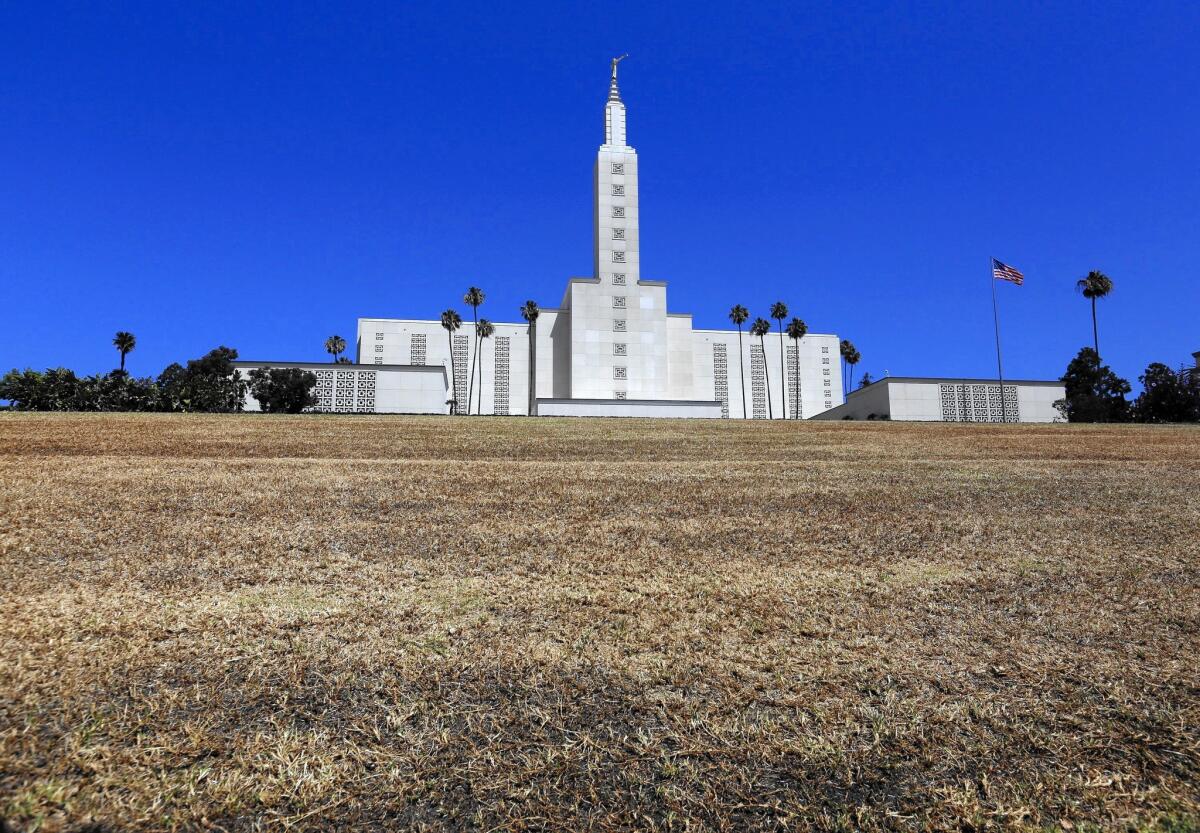
The once-green grass in front of the Mormon Temple on Santa Monica Boulevard in West L.A. has become parched since the church stopped watering it about a month ago because of the drought.
(Francine Orr / Los Angeles Times)
Where Art Thou?
A Novel
by
John Presco
Paul says he tortured members of the first church to get them…..”to denounce their Lord” I asked;
“What Lord?”
I could not imagine Jewish officials giving Paul official papers to hunt down women followers of
THE LORD
Did any official Jew believe Jesus was….THE SON OF GOD? Why bother? What, or who I have been looking at, is this…..THING?
13 Again the Israelites did evil in the eyes of the Lord, so the Lord delivered them into the hands of the Philistines for forty years.
2 A certain man of Zorah, named Manoah, from the clan of the Danites, had a wife who was childless, unable to give birth. 3 The angel of the Lord appeared to her and said, “You are barren and childless, but you are going to become pregnant and give birth to a son. 4 Now see to it that you drink no wine or other fermented drink and that you do not eat anything unclean. 5 You will become pregnant and have a son whose head is never to be touched by a razor because the boy is to be a Nazirite, dedicated to God from the womb. He will take the lead in delivering Israel from the hands of the Philistines.”
6 Then the woman went to her husband and told him, “A man of God came to me. He looked like an angel of God, very awesome. I didn’t ask him where he came from, and he didn’t tell me his name. 7 But he said to me, ‘You will become pregnant and have a son. Now then, drink no wine or other fermented drink and do not eat anything unclean, because the boy will be a Nazirite of God from the womb until the day of his death.’”
I didn’t ask him where he came from, and he didn’t tell me his name.
How did this UN-NAMED mother know he looked like an angel of God?
After I, moved to Los Angeles in 1962, I spent time on the grounds of the Mormon Temple. When I took Marilyn there, I began to seak with a spiritual tongue. We were amazed. I asked her who the statue ws, and she said it was Gabriel. Ten minutes ago I discovered this is…. angel Moroni
Eureka! I found The Greatest Religious object of all time! I must talk to The Elders. I own the key! I want to do a statue of the Come Unot Me Jesus, and put it in the new temple near me!
John Presco
https://www.ldsliving.com/5-things-you-never-knew-about-the-christus-statue/s/78222
https://en.wikipedia.org/wiki/Los_Angeles_California_Temple
When it was dedicated in 1956, it was the largest of the church’s temples, though it has since been surpassed by the Salt Lake Temple due to later expansions.[1] The temple serves 39 stakes in Los Angeles, Ventura, Kern, Santa Barbara, and San Luis Obispo counties. The grounds include a visitors’ center, which was renovated in 2010, the Los Angeles Regional Family History Center, both of which are open to the public, and the headquarters of the church’s California Los Angeles
The Los Angeles Temple was announced on March 23, 1937, by church president Heber J. Grant, when the church purchased 24.23 acres (98,000 m2) from the Harold Lloyd Motion Picture Company. Construction was to begin soon thereafter, but financial difficulties relating to the Great Depression and World War II delayed its construction.
This was the first temple with an angel Moroni statue since the Salt Lake Temple. When the statue was installed it faced southeast, as the temple does. It was later turned to face due east at the request of church president David O. McKay. This was the last temple designed to use live actors instead of a film to present the endowment.
Atop the temple stands a 16-foot (5 m) tall statue of the angel Moroni.[7] The building’s architect, Edward O. Anderson, patterned it after Mayan architecture.[8]
A Small Church’s Big Bet on the U.S. Constitution
Is a church the key to saving democracy? Latter-day Saints’ beliefs could prove pivotal in the outcome of the next election.
The fate of American democracy rests squarely in the hands of members of The Church of Jesus Christ of Latter-day Saints.
America’s Quilt of Faith is an apolitical, civic nonprofit that champions the idea that religion is indispensable to the American experiment in self-government. For a decade and a half, the organization has engaged with the founding generation’s vision of religion’s necessity: the unique capacity of religious communities to build virtuous citizens. This capacity rested on, in the language of the times, the various denominations’ and faiths’ “future state[s] of rewards and punishment.” That is, religions, wielding divine authority, tell adherents that if they do God’s will while on earth, eternal rewards await them in the life to come. Certainly, religions have advanced alongside society since that time but the basic idea remains valid: religions possess a unique power of persuasion in encouraging their people to live virtuous lives, upon which lives our constitutional democratic republic depends.
Since 2008, America’s Quilt of Faith has explored how America’s religions are fulfilling this mandate. The results are mixed. While affiliation with organized religion is down (something America’s Quilt of Faith sees as harmful to America’s present and future vitality), many, if not all, religions as institutions continue to maintain that theirs is a unique and needed role in society, which they will not give up and for which they will fight. While several of what one might call “traditional” religious commandments are not emphasized from as many pulpits as they once were, chastity before marriage and Sabbath-keeping being two examples (something America’s Quilt of Faith also sees as harmful to America), American religion generally seems to be more aware of marginalized and vulnerable populations and is acting in accordance with that more expansive vision.
The constitution contains a critical and world-changing religious freedom framework.
While religiously motivated people can and do have reasonable debates about the candidates’ various public policy positions, there is one distressing phenomenon that is anti-constitutional: large numbers of American religionists have given strong and unwavering support, in religion’s name, for Donald Trump, who attempted to stay in power after losing in a free and fair presidential election by overthrowing the United States Constitution. Among the constitution’s key purposes is to ensure the peaceful transfer of power. The constitution instructs that the Vice President “shall” count the electoral votes from the states. Trump, however, strategized to get Mike Pence to ignore that duty and declare Trump reelected instead, preventing the peaceful transfer of power the Constitution dictates.
As the founder and president of an organization that has for years been shouting from the housetops that religion is essential to American democracy and the fulfilling of its purposes in the world, it is extremely distressing when religion is now implicated in the support of a politician who so brazenly tramples American democratic institutions. Because the constitution contains a critical and world-changing religious freedom framework in its Article VI “no religious test for office” clause and First Amendment free exercise and no establishment clauses, religion is biting the hand that feeds it!
Enter The Church of Jesus Christ of Latter-day Saints, a church with only 6.5 million members in the United States, but exerting a larger influence than would be expected by its size because of the organization’s structure, doctrine, religious life, and its members’ robust activity. I have come to believe that this young, American-born Christian denomination (incorporated in New York in 1830) is uniquely situated to break the chokehold the former president has on the Republican party and save the Constitution.
Members are historically a politically conservative bunch, at least in the United States. Furthermore, they provide significant support for Trump: 45% of Utahns supported him in 2016, and an August 2023 NPI poll found 48% of Republicans in Utah support him now.
However, it also turns out that this group believes in Old Testament-type prophets with a New Testament message, called by God to preach Christ and His Kingdom, and that they should follow these prophets’ counsel.
Religionists are the ones that can save it.
One of these, Dallin Oaks, spoke “for” the United States Constitution on Easter Sunday 2021, just three months after the former president of the United States attempted to subvert that very document. In that sermon, emphatic because of its delivery during the holiest period on the Christian calendar, Oaks made it clear that mobs may not “intervene to intimidate or force government action,” which is exactly what Trump had instigated just months earlier. Prophet Oaks also reminded members of The Church of Jesus Christ of Latter-day Saints that their “loyalty is to the Constitution and its principles and processes, not to any office holder,” addressing what looks to us like a personality cult regarding the former president, and warned that ignoring such political cults allows autocrats to gain power and corrupt democracy.
Significantly, he also told church members, traditionally and strongly Republican in recent decades, that they should always consider switching parties, even from election to election, depending on the most important issues. This suggests that the Republican party’s embrace of Trump should be repudiated, and members of the Church of Jesus Christ can take the lead. Finally, he shared with the world the doctrine that the U.S. Constitution is divine—that Jesus Himself had a hand in bringing it to fruition—and that those who “recognize” Him are called to “uphold and defend its great principles.”
There are many complaints about Donald Trump. They range from complaints about his temperament, to his policies, to the degree of corruption in his administration, among others. Complaints of these types are made about all politicians, and it’s up to voters to weigh the relative merits of those concerns in the voting booth. But because Trump took proactive steps to prevent the peaceful transition of power based on a legal election by overthrowing the Constitution, he represents a grave threat that Oaks seemingly points to as unique and prioritized. Latter-day Saints who have entrenched concerns with other candidates may wonder who else they can vote for if Trump becomes the Republican candidate. It seems Oaks’ urging is rather straightforward: choose among those candidates who do not subvert the Constitution in attempting to prevent the peaceful transition of power, even if you oppose them in other significant ways. There is nothing more foundational to American democracy than that document.
From our vantage point, it appears that members of The Church of Jesus Christ of Latter-day Saints, and indeed the entire country, have been given a clarion call to protect the Constitution by emphatically rejecting any and all anti-constitution candidates, including Donald Trump, at the ballot box. If a significant percentage of members in the United States follow Oaks’ counsel (as America’s Quilt of Faith interprets it) and suddenly withdraw their support, stating that his re-election would both harm the Constitution and put it in the gravest of dangers, a political earthquake would be underway. This could initiate a break in the chokehold the former president has on the Republican party that deprives American democracy of life-sustaining breath. Such a movement would have national ramifications by providing both inspiration and cover for millions of religionists to follow suit.
I am in no position to tell members of The Church of Jesus Christ of Latter-day Saints to heed their prophet in the ways outlined above. But I can say that the United States Constitution has been severely damaged and is threatened once again by certain religionists and that certain religionists, summoning uncommon courage and humility, are the ones that can save it.
Mormons and White Evangelicals Are Divided over Trump
December 03, 2019
For much of Donald Trump’s presidency, scholars and journalists have invested considerable time trying to understand white evangelical Protestants’ unwavering support for the president. However, there is another highly religious, Republican-leaning group that Trump has struggled to win over: Americans who belong to the Church of Jesus Christ of Latter-day Saints (LDS), a group more generally referred to as Mormons.(1) In the Trump era, while white evangelical Protestants continue to back the president, Mormons are forging a more independent political path.
Using data from Democracy Fund + UCLA Nationscape—a survey interviewing more than 6,000 Americans each week—I examine the views Mormons have toward American political parties, their feelings about the place of Christianity in society, and how they plan to vote in 2020. Though Mormons are typically too small of a group to analyze using traditional national surveys, the size of the Nationscape survey allows us to analyze small but vital subgroups in the American electorate. Combining data collected between July 18, 2019 and November 13, 2019, this analysis is based on more than 1,300 interviews of Mormon Americans.
Several findings stand out. First, despite their similar levels of identification with the Republican Party, Mormons are less likely than white evangelical Protestants to have a positive opinion of Republicans and a negative view of Democrats. Second, Mormons are less likely to hold views that have been a key part of Trump’s appeal to conservative Christians—namely, narratives that highlight the dual threats of religious decline and immigration-fueled demographic changes. Finally, while white evangelical Protestants and Mormons have had nearly identical presidential voting patterns since 2004, their voting patterns diverged sharply in 2016. Heading into 2020, Mormons are not the stalwart Republican supporters they have been in previous election cycles.
Mormons Express Less Affinity for the GOP, Less Antipathy Toward Democrats
Americans who belong to the Church of Jesus Christ of Latter-day Saints are part of one of the most Republican-leaning denominations in the United States. According to Nationscape data, about two-thirds (65 percent) of Mormons identify as Republican or lean toward the Republican Party. This is similar to the Republican partisan identification of white evangelical Protestants (71 percent).
Despite the comparable levels of Republican affiliation overall, Mormons are less likely to report a favorable view of the GOP than are white evangelical Protestants. Only about half (54 percent) of Mormons say they have a somewhat or very favorable impression of Republicans. By contrast, more than two-thirds (67 percent) of white evangelical Protestants say they have a favorable opinion of Republicans.
Mormons also express less disaffection toward Democrats than white evangelical Protestants do. About half (53 percent) of Mormons report having an unfavorable view of “Democrats,” while nearly two-thirds (64 percent) of white evangelical Protestants say the same. There is also a sizable intensity gap; Mormons are less likely to say they have a very unfavorable view of Democrats than white evangelical Protestants (28 percent vs. 40 percent).
Mormons Are Less Anxious About Cultural Change; Fewer Believe Discrimination Against Christians Is a Problem
Trump’s appeals to conservative Christian voters consistently rely on invoking religious decline. At the 2019 Values Voter Summit, an annual political conference of conservative Christian activists hosted by the Family Research Council, Trump argued that liberals were “waging war” on Christians and “trying to hound you from the workplace, expel you from the public square and weaken the American family and indoctrinate our children.”
However, the perception that Christians are losing cultural and political influence is less widely accepted among Mormons than it is among white evangelical Protestants. Fewer Mormons than white evangelical Protestants believe there is a great deal or a lot of discrimination against Christians (32 percent vs. 50 percent). While 35 percent of Mormons say there is little discrimination or none at all, just 23 percent of white evangelical Protestants share that sentiment.
 Rosamond Press
Leave a comment