I have become un-stuck! For ten years I have been frozen in amber.
Jon Ambrosius!
Joaquin Miller And Emma Brown
Posted onSeptember 4, 2019by Royal Rosamond Press
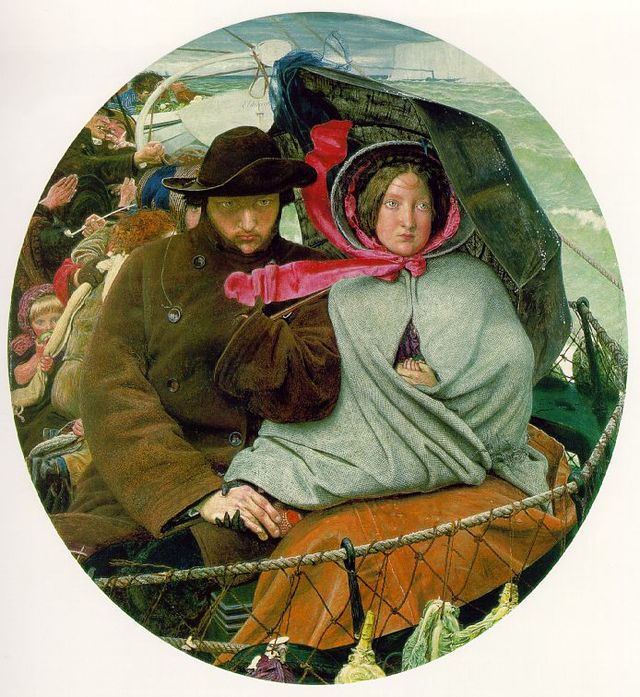
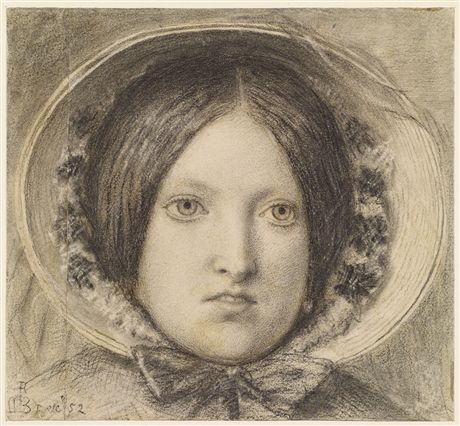
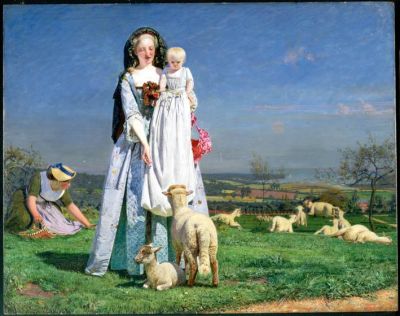

I learned yesterday that Joaquin Miller proposed to Pre-Raphaelite Muse, Emma Hill, who became the wife of Ford Maddox Brown. Joaquin spent some time in Maddox’s famous home at 37 Fitzroy Street that is regrettably owned by Scientology. Some of the greatest artists, poets, and writers of Britain met here, especially the Pre-Raphaelites, of which I declared I was one in 1969. I shared these artists with my late sister, the world famous artist known as ‘Rosamond’ who took up art in 1972. I have posthumously titled Christine a Pre-Raphaelite Artist. One of the artists that spent time at William Morris whom had a great influence on J.L. Tolkien. The painting Brown rendered are moviesque. I will try to get the director of my movie ‘Hromund’ to use the work of the Pre-Raphaelites.
Joaquin Miller was friends with William Michael Rossetti, and his brother, Gabriele. William married Lucy Maddox Brown. If Joaquin had married Emma, then he would be kin to the most literary and creative people in the West. For years I have been trying to get City Manager, Neil Laudati, interested in making Springfield Oregon, the Home of the Pre-Raphaelites, because the Miller family lived down the road apiece, and were Oregon Pioneers. My family knows nothing about this history. Since Christine’s death, Drew Benton, Shannon Rosamond, and Shamus Dundon have not written and published ONE WORD about the Artists and Writers in their family, yet, they claim so much! This is an astounding Creative Legacy that will be recognized by Great Britain, once they are made aware of it.
I modeled Royal Rosamond Press after The Germ. I elevated the famous commercial success of Drew and Shannon’s mother, and I have never been thanked. Christine said she owed her success to me, her teacher. The proof of this is evident.
Yoni Noguchi was at the Fitzroy House and lived with Miller in the Oakland Hills. My family knew Miller who may have modeled his Bohemian enclave after the Pre-Raphaelites and the creative souls who knew the Brown family. Yoni appears to have been a Japanese Spy sent by the Emperor to learn Western Culture through poetry. This is so Tolkienish! Here is the Japanese Bilbo who travels to a strange land and bonds with Gandalf. Joaquin write about their small statue. More of his “brown” people came to the Hights.
So soon after I gave my family a flash of bright light, there are dark problems about why I was not told Vicki died ten days ago. It has been suggested I was both the mother and father to my parents, and my siblings. I have been avoiding the possibility I am……..The Family Giver…………and I have been severely ripped off? Or is it a case of the naughty stupid children hiding everything from their brilliant parent who may be their superior, and a genius. No one but me took the time to learn anything about art, and, literature!
Joaquin Miller was the editor of Eugene’s first newspaper – before there was a Springfield. His brother George married a Cogswell who are the founders of the Eugene Register Guard. There’s newspaper men surrounding the Pre-Raphaelite Brotherhood and Sisterhood. George could have been the brother-in-law of Emma Hill.
Joaquin put the make on English Women dressed as a cowboy, or, Californian Hippie. He came to conquer – with poetry! I would like to employ Miller’s poetry in my book and movie the same way Tolkien did with the poetry of William Morris. Joaquin did his best to wed English Literature to the Wild West. Joaquin’s influence on the culture of Japan needs a collegiate study. The Invasion of Pearl Harbor may have contained Miller’s poetry.
“The Californians like to laze about all day reading poetry to one another, and painting pretty picture. Then, when the mood strikes them, they roll over on one another and fornicate like beasts. Our Imperial Marines will make quick work of them. Bonsai!”
The Beauty that Joaquin really wanted to roll over one, was Mathilde Blind. But, he met his Waterloo! Alas I think I have found the Teutonic Woman that broke Miller’s heart. Did he propose to Emma after Blind body-slammed his cowboy ass in the Bohemian Cage of Pathos, Life, and Death? Our Orgonian was out of his league. There is no Pathos, here, here! Lucy Maddox Brown did a portrait of Blind.
https://en.wikipedia.org/wiki/Lucy_Madox_Brown
With the passing of my sister my thoughts went to the loneliness of Rena Victoria Easton, my Waterloo. It is this connectivity that motivates and moves these Bohemians across a flowery dance floor seeking first the attention of their Sisters and Brothers. Here are the original Hobbits and Hippies, the timeless root of the New Cooperation.
The other day, when my beloved sister came to me while I took my old man nap, she thanked me! From heaven she could behold the Big Picture now that her artistic siblings allowed her to be a part of. She was – wowed! She could not believe her good fortune, and the great choice she made, to be born from the same Rosy womb!
Are those California poppies? Did Joaquin bring a pot of them, over there, on a ship?
John Presco
President: Royal Rosamond Press
Copyright 2019
Here is my
George Melvin Miller was titled ‘The Prophet of Lane County’. Lane County was named after Joseph Lane who ran with John Breckenridge for the White House. John is my kindred via John Preston who is kin to Jessie Benton Fremont who authored her husband’s journal about his expedition into the Oregon Territory.
Joseph wrote a letter to Rose O’Neal, a Confederate spy. It is alleged Joseph helped Joaquin Miller become the editor of the Eugene City Democratic Register, a pro-slavery newspaper. However, there is no proof of this, or, Miller was for the Confederacy. Quite the contrary. Joaquin Miller worshipped the ‘Pathfinder’ who was the first Presidential candidate nominated by the Republican Abolitionist Party. Miller made a folly to Fremont on his property in the Oakland Hills above where my great grandfather, William Stuttmeister, had a farm. William built about forty homes in Fruit Vale, a city that was later incorporated into Oakland. This rock monument supposedly marks the spot where Fremont first got a glimpse of the Golden Gate.
Joaquin wrote a book called ‘City Beautiful’ and appears to be part of that movement. I suspect his brother George was also, because he lay out the plan for two town, Florence, and Fairmount. Fairmount was in the hills above Eugene between 27th. Ave, and the Willamette. The Mathew Knight Arena is built upon land that once belonged to George. Was George inspired by his visits to ‘The Hights’ as Joaquin called his Mecca for California Artists and Poets?
The testimony on George’s nameless tombstone, reads
“Promoter Fairmount & Winnemucca to the sea, by Oregon, Lewis & Clark, D.A.R”
What does this mean “Winnemucca to the sea”? In my novel I write about my 1950 Dodge breaking down in this desert town located on Route 66. When I got home and on my computer, I read about the building of a from the desert to the sea. But, instead of going to Florence as George Miller intended, this road ended up in Crescent City. The Promoter’s dream, had missed the mark. He died not knowing – they almost got it right!
Folks who believed in George’s dream tried to get a marker honoring him on the Siuslaw River Bridge that Miller also promoted – while he was alive! Miller objected, and I assume left instructions to not include his name on his marker – just his two dreams! If you don’t know a man’s dream, then, you don’t know the man! Later, someone placed a marker at George’s feet.
I planted two Petunias by the Miller markers. I had traded some items at Isabella’s Garden in Brownsville for seven plants. I saluted George’s Dream that I compared to Fremont’s. Here lie the unsung ‘Pathfinder’ who likened himself to Lewis and Clark.
I had meant to declare myself a Newspaper Man, but, remembered when I came upon a fire in the town of Coburg. It was deliberately set by the fire department. I was in shock to see this beautiful Victorian going up in smoke. I talked to two fire fighters about why the town did not save it. They told me they tried, but, no one wanted it. I am going to investigate, because, I am a reporter for Royal Rosamond Press, a newspaper registered in Lane County.
I then walked into a antique store and asked the proprietor if she had a spindle for sale. She took me into the back room and showed me three spinning wheels that were once owned by an old woman who recently suffered from three strokes. I tried to get information about this woman, but, was not given her name. After seeing a incredible photo of her ancient mother, spinning, the Legend of Sleeping Beauty overcame me!
Alas, I had found her, she not able to communicate after her strokes! In a comatose state, her dream is taken to an antique store, it all in pieces. I am upset, because her history is about to be lost! Did she live in that house that was being burned down? Did she know the Millers, and the Dreamer of Fairmount, the Lost City that is no more, it swallowed up in that ongoing disaster – Eugene City Planning?
Sleeping Beauty was named, Rosamond, my mother’s maiden name. There is Fair Rosamond, and a Floral City by the sea. There is Belmont, a city cofounded by my great grandfather in California. The Cogswell-Miller home in Eugene is surrounded by Rose Trees, Rhodadendrons!
The next day I went to East face of Skinner Butte and looked at the two homes that are associated with John Cogswell and his family. John is the unsung Founding Father.
Kundry Keeper of the Grail
Posted onNovember 5, 2011by Royal Rosamond Press



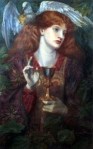

Above is a painting done by my late sister titled ‘Story Teller’. Christine was a good story teller, as was Rosemary and myself. This gift ran in the family. What is astounding, is, that the ghost writer Stacey Pierrot hired, claims there exist very few of Christine Rosamond’s words, and thus Tom snyder does not include but a handful. This contradicts what Pierrot said in 1997, that Christine was dictating her life story to Sanda Faulkner. If there exist words by the Rose of the World, then Pierrot can not now proudce them lest she be titled a ‘Story Teller’. I laugh!
Story Teller can be titled ‘Kundry and the Flower Maidens’. Kundry is depicted as a Mary Magdalene, who in turn is depicted as a Grail Lineage from Jesus that begat a royal and divine race. Kundry is called ‘The Rose of Hades’ a name that can be applied to Orpheus and his wife, Eurydice. The photograph of Rena Christiansen, that was used for a Oktoberfest poster at the University of Nebraska, would make a excellent Kundry. Indeed, Rena and her boyfriend engaged in the black arts, which I would push out of her being atop a mountain.
Rena is the Silent Muse of Christine Rosamond, daughter of Rosemary, granddaughter of Maryly Magdalene Rosamond. Yesterday I had lunch with Marilyn Reed who has agreed to help raise Rosamond’s Creative Legacy from hell. She will help sell Rosamond’s images of beautiful women for my two nieces, and act as my agent in seeking a publisher and a producer of a great story – that needs to be told!
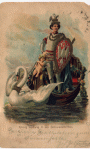
Members of the Rosemond family in Holland were Swan Brethren. Lohengrin was a Knight of the Swan. His father, Parsifal, encounters Kundry and the Flower Maidens who hold the secret of the Grail that is needed to save King Arthur’s kingdom. Christine and I were Flower Children.
I have been on the bus!
Jon Presco
Copyright 2011
http://www.magpictures.com/magictrip/
It is in her winter aspect that Eriu appears in the story of Niall, and it is in her spring aspect that she appears in the tale of Conn, in which she offers the hero drink from a golden cup.
Herodias, Magdalen and Prakriti
ike the young Parsifal, the wild woman has many names. The many elements in Wagner’s Kundry included another archetype found in literature from the Middle Ages onwards: the Wandering Jew. In Wagner’s poem, Kundry becomes a reincarnation of Herodias who, because she had laughed at the Saviour’s suffering, was cursed to wander through the world until His return. She is not only cursed to wander, but also always to tell the truth; and she cannot weep, only laugh her accursed laugh. Another Herodias can be found in Heine’s poem Atta Troll; this former princess of Judea does not wander the world, but rides, laughing, with the Wild Hunt across the sky. She appears as a cruel rose in Mallarmé’s Les fleurs
n her Cambridge Handbook, Lucy Beckett entirely misses the point of the Herodias reference, but makes an interesting observation about the reference to Mary Magdalen. Beckett reminds us that in 1848 Wagner had sketched a scenario for a play called Jesus of Nazareth, which includes a scene in which the penitent Magdalen kneels in repentance before Jesus on the shore of Lake Gennesareth; later in the play she was to anoint his head and wash his feet, just as Kundry does toward Parsifal in the opera. Although Wagner repeatedly denied that Parsifal was a Christ- figure (I never gave the Saviour a thought, he said), this image had stayed with him and was incorporated by him into the Good Friday scene.
n Die Sieger, an opera that Wagner never completed, a chaste young man called Ananda receives into the religious community a beautiful girl called Prakriti, who has passionately loved him; but Shakyamuni, the future Buddha persuades him to renounce her. The Buddha reveals that in an earlier incarnation, Prakriti had rejected, with mocking laughter, the love of a young man. Prakriti is a parallel to Mary Magdalen in the sense that both are outcasts. By absorbing these two outcast women, in their different ways excluded and despised by patriarchal societies, who by their associations with the Buddha and Christ respectively introduce further religious iconography to Wagner’s drama, Kundry gained a further dimension
Arise! Arise! To me!
Your master calls you, nameless one,
First she-devil! Rose of Hades!
Herodias were you, and what else?
Gundryggia then, Kundry here!
Come here! Come here now, Kundry!
Your master calls: arise!
e triumphant youth finds himself in a wondrous garden, surrounded by beautiful and seductive Flower-maidens. They call to him and entwine themselves about him while chiding him for wounding their lovers (“Komm, komm, holder Knabe!”). They soon fight and bicker amongst themselves to win his singular devotion, to the point that he is about flee, but then a voice calls out, “Parsifal!” He now recalls this name is what his mother used when appearing in his dreams. The Flower-maidens back away from him and call him a fool as they leave Parsifal and Kundry alone.
He wonders if this Garden is a dream and asks how it is that Kundry knows his name. Kundry tells him she learned it from his mother (“Ich sah das Kind an seiner Mutter Brust.”), who had loved him and tried to shield him from his father’s fate; the mother he had abandoned and who had finally died of grief. She reveals many parts of Parsifal’s history to him and he is stricken with remorse, blaming himself for his mother’s death. He thinks himself very stupid to have forgotten her. Kundry says this realization is a first sign of understanding and that, with a kiss, she can help him understand his mother’s love. As they kiss Parsifal suddenly recoils in pain and cries out Amfortas’ name: he feels the wounded king’s pain burning in his own side, and now understands Amfortas’ passion during the Grail Ceremony (“Amfortas! Die Wunde! Die Wunde!”) Filled with this compassion, Parsifal rejects Kundry.
Furious that her ploy has failed, Kundry tells Parsifal that if he can feel compassion for Amfortas, then he can feel compassion for her as well. She has been cursed for centuries, unable to rest, because she saw the Savior on the cross and laughed. Now she can never weep, only laugh, and she is enslaved to Klingsor as well. Parsifal rejects her again but then asks her to lead him to Amfortas. She begs him to stay with her for just one hour, and then she will lead him to Amfortas. When he still refuses, she curses him to wander without ever finding the Kingdom of the Grail, and finally she calls on her master to help her.
Klingsor appears and throws the Spear at Parsifal but it stops in midair, above his head. Parsifal takes it and makes the sign of the Cross. The castle crumbles and as he leaves the scene, he tells Kundry that she knows where she can find him again.
Unicorn tapestries, tarot trumps, medieval watermarks and numerous paintings contain symbols that point directly to the “Great Secret” – the Heresy of the Holy Grail – discussed at length in The Woman with the Alabaster Jar (Bear and Company, 1993).
It is these fossils lodged in the art and literature of the Middle Ages that were the vessels of the heresy, amazingly resilient in the face of adversity and suppression. The Great Secret survived with incredible tenacity because the truth of the Sacred Union that imaged the Divine as partners was rooted in the Scriptures themselves, affirmed by legend and lore and cherished in the hearts of the people.
It has now resurfaced at the threshold of the third millennium Domini, most recently in The Da Vinci Code that cites Holy Blood, Holy Grail and The Woman with the Alabaster Jaras two of its major sources of inspiration for Magdalene’s story.
In reclaiming Magdalene as the “chalice” of the sangraal,we reclaim the Sacred Partnership set at the very heart of the Christian story, “the cornerstone the builders rejected.”
Let us build the “kingdom of God” with this as the foundation stone for a new dispensation of inclusive and egalitarian principles that embrace the entire human family – “in memory of her.”
http://www.grailladyfaire.com/
It appears that the noble intentions of the Grail Company in the Western world are intimately linked to the central Buddhist tradition of the far East.
The Flemish Connection
As noted in the previous lesson, with the passing of the Grail to Lohengrin, the legend shifts to Flanders — in modern terms, the Benelux countries, Belgium, Netherlands, and Luxembourg. Wolfram sets up this part of the story by a careful orchestration of dynastic links. Prince Kaylet of Castile, a cousin of Parzival´s father Gahmuret, rejected a young woman named Elize. During the great tournament where Gahmuret met Herzeloyde, Elize was claimed by a knight from Flanders, Duke Lambekin of Brabant and Hainaut. Elize was a Gascon princess from the border of France and Spain, across from Castilia. Her marriage with Duke Lambekin formed a dynastic link between Gascon-Castilia region and Flanders.
From the Middle Ages onward there were close ties between Spain and the Lowlands. In fact, Flanders was for a time under Spanish rule. Flemish soldiers who visited Spain during the rule of Hapsburg Emperor Charles V (Charles I of Spain, reigned 1516 – 56) became known for their physical largeness and crude manners. The soldiers were considered to be “roughhouses” or “road house” types. When Spanish gypsies emerged as a distinct class in the 18th Century, they were observed to have a similar style, a roadhouse or rowdy manner. The local populace loosely applied the racial term (an insult, really) for the soldiers — Flamencos, “Flemings” — to the gypsies and, by extension, to their wild, outrageous manner of dancing. So it came about that the Andalucian art of Flamenco, to many people the very signature of Spain, is called by a Flemish name.
The Flemish connection figures centrally in the story of Lohengrin, the Swan Knight. After Parzival renounced the kingship of the Grail, he gave some special instructions to his son who proceeded to Hainaut and Brabant, following the dynastic link to which Wolfram alludes: the marriage of Princess Alize to Duke Lambekin.
At the end of the 12th century, Wolfram drew the elements of the Grail story in part from the unfinished work of Chretien de Trois. The town of Trois is in the province of Champagne in France, southwest of the Lowlands (a car journey of about five hours). Chretien was known to have composed the Grail story for his patron, Philipe of Flanders, as things were done in those times. Interestingly, the literary provenance of the Grail story links it to the Lowlands at the close of the 12th Century, between 1185 and 1206, and the actual historical events that reflect the story also point to this region, but two centuries earlier. Lotharingia or Lorraine originally extended northward into the Lowlands (Lower Lotharingia) and southward into Alsace (Upper Lotharingia). I presume the key moment of Parzival´s quest to have been 968 CE, and the time of Lohengrin to have been the end of the 10th Century, around 985 CE. Specific celestial designs signal these moments.
http://www.metahistory.org/GRAIL/SwanKnight.php
The Promoter of Fairmont
Posted onFebruary 4, 2019by Royal Rosamond Press
The Lost Promoter of Fairmount
March 17, 2014


 Rosamond Press
Leave a comment