
Former President Donald Trump appears in court during his trial for allegedly covering up hush money payments at Manhattan Criminal Court on May 20, 2024, in New York City. Trump was convicted on 34 felony counts of falsifying business records. Delays at the U.S. Supreme Court on his claims of presidential immunity will likely delay his trial for interference in the 2020 election until after Election Day in 2024. (Photo by Steven Hirsch-Pool/Getty Images)
“Jefferson Davis was apparently eager to defend himself in court. He intended to argue that secession had been legal in the hopes of publicly (and legally) vindicating himself and the entire Confederate movement.
“The question of secession’s lawfulness was instead ruled upon by the United States Supreme Court in a less sensational case just two months later. Texas v. White, in April 1869, stated succinctly that the Confederacy’s secession had been “absolutely null.” Williams v. Bruffy, an 1877 case, elaborated further on secession’s illegality with much more a thorough explanation by the court of the legal reasoning involved.
Trump and the Republicans CANCELED the results of the last election, and have declared Biden and the Democrats STOLE THE ELECTION! Why should President Biden, subject The Nation to more Election Denying that is very injurious to our Democracy. There is evidence Trump and the Republicans will accuse The Sitting President and his party – OF POLITICAL THEFT!
The Supreme court ruled to day, that Trump can not be FOUND GUILTY of what Jefferson Davis did, when he refused to ACCEPT the election results – and secede from The Union. To not concede, and accept the results of any election, is to BE AGAINST DEMOCRACY. The United States has spend a trillion dollars, and shed much blood, brining Democracy to other countries – or trying to. The Vietnam War was a failure. How many nations, who want what we got, now see the Republican’ Party as the
REJECTORS OF DEMOCRACY!
Davis was put on trail for being a Rejecter of Democracy. He wanted to prove Secession WAS LEGAL. Today, the Supreme Court backs Davis and the Confederacy. Was PRESIDENT Davis IMMUNE from prosecution? No! Would President Biden be prosecuted for canceling the elections, AND THE SUPRME COURT, because they promote the Invalidation of our voting system by saying no President can be taken to court for…..RIGGING AN ELECTION! Biden was not President when he allegedly “rigged the election” and thus he can be PROSICUTED?
I am going to try to put a case before the Supreme Court that will require all Republicans running for office, and holding office, to sign a New Iron Clad Oath, that admits the sitting President WON THE ELECTION – LEGALLY!
Can President Biden DELAY the elections till all Donald Trump’s trials are done? Millions of taxpayers have contributed a trillion dollars to make other nations free – and keep them free! How much money does the taxpayer give to our Military – to keep us ALL FREE? Protect our investment in Liberty…
Mr. President!
John Presco
The Trial of Jefferson Davis Cancelled – February 15, 1869
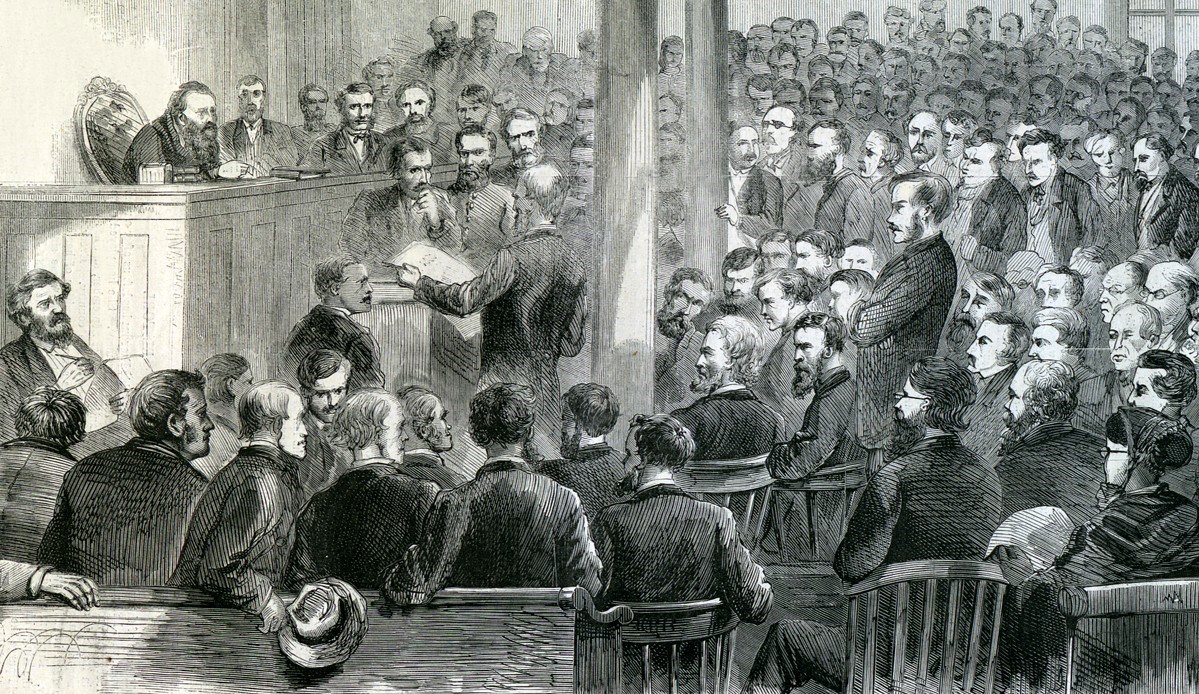 Jefferson Davis is depicted in a federal courtroom in Richmond, Virginia, during the preliminary stages of his trial.Harper’s Weekly, June 1, 1867On February 15, 1869, Jefferson Davis was scheduled to begin his trial in the United States District court in Richmond, Virginia. He was charged with treason against the United States for his part in leading the states in rebellion during the American Civil War, 1861-1865. But instead proceeding with the trial, federal prosecutors entered a “nolle prosequi,” or statement of decision not to prosecute.Thirty-seven other treason indictments were dropped at this time as well, including the pending litigation against Robert E. Lee.1 All former Confederates not under those indictments had been mass pardoned by President Andrew Johnson the previous Christmas Day, and the February nolle proesqui order drew to a quiet conclusion any threat of legal action against anyone for their participation in the war against the United States.Many factors aside from the merits of the case itself prompted the federal government to abandon prosecuting Davis. Delays had dragged out the trial process for years, including the reluctance of one of the two trial judges – Chief Justice Salmon Chase – to participate and his lengthy absence to preside over the impeachment of President Andrew Johnson. Chase’s aspirations to run for president himself in the next election cycle and his private consultations with Davis’ legal team also muddied the function of the case, as did the hyper-partisan attitudes of the judge who co-presided, radical Republican John C. Underwood. The unpredictability of a Richmond jury (which excluded former Confederates from serving and was thus composed of wartime Unionists and African Americans) and a last-ditch effort to bypass the jury by having the case dismissed on unrelated constitutional grounds made the case, in the estimation of prosecutors, too complex and politically charged to be worth pursuing.For his part, Jefferson Davis was apparently eager to defend himself in court. He intended to argue that secession had been legal in the hopes of publicly (and legally) vindicating himself and the entire Confederate movement. His counsel, however, prioritized securing his client’s freedom over the larger question of settling secession’s legality, and was successful in concluding Davis’ case without having to place the question of secession before a Richmond jury. The question of secession’s lawfulness was instead ruled upon by the United States Supreme Court in a less sensational case just two months later. Texas v. White, in April 1869, stated succinctly that the Confederacy’s secession had been “absolutely null.” Williams v. Bruffy, an 1877 case, elaborated further on secession’s illegality with much more a thorough explanation by the court of the legal reasoning involved. These rulings stand as the current authority on the status of secession in American law.21 John Reeves, The Lost Indictment of Robert E. Lee: The Forgotten Case Against an American Icon (Rowman & Littlefield, 2018), 63-64. Jefferson Davis is depicted in a federal courtroom in Richmond, Virginia, during the preliminary stages of his trial.Harper’s Weekly, June 1, 1867On February 15, 1869, Jefferson Davis was scheduled to begin his trial in the United States District court in Richmond, Virginia. He was charged with treason against the United States for his part in leading the states in rebellion during the American Civil War, 1861-1865. But instead proceeding with the trial, federal prosecutors entered a “nolle prosequi,” or statement of decision not to prosecute.Thirty-seven other treason indictments were dropped at this time as well, including the pending litigation against Robert E. Lee.1 All former Confederates not under those indictments had been mass pardoned by President Andrew Johnson the previous Christmas Day, and the February nolle proesqui order drew to a quiet conclusion any threat of legal action against anyone for their participation in the war against the United States.Many factors aside from the merits of the case itself prompted the federal government to abandon prosecuting Davis. Delays had dragged out the trial process for years, including the reluctance of one of the two trial judges – Chief Justice Salmon Chase – to participate and his lengthy absence to preside over the impeachment of President Andrew Johnson. Chase’s aspirations to run for president himself in the next election cycle and his private consultations with Davis’ legal team also muddied the function of the case, as did the hyper-partisan attitudes of the judge who co-presided, radical Republican John C. Underwood. The unpredictability of a Richmond jury (which excluded former Confederates from serving and was thus composed of wartime Unionists and African Americans) and a last-ditch effort to bypass the jury by having the case dismissed on unrelated constitutional grounds made the case, in the estimation of prosecutors, too complex and politically charged to be worth pursuing.For his part, Jefferson Davis was apparently eager to defend himself in court. He intended to argue that secession had been legal in the hopes of publicly (and legally) vindicating himself and the entire Confederate movement. His counsel, however, prioritized securing his client’s freedom over the larger question of settling secession’s legality, and was successful in concluding Davis’ case without having to place the question of secession before a Richmond jury. The question of secession’s lawfulness was instead ruled upon by the United States Supreme Court in a less sensational case just two months later. Texas v. White, in April 1869, stated succinctly that the Confederacy’s secession had been “absolutely null.” Williams v. Bruffy, an 1877 case, elaborated further on secession’s illegality with much more a thorough explanation by the court of the legal reasoning involved. These rulings stand as the current authority on the status of secession in American law.21 John Reeves, The Lost Indictment of Robert E. Lee: The Forgotten Case Against an American Icon (Rowman & Littlefield, 2018), 63-64.2 see Cynthia Nicoletti, Secession on Trial: The Treason Prosecution of Jefferson Davis (Cambridge University Press, 2017) for the definitive account of the Davis trial. |
Live Updates: Supreme Court Gives Trump Substantial Immunity From Prosecution
The ruling makes a distinction between official conduct of a president and the actions of a private citizen. A dissent from the liberal wing laments a vast expansion of presidential power.

Pinned
July 1, 2024, 1:45 p.m. ET55 minutes ago55 minutes ago
Here’s the latest on the ruling.
The Supreme Court ruled on Monday that former President Donald J. Trump is entitled to substantial immunity from prosecution, delivering a major statement on the scope of presidential power. The vote was 6 to 3, dividing along partisan lines.
The decision will almost surely delay the trial of the case against him on charges of plotting to subvert the 2020 election past the coming election in November. If that happens and Mr. Trump wins, he could order the Justice Department to drop the charges.
Here’s what to know:
- The ruling: The justices said that Mr. Trump is immune from prosecution for official acts taken during his presidency but that there was a crucial distinction between official and private conduct. Broad immunity for official conduct is needed, Chief Justice John G. Roberts Jr. wrote for the majority, to protect “an energetic, independent executive.” Read the full article about the ruling.
- A vehement dissent: Justice Sonia Sotomayor, joined by her liberal colleagues, Justices Elena Kagan and Ketanji Brown Jackson, wrote that the decision was gravely misguided. “The court effectively creates a law-free zone around the president, upsetting the status quo that has existed since the founding,” Justice Sotomayor wrote. Read more about the dissent here.
- The trial timing: The prospects for a trial in the 2020 election interference case before this November’s election seem vanishingly remote. The case returns to the lower court, which will decide whether the actions Mr. Trump took were in an official or private capacity. The process could take a while to conduct as well as to prepare for.
- The charges: The former president faces three charges of conspiracy and one count of obstructing an official proceeding, all related to his efforts to cling to the presidency after his 2020 loss. He was indicted last August by the special counsel, Jack Smith, in one of two federal criminal cases against him; the other relates to the F.B.I. raid on his private club, Mar-a-Lago, in August 2022 that recovered missing government documents.
- Inside the court: The sense of anticipation was palpable on Monday morning as the justices delivered the last blockbuster decision of the term. Read more about the scene. No Supreme Court term in recent memory has featured so many cases with the potential to transform American society. See more about the decisions here.
Show more

July 1, 2024, 1:39 p.m. ET1 hour ago1 hour ago
Simon J. LevienA member of the 2024-25 Times Fellowship class, covering politics
Representative Alexandria Ocasio-Cortez said on X that the court has been “consumed by a corruption crisis.” She pledged to file articles of impeachment against the justices, though she did not specify which. The last time a Supreme Court justice was successfully impeached was in 1804, and it would require that she and her fellow Democrats win significant support from Republicans, who control the House, to even bring any impeachment to a vote.
July 1, 2024, 1:25 p.m. ET1 hour ago1 hour ago
Richard FaussetDomestic correspondent based in Atlanta
The Supreme Court’s immunity ruling will also reverberate in Fulton County, Ga., where Trump and 14 of his allies have been criminally charged in a sprawling racketeering indictment. In January, Trump’s Georgia lawyers filed a motion arguing that the case should be dismissed on immunity grounds. But prosecutors have been waiting on the Supreme Court, and have said they will file a response to Trump within two weeks of the issuance of the immunity ruling.
 Rosamond Press
Leave a comment