SLEEPS and my Christian neighbors abused a Senior and his cats because he clamed he is a prophet. They did this after he paid for the funeral of his homeless friend, and found a church ‘The Radio Church of God’. This is real national news that will affect us all for centuries.
Advocates for homeless seek lasting solutions even as Supreme Court weighs Grants Pass case
By Jeremiah Hayden (Street Roots)
May 9, 2024 6 a.m. Updated: May 9, 2024 12:17 p.m.
Cassy Leach woke up early on April 22, the day the U.S. Supreme Court heard oral arguments in Grants Pass v. Johnson across the country in Washington, D.C.
That morning, Leach, Mobile Integrative Navigation Team, or MINT, cofounder, a Grants Pass service provider for people living in parks, tuned into the livestream while helping a 62-year-old homeless woman look for her cat, Sylvester. The cat had gone missing in Fruitdale Park when Grants Pass police forced the woman, who is blind in one eye, to move her tent and belongings two miles away to Tussing Park.
A Grants Pass city ordinance requires homeless residents living in vehicles to move every 72 hours, and police require anyone living in parks to move as often as is allowed by state law, which is also every 72 hours.
Related: Grants Pass v. Johnson: Here’s what led to key homelessness case before high court
Later that day, Leach drove another homeless resident to a doctor’s appointment, dropped off wound supplies in local parks and transported an elderly, deaf homeless resident to an orthopedist appointment.
The Supreme Court’s decision in the case out of southern Oregon, expected in June, will broadly impact how local governments write homelessness policy in the United States.
Since the Supreme Court took up the case in January, Democrat and Republican governments, district attorneys and business associations submitted amicus briefs arguing a 2022 Ninth U.S. Circuit Court of Appeals injunction removes necessary tools for enforcing laws against homeless residents sleeping on public property.
A host of organizations submitted amicus briefs in support of counsel representing homeless residents, saying laws punishing individuals for being homeless are cruel and unusual. The briefs also argued the laws do nothing to solve the homelessness crisis and will likely exacerbate the issue.
Leach said most Grants Pass residents are well aware of the case before the Supreme Court. Some hope the justices will uphold the ordinance, and others generally support efforts to solve the housing crisis, regardless of the court’s decision. While there are fundamental disagreements on how to treat homeless residents in Grants Pass, Leach said the community can agree to come together and create a safe place for people so they don’t have to live in the parks.
“We still need to do something, so let’s just do it,” Leach said.
’You don’t arrest babies who have blankets’
The Supreme Court is a lavish theater for a case deciding whether cities can punish people for sleeping when they have nowhere else to go.
Court staff ushered some 400 guests, lawyers, journalists and family members across the Grand Hall and into the courtroom through bronze gates flanked by marble pillars on the morning of arguments. Dark, wine-red drapery framed the chambers on all sides. Above the curtains, friezes of prophets, owls and allegorical figures looked on just beneath a high red and blue-checkered ceiling with white and gold-trimmed rosettes as court aides paced across the bench between two American flags.
For over two and a half hours, the justices questioned counsel for each side, as well as Edwin Kneedler, U.S. Justice Department deputy solicitor general. A central theme was where the line should be drawn between the involuntary status of being homeless and the conduct associated with being homeless.
That question of status and conduct arises from a 1962 Supreme Court decision in Robinson v. California. Justices ruled it is cruel and unusual for the state to punish a person for a status — in that case, the status of being addicted to narcotics — and therefore violated the Eighth Amendment. However, in a case six years later, Powell v. Texas, justices decided the state can punish a person for the conduct of using substances, creating a legal distinction between status and conduct.
The justices presented a range of hypotheticals meant to clarify the question: Addiction is to drug use as sleeping is to what? And where is the line between a universal need and punishable behavior?
Justice Ketanji Brown Jackson helped differentiate between the conduct of drug use as a consequence of the status of having an addiction and the conduct of using a blanket for the universal status of needing to sleep. She said drug use is punishable because it is not a universal need, despite some people having an addiction to drugs. However, people cannot be held criminally liable for universally necessary acts that are in and of themselves not criminal, like using a blanket to sleep.

“Not only is it something that everybody engages in, but it’s something that everybody has to engage in to be alive,” Kneedler responded.
In this case, counsel for homeless residents argued the city of Grants Pass punished the status of being homeless by creating ordinances making it impossible for homeless people to be anywhere in the city without receiving constant fines or jail time — a violation of the Eighth Amendment.
Jackson asked whether the same ordinance could apply to eating in public spaces. Justice Neil Gorsuch extended the question to whether other biological necessities, like urination and defecation, would be considered status or conduct. Chief Justice John Roberts went so far as to ask if being a bank robber is considered a status, while Justices Samuel Alito and Gorsuch tested whether a person could steal food if they were hungry without being punished.
In an early, fiery exchange, Justice Sonia Sotomayor asked Theane Evangelis, Grants Pass’ counsel, if the city enforced the ordinance against the general public or exclusively against people who have no other place to go.
“If a stargazer wants to take a blanket or a sleeping bag out at night to watch the stars and falls asleep, you don’t arrest them,” Sotomayor said. “You don’t arrest babies who have blankets over them. You don’t arrest people who are sleeping on the beach.”
Evangelis said the laws apply to everyone.
“Yeah, that’s what you want to say,” Sotomayor said.
Sotomayor referenced an amicus brief filed by a group of criminal law and punishment scholars, which included testimony from a police officer saying that someone would “violate the ordinance if he did not ‘have another home to go to,’” and “laying on a blanket enjoying the park” would not violate the ordinance. In other words, sleeping in public is a crime for homeless individuals, but not for those who have a home.
Evangelis said one example exists of a person in Grants Pass receiving a citation despite having a home address.
“There’s nothing in the law that criminalizes homelessness,” Evangelis said.
’Ending homelessness is possible’
Early on the cool April morning in Washington, D.C., before oral arguments began, a crowd gathered outside the Supreme Court. In the clear sky, the sun rose behind the building, forming a corona around its roof.
THANKS TO OUR SPONSOR:
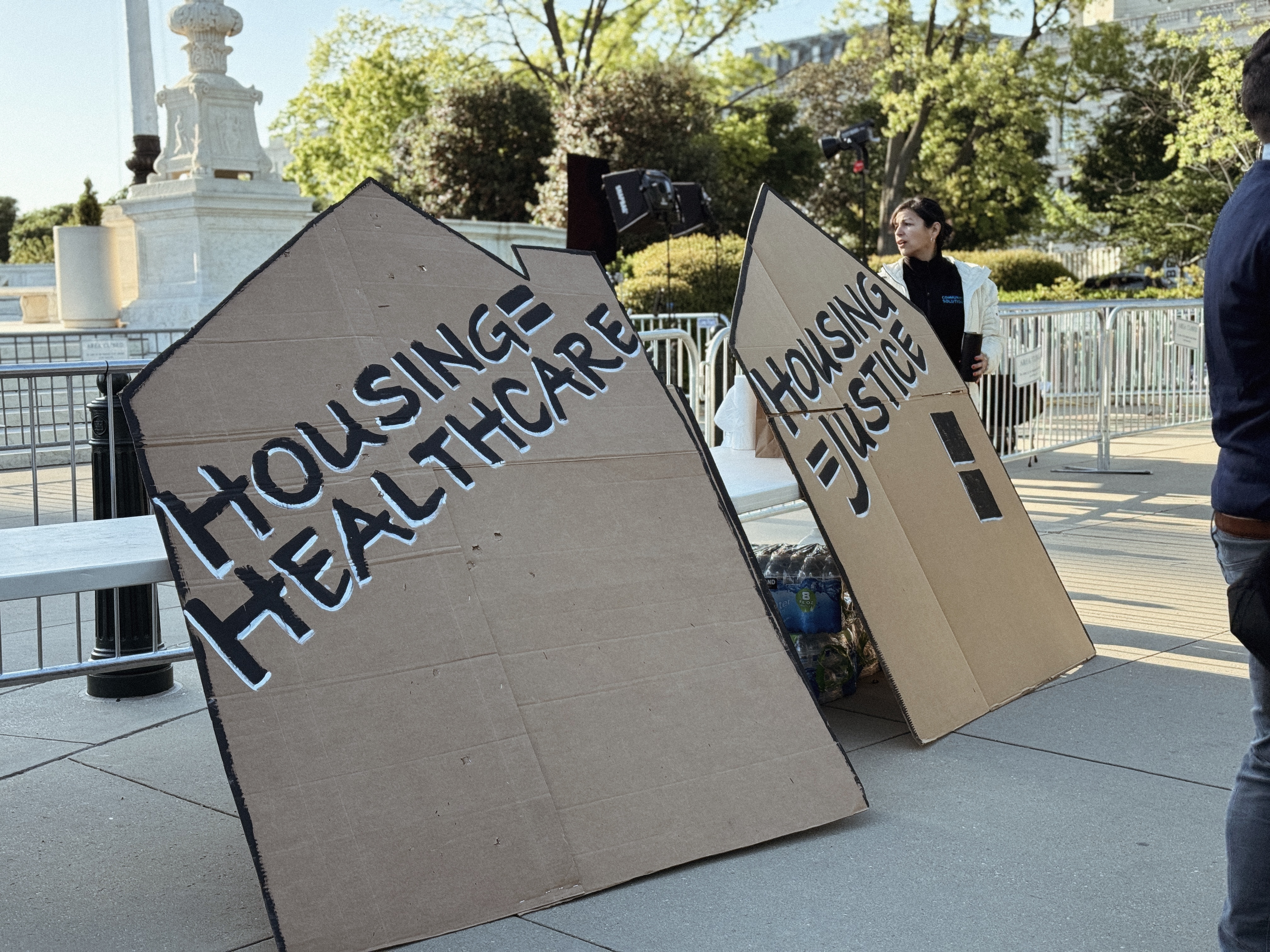
The National Homelessness Law Center, or NHLC, organized a rally for “Housing Not Handcuffs,” a national campaign advocating for housing as a human right and demanding an end to the criminalization of homelessness.
Over 600 people showed up for the event, which included homelessness advocates from across the country giving speeches.
Jesse Rabinowitz, NHLC campaign and communications manager, said the court’s decision to hear the case indicates how politicized homelessness has become.
“It’s also a reflection on the fact that we do have a homelessness crisis in this country and our elected officials are not doing what they need to do to make sure everyone has housing that meets their needs,” Rabinowitz said.
Rabinowitz said it is a catalyzing moment for homeless advocacy across the nation.
“We know that ending homelessness is possible, but it’s going to take building power and getting our elected officials to do their jobs,” he said.
The National Low Income Housing Coalition’s 2023 “Out of Reach” report shows a person needs 1.6 full-time jobs at minimum wage, or must make at least $22.44 per hour to afford a two-bedroom at fair market rent in Grants Pass.
As the justices debated the constitution some 3,000 miles away, Leach saw a similar demonstration as she drove past the Josephine County Courthouse. Roughly a dozen homeless residents held signs reading “Stop Sweeps” and “If everyone can’t pay the rent, they shouldn’t fucking take our tent.”
’Objectively reasonable’
The Oregon Legislature passed ORS 195.530 in 2021, which dictates laws regulating sitting, lying, sleeping or keeping warm and dry outdoors on public property “must be objectively reasonable with regards to people experiencing homelessness.” The statute is somewhat vague, and cities like Portland — Oregon’s largest city — have battled in court to determine what is “objectively reasonable.”
Lawmakers intended to codify the 9th Circuit’s 2018 Martin v. Boise decision into the state statute, which ruled 9th Circuit jurisdictions, including Oregon, have the authority to regulate when and where people can or cannot stay but cannot punish people when shelter is unavailable.
Martin v. Boise served as the backdrop for the Grants Pass case when it arrived at the 9th Circuit, and governments leaning toward both sides of the aisle argue the two 9th Circuit decisions hamstring them from solving the homelessness crisis.
Referring to the state law, Jackson asked about “constitutional avoidance,” a legal doctrine that would allow the Supreme Court to decline to render a decision on the constitutionality of the Grants Pass ordinance. Roberts appeared to also question the court’s responsibility, asking why “these nine people are the best people to judge and weigh those policy judgements.”
The lower court’s decision will stand if the court decides not to issue a ruling as a matter of constitutional avoidance. Kelsi Corkran, Georgetown Law Supreme Court director and counsel for the class of homeless residents, told the court she would have no issues with that outcome.
If the court determined the ordinance does not violate the Eighth Amendment because Oregon has a necessity defense, the burden of proof would fall on each homeless individual to show a court they were sleeping outside for a reason, each time they received a citation.
Ed Johnson, Oregon Law Center director of litigation, initially filed the suit against Grants Pass in 2018. On the sidewalk below the steps of the high court, he said in a city with zero available emergency shelter, the status and conduct of homelessness are two sides of the same coin.
“Living outside and trying to stay warm with a blanket is literally the definition of what it means to be homeless when you don’t have anywhere else,” Johnson said.
’Homelessness is a choice made by our elected officials’
On April 17, just five days before the case arrived at the Supreme Court, Grants Pass City Council unanimously approved a new MINT property just off Redwood Highway. Leach said people who initially opposed MINT’s tactics showed up to testify in support of its efforts.
One Grants Pass resident previously testified in a contentious May 17, 2023, City Council meeting, saying the community needed to “get aggressive” and “take their parks back,” calling on neighbors to “make them feel uncomfortable.” Less than a year later, he told City Council the new MINT shelter is a “win-win” because “abracadabra” won’t fix the issue regardless of the Supreme Court’s decision.
A local “park watch group” organizer recently volunteered to install flooring in the new MINT building.
“I get emotional just thinking about it,” Leach said. “When you’re doing something good and right, people come along.”
Rabinowitz said in the places most successful in reducing homelessness — like Milwaukee, Wisconsin and Houston, Texas — everyone comes to the table to address the root causes.
“Ending homelessness requires collaboration and buy-in,” Rabinowitz said. “That cannot happen when the government is focused on throwing away people’s stuff and throwing folks in jail.”
Tickets can impact credit scores, making it more difficult for people to be accepted into housing, and a criminal history also creates significant barriers.
“All of these things break connections and displace people from their chosen communities,” Rabinowitz said. “They all make homelessness worse.”
There is a broad range for what the Supreme Court could ultimately decide, Rabinowitz said. It could uphold the 9th Circuit’s decision saying civil and criminal punishments against homeless residents for being homeless are cruel and unusual. It could say people can be fined but not arrested, or it could overturn Martin v. Boise. While there appeared to be little appetite for it in the courtroom, the court could go so far as to say it has wrongly interpreted the Eighth Amendment in cases like 1962′s Robinson v. California. That could make way for laws criminalizing other involuntary statuses.
Rabinowitz said in the best-case scenario, the Supreme Court will set a bar — albeit a low bar — saying homelessness cannot be criminalized. People still need a place to go, regardless of the court’s decision. Until the support systems are in place to keep people from becoming homeless, the crisis will continue, according to Rabinowitz.
“Homelessness is a choice made by our elected officials every day when they fail to fund housing,” he said.
Leach, MINT volunteers and the coalition of organizers in Grants Pass are trying to address their community’s short- and long-term needs. Whether providing emergency shelter, health care and harm reduction tools or reuniting Sylvester the cat with his owner in the park, Leach said she believes Grants Pass will make national news again, “but for how we worked to fix homelessness and housing.”
Despite philosophical clashes and frustrations in the local community, Leach remains hopeful as the national spotlight shines on the city.
“There’s a weird unification that’s happening,” she said. “And it’s beautiful.”
Editor’s note: A previous version of this story failed to distinguish between a Grants Pass ordinance requiring homeless people living in cars to move every 72 hours and Grants Pass police requiring people living in parks to move as often as is allowed by state law, which is also every 72 hours. This story has been updated to include that distinction.
Street Roots is covering the Grants Pass case in a media collaboration with Oregon Public Broadcasting. Street Roots is a nonprofit organization in Portland, Oregon, that publishes a weekly social justice newspaper sold by people experiencing homelessness and poverty to earn an income. Learn more at streetroots.org.
My Work With Homelessness
Posted on April 16, 2022 by Royal Rosamond Press
Hollis and John Founded Homeless Church
Posted on September 6, 2018 by Royal Rosamond Press



I now understand why Neil Laudati did not respond to purchasing KORE. He was afraid I would open the flood gates to the homeless of Springfield, and a Tent City would gather around the old radio tower where broadcast The Word of God, that was relayed across the Atlantic, to Radio London. Below is my letter to ex-Mayor, Kitty Percy, who was a friend of Hollis.
What I was poised to do, was have The Homeless – OWN A CHURCH! No longer would they be -mere guests! All the tithe of The Homeless Church, would go directly to them. The middle man would be cut out. The Church has long USED THE POOR AND HOMELESS to get monies for the poor – and then they build cathedrals! Here is te first Poor Altar that was erected by God in a building slated to be torn down. The owner demanded it be removed.

“The last will later be first!”
God has given me a message to give unto you………..Heaven is now close to everyone but the homeless. Only they will be taken up when they die – until further notice!
Hollis took me to the home of a Kesey whose name I forgot. He had stayed here for a couple of month. It is a Christian half-way house. It was Halloween night. My homeless friend wanted to give me a gift. He wanted me to talk to the Christians here, and convert to Christianity. No one has offered me a more precious gift.
I told H that Jesus already came into my life, and he and God bid me to be a Nazarite.
“I seperated and consecrated myself – directly to God! I await His instructions. I am forbidden to boast about my seeing and hearing Jesus – directly!”
Hollis was amused, in his cute way. Hollis’ father didn’t want anything to do with him after he got out of the Army. His mother had died, and he had remarried. H was an orphan in the world who claimed he was kin to Elvis Presley. Born in Kentucky, H loved the South. At the end of his memorial we stood for – The King. When the homeless own churches all over the world, there will never be another Homeless Orphan. The church has been turned upside down! Say hallelujah!
Make it so!
John ‘The Prophet’
Hi Aura!
I talked to you earlier about my friend, Hollis Williams.
https://www.facebook.com/#!/HollisLeeWilliams
If Safeway gave the option to donate redeemed can slips to homeless vets, I think many will say “Yes”
Monies could be used to hire homeless vets to work in community gardens and grow porduce for kitchens for the hungry. Vets could be hired, or, volenteer during peek hours to recieve cans and feed them into recycle machines they would know how to maintain. This would help Safeway employees. Vets could wear name tags in form of flag. Customers will love the opportunity to help those who served.
Monies could be used to pay for funerals of unfamilied vets. I tried to do this for Hollis with my trust monies, but, was given the wrong information. I did not want him declared an indigent and thrown away. I adopted Hollis through the Elks Association.
Sincerely
John Presco
Dear Kitty Piercy
My dear friend Hollis passed away on March 8th. He was a homeless Veteran for many years and had been placed in an apartment two months ago by HUD-VASH. He also received funds from The Vet-Vincent De Paul program. Because Hollis has no next of kin, I adopted him through the Elks Society, and am paying for his cremation with monies from a Special Needs Trust. I am on SSI. Mr. Williams is now my son. I did not want him to be treated like a unfamilied pauper – after he is dead!
The people at HUD-VASH have been very helpful, however, they have no funding in order to make sure Veterans like Hollis – have not served in vain! For this reason, I have established the Hollis Williams Memorial Fund at Selco Community Credit Union. At Hollis’ memorial, I will present the idea that if we collect $1,005 dollars, then Hollis himself can pay for the burial cost of the next Homeless Vet who dies unfamilied. This is the passing of a baton amongst a Band of Brothers. Here is a hand from heaven lifting up the next Homeless Veteran who passes on.
I am not a Veteran. I was drafted in 1966, but because of grave emotional problems I was classified 4F.
I have always respected those who served, and have considered them my brothers.
The memorial will be at the Campbells Senior Center 155 High St. at 1:30 Sunday the 17th.
Sincerely
John Presco
717 Oakdale #216
Springfield, Or. 97477
541 844-1974
Dear Jerry
I recieved a letter from the Rice Trust saying I will get a check for $13,746.23 within 15 days if everyone signs. I got a call from Maria Cortez at HUD-VASH and we are trying to locate funds to bury my dear friend who died last Friday. I am Hollis William’s foster-father and will recieve a document shortly. He is a Vetran, and I do not want my Foster-son to be buried as a pauper. How much money is left in my trust? The cost of the burial is $1,005 dollars. I want to have enough to keep open my Trust with you until check arrives.
Sincerely
John Presco
John Ambrose <braskewitz@yahoo.com>
To
Jul 13 at 1:50 PM
My friend Ben Toney titled me “The Sage of Oregon” this morning. We have Fair Rosamond as a common ancestor. Ben was a head of Radio London, that due to censorship, broadcast from a ship off the coast. He knew all the great music stars in Britain and the US. I showed him this video of Chuck Kesey telling me how proud Springfield was to get the Grateful Dead tossed out of a downtown bar – and there you were! I might have a video of my interview with you. Ben is looking for a home for his history – too. ‘Hands across the water”
Radio London – Ben Toney Memoirs P1
| Radio London – Ben Toney Memoirs P1I believe the City of Springfield should buy KORE radio and do live broadcast – even to Ken Kesey Square! I was going to do a large blog ‘Radio Free Springfield’ today, but, thought I should run it thru you – so they don’t raise the price.John PrescoBen, I have been looking at your Radio London history and would like to present some of it to city planners. Here is Chuck Kesey, Ken’s brother, who told me how the Grateful Dead were oppressed in Springfield. Thats Eil Laudati on stage. I want to splice you into this history, |
Genesis of the New Radio Church
Share this:
Share this:
https://newradiochurch.wordpress.com/
 Rosamond Press
Leave a comment