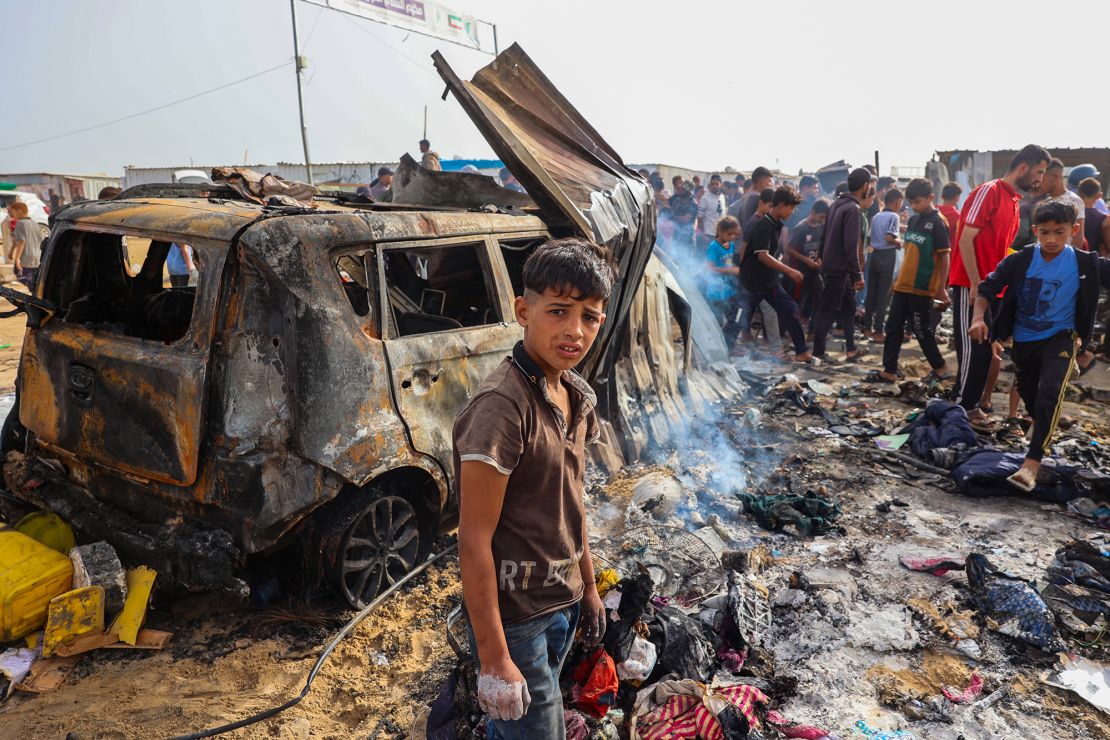
Palestinians gather at the site of an Israeli strike on a camp housing internally displaced people in Rafah, Gaza on Monday. Eyad Baba/AFP/Getty Images
“Blood on my Hands”
Oppenheimer felt Truman’s answer was utter foolishness. As he and his fellow scientists at the Los Alamos Laboratory had previously warned, Oppenheimer knew the technology for using the energy released from nuclear fission to make a bomb wasn’t something that could be kept secret, and Russia would eventually unlock it, according to Monk.


The tile is down, new carpet is installed, fresh paint has dried and the only thing left is to officially welcome the community to the unveiling of the spruced up Twin Pines Senior & Community Center.
The City of Belmont is – PLOTTING! Yesterday I watched a lot of stuff about the two World Wars. Historians conclude Hitler would have never rose to power, if The Victors had not treated Germany with disdain and stuck them with a 80 billion rebuilding bill. Yesterday we saw Israel remodel Palestinian tents. There is no talk about rebuilding Gaza. In Belmont, most citizens want The Bomb Shelter of the Gods, dug deep enough to escaped destruction by the 2,000 pound bombs the U.S. gave the Zionists.
For seven months, 300 million Americans are not allowed to put Israel on their……
MOST LIKELY TO BOMB US – list?
I watched the movie Oppenheimer two days ago.
“I feel there is blood on my hands!”
“I don’t want that crybaby scientist in my presence again!” President Truman
I suspect I got on The Belmont Enemy List the day I made contact with the Belmont Historical Society, and, when I spoke at a meeting on October 10th. I was treated like Oppenheimer was treated because I turned over The Victory Rock – and exposed the truth! And what is the truth? Victory – is fleeting. And, peace and security – is a lie! I want the Barrett Community Center renamed the Janke Community Center. It’s time to tell the truth – and see what Barrett Community Center! If that doesn’t change things, then – why live in a lie?
John Presco
A product of the post-WWII construction boom, the Barrett Community Center — Belmont’s unofficial hub of theatre, art, youth sports and recreation — was originally built as an elementary school to serve the families of returning GIs.
The meeting between Oppenheimer and Truman did not go well. It was then that Oppenheimer famously told Truman that “I feel I have blood on my hands”, which was unacceptable to Truman, who immediately replied that that was no concern of Oppenheimer’s, and that if anyone had bloody hands, it was the president.
As demonstrated in survey responses to-date, everyone agrees: the Center should have the capability to serve as an emergency relief shelter. Currently, it does not have the infrastructure or capacity to be utilized for emergency relief. Should the City consider utilizing the Center as an emergency relief center, the City can seek matching funds from the State or County.
https://www.belmont.gov/departments/parks-and-recreation/projects/the-community-center-conversation
Russia’s nuclear ballistic missile early warning radar network has emerged as a key target of long-range Ukrainian strikes, with three facilities having now been attacked by Kyiv’s drones in the past two months.
Two such strikes occurred in the past week. First, a drone hit a “Voronezh-DM” radar at the Armavir Radar Station in the southern Krasnodar region on May 22. The site is home to two Voronezh-DM radars with a range of around 6,000 kilometers (3,730 miles).
https://patch.com/california/belmont-ca/the-evolution-of-a-community-center
The real question, Gervais says, is, “What does this become? Do we want to create European-style town square where dad can have a cup of coffee while his daughter is at ballet class? Or maybe partnerships with an established organization like the YMCA to generate revenue and help offset operating expenses.”
The next step, said Gervais, is to form a group of community members to take a look at all aspects of long term redevelopment of Barrett — whether to fix it up, or to completely level it and start anew. Currently there is no central gas heat or hot water at Barrett, and the roofs need to be replaced.
Despite the addition of stage flooring, mirrors and ballet bars in the center’s two dance studios, Gervais cites the dance program as an example of the need for overall improvements.
“The dance program is booming,” he said. “It’s filling up and thriving, yet people notice the condition of the aging facility and they want to see some changes.”
Jim Ahearn, who’s lived next to Barrett for 15 years, and has been the center’s building superintendent for as many years, has a different view.
“I like it the way it is, I don’t want to see any changes,” Ahearn said in a straight-forward manner that reflected his 30 years in the Marines.
https://www.washingtonpost.com/history/2023/07/21/oppenheimer-truman-atomic-bomb-guilt/
The meeting between Oppenheimer and Truman did not go well. It was then that Oppenheimer famously told Truman that “I feel I have blood on my hands”, which was unacceptable to Truman, who immediately replied that that was no concern of Oppenheimer’s, and that if anyone had bloody hands, it was the president. Oppenheimer felt as though the future was in the balance, and that the American government was using/would use the bomb as a political tool against the Soviets. Actually, the employment of the bomb as a part of American foreign policy was–obviously–a new affair, and the application of it as a sort of Pax Atomica in the early years following the end of the war was a wholly new development. And applying the threat of the use of the weapon against the Soviets was a natural state, as many military figures (including, for example, General Leslie Groves) considered them as an enemy right from the start. The fight between the U.S. and the U.S.S.R. started pretty much in 1944, when (with General Groves, again) there was a spearhead movement to control all of the world’s supplies of atomic-bomb-related natural resources.
That is just a little of the background to the meeting in the Oval Office back there in October 1945. Truman had very little use for Oppenheimer then–little use for his “hand wringing”, for his high moral acceptance of question in the use of the bomb, for his second-guessing the decision. Cold must have descended in the meeting, as Truman later told David Lillenthal of Oppenheimer that he “never wanted to see that son of a bitch in this office again”. Truman would retell the story in different waysm, but with generally the same result, waxing about how he dismissed the “cry-baby scientist”.
The Community Center Conversation
A Community Resource in Need
As many of you are aware, our beloved 73-year-old Barrett Community Center, which has been the heart of our community for generations, is in dire need. The Center has been heavily used over the years, providing a space for gatherings, events, and activities that have brought us together as a community.
Given its age, the Center requires extensive repairs and maintenance to meet modern-day earthquake, fire safety, and accessibility standards. Without these repairs, the City and community may not be able to use the facility in the near future.
With the help of residents, we have launched The Community Center Conversation, a community-wide conversation online and in-person, to identify community priorities for the future of Belmont’s Community Center.
As demonstrated in survey responses to-date, everyone agrees: the Center should have the capability to serve as an emergency relief shelter. Currently, it does not have the infrastructure or capacity to be utilized for emergency relief. Should the City consider utilizing the Center as an emergency relief center, the City can seek matching funds from the State or County.
Belmont is committed to ensuring the Center and its vital programs are accessible for all residents for generations to come. As we continue to look forward and prepare for the future, we strive to have every part of our community do its part to maintain the important services the community relies on. While we have this important community conversation, the City will also be exploring the use of developer contributions from new construction in the City and infrastructure grant opportunities to leverage funding for future Center needs and upgrades.
Take the Survey!
Thank you to all of the residents and community members who have provided feedback on this effort to-date. So far, we’ve hosted several open houses, community presentations, and a community survey. Your feedback continues to be invaluable to the future of our community center and the services and activities it provides.
Preliminary survey results from 152 respondents have indicated the following attributes were the most valued in our current community center and desired for the future of the center. If you have not already, it’s not too late to take the survey!
Upcoming Meetings
(All Categories) The Community Center Conversation
- JUN1210:30 AM – 11:30 AMSenior Club Presentation: Community Center Conversation
- JUL211:00 PM – 4:00 PMBelmont Parks Boosters Summer Concert: Community


With several major projects in Belmont nearly complete — the , , Emmett House — city officials may soon be turning their attention to revamping the .
A product of the post-WWII construction boom, the Barrett Community Center — Belmont’s unofficial hub of theatre, art, youth sports and recreation — was originally built as an elementary school to serve the families of returning GIs.
The school’s frontage and surrounding neighborhood was also developed with single family houses in anticipation of soldiers returning from war and starting families.
The 1940s architectural style of Barrett Elementary School is still evident in the “winged” design of the building; the original three wings housed classrooms and were divided by grassy common areas and breezeways. An additional “quad” was added in the 1960s.
As the last of the baby boomers moved on and school enrollment sharply declined, the city of Belmont acquired the site, and in a burst of civic confidence, converted it into Barrett Community Center in 1985.
Find out what’s happening in Belmontwith free, real-time updates from Patch.
Subscribe
That conversion paved the way for much-needed recreation space, as well as a revenue-generating opportunity for the city by leasing some of the space to artists, fee-based recreation classes, and an after-school program.
Today, Barrett is one of Belmont’s most prized recreational assets. Those wings have been subdivided into rooms that serve the diverse needs of Belmont residents. In addition to sports fields, dance studios, an after-school classroom, theatre/multi purpose room, teen center, community garden and a preschool, Barrett is also home to 26 visual artists who occupy the space known as 1870 Art Center.
With all that activity, it might be hard to imagine any further use for this 3.25-acre site, but Director Jonathan Gervais is preparing to ask members of the community to do just that.
“I get a sense that something is bubbling up,” said Gervais in response to the increased activity at Barrett.
When asked about the potential for expansion and improvement, Gervais explained, “It’s a community discussion we’d like to start. Davey Glen and Semeria (parks) are almost complete, and our department will then be ready to move onto Barrett.”
The Parks and Recreation Commission has ranked the revitalization of Barrett relatively high on its priority list, and the Belmont City Council agreed at its Feb. 8 meeting, placing Barrett on its list of new projects being recommended for ranking.
Although the City Council has placed Barrett on its priority list for future upgrading, Mayor Coralin Feierbach would like to see some short-term improvements.
“I’d like to see Barrett upgraded a bit now,” she said. “It would look a lot better with some paint and landscaping.”
Long term, Feierbach stressed the importance of having a center that reflects the wishes and needs of the Belmont residents. “When we start exploring the options for Barrett, we need to have everyone in the community represented—sports groups, families, neighbors, and people who use the park,” she said.
She also wants the discussion of the future of Barrett to take a sustainability approach. “Whatever we do, we have to do it with ‘green’ in mind, taking into consideration what we want in 2020 or 2030.”
The real question, Gervais says, is, “What does this become? Do we want to create European-style town square where dad can have a cup of coffee while his daughter is at ballet class? Or maybe partnerships with an established organization like the YMCA to generate revenue and help offset operating expenses.”
“This is the time for a full and open discussion of the possibilities,” he added. “There needs to be a planning process to engage all community members and figure out the right combination of functions.”
A recent survey revealed citizens would like a community swimming pool and a centralized meeting place.
The next step, said Gervais, is to form a group of community members to take a look at all aspects of long term redevelopment of Barrett — whether to fix it up, or to completely level it and start anew. Currently there is no central gas heat or hot water at Barrett, and the roofs need to be replaced.
Although there is a steady amount of activity throughout the day, late afternoon is when Barrett really comes alive. Footsteps Child Care, an after-school program for local elementary students, opens its doors and a steady stream of first and second graders from stream into the cheery classroom.
Footsteps site director Carrie Janway stresses the convenience of Barrett for after school care.
“It’s very convenient, and some of the kids have siblings at the Community Learning Center [preschool on the same site].” Through its partnership with Belmont Parks and Recreation, Footsteps offers enrichment activities including Lego engineering, chess, art, and Spanish. Janway added that the Footsteps program is open to kids from all schools, not just Central.
Despite the addition of stage flooring, mirrors and ballet bars in the center’s two dance studios, Gervais cites the dance program as an example of the need for overall improvements.
“The dance program is booming,” he said. “It’s filling up and thriving, yet people notice the condition of the aging facility and they want to see some changes.”
But not everyone thinks it’s time for a change.
Jim Ahearn, who’s lived next to Barrett for 15 years, and has been the center’s building superintendent for as many years, has a different view.
“I like it the way it is, I don’t want to see any changes,” Ahearn said in a straight-forward manner that reflected his 30 years in the Marines.
Ahearn is also one of the performers Belmont Community Players, the local theatre group that puts on the popular annual melodrama.
Ahearn feels the theatre — which is also used as a multi purpose room for dance and art classes — is adequate for his theatre group and mentioned that the San Carlos Children’s Theatre also now uses the Barrett theatre for its productions.
On a recent unseasonably balmy winter afternoon, moms played with their toddlers on the tot lot, Footsteps kids tossed a Nerf football, girls in pink tights and ballet slippers filed into the dance studios, a group of adults gathered in the theatre for a line dance class, and three happy Bernese mountain dogs and a Labradoodle tromped around the field after their owners.
The Berneses’ owner, Frank Henry, has been a regular at Barrett for 25 years. “These are our seventh, eighth and ninth dogs taken to Barrett,” said Henry. “I live two blocks away and I come here every day.”
He is quick to point out that he and fellow dog owners would like to see some , and he has worked on a proposal that would allow sports teams, kids, and dog owners to all benefit from the wide open field.
The evolution of Barrett from post-war school to gathering spot to active community center reflects America’s history of such urban centers. In the early 1900s, community centers were based in schools, providing facilities to townspeople after school hours. Initially, public officials and politicians expressed concern that the centers might provide a focus for alternative political and social activity, but the collective need for neighborhood gathering spots for recreation soon erased those concerns.
Geographically, Barrett can be considered the nucleus of Belmont. Centrally located near the intersection of Alameda de las Pulgas and Ralston Avenue, the center is easily accessible from all points in Belmont and surrounding cities.
Like a city within a city, Barrett is a microcosm of life on the mid-Peninsula. It’s a facility that offers a combination of cultural, athletic, artistic, educational and agricultural activities in an urban space devoted to the city’s growing recreational interests and social support.
So, how would the city fund the redevelopment of Barrett Community Center? Gervais points to a current project that once seemed impossible.
“Look at the bike bridge — that’s a good example of, ‘If it’s a good idea, the funding will come.’”
He’s referring to the pedestrian/bike bridge, currently under construction, which will be a safe means to cross over the freeway for access to the Belmont Sports Complex. Funding for that project was in question until stimulus money and other funding sources made it a reality.
Finding the right mix to suit the community’s needs is key, stresses Gervais.
“If we can take hold of people’s imaginations, then the design and the funding will come.”
Get more local news delivered straight to your inbox. Sign up for free Patch newsletters and alerts.
Belmont rec center design is approved
New 42,000-square-foot building expected to cost nearly $58 million
- By Zachary Clark Daily Journal staff
- Nov 16, 2019 Updated Nov 20, 2019
- 1

A new two-story, 25,000-square-foot community center will be much closer to Ralston Avenue than the existing one, but sufficiently set back to maintain the trees and open space.
Daily Journal file photo
The Belmont City Council Tuesday approved the conceptual design for a new community center, which comes with a price tag estimated at nearly $58 million.
“Barrett [Community Center] is on the cusp of becoming something amazing,” said Councilman Charles Stone, according to a video of the meeting. “For many years in Belmont we’ve looked north to San Mateo with envy for centers like Beresford, we’ve looked south to San Carlos with Burton and Redwood City with their lovely facility and fields and felt why don’t we have something like that?”
The conceptual design was shaped by input from more than 3,000 residents over the past nine months. Councilmembers were thrilled so many participated and were supportive of the latest plans, but acknowledged the difficult road ahead in funding the project.
“It’s going to be more than a daunting task to find where we can get the revenue to do this,” said Vice Mayor Warren Lieberman.
After more than 70 years of extensive use, the existing Barrett is in dire need of replacement, according to city officials who say they’ve been struggling for years to keep the deteriorating building operational.
The goal for the new facility is to equip it with spaces and programming that serve the entire community rather than primarily youth as is the case currently.
Located at 1835 Belburn Drive, the new two-story, 42,000-square-foot community center will be much closer to Ralston Avenue than the existing one, but sufficiently set back to maintain the trees and open space. With two stories, the new design increases open space by 30% and the latest configuration for the new center will allow the existing one to remain operational during construction.
The new building includes a 10,000-square-foot gym, potentially with a walking track on the perimeter, and outdoor pool on the southeast side of the property. It will also include a child care facility with a dedicated play yard at its rear, behind which will be another playground with a splash pad adjacent to basketball courts.
Behind the basketball courts will be fields for softball and soccer sandwiched between the community garden and parking lot, which can accommodate twice as many cars as the existing center. Multiple drop-off areas will be on the west side of the property and there will be a dog park in the southwest corner of the lot separate from the sports fields.
Connecting the main elements of the project will be an outdoor promenade lined with canopy trees and picnic furniture that will wind from Ralston Avenue to Belburn Drive.
Barrett’s entrance will include a lobby with a service desk and visual connections throughout the building and to the second floor.
“Being able to see where you want to go and to be engaged by the spaces and pulled — kind of that magnet drawing you in — is one of the new things community centers can offer,” said Dawn Merkes, principal with Group 4 Architecture, which handled the project’s design.
There will be a total of six flexible program rooms, with three on the first floor and three on the second floor. Each room accommodates about 30 people and can be connected to adjacent ones for larger meetings. The rooms will be for conferences, fitness and arts and crafts, among other activities.
There will also be a lounge on the first floor that can be a space for seniors to socialize in the morning or throughout the day and a gathering place for teens in the afternoon before their after-school programs begin, Merkes said. The building also features a community resource room that can be used to charge devices, for medical assistance or to shower in the event of a power shutoff or emergency.
“This is not just a recreation center,” said Councilman Thomas McCune. “Some people will look at it purely as a recreational center, but there’s more benefit to the community other than that.”
Note to readers: The story has been updated. The new proposed rec center is 42,000 square feet and not 25,000 square feet.
 Rosamond Press
Leave a comment