“They denounced the Nazi regime’s crimes and oppression, and called for resistance. In their second leaflet, they openly denounced the persecution and mass murder of the Jews.”
Rich Jews are making the case College Students in America have no CONCIENCE, and, students should be punished for being Pro-Palestinian, which means, they are Anti-Israel Zionists? These students know the difference. They are being accused of not being able tell who the bad guys are, because they know nothing about how the Nazis murdered millions of Jews. Now that the ICC has issued a warrant for Netanyahu, these claims AGANST STUDENTS – are null and void. They amount to DEMONIZING a group of Americans for political reasons! How many Jews want Trump to win?
Members of The White Rose knew their leaders were committing genocide, and did all they could to STOP the slaughter of Jews. Did any learned Jews, or Zionists convince the German White Rose that killing millions of Jews – was wrong? Ot, did they come to this conclusion – all by themselves – without the help of the Zionist Jews? How many Zionists condemned Trump’s Insurrection – because it was wrong? It didn’t look NORMAL for a Democracy to do this. I suggest that every Jewish Citizen of the United States take a LOYALTY OATH, to tell fellow Americans they do not back…..
FOREIGN CRIMINALS!
I will now fight for the right for all people to own a conscience, and not just – THE ZIONISTS!
I demand all Jewish College Students author a letter to Netanyahu, and Jewish Billionaires – and demand they condemn Putin for his evil invasion, and hideous WAR CRIMES in Ukraine!
SIGN IT NOW! Prove you have a – CONCIEANCE!
John Presco
“In a speech Sunday, Bennett called on Netanyahu to move on and let the new government take office. He condemned violence but also said that “not every opposition to the government is incitement” and that politicians need to “develop a thick skin.”
“It’s not a catastrophe, it’s not a tragedy, it’s a change in government — a normal event in any democratic state,” Bennett said. “I call on Mr. Netanyahu: Let go. Allow the state to move on. People are allowed to vote for a government even if you don’t lead it.”
Netanyahu’s speech came as the head of Israel’s Shin Bet security service warned of a rise in rhetoric that encourages violence. A pro-Netanyahu lawmaker compared two of his rivals to “terrorists” facing a “death sentence,” and members of the incoming coalition have received death threats in recent days.
At least one American Middle East analyst compared Netanyahu’s words to former President Donald Trump’s rhetoric ahead of Jan. 6. “
Your conscience is what makes you feel guilty when you do something bad and good when you do something kind.1
It is the moral basis that helps guide prosocial behavior, or behavior that helps others, and leads you to behave in socially acceptable and even altruistic ways.
In Freudian theory, the conscience is part of the superego that contains information about what is viewed as bad or negative by your parents and by society—all the values you learned and absorbed during your upbringing. The conscience emerges over time as you take in information about what is considered right and wrong by your caregivers, your peers, and the culture in which you live.
The White Rose (German: Weiße Rose, pronounced [ˈvaɪ̯sə ˈʁoːzə] ⓘ) was a non-violent, intellectual resistance group in Nazi Germany which was led by five students and one professor at the University of Munich: Willi Graf, Kurt Huber, Christoph Probst, Alexander Schmorell, Hans Scholl and Sophie Scholl. The group conducted an anonymous leaflet and graffiti campaign that called for active opposition to the Nazi regime. Their activities started in Munich on 27 June 1942; they ended with the arrest of the core group by the Gestapo on 18 February 1943.[1] They, as well as other members and supporters of the group who carried on distributing the pamphlets, faced show trials by the Nazi People’s Court (Volksgerichtshof); many of them were imprisoned and executed.
Hans and Sophie Scholl, as well as Christoph Probst were executed by guillotine four days after their arrest, on 22 February 1943. During the trial, Sophie interrupted the judge multiple times. No defendants were given any opportunity to speak.
The group wrote, printed and initially distributed their pamphlets in the greater Munich region. Later on, secret carriers brought copies to other cities, mostly in the southern parts of Germany. In July 1943, Allied planes dropped their sixth and final leaflet over Germany with the headline The Manifesto of the Students of Munich. In total, the White Rose authored six leaflets, which were multiplied and spread, in a total of about 15,000 copies. They denounced the Nazi regime’s crimes and oppression, and called for resistance. In their second leaflet, they openly denounced the persecution and mass murder of the Jews.[2] By the time of their arrest, the members of the White Rose were just about to establish contacts with other German resistance groups like the Kreisau Circle or the Schulze-Boysen/Harnack group of the Red Orchestra. Today, the White Rose is well known both within Germany and worldwide.
Members and supporters[edit]

Students from the University of Munich comprised the core of the White Rose: Hans Scholl, Alexander Schmorell, Willi Graf, Christoph Probst, and Kurt Huber, a professor of philosophy and musicology. Hans’s younger sister, Sophie later came to be a core member of the White Rose.
They were supported by other people, including: Otl Aicher, Willi Habermann [de] (“Grogo”), Theodor Haecker, Anneliese Graf, Traute Lafrenz, Katharina Schüddekopf, Lieselotte “Lilo” Ramdohr, Jürgen Wittenstein [de], Falk Harnack, Marie-Luise Jahn, Wilhelm Geyer [de], Manfred Eickemeyer, Josef Söhngen [de], Heinrich Guter [de], Heinrich Bollinger [de], Wilhelm Bollinger [de], Helmut Bauer, Harald Dohrn [de], Hans Conrad Leipelt, Gisela Schertling, Rudi Alt, Michael Brink, Lilo Dreyfeldt, Josef Furtmeier, Günter Ammon, Fred Thieler and Wolfgang Jaeger.[3][4] Most were in their early twenties. Wilhelm Geyer taught Alexander Schmorell how to make the tin templates used in the graffiti campaign. Eugen Grimminger of Stuttgart funded their operations. Grimminger was arrested on 2 March 1943, sentenced to ten years in a penal institution for high treason by the “People’s Court” on 19 April 1943, and imprisoned in Ludwigsburg penal institution until April 1945. His wife Jenny was murdered in the Auschwitz-Birkenau extermination camp, presumably on 2 December 1943. Grimminger’s secretary Tilly Hahn contributed her own funds to the cause, and acted as go-between for Grimminger and the group in Munich. She frequently carried supplies such as envelopes, paper, and an additional duplicating machine from Stuttgart to Munich. In addition, a group of students in the city of Ulm distributed a number of the group’s leaflets and were arrested and tried with the group from Munich. Among this group were Sophie Scholl’s childhood friend Susanne Hirzel and her teenage brother Hans Hirzel and Franz Josef Müller.[5] In Hamburg, a group of students including Reinhold Meyer [de], Albert Suhr [de], Heinz Kucharski [de], Margaretha Rothe [de], Bruno Himpkamp [de], Rudolf Degkwitz (junior) [de], Ursula de Boor [de], Hannelore Willbrandt [de], Karl Ludwig Schneider [de], Ilse Ledien, Eva von Dumreicher, Dorothea Zill, Apelles Sobeczko, and Maria Liepelt [de] formed the White Rose Hamburg resistance group against the National Socialist regime and distributed the group’s leaflets.[6]

Netanyahu accuses ICC prosecutor of trying to ‘demonize Israel’ over arrest warrants© Provided by Washington Examiner
Israeli Prime Minister Benjamin Netanyahu harshly criticized the International Criminal Court for its plans to issue arrest warrants against him, claiming the court is trying to “demonize” the country.
The ICC announced Monday that Netanyahu is one of two Israeli officials the court intends to pursue arrest warrants against, with the other being Israeli Defense Minister Yoav Gallant. A prosecutor at the ICC has accused Israel of withholding water to Hamas terrorists and Gaza civilians, an accusation Netanyahu deemed “absurd.”
“We are supplying now nearly half of the water of Gaza,” Netanyahu said on ABC’s Good Morning America. “We supplied only 7% before the war, so this is completely opposite of what he’s saying. He’s saying we’re starving people? We have supplied half a million tons of food and medicine with 20,000 trucks. This guy is out to demonize Israel. He’s doing a hit job.”
The ICC’s announcement also detailed plans to pursue arrest warrants against Yahya Sinwar, the head of Hamas in Gaza, Mohammed Deif, the head of its military, and Ismail Haniyeh, the head of its political bureau. Netanyahu criticized this, comparing these planned arrest warrants to a hypothetical scenario of if the ICC pursued arrest warrants against then-President George Bush and Osama bin Laden after the 9/11 terrorist attacks.
The Israeli prime minister also said the ICC’s prosecutor is adding fuel to “the fires of antisemitism.”
“Because he is attacking the one and only Jewish state and trying to handcuff us, preventing us from exercising responsibly, through the laws of war as we obey them, and we are subordinate to them,” Netanyahu said. “He’s saying we are not. He’s creating false symmetry, false facts, and he’s doing a grave injustice to the international court.”
CLICK HERE TO READ MORE FROM THE WASHINGTON EXAMINER
Regarding his plans for what happens when the war ends, he explained their goals after destroying Hamas include demilitarizing Gaza and ensuring the region seeks a civilian administration not affiliated with the terrorist group. He said another goal is to rebuild Gaza “in a peaceful way.”
President Joe Biden also criticized the ICC’s plans for arrest warrants, calling them “outrageous” and stressing that “there is no equivalence” between Israel and Hamas. He added the United States would continue to support Israel amid any threats the Middle Eastern country faces.
Netanyahu condemns incitement from ‘every side’ but also decries ‘election fraud’ as Israeli officials fear violence
BY BEN SALES JUNE 6, 2021 2:55 PM
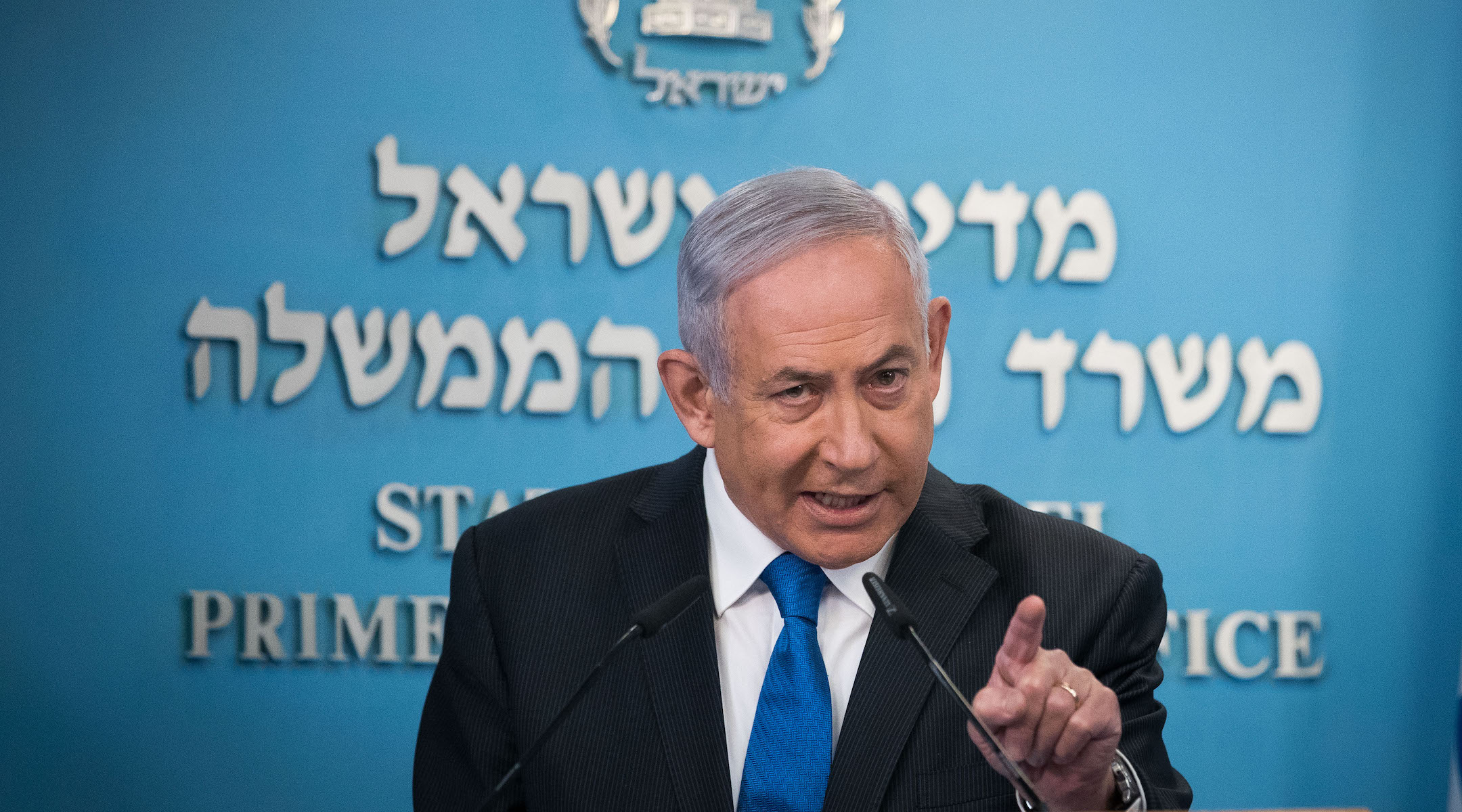
Israeli Prime Minister Benjamin Netanyahu speaks to the media in Jerusalem, Aug. 13, 2020. (Yonatan Sindel/Flash90)
(JTA) — Israeli Prime Minister Benjamin Netanyahu condemned violent rhetoric on “every side” of the political spectrum Sunday but also claimed that Israel’s incoming government, which will replace him, is the result of “the greatest electoral fraud in the history of the country.”
Netanyahu’s speech came as the head of Israel’s Shin Bet security service warned of a rise in rhetoric that encourages violence. A pro-Netanyahu lawmaker compared two of his rivals to “terrorists” facing a “death sentence,” and members of the incoming coalition have received death threats in recent days.
At least one American Middle East analyst compared Netanyahu’s words to former President Donald Trump’s rhetoric ahead of Jan. 6.
“Recently, we have identified an increase and severe exacerbation in violent and inciting discourse, especially on social media,” said Nadav Argaman, the head of the Shin Bet, which is roughly equivalent to the FBI in the United States. “This discourse could be interpreted by certain groups or individuals as permission to commit violent and illegal activity that could, God forbid, cause harm to human life.”
Last week, an ideologically diverse coalition of Netanyahu’s opponents declared that they would be able to form a government that would end Netanyahu’s 12-year run as prime minister, the longest in Israeli history. The coalition will have the narrowest of majorities in Israel’s parliament, the Knesset, and needs to be voted in before it takes office.
Netanyahu and his allies have been trying to persuade members of the coalition to defect and vote against it, which would deprive it of a majority. The vote approving the new government will be held on or before June 14.
In the days surrounding the announcement of the new government, right-wing groups have protested outside the private homes of politicians in the new coalition, and some lawmakers have received added security after receiving threats to their lives.
An open letter from leading right-wing religious Zionist rabbis published on Saturday night called on readers to “do everything so that this government is not formed.” Afterward, prominent signatories said that they were not condoning violence.
In addition, Israeli officials are weighing whether to allow right-wing activists to march in Jerusalem’s Old City on Thursday, in a parade that has previously featured racist chants. The parade was rescheduled for Thursday after having been interrupted by rocket fire from Gaza last month.
On Sunday, a lawmaker from Netanyahu’s Likud party, May Golan, compared two members of the incoming coalition to “suicide bombers:” Naftali Bennett, the incoming prime minister, and Gideon Saar — both of whom were Netanyahu allies before joining with his political rivals.
“Not at all to equate these things, but I compare them today to suicide bombers,” said Golan in an Israeli TV interview. “They’re like terrorists who don’t believe in anything, go out on their suicide mission, [and] even if they know they’re getting a death sentence, they don’t care.”
Earlier that day, in a speech to Likud lawmakers, Netanyahu publicly condemned violent rhetoric for the first time since the new government was announced. He claimed that he and his family had also received death threats, which he said weren’t treated with equal weight.
“We condemn all incitement and violence from every side,” he said in his speech Sunday. “The principle needs to be clear and the same for everyone. Incitement and violence, and incitement to violence, will always be out of bounds.”
But he added, “You can’t treat criticism from the right as incitement and criticism from the left as a legitimate act of free expression.”
Immediately after saying that, Netanyahu claimed that the incoming government was the result of historic election fraud. And at the end of his speech, he said, as he has multiple times recently, that the new government “endangers the state of Israel in a way we haven’t seen for many years.”
“We are witnesses to the greatest electoral fraud in the history of the country, and in my opinion, in the history of democracy,” he said. “And so people feel, justifiably, very cheated, and they’re reacting to that. You can’t silence them.”
He added that “the commentators, the studios, and the whole absurd propaganda machine that has come together for their benefit — you don’t need to be afraid to go after them, my friends. Because that’s part of the fraud.”
The outgoing prime minister also made clear that he has no plans to retire if the new government takes office. Netanyahu, who is slated to become leader of the parliamentary opposition, said that if the new government “is established, God forbid, we will bring it down very quickly.”
One American scholar who studies Israel, Aaron David Miller, wrote on Twitter that Netanyahu’s speech recalled former President Donald Trump’s rhetoric following his defeat last year, which led to the violent insurrection at the U.S. Capitol on Jan. 6.
“Foreboding echoes of Trump,” tweeted Miller, a former Middle East analyst at the State Department. “Netanyahu calls election biggest election fraud. Is an Israeli January 6th coming?”
Meanwhile, the heads of the new coalition are preparing to take office. Leaders of its eight parties, which span the political right and left and include an Arab-Israeli party, met on Sunday for the first time since their coalition was announced.
In a speech Sunday, Bennett called on Netanyahu to move on and let the new government take office. He condemned violence but also said that “not every opposition to the government is incitement” and that politicians need to “develop a thick skin.”
“It’s not a catastrophe, it’s not a tragedy, it’s a change in government — a normal event in any democratic state,” Bennett said. “I call on Mr. Netanyahu: Let go. Allow the state to move on. People are allowed to vote for a government even if you don’t lead it.”
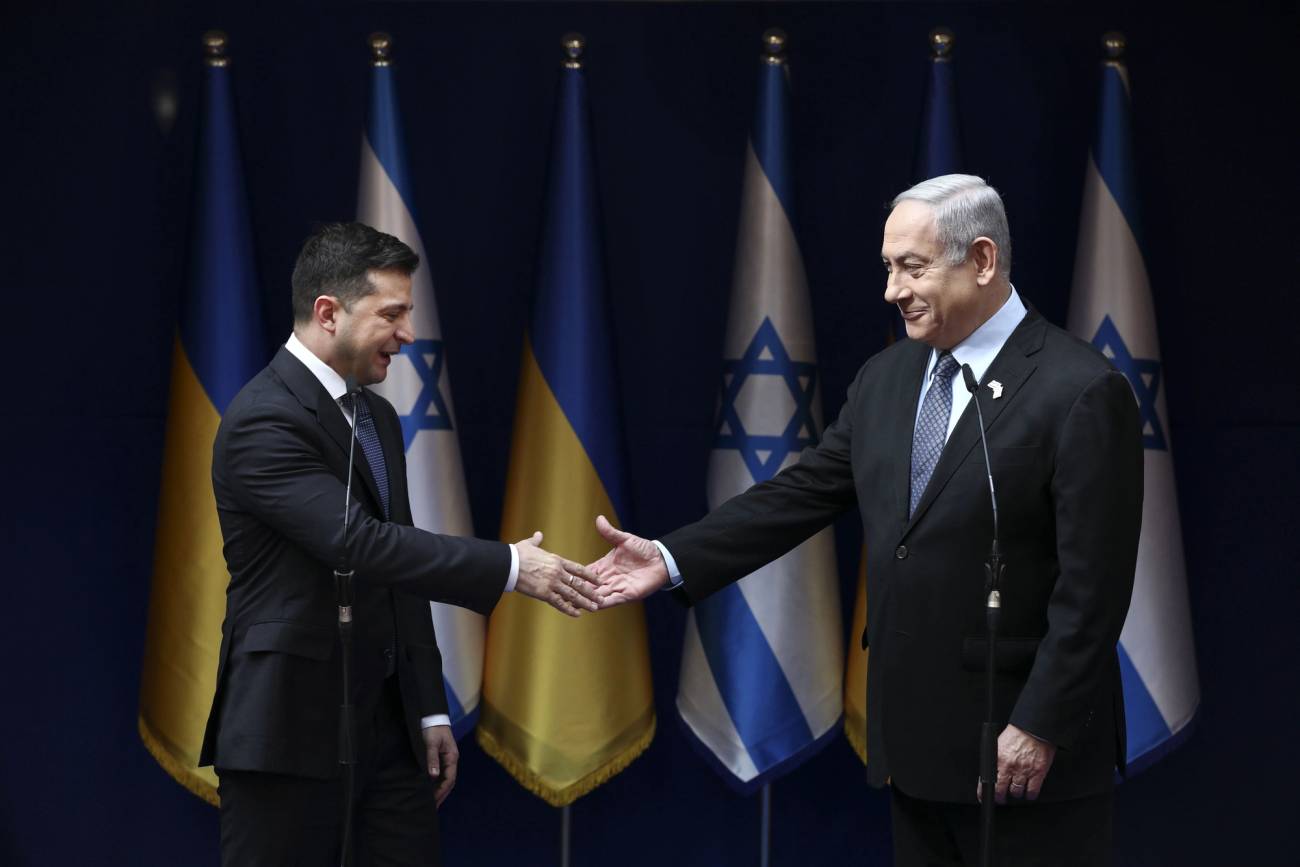
Israeli Prime Minister Benjamin Netanyahu and Ukrainian President Volodymyr Zelensky shake hands during their meeting in Jerusalem on Jan. 24, 2020
ODED BALILTY/POOL/AFP VIA GETTY IMAGES
COLLECTION
This article is part of Hamas’ War on Israel.
The Hamas massacres in the Israeli south that killed more than 1,400 Israeli civilians and members of the Israeli Defense Forces on October 7 constituted the worst day of violence against Jews since the Holocaust. The terrorist incursion also had the effect of undermining multiple long-standing and delicate balancing acts of regional diplomacy, which rested upon logic, predicates and assumptions that turned out to be delusional. The efficacy and wisdom of the neutrality entente between Moscow and Jerusalem, formerly a pillar of regional security arrangements, suddenly looks a lot less rational or defensible than it did to Israeli leaders before the attack.
Israel’s steadfast commitment to a doctrine of nonintervention in the wars raging in Eastern Europe and the Middle East was a key part of Israeli Prime Minister Benjamin Netanyahu’s regional security policy. The original entente reflected the conflict-averse Netanyahu’s desire to keep the Israelis out of the cauldron of the Syrian civil war. Positioning the advancing Iranian forces and their proxies at a remove from Israel’s northern border was a corollary of the deal, which stipulated that the Iranians would be prevented from operating along the Golan Heights, with the Russians acting as a de facto arbitrer of who controlled the territory adjacent to Israel.
Crucially, Moscow allowed the Israeli air force to carry out air strikes against Iranian proxies that operated in Syria, where the IDF would routinely request that Russian missile and air defence systems in Syria be temporarily powered down. The arrangement allowed Israel to stay out of a war in which Tehran’s proxies rampaged across Arab lands, but that augmented the power of the ring of Iranian-backed enemies that surrounds Israel. That encirclement further cemented Jerusalem’s military alliance with the Sunni Arab bloc.
Netanyahu’s arrangement with the Russians allowed the Israeli leader to portray himself as a masterful geopolitical strategist over multiple election cycles. He had always considered his close personal relationship to Russian President Vladimir Putin to be both a political and national asset, grounded in a symbiosis of mutual respect and transactional necessity.
Yet the Netanyahu-Putin relationship had noticeably cooled over the last year-and-a-half before October 7, for numerous reasons. While Putin genuinely respects—and somewhat fears—Israel, he has continued to balance his relationship with Netanyahu against Moscow’s commitments and alliances within the Arab world as well as with other Muslim allies. Russia’s relationships in the Middle East with powers hostile to Israel represent a direct continuation of the regional position of the Soviet Union; many of the USSR’s regional terror assets were inherited either directly or indirectly by Iran.
Nevertheless, the Israeli-Russian neutrality pact has constrained Israel from engaging more closely with or arming the Ukrainians against the Russian invasion. In turn, Israel has paid a substantive diplomatic price with numerous allies because of its neutral stance since the start of Russia’s invasion. Many people around the world (including prominent Israelis like the the ex-refusnik leader and former Israeli cabinet minister Natan Sharansky) have viewed that arrangement as placing Israel on the wrong side of a historical conflagration. The president of Ukraine has repeatedly and fruitlessly deployed his own Jewish background in order to shame Israel into ramping up military assistance.
Yet as the war against Ukraine, which is now well past its 600th day, turned into a disastrous quagmire for Moscow, Putin has turned to his Iranian allies for assistance. While Russia’s alliance with Iran is inherently transactional, it is of ever-growing importance, sanctions have made it difficult for Moscow to procure weapons systems, munitions, and microchips. The Russian-Iranian relationship therefore imposes both a new threat to Israel, and a form of commonality—and even solidarity—with Ukraine.
Ukraine and Israel are now both at war with Iran, either openly or by proxy forces that are being directly supplied, trained, and commanded by Tehran. This is a fact that Ukrainian military and diplomatic officials have tried to hammer home to their Israeli counterparts over the last 19 months of the Russian invasion. The Iranian-made Shahed suicide drones that Iran first provided to the Russians in the summer of 2022 have been critically important in the drone arms race between the Ukrainians and Russians. These drones have been responsible for the deaths of many Ukrainian civilians in Odessa, Kyiv, and other cities, as well as for the crippling of numerous Ukrainian armored vehicles. The Israeli military has observed the technical capacity of the Iranian drones in the Ukrainian battle zones with great interest. The Russian-Iranian alliance has already destroyed half of all Ukrainian electrical pylons and infrastructure hubs. As a result, Ukrainian athletes now routinely refuse to shake hands with their Iranian competitors while taking part in international sporting events.
In return for drones and other support, Tehran, which continues clamoring for Russian technical assistance with its nuclear program, was proffered a certain amount of Russian diplomatic support to go with Russian upgrades on their drones. Moscow is also reported to have allowed Iran to build a massive drone factory in Russia. A great deal of discreet cooperation also takes place on the level of bypassing Western sanctions—an art that Tehran has mastered over the past 40 years, and which Moscow is now learning.
Last year, Russia also promised to sell Tehran a fleet of modern Russian Su-35 attack fighter jets—a transaction that could have potentially realigned the dynamics of air power in the Middle East. However, that deal seems to have been halted or scuppered, and the reasons for the deal not taking place have never been publicly explained. Moscow skillfully manages to find a common language between antagonistic Arabs, Iranians, and Jews, dealing with each discreetly on their own terms.
Yet because Putin had always been seen as viewing Israeli security concerns with appropriate consideration, his waffling, cagey and diffident response to the Hamas attack took many by surprise. Three days after the assault, Putin proffered his first comments on the war between Israel and Gaza during a conversation with the prime minister of Iraq. He stated that “it was a clear example of the failure of U.S. policy in the Middle East, in that the Americans had not taken the core interests of the Palestinian people into account (that is working to create an independent Palestinian state).” The statement worked on numerous registers: placating Arab audiences, reassuring the Iranians, restating Russian diplomatic commitments, and snubbing the Americans for their lack of skill in executing their chosen policy in the region. In other words, a typical aperçu for the trolling strongman.
It also took the Russian president an entire week-and-a-half to call Netanyahu in order to offer his condolences. Putin reportedly did not even bother to condemn the Hamas assault during the phone call. Ukrainian President Zelensky, meanwhile, was one of the first heads of state to render a call, offering to visit Israel. When that gracious offer of solidarity was declined, Ukrainian media and commentators felt deeply insulted by the rebuff.
COLLECTION
Hamas’ War on Israel
All of Tablet’s coverage of the October 2023 attack on Israel and the world’s response.
While the Russians will doubtless attempt to take full advantage of Hamas’ attack on Israel and have already benefited greatly from it, that is not a priori evidence of their having had a hand in planning or executing the massacre. The question of who did know about the incipient assault, which surely took months of training and several years of planning, as well as significant outside technical and logistical assistance, remains unanswered.
The technical prowess that would appear to be needed to take down the billion-dollar Israeli fence is necessarily either a Russian or Iranian contribution. If the American intelligence services had any early warning of what was about to transpire from active signals intelligence in Lebanon or elsewhere, it seems quite possible that the Russians may have also been offered advance notice by their Iranian allies. Moscow has also not backed Israel in the United Nations over the past weeks. After the Israelis destroyed the Damascus and Allepo airports last week, the Russians allowed Iranian military flights—presumably carrying supplies, arms and military advisers—to continue using a Russian military airfield in the north of the country. Yesterday, Russian Foreign Minister Sergei Lavrov arrived in Tehran for talks with his Iranian counterpart.
For the past week and a half, some Ukrainian analysts have been attempting to demonstrate the existence of a direct link between the Russians and the Hamas attack. Proof of Russian involvement in the Hamas incursion would doubtless be a world historical event. Meanwhile, Ukrainians point to the Hamas attack as proof that Netanyahu and the Israelis badly miscalculated in their relationship with Putin, and must now change course.
“Netanyahu is guilty of expecting Putin to remain loyal to his deal with him,” the British Ukrainian analyst Taras Kuzio complained to me. “I have always thought that the official Israeli arguments for why Israel was not aiding Ukraine—that is to avoid angering Putin in Syria—were overplayed and I find it bizarre that Netanyahu did not view the emboldening of Iran by Russia as a potential security threat.
“If Iran is to achieve its objective of a nuclear bomb,” Kuzio continued, “that would be because of Russian support.”
 Rosamond Press
Leave a comment