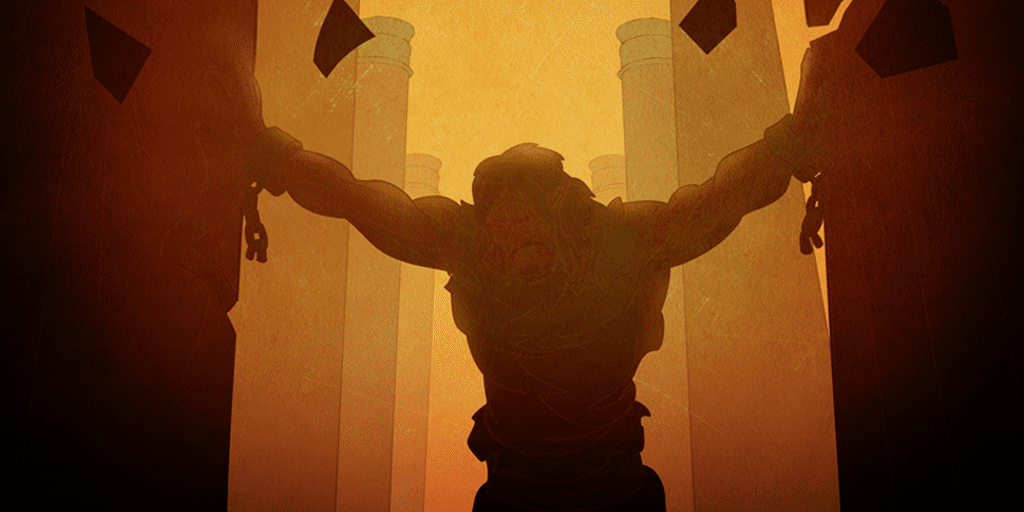

Yesterday I was going to go support the Pro-Palestinian encampment on the grounds of the University of Oregon. I’m going today. I saw Kaleigh Bronson on the news and she quoted Mandela of South Africa. We are DEEP in Biblical Prophecy. If demonstrators take the Vow of the Nazarite, we will be protected by the Constitution in regards to Freedom of Religion. But more importantly, the title “Anti-Semite” can not be applied because Samson married Judaism to the Philistines. He had relations with three Gentile Women. This is why Gentiles were taking the Nazarite Vow around the time John the Baptist and Jesus ministered. John was a Nazarite For Life, as was Jesus. I the image of Samson pushing two pillars down, can be seen as the New Nazarites pushing open the door Jews closed to all outsiders. This door…..is now open! You too – can be a Jew!
John Presco ‘The Nazarite’

The letter states that students have also already faced harassment from counter-protesters and indicated there are fears about the potential for violence if police are called to remove the encampment.
A crowd of more than 500 University of Oregon students and employees marched from the UO Gaza Solidarity Encampment to Johnson Hall on Tuesday, calling for an end to the war in Gaza and chanting “disclose, divest, we will not stop, we will not rest.”

The coalition negotiating group stated that the administration has failed to meet “the very bare minimum” of its demands, which called for protections for vocal students and staff, divestment from companies that support Israel, and education on the history and current situation in Gaza.
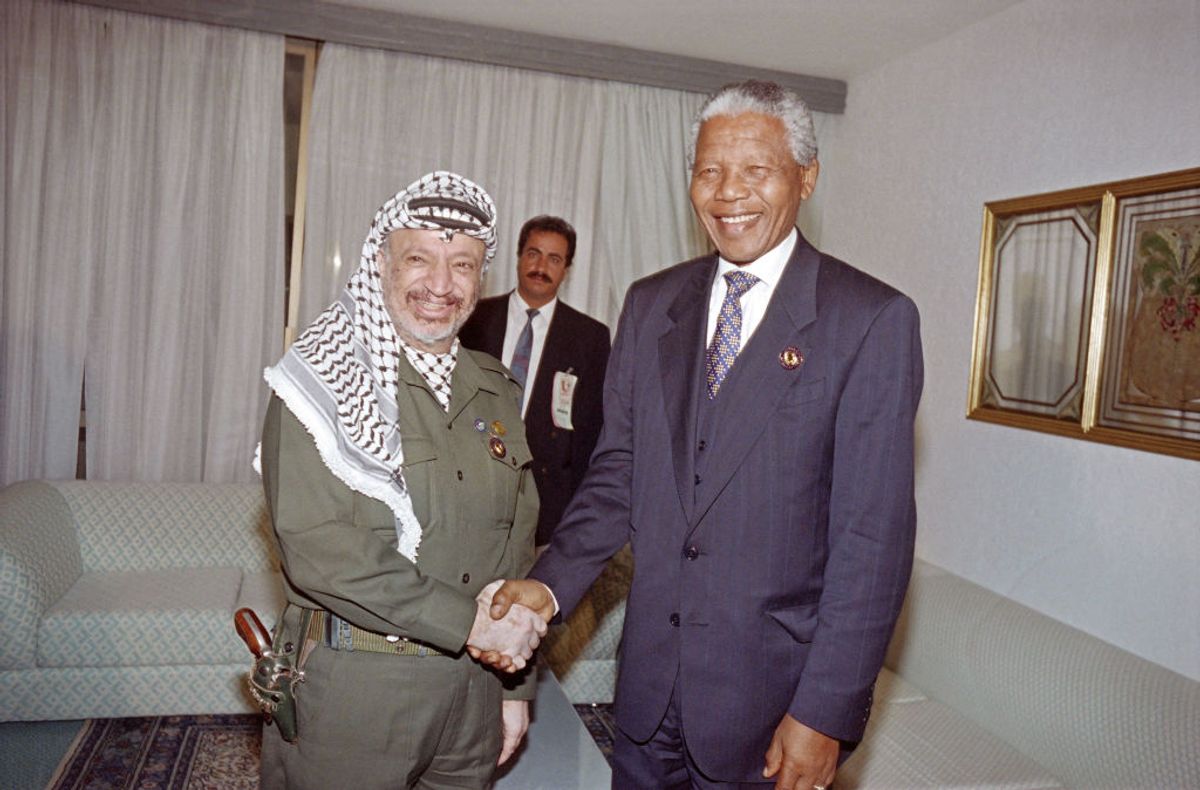
Image courtesy of Getty Images
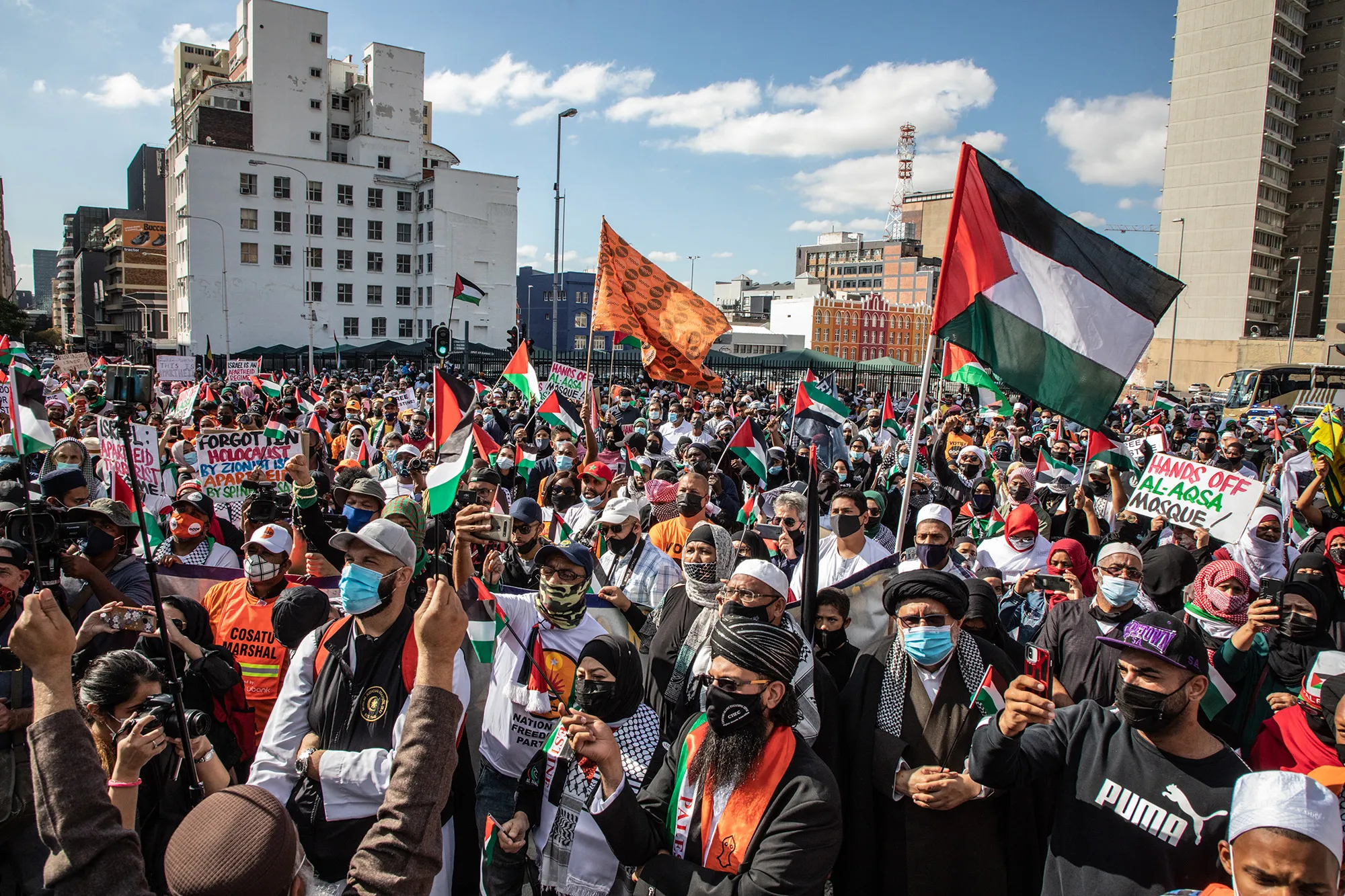
BY MOGOMOTSI MAGOMEUpdated 6:52 AM PDT, November 29, 2023Share
https://www.snopes.com/fact-check/nelson-mandela-freedom-palestinians/
In late 2023 and early 2024, as the Israel-Hamas conflict continued and Israel bombarded Gaza, many online began to share a quote allegedly by South African anti-apartheid activist Nelson Mandela in which he spoke in solidarity with the Palestinian people.
According to numerous posts, Mandela said, “We know too well that our freedom is incomplete without the freedom of the Palestinians.”
Mandela did indeed say the above words in 1997, during a speech he made at the International Day of Solidarity with Palestinian People in Pretoria, South Africa, according to his official speech transcripts and verified social media accounts. We thus rate this a Correct Attribution.
JOHANNESBURG (AP) — Members of South African political parties, civil society organisations and other supporters marched through the streets of Johannesburg on Wednesday demanding a permanent cease-fire in Gaza as they marked the International Day of Solidarity with the Palestinian People.
CAPE TOWN, South Africa (AP) — Barely two weeks after he was released from prison in 1990, Nelson Mandela flew to Zambia to meet with African leaders who had supported his fight against South Africa’s apartheid system of forced racial segregation.
One figure stood out among the men in dark suits eagerly waiting to greet Mandela on the airport tarmac: Palestinian leader Yasser Arafat, wearing his black and white checkered keffiyeh headdress, had traveled to see the newly freed Mandela.
He grabbed Mandela in a bear hug and kissed him on each cheek. Mandela smiled broadly. It was confirmation of the solidarity between two men who considered their peoples’ struggles for freedom to be the same.
South Africans continue to support the Palestinian cause, and the country has taken the rare step of bringing a genocide case against Israel at the International Court of Justice because of its war in Gaza.
ADVERTISEMENT
South Africa is not a diplomatic heavyweight and is geographically far from the conflict. But its ruling African National Congress, which Mandela led from an anti-apartheid liberation movement to a political party in government, has retained its strong pro-Palestinian stance even after Mandela died in 2013.
“We have stood with the Palestinians and we will continue to stand with our Palestinian brothers and sisters,” Mandela’s grandson, Mandla Mandela, said at a pro-Palestinian rally in Cape Town in October, days after the Hamas attack in southern Israel spurred the war on Gaza. Mandla Mandela, an ANC lawmaker, wore a black and white Palestinian keffiyeh around his neck as he spoke to a large crowd.
A SHARED STRUGGLE
Nelson Mandela regularly raised the plight of the Palestinians. Three years after apartheid and white minority rule was dismantled in South Africa and Mandela was elected president in historic all-race elections in 1994, he thanked the international community for its help. He added: “But we know too well that our freedom is incomplete without the freedom of the Palestinians.”
Prelude to The World Holy Word War
Posted on October 7, 2023 by Royal Rosamond Press

Yesterday, on October 6, 2023, I went to the Knight Library to look for a book I found twenty years ago, that proves Jesus was a Priest overturning rulings by the Sanhedrin. He was not a prophet, or a Zealot, though I believe his judgements were the PRELUDE to the War of the Jews against Rome. When his revolt was defeated, his history was altered to keep the suppression of his followers – going – as long as it takes. The suppression of Jesus ‘The Freedom Fighter’ led to the attack on Israel – on the Sabbat. I did not find that book, but took this pic of me amongst a wall of books about the Jews. I knew my prophecies were about to come true. I am for Reformed Judaism which is being demonized by Israelis.
When I left the library, I thought about my ex-friend, Mark Gall, who was the head of the Department of Education at the University of Oregon. I could see the building he worked in when we first met. I was going to send him this article about Christians being attacked by Orthodox Jews. For years we had arguments about ‘The Israeli Right to Exist’. Mark still knows nothing about comparative religion – or just plain religion. I sent him articles on how orthodox Jews are attacking Christians. Mark declared me a Nazi in a e-mail, and recently toned that down to me “acting odd”. I suggested he and his wife write a book together – then included myself! NO REPLY. I am now convinced the Galls are writing a biography – behind my back – knowing I have been working on my autobiography for years. I have asked Mark Gall to help me. He authored many books. I suspect he showed one of my e-mails to the Corbin brothers, and is why I was un-invited to a wake for their father. Mark wants his book out before mine, wherein I am demonized, and their son Jonny Gall, glorified in the name of the Jewish Nation. This is one of the reasons I declared The World Holy War has begun! Its a WAR OF HOLY WORDS!
South Africa, Hamas, And Israel
Posted on December 19, 2023 by Royal Rosamond Press


There are sixty million human beings in South Africa. There are nine million human beings in Israel. There are two million human beings in Gaza. Most of the human beings in the world condemned Hamas for murdering children, and wished they could have STOPPED the horror.
Alas there are questions about why it took Israel soldiers so long to come to the murder scene = and stop the slaughter. Most of the human beings of the world – are horrified to see Israeli bombs murdering children. All but a handful of human beings – desperately want to STOP the murder of children – in Gaza! Why is it taking so long! STOP!
Tens of thousand of Black Voters in America are threatening to not vote for Biden – unless he STOPS the murder of babies in Gaza. If they do, then Trump will be president again. Putin will let out a war whoop, and murder more children in Ukraine. The objective of most human beings, is to have the armies of Israel and Russia – STOP murdering children – AND GO HOME!
In 1989 I declared myself a Nazarite and became a member of the Shembe Zulu Nazarite/Nazareth Baptist church of South African. I was driven out of the Christian church I tried to join. When I told my friends and family I was a Shembe Zulu Nazarite – they were pleased because they were able to dismiss me, even title me “odd” and – INSANE! One racist’ acquaintance is trying to take over my history and much of my blog in order to save the white race. I made Starfish a South African Nazarite and Lesbian who marries James Bond’s granddaughter. Bond lovers HATE my book. Pope Francis just blessed Gay Marriages.
When I titled myself The Third Christ, who owns proof Jesus was a Nazarite, I was EXCOMMUNICATED. There was no Nazareth when Jesus walked the earth. Unless he was a Nazarite – he is a fictional person. And, that is that!
This is a Jubilee year. King Herod did not order the murder of innocent babies in order to get rid of a Rebel that would throw Herod off his throne. You Christians need to – retreat and take a deep breath. You need to put down Putin and Trump, and support the Democracy of the United States of America!
John ‘The Nazarite’
EXTRA! I saw this right after this post. Zionists still hold a grudge that the ally armies did not do more to save the Jews. President Truman signed a paper allowing the Jews to form the nation of Israel – so they could form an army – and protect themselves! WHAT HAPPENED? As fifteen hundred Jews got murdered and kidnapped – THE ISRAELI ARMY DID NOTHING for ten hours!! It was – right there – very close by! The U.S, gave billions for it to be – READYTO DEFEND JEWS! Instead, the War Hawks gave Hamas billions – that could have been spent to hire mercenaries, like Black Hawk. They could have guarded the Nova Trance Dancers – FOR MONEY! Demand the Republicans launch a investigation – NOW!
https://www.rawstory.com/nick-fuentes-trump-2658827118/
Students, faculty rally at University of Oregon encampment, call for cease-fire in Gaza
https://imasdk.googleapis.com/js/core/bridge3.640.0_en.html#goog_1116316349
A crowd of more than 500 University of Oregon students and employees marched from the UO Gaza Solidarity Encampment to Johnson Hall on Tuesday, calling for an end to the war in Gaza and chanting “disclose, divest, we will not stop, we will not rest.”
The rally marked the latest effort from the pro-Palestinian student encampment’s call for action from the UO administration. The encampment, put up a week earlier amid similar movements on campuses across the U.S., continues to grow, with more than 120 tents set up across the Knight Library Lawn as of Tuesday.
More than 100 UO faculty and staff had signed a letter titled “University of Oregon Faculty & Staff are proud to support the student Gaza Solidarity encampment and urge UO administration to refrain from escalation” as of Tuesday afternoon.
Kaleigh Bronson, a research professor at UO and a founding member of the group called UO Faculty and Staff for Justice in Palestine, read the letter aloud during the rally.
UOFSJP was one of two employee groups that spoke during the rally, joining a group that supports students’ right to free speech. That group does not explicitly agree with the encampment’s demands, according to Bronson. She said the two employee groups, while separate, are working together to protect students.
“We are concerned that although it has been stated by administration that there is no current plan to remove protesters from the encampment, students in the encampment were hand-delivered an official notice that threatened ‘legal consequences of non-compliance, such as student disciplinary action, arrest, and punishment for trespass and disorderly conduct,’” Bronson said.
“This encampment is not acting in any way that threatens the safety of our campus community,” she said. “The students participating in the encampment are engaging in an act of peaceful protest while simultaneously engaging in educational discussions and critically important dialogue, some of which has been led by UO faculty members.”
The letter states that students have also already faced harassment from counter-protesters and indicated there are fears about the potential for violence if police are called to remove the encampment.
Bronson told media that many faculty and staff have received what they consider “veiled threats” from the administration. She said she took the day off work to attend the rally and avoid any potential discipline.
https://cm.registerguard.com/article-body/inline-desktop_022024_Elections24
“They just keep reiterating over and over again, don’t hold your class at an encampment, don’t do anything political on work time,” Bronson said. “(They’ve sent) really problematic, in our mind, statements about safety on campus.”
Bronson was among a half dozen faculty and staff who spoke during the rally. A dozen more employees stood together behind the speakers.
UO administration’s statements on pro-Palestinian student encampment
University administration has released a string of statements since the student encampment was erected on April 29.
A letter from interim Provost Karen Ford directed UO employees that they “must not use work time or the workplace to promote or oppose political views that are not relevant to our assigned work.”
A similar message was included in a letter on Monday from Kris Winters, interim vice president for student life, reminding faculty of their instruction obligations.
“No student should be encouraged or compelled by UO employees to be exposed to the protest or encampment,” Winters stated. “This includes visiting the encampment for any academic or instructional purpose including class or office hours.”
Winters encouraged students to report any violations by faculty members.
“I want to acknowledge that this is a tense time, and we may hear and see things that are deeply offensive and hurtful to us,” Winters stated. “While upsetting, this type of challenging speech, even that which may be considered hate speech, is generally protected by the Oregon and US Constitutions. UO respects and protects the constitutional right to free speech, peaceful dissent, and freedom of expression, while also being committed to upholding the right for all our students to receive their education, to participate in and attend classes, and to do so safely and without intimidation. Antisemitism, Islamophobia, racism, anti-Palestinian hatred, and other forms of hate and intimidation are loathsome and do not reflect the values of our university.”
Ralliers have called for the university to divest from several companies with ties to Israel’s military Jasper Ridge Partners, Boeing, Elbit and Vanguard. A recent letter from President Karl Scholz stated that investments are managed by the UO Foundation and he would not ask it to “deviate from their responsibilities and approach.”
“The foundation appropriately focuses on long-term investment decisions that ensure the university remains on strong financial footing,” Scholz stated. “That is done through rigorous management of our investments, evaluating opportunities through an environmental, social, and governance framework, a framework that is attentive to environmental, social, and governance considerations.”
University of Oregon students appreciate staff support, plan to stay
LJ Smith, a UO student and media liaison for the encampment, said it was a tough weekend, with the downpour of rain. Community members rallied to donate tarps, raincoats, handwarmers and more essentials. Smith said they have been grateful for the support from community members and UO employees.
“We were so honored that we had that letter from faculty and staff go out in support of the encampment,” Smith said. “It tracks that there was a direct response from admin on that, and that is very much how we did perceive the statement — a reaction to that action. (The letter from admin) hasn’t changed much for us here. The goals are the same, the spirit is the same.”
The UO Palestine Coalition has stated negotiators received a letter from UO administration, which “threatened to revoke academic amnesty for all protesters starting (Tuesday) at noon.”
The letter reportedly stated that UO “offered to forego pursuit of student conduct code charges against those in the encampment (for violating space reservation and overnight camping rules, which are in pace for campus to maintain respectful operations and physical safety) if there is no further overnight camping and if recognized student groups reserve space for further gathering during daytime hours through appropriate channels … this offer expires at 12:00 noon on Tuesday, May 7, 2024.”
The coalition negotiating group stated that the administration has failed to meet “the very bare minimum” of its demands, which called for protections for vocal students and staff, divestment from companies that support Israel, and education on the history and current situation in Gaza.
This means that as of Tuesday afternoon, students could be even more at risk of academic discipline or arrest.
Smith said this letter hasn’t affected morale at the camp.
“We’ve all been aware of the risks since we stepped foot in camp,” Smith said. “Something I am deeply proud of is the organization that has gone into this, and part of that has been extensively informing all students who come onto campus, the levels of risks that are involved with that. We have known from the start, that academic amnesty ending was a possibility. We’re here to stay. We’re prepared to be here until our demands are met.”
Miranda Cyr reports on education for The Register-Guard. You can contact her at mcyr@registerguard.com or find her on Twitter @mirandabcyr.
14 When Samson went to Timnah, he saw a young Philistine woman. 2 He went ⌞home⌟ and told his father and mother, “I’ve seen a Philistine woman at Timnah. Now get her for me so that I can marry her.”
3 His father and mother asked him, “Aren’t there any women among our relatives or all our people? Do you have to marry a woman from those godless Philistines?”
https://jwa.org/encyclopedia/article/women-in-samsons-life-midrash-and-aggadah
The three women in Samson’s life were Gentiles. The first was the woman from Timnah whom he married, the second was the whore from Gaza, and the third was the only woman mentioned by name, Delilah, with whom Samson “fell in love.” According to the Biblical account, Samson’s relations with these women were a means to be revenged upon the Philistines. Nonetheless, the Rabbis use these ties to denounce the attraction to foreign women prevalent at the time.
The Zulu African Nazarites
Posted on December 4, 2022 by Royal Rosamond Press
In 1987 I became a Nazarite. In 1990 I talked to rabbi at the Hillel Center in Eguene, about converting to Judaism. Here is what a Nazarite is about.
John
https://en.wikipedia.org/wiki/Nazirite
https://www.bbc.com/news/world-africa-66308185
Divided They Fall
Posted on February 23, 2023 by Royal Rosamond Press



Yesterday I was composing in my head a new chapter of ‘The Royal Janitor’ that will explain how and why Starfish fled to South Africa. I was reminded of this event in a recent post. I also have Starfish take the Vow of the Nazarite. She will do this is South Africa.
I have been debating about putting more of my Biblical knowledge in my Bond book. This morning I read an news article about South Africa getting chummy with Putin. I am going to completely trust my intuition from now on. So what there is a lot of Biblical knowledge in my/a Bond book? So what? I’m not in it for the money. I can use the fame for other projects.
I just discovered there are Naval drills going on. Sound the Nazarite Shofar!
John Presco
“The Russian military frigate Admiral Gorshkov in Cape Town’s harbor on Feb. 13, ahead of joint maritime drills with South Africa and China.© -/AFP/Getty Images
Jubilee of the Zulu Zionists
Posted on December 16, 2013 by Royal Rosamond Press
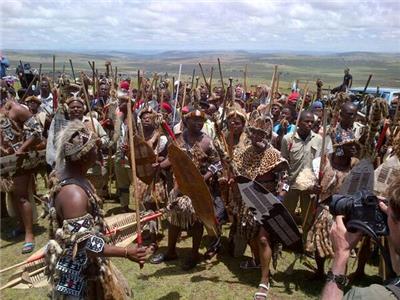

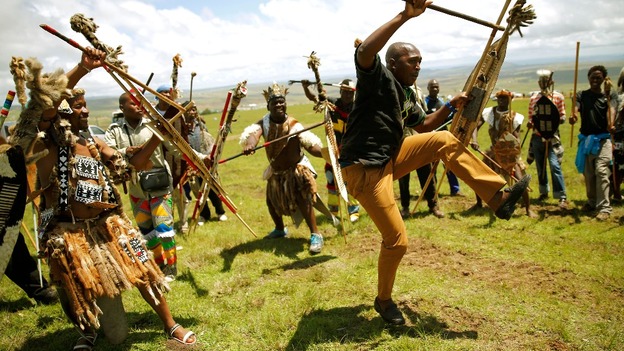


“At one spot overlooking Mandela’s compound, several hundred people gathered to watch the televised ceremony. A group of Zulu traditional dancers with spears and shields gathered nearby to pay their last respects to Mandela.”
On CBS I watched members of the Zulu Nation dancing on a hill overlooking Mandela’s memorial they were not invited to. This gathering began with the appearance of a man in white that was titled a “priest”. I believe he is a Zulu Nazarite, a member of a church I belong to.
Above is a photo of young man blowing a trumpet on a hiss, he too titled a Zulu. The Shembe Zulu Nazarites blow a long trumpet, like a SHOFAR. For this reason I believe God Himself has restored the Year of the Jubilee, which is my mission to assist God in this matter, as it was the mission of Jesus, the Jew, when he came out of the Wilderness. My local news carried the same story which I filmed.
Many years ago I dreamed I was in a house in Hebron where the Messiah of the Jews were born. His father came into the living room where very important Rabbis had performed the brisk and the naming of the child. I can still see his face. He was a secular doctor, and was confused by the attention. I them had another dream where I am walking behind the Messiah I with a joyous group on our way to the Waling Wall. I had grey hair. I have reached the age I was in the dream.
This very real prophecy is not put together as it should be, but, I wanted to get it out before this day is done. It is 12:15 A.M.
Jon
The Nazarite
http://www.cbsnews.com/videos/nelson-mandelas-long-goodbye-ends-with-a-traditional-farewell/
A good king has one job. He must stick his neck out for the good of the people. A couple of weeks ago I am declaring I am the Fisher King and am bid to lead brave souls to Sion….BUT FIRST WE MUST GO TO SOUTH AFRICA, AND SAY HELLO TO THE NAZARITE ZULU! How many thought me mad – and not ever a mad king? The center of the universe will be South Africa tomorrow for a new brand of democracy is born!
https://rosamondpress.wordpress.com/2011/12/24/nazarite-zulu-of-drakensberg-mountain/
The Great Reversal Has Arrived
Posted on February 16, 2012 by Royal Rosamond Press
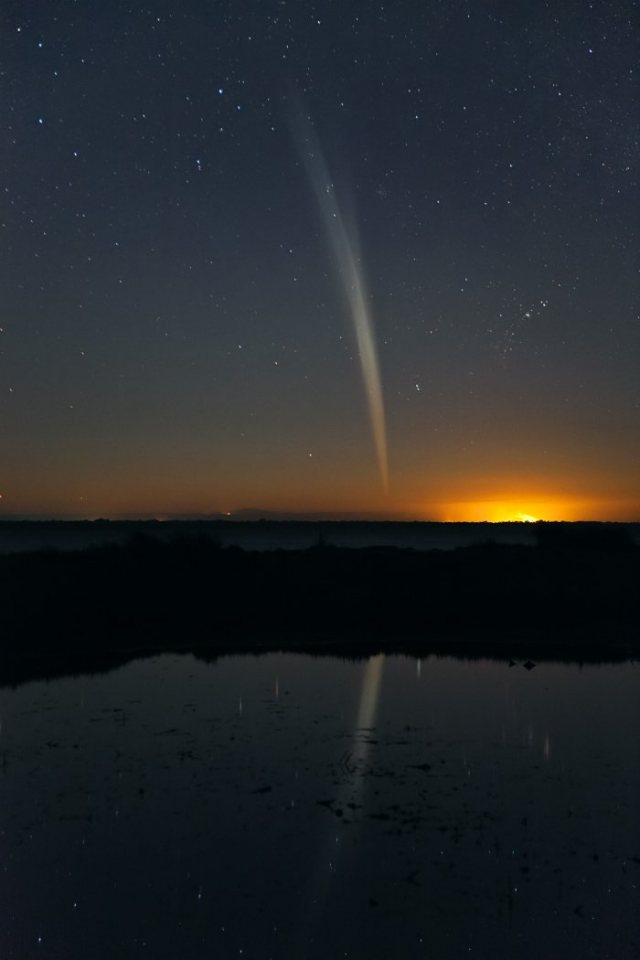
When I tried to become a Christian at forty years of age, I was asked to leave the Christian church at McKenzie Bridge by a man who I thought was my friend, who said this;
“As a Christian, I am bid to love you. But, that doesn’t mean I have to like you.”
I had suggested to him a week earlier that the grove of trees next to the church would be a wonderful place for folks up river to hear the Inspiration Gospel Choir that my childhood friend, Marilyn, sang in. What a look I got, that told me the old peckerwoods in the logging industry won’t like black folks singing in their trees.
A few weeks later I Baptize myself in the McKenzie River, after write on a piece of paper “I am a Nazarite’. A week later, I find ‘My People’ in South Africa. I sent them a letter.
A few weeks later I have a psychic reading, and am told this;
“You own your own creation – You died!”
I am coming to understand that Jesus was killed just after his ministry began. Just after he read from Isaiah, the Jews grabbed him and tried to throw him off a cliff. Allegedly, he got away. The introduction of Lazarus to the story of Jesus has confused Biblical scholars. I believe he is included for the reason the original Church was saying their Lord and Rabbi was raised from the dead – and was with them for months! Was he then crucified for saying he was of the dead, and had come to raise the dead into the New Heaven and Earth?
The Shembe Zulu live in the shadow of the Drankeburg mountians where the arks arrive to found a new earth in the movie 2012.
One day, Marilyn dropped in unexpecedty.I was reading the Bible. When I opened the door, she was startled;
“Your face! It’s all white! your glowing!”
The Great Reversal has arrived!
“The last will be first,and the first will be last!”
Jesus himself was gathering the Gentiles that had at one time helped the Jews, and had been considered Jews. What need of Paul? The Shembe Zulu……………..are The Last!
I warned you at Christmas when a great star appear in the heaven. Repent!
The prophet Shembe got it right, that Jesus was the Liberator Redeemer of the Jews. His Nazarites contacted the Hasidic Jews in order to be recognized as Children of God. They were ignored. But, I hear you my brothers and sisters. Come, let us prepare THE WAY for our Lord. Bring out the Ark of the Covenant! Let us see our Lord before we die!
Jon the Nazarite
Copyright 2012

God’s Nazarites Are Reborn
Posted on February 16, 2012 by Royal Rosamond Press


Shembe got it so right, and he and his people were so isolated from the world. Nazarite means “seperated and concecrated to the Lord.”
“Like a voice crying in the wilderness!”
He who is cast down, shall be raised up!
John and Jesus were Nazarites, for they both went out into the wilderness to undergo a ritual where they resist the temptations of Satan that has everyhting to do with the Great Reversal, for you are joined to the Kingdom of God on earth, and in heaven. This is a test, to see if your are worthy to be a Councilor, a Judge filled with the Holy Ghost and Spirit. All Nazarites are eqaul to one another in the eyes of the Lord when they are joined to the secret NAME of their Lord. Consider John 17.
Five months ago I put Shembe’s words in a poem and read them at the Granary poetry reading. I bid all Africans to wake up! Kadafi was a very wealthy dictator and king. He left this world with nothing.
Play all videos as you read the Zulu Nazarite Cosmology – and be taken to the mountain tops where you will be filled with joy!
Amen
Jon the Nazarite
“Those are bestowed kingly authority
upon the mountain,
Wake up, wake up
ye Africans’.
The Scriptures of the amaNazaretha of EkuphaKameni
The amaNazarites of Isaiah Shembe are the oldest African Independent/Indigenous Church in South Africa. The church divided into two main sections in 1976 following the death of its leader Johannes Galilee Shembe [1904-1976]. The largest group was led by Amos Shembe [1907-1996], the other, smaller group, by Londa Shembe [1944-1989]. The following texts were produced with the encouragement of Londa Shembe. By reproducing them we remain neutral with regard to the division in the church. Our only concern is to publicize the work of the founder the “prophet” Isaiah Shembe.
THEOLOGY OF THE AMA-NAZARITES WRITTEN AT THE REQUEST OF THE RIGHT REVEREND LONDA NSIKA SHEMBE BY G. C. OOSTHUIZEN
INTRODUCTION
Shortly before his tragic murder in April 1989 the Right Reverend Londa Nsika Shembe,[1] leader of the Ekuphakameni amaNazarites,[2] asked me to write a theological introduction to his translation of Some Prayers and Writings of the Servant of Sorrows: Thumekile Isaiah Shembe.[3] Although Londa Shembe and I had many long discussions about theology in general, and his church in particular, we had never really talked about the specifics of his theology. Therefore this chapter is based on general conversations and hints he gave before he died. The most important clue to his thinking is found in the fact that he repeatedly told me and many foreign visitors[4] that he completely agreed with the view given in my book The Theology of a South African Messiah,[5] and my article “Isaiah Shembe and the Zulu World View.”[6] He also told me that his father Johannes Galilee Shembe had referred him to both of these publications and advised him to read them.[7]
The theology of Isaiah Shembe was not based on the sword or violence but on his sincere conviction that he was the mouthpiece and instrument of Jehova, whom he reflected among the people, to lead the Zulu nation out of bondage. This
view also seems to have been held by Londa Shembe whose ideas were deeply embedded in the spirit of Isaiah Shembe. He firmly believed that Isaiah Shembe, his grandfather, had a special place in the celestial sphere. For him Isaiah Shembe was a messianic figure who had been a messiah to eight other peoples before he was incarnated into the Zulu people. Thus Londa Shembe saw Isaiah Shembe as a global figure who was born into the Zulu nation at a specific stage of their history to be their messiah. But, in his view, Isaiah Shembe was a cosmic messiah who should not be identified with the Zulus alone.
Londa Shembe maintained that his grandfather, Isaiah Shembe continued the essence of Jewish religion in his own teachings. He taught that the Biblical prophet Jeremiah referred to the Zulu people whom he believed were descended from the Jews.[8] As a result Londa Shembe began to study Hebrew and was a voracious reader of books dealing with Jewish Religion. He also made contact with an Orthodox rabbi in Durban and unsuccessfully attempted to contact an Hasidic group in Johannesburg. Developing this theme he believed that the teachings of Isaiah Shembe and the teachings of “the old Afrikaner people” were the same because they both emphasized “Unkulunkuln Ka Adam”, the God of Adam.
The place of Jesus in Isaiah Shembe’s theology is problematic. According to Londa Shembe, Jesus was important to Isaiah Shembe when he first founded his church, as a result in his early hymns the name of Jesus was frequently mentioned. But, as time past, the name of Jesus disappeared from the hymns and the names Unkulunkulu,[9] Umvelingqangi[10] and Jehova, which are names for God, gradually became prominent.
Isaiah Shembe referred to Jesus as Liberator and Redeemer in Hymn 2:4 where he praises “the liberation of the hosts of heaven through Jesus the uMkhululi, Liberator, Redeemer.” In Hymn 5 the way of Jesus is pictured as hard and difficult, verse 1, because the gate is narrow, verse 2, and Jesus had no place to rest, verse 3. Therefore his followers have to take up the Cross, verse 5. Later in Hymn 23:4 Shembe stated that Jesus said if people love Him they will stay with Him[11] and in Hymn 50.2 he stated “the brave ones are of Jesus,” amaqhawe ngaka Jesu.” Later in the same Hymn Jesus is referred to as “the judge of men, verse 6, while in Hymn 66:6 Isaiah Shembe refers to “the Father of Jesus” and “the Rewarder of love.” In an interview with Londa Shembe he stated:
When Isaiah started you find Jesus, for example, in Hymn 2 which was the first hymn he composed on Mount Nhlangakazi. In many of the songs and early hymns Jesus’ name appeared but towards the middle period no specific references are made to Jesus but the references are to Unkulunkulu, Umvelingqangi and Jehova. Towards the end it is neither Jesus nor Jesus Christ but Baba Isaiah himself. Isaiah Shembe in the last hymn states he went to the valley of sorrow/distress, cf. Hymn 219:4. His flock has broken his word. It is now his word that they have broken. One sees here how he has been growing. When one looks at the ezitsha (the objects) that he used for communion, there was a crucifix inside the box which means that he accepted it but he gradually grew more into himself. `When the bell rings at 9 o’clock’ he said, ‘you must remember me’. That’s why the services at all the churches and mission stations start at nine.[12]
The theme of liberation touched Londa Shembe deeply as a law student and later as a church leader. He saw, however, that his grandfather’s theology must be seen in the context of the whole of South Africa and its enslavement under an apartheid ideology not just the liberation of the Zulu.
Zulu Christians, belonging to mission churches, often claim that followers of Isaiah Shembe believe he is God. On the basis of our conversations and my own research, I believe, it would be wrong to describe Isaiah Shembe as God, a god or even as a Black Jesus Christ. Rather, he was, and still is, a reflection of “Jehova” in the iBandla lamaNazaretha. This is because his spirit rules supreme in the hearts and minds of his people within the church. Londa Shembe believed that the spirit of his grandfather Isaiah Shembe was manifest in his father, Johannes Galilee Shembe, and finally, in his own person, thus giving unique authority to his own ministry.
In the history of religions people have often built messianic features into a founder of a religious movement and members of the iBandla lamaNazaretha are no exception. The hymns of Isaiah Shembe played a great role in this regard by elevating Isaiah Shembe above mortal men. To understand this development it is necessary to review the history of the founding of the church and Isaiah Shembe’s spiritual development.
THE HISTORY OF Isaiah SHEMBE AND THE AMA-NAZARITES
The church of the ama-Nazarites, also generally known as The Nazareth Baptist Church, or iBandla LamaNazaretha as they are known in Zulu, was founded by Isaiah Shembe around 1911. Isaiah Shembe was born around 1867 near the white town of Harrismith,
in the Orange Free State, into the family of an illiterate farm labourer who had great respect for the culture and tradition of his ancestors the Zulu people. When he died on May 2, 1935 he left behind one of the most influential churches in Africa. This church was and is totally separate from missionary churches and white control and is in no way dependent on them for ideas or financial support.
Isaiah Shembe firmly believed he received his calling directly from `Jehovah’. According to tradition Isaiah Shembe heard a “Voice” in a thunderstorm which told him to leave his mother and four wives, to shun immorality, and to serve God. During the storm he was burned by lightning but obeyed the “Voice” which told him not to have the lightning burns healed by medicine because Jehovah said he should be healed by His word alone. Following this experience Isaiah Shembe developed the qualities of an oboniswayo, a seer, within Zulu society and acted with great self-assurance. Relatively little is known, however, about Isaiah Shembe’s involvement with Christianity or missionaries. It seems he had some contact with the Methodist Church and became a member of the African Baptist Church in 1906. At that time he was already known among African Christians for his preaching and leadership abilities.
When he founded the iBandla lamaNazaretha in 1911 he did so because he was fully convinced that the Christians had failed to obey God’s law as laid down in the Hebrew Bible. In particular he emphasized that only through observation of the Sabbath could the Zulu nation be fully restored to its independence and former glory. In 1913 he selected a mountain in southern Natal, Nhlangakazi,[13] as the “holy mountain,” or Sinai, of his church and founded the holy city of Ekuphakameni[14] in 1914. Both places were to be sites of pilgrimage and annual rejoicing.
In 1911, when the ama-Nazarite movement was born, over 85 percent of the African population in South Africa still practised the indigenous religion of their ancestors. It is probable that Isaiah Shembe left the Methodist Church to join African Baptist Church in 1906 because of its indigenous character, Biblical literalism, and the importance it attached to adult baptism.
But, Shembe also had a deep concern for the restoration of the independence of the Zulu nation which was lost as a result of the Anglo-Zulu Wars of 1879[15] and further weakened by the Zulu Rebellion of 1906.[16] Yet he realized that it was impossible for a small and isolated church to restore the spiritual well being of the Zulu people as a whole. Therefore he had the vision of a people’s movement which is what, under his able leadership, the Ama-Nazarites became.
We can safely say that the mission of Isaiah Shembe was to restore the dignity of the Zulu person and the independence of the Zulu nation who suffered greatly when they resisted the invasions of their country by first the Boers and later the British. The aim of Isaiah Shembe was to restore his people to the previous glory and this he believed could be done on the basis of God’s presence among the Zulu people in the same way as God had revealed His presence to ancient Israel. In 1913, two years after he founded The Church of the Nazarites, he had a vision which led him to declare that the church accepted the Sabbath as God’s holy day instead of the Christian Sunday. As a result of this vision he considered the Sabbath to be the key to Zulu fortunes because it was the test of true obedience to God.
All accounts make it clear that Shembe was a tremendous, dynamic preacher, counsellor and healer. He brought a sense of God’s presence into the midst of his hearers. His son Johannes Galilee Shembe described his father’s work by saying: “Isaiah Shembe showed you a God who walks on feet and who heals with his hands”.[17] In this statement he acknowledges the fact that his own ministry depended on the spirit of his father, Isaiah Shembe. Furthermore, as the King was the sum and substance of the Zulu nation so too Isaiah Shembe was the King of his people. The Kingship pattern of Zulu society and its system of rank is deeply ingrained in “The Church of the Nazarites.” Londa Shembe emphasized this continuously. In an interview shortly before his death he stated:
My grandfather said to DiniZulu KaSolomon this is a kingdom of blood. He said: `You must come to Ekuphakameni and I will unite the tribes before God – they are still separate tribes and not united’. King Solomon agreed. There was then a house built for King Solomon (emzi Nkosi). My grandfather said that the house half-built should remain like that as a memorial to the fact that he called the Zulu King but he eventually declined the call which he eventually will regret. My grandfather told him that his Kingship will end and that his grandson Zwelithini will be the last Zulu King with the royal surname. Mangosuthu Buthelezi’s mother stayed at Ekuphakameni just before she had to go to McCords Hospital in Durban for the birth of her famous son. Mangosuthu is taking over all but in name from the King. My grandfather said all Zulus will be ruled by a man who comes from Ekuphakameni.
Thus Isaiah Shembe was not only a mediator between man and God but became a messianic figure – a messiah for the Zulu nation which he hoped to restore to its former glory.
Isaiah SHEMBE’S CONSCIOUSNESS OF HIS OWN MISSION
Towards the end Isaiah Shembe’s life it appears that his consciousness of his mission for the liberation of the Zulus became more evident. This is very clear in his hymns. For example in Hymn 214 each stanza as the refrain: “Ye Zulus, we have heard him now”. Thus stanza 1 reads:
Our uMkhululi – (Liberator, Redeemer)
we the progeny of Dingaan
we have heard him, he has arrived.
uMkhululi has arrived!
uMkhululi has now arrived!
Ye Zulus, we have heard him now.[18]
The whole tone of this Hymn emphasizes a people which suffered greatly as the result of white penetration and, as they saw it, the destruction of their country and nationhood. Significantly, reference is made to both Dingaan and Sendzangakhona. Dingaan was the Zulu chief who resisted white settlement only to be destroyed through the victory of his white enemies at the Battle of Blood River in 1838. Sendzangakhona, is generally accepted as the father of the Zulu people. These men also feature in Hymn 216 alongside the great folk hero of Zulu history Shaka and his half-brother Mhlangana.
In Hymn 218 the Zulus are called to come to Isaiah Shembe who is addressed as the iNkosi, or Lord . In the last Hymn written by Isaiah Shembe, Hymn 219, he is designated Babamkhulu or great father.
According to Londa Shembe “one can see Isaiah Shembe growing in the hymns he composed.” He maintained that the last Hymn before Isaiah Shembe’s death brought his work to completion by referring to the thousands of generations who stand before him.
Isaiah SHEMBE AND THE RESTORATION OF ZULU PRIDE
Isaiah Shembe wanted to acquire legitimacy and the sanction of the Zulu nation for his movement as well as his own person. To achieve this he tried to restore respect for the Zulu hierarchical system during a time when it was collapsing as a result of the disruption of Zulu society by white conquest. He instinctively knew that roles and statuses must be legitimate in the society in which they occur if they are to have moral and jural sanction.[19] Therefore, because Isaiah shembe did not belong to the royal family but received royal standing among his hundreds of thousands of followers he emphasize religious conceptions and ritual institutions of kingship which fulfilled critical integrative functions.
The recognition of Nhlangakazi, the annual pilgrimage and July festival are a grasping back to the Zulu religion and its ancestry. The holy mountain especially with the presentation of the flowers to the ancestors at various places while ascending the mountain, emphasize the significance of the “cloud of witnesses” in this church. Through contact with the numinous power conveyed by the ancestors, the Nazarites or followers of Isaiah Shembe are strengthened.
In this case the effects of the combination of Christian and basic traditional Zulu religious elements lead to quite formidable results. Not only did Jehova and Isaiah meet on the mountain – Jesus is not referred to in this context – but Isaiah Shembe has brought Jehova to his followers and their ancestors together on a holy mountain where they covenant with Jehova and are accepted as Zulus proud of their heritage.
This was so different from the established Christian churches which sought to westernize their flock, i.e. make them strangers to their traditional kith and kin, by discarding traditions of which they should be proud. Londa Shembe was greatly interested in the history of Israel and how these people of the Old Testaments retained their identity. In all this Shembe played a messianic role as far as his followers are concerned. Isaiah Shembe saw himself as a liberator restoring the Zulu kingship in all the glory it had before Boer and Brit destroyed the Zulu nation due to land greed.
In Hymn 68 Jehova and the royal ancestors are mentioned together: “Jehova saved the Nazarites from their enemies” (verse 2) and protected them “with the royal ancestors who have power” (verse 3) and Isaiah Shembe adds: ”
He counselled them at the mountain
of Nhlangakazi
He scattered the device
of the schemers
He changed their slavery;
It became kingly authority”
In Hymn 17 Isaiah Shembe blamed the enemies of Jehova for destroying the temporal kingly authority after having destroyed that of the Zulu nation. The restoration of this kingly authority is received on Nhlangakazi, as is undoubtedly stated in Hymn 17. Each of the five verses in this hymn ends with
Wake up, rise up
Ye Africans
The first verse in this Hymn says so much that it should be repeated here:
1. “He who is punished is not forsaken
he must not despair
wake up, wake up
ye, Africans.”
Many Africans have had great difficulty in accepting themselves as people who deserve respect and many Zulus have been subjected to humiliation by white overlords. For example, in White South African society Zulu males have often been referred to as “boys” and treated like ignorant people. In their own society they never took orders from women but in White society they were ordered around by White women who often treated them as if they had no status or self-respect. As a result a negative self-image is created which pervades an entire nation.
In this negative context many became fatalistic, accepting that they have no chance of improving their positions. Against this Isaiah Shembe reacted. In
Hymn 17:3 Isaiah Shembe states:
“The enemies of Jehova
rise up against you
wake up, wake up
ye Africans
The enemies of Jehova are those who have destroyed the Zulu nation namely Boer and Brit. But he adds in verse 4:
“Those are bestowed kingly authority
upon the mountain,
Wake up, wake up
ye Africans’.
The Mount Sinai of the amaNazarites is not only related to Jehova but also to the predominantly non-Christian but now sanctified royal ancestry of the Zulu nation. The Christianity of the Whites rejected them but through Isaiah Shembe Jehova sanctified and accepted them in spite of the fact that they passed away as non-Christians. At the Mount Sinai of the Nazarites the Zulu nation has come into a new relationship with Jehova. Here they drink from the fountain of Sendzangakhona the father of the Zulu nation, Hymn 216:5, and from the rock of Mount Sinai, lulelotshe lasentabeni yase sinayi, Hymn 83:5. Isaiah Shembe is seen here as the mediator for the Zulu nation and not those who want to snatch away the eternal kingly authority. He warns in Hymn 17:5:
“They now want to dispossess you
of eternal kingly authority,
Wake up, wake up
ye Africans”
As a result of the mysterious happenings on Nhlangakazi Isaiah Shembe has indeed become the mediator of the Zulu nation. He has the breeding for his position as a Ntungwa, a man of pure Nguni racial stock, from which the Zulu nation originated. Among many Zulu outside his church there were doubts about the ancestry of Isaiah Shembe because he came from the Orange Free State. Some gossips even suggested that he could either be of Sotho or Tswana descent. But, in the Preface to the published book of Hymns[20] Johannes Galilee Shembe, his son and successor states, quite explicitly that he was “the son of Mayekisa, of Nhliziyo, of Nzazela, of Sokhabuzela, of Nyathikazi”, that the Shembes are “Ntungwa of Nhlanzi of Donsa”. Isaiah Shembe was in his very being a Zulu.
7 Commenting on this issue Professor Vilakazi says Johannes Galilee Shembe was “deliberately and unapologetically Zulu”.[21] He adds that the movement has no particular concern for Whites and Indians but is rather meant for “the children of Sendzangakhona.”[22] Thus it may be said that Isaiah Shembe had a never failing sense of supernatural presence.
THE ROLE OF Isaiah SHEMBE IN AMA-NAZARITE RITUAL
Traditional Zulu religion is expressed in ritual rather than dogma. Among the amaNazarites some of the rituals are elaborate, for example, the events on the holy mountain of Nhlangakazi, during the annual January celebrations and the First Fruit Ceremonies held during Christmas period. One such ritual is the u-Fontina ceremony which commences on the evening of the 13th of every month. This is a women’s ritual involving married members of the amaNazarites.[23]
The ceremonies are held at the temples nearest to the amaNazarite settlement where the women live. First, the women assemble at the gate of the settlement dressed in their white robes, known as umNazaretha. Then they form a procession into the settlement singing Hymn 173 which begins:
1. Give way that we enter
that we may serve Jehova.
We had been imprisoned
the gates are now opened
2. Give way that he may enter
oh, here is the Zulu nation
the progeny of Dingaan
and Sendzangakhona.
Upon arrival at the place of worship the services begin with dancing while singing hymns and beating the drums and blowing the trumpets. These rituals were taught to the women by Isaiah Shembe himself. When the dancing stops, the leader, a deaconess, blesses the dancing women by shouting out “Inkosi inibusise!,” Blessed be the Lord! The congregation responds with a loud: “Amen!”
The second phase is devoted to preaching. Each and every women at the gathering kneels and preaches, one by one, as the “spirit moves them”. No one is debarred from preaching. The service is then closed with a prayer usually on the dawn of the 14th day of the month. During that day all the women work at the settlement from the morning until the afternoon. This labour is done as a sacrifice to uNkulunkulu.
The women assemble again that evening in order to worship God first by dancing and then by preaching and praying. In this service the women testify to the work of Shembe in their lives and seek support from each other in their domestic trials and tribulations. They thank God for the blessings received during the previous month and “give praise to uNkulunkulu Ka Shembe wase Kuphakameni,” the God of Shembe who is at Ekuphakameni.
Isaiah Shembe also introduced an adapted version of the Zulu First Fruits Ceremony into his church. In the traditional context this ceremony has to do with the royal ancestors, amakhosi.[24] Krige described it as “the great festival of the ancestral spirits of the tribe,”[25] the great national festival introducing the new year cycle for the Zulus.
When he introduced his own version of the First Fruits Ceremony as one of the ritual foci of his church, the celebration of Christmas – the festival celebrating the birth of Jesus Christ – was terminated by Isaiah Shembe.
On the occasion of the First Fruit Ceremonies the prestige of the king, as the representative of the tribe, was revealed in its greatest strength and power, making the celebration the most important ceremony of the Zulu nation. In the 19th century the King of the Zulus put an end to the feast, probably because the ceremony included strangling a black bull and the inspection of soldiers on parade. The original ceremony was divided into two events named the Little Umkhosi which took place about Christmas time and the Great Umkhosi which took place in January; with the first, certain ceremonies and rituals were observed to protect the King from the evil effects of ukusula medicines which were applied to enhance the growth of the crops. The Little Umkhosi is held mainly in order to protect the King from harm which might result from his possible contacts with those who partake of the first fruits without purification.
During the Great Umkhosi the Zulu nation was represented in great numbers at the Kings place housed in a vast camp of grass huts. During January, the same time as the Great Umkhosi used to convene, Isaiah Shembe and his flock gathered at Nhlangakazi in grass huts – most of the huts are now made of canvas and other materials. During the traditional Umkhosi omkulu the King is strengthened with powerful medicines in order to get ascendancy (ukutonya) over his enemies. Various ceremonies and rituals are observed, inter alia, the slaughtering of oxen, after they have been driven past the graves of the Zulu Kings, at the capital of the Zulu people. Here the regiments stand at a distance and shout: “Woza-ke, woza-lapa” or “Come therefore, come thither”[26]. This reminds of the followers of Shembe who shout from a mountain near the Sinai of the iBandla lamaNazaretha, “Come to us, all ye people, let the spirit send you to us”.
The atmosphere created at the Umkhosi is of great significance and thus the brief reference of the ritual which is far more complicated.[27] The main concern is the importance and effects the festival produced on the Zulu life and thus on Isaiah Shembe, who introduced it into his church’s calender. Contact with the metaphysical forces of the Zulu people was a major concern of the Umkhosi Omkulu and thus to kept the cosmic order.
These first fruit ceremonies constitute a sacrament with two roots, namely, eating with the gods or ancestors and eating together. Eating together means possessing together, which in its deepest sense is a demonstration of inner unity. It is a feast of thanksgiving, but in it an anxiety for the new is revealed. The new season is then danced in.
According to Londa Shembe, Isaiah Shembe terminated Christmas ceremonies because the celebration of Christmas involved Black women in menial work for White families. At Ekuphakameni and at the Umkhozi Omkhulu the king called up the ancestors to be present as it would be an impious act for him to presume to celebrate without their presence”.[28] In the same manner the ancestors of the iBandla lamaNazaretha are called up at Nhlangakazi and also at Ekuphakameni. In Hymn 148:4 Isaiah Shembe states:
They have been called out of the graves;
They are already out, we have seen them,
They have entered the holy city
May Jehova be praised.
The graves of the royal ancestors are also visited by the Nazarites during festivals. During the July festival a special visit of the graves at Ekuphakameni takes place. It is here not a question of the biblical resurrection but of continuation into the metaphysical sphere with which there is a symbiotic union. The ancestors are present and Isaiah Shembe himself is present in the person of the leader of the church at the festival.
 Rosamond Press
Leave a comment