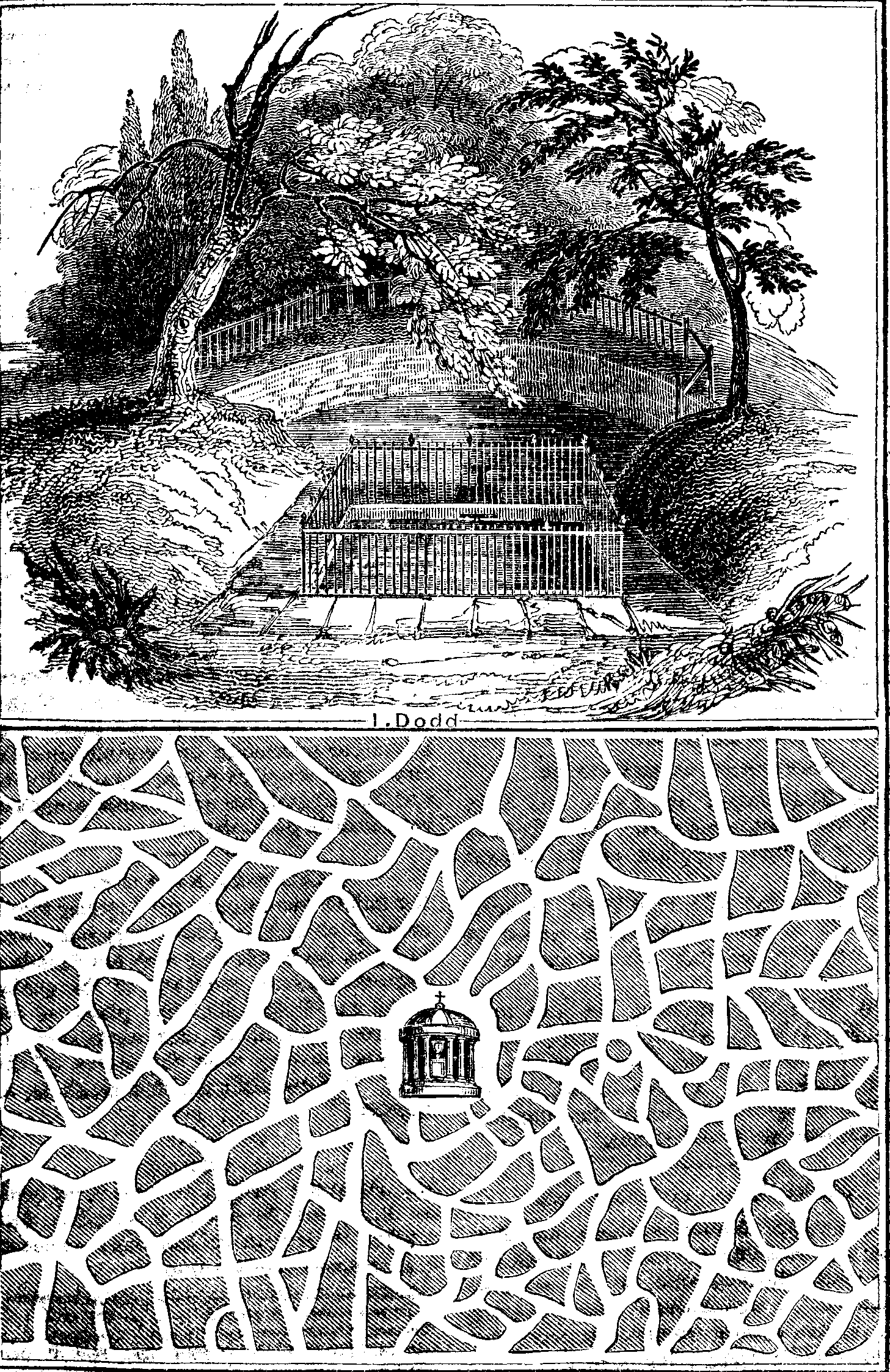
The estate given by the nation to Marlborough for the new palace was the manor of Woodstock, sometimes called the Palace of Woodstock, which had been a royal demesne, in reality little more than a deer park.[14] Legend has obscured the manor’s origins. King Henry I enclosed the park to contain the deer. Henry II housed his mistress Rosamund Clifford (sometimes known as “Fair Rosamund”) there in a “bower and labyrinth”; a spring in which she is said to have bathed remains, named after her.[14]
Hoffmann dedicated his life to collecting people striving for such a “kingdom” and setting up communities in which their striving would express itself in daily life. Initially (1854) known as theFriends of Jerusalem, the group in June 1861 formed itself into an independent Christian religious organisation known as Deutscher Tempel, its members identified themselves as Templers. In 1868 the Templers started to create settlements in Palestine.
Gottlieb’s theological thinking was inspired by reading the works of Johann Albrecht Bengel, whose studies had led him to the conclusion that Christ would return in 1836.[1]
Early British and American support for a Jewish state in Palestine
“Memorandum to the Protestant Powers of the North of Europe and America”, published in the Colonial Times (Hobart, Tasmania, Australia), in 1841
Ideas of the restoration of the Jews in the Land of Israel entered British public discourse in the early 19th century, at about the same time as the British Protestant Revival.[24]
Not all such attitudes were favorable towards the Jews; they were shaped in part by a variety of Protestant beliefs,[25] or by a streak of philo-Semitism among the classically educated British elite,[26] or by hopes to extend the Empire. (See The Great Game)
At the urging of Lord Shaftesbury, Britain established a consulate in Jerusalem in 1838, the first diplomatic appointment in the city. In 1839, the Church of Scotland sent Andrew Bonar and Robert Murray M’Cheyne to report on the condition of the Jews there. The report was widely published[27] and was followed by Memorandum to Protestant Monarchs of Europe for the restoration of the Jews to Palestine. In August 1840, The Times reported that the British government was considering Jewish restoration.[24] Correspondence in 1841–42 between Moses Montefiore, the President of the Board of Deputies of British Jews and Charles Henry Churchill, the British consul in Damascus, is seen as the first recorded plan proposed for political Zionism.[28][29]
Lord Lindsay wrote in 1847: “The soil of Palestine still enjoys her sabbaths, and only waits for the return of her banished children, and the application of industry, commensurate with her agricultural capabilities, to burst once more into universal luxuriance, and be all that she ever was in the days of Solomon.”[30]
In 1851, correspondence between Lord Stanley, whose father became British Prime Minister the following year, and Benjamin Disraeli, who became Chancellor of the Exchequer alongside him, records Disraeli’s proto-Zionist views: “He then unfolded a plan of restoring the nation to Palestine—said the country was admirably suited for them—the financiers all over Europe might help—the Porte is weak—the Turks/holders of property could be bought out—this, he said, was the object of his life…” Coningsby was merely a feeler, my views were not fully developed at that time—since then all I have written has been for one purpose. The man who should restore the Hebrew race to their country would be the Messiah—the real saviour of prophecy!” He did not add formally that he aspired to play this part, but it was evidently implied. He thought very highly of the capabilities of the country, and hinted that his chief object in acquiring power here would be to promote the return”.[31][32] 26 years later, Disraeli wrote in his article entitled “The Jewish Question is the Oriental Quest” (1877) that within fifty years, a nation of one million Jews would reside in Palestine under the guidance of the British.
Syria and Palestine, in a word, must be taken under European protection and governed in the sense and according to the spirit of European administration.
It must ultimately come to this. What a great advantage it would be, nay, how indispensably necessary, when at length the Eastern Question comes to be argued and debated with this new ray of light thrown around it, for the Jews to be ready and prepared to say: “Behold us here all waiting, burning to return to that land which you seek to remould and regenerate. Already we feel ourselves a people. The sentiment has gone forth amongst us and has been agitated and has become to us a second nature; that Palestine demands back again her sons. We only ask a summons from these Powers on whose counsels the fate of the East depends to enter upon the glorious task of rescuing our beloved country from the withering influence of centuries of desolation and of crowning her plains and valleys and mountain-tops once more, with all the beauty and freshness and abundance of her pristine greatness.”
The estate given by the nation to Marlborough for the new palace was the manor of Woodstock, sometimes called the Palace of Woodstock, which had been a royal demesne, in reality little more than a deer park.[14] Legend has obscured the manor’s origins. King Henry I enclosed the park to contain the deer. Henry II housed his mistress Rosamund Clifford (sometimes known as “Fair Rosamund”) there in a “bower and labyrinth”; a spring in which she is said to have bathed remains, named after her.[14]
American public opinion has tended in favor of Israel and against Palestinians for a number of years, although pro-Palestinian sentiment has increased in the United States during the 21st century.[55]
In 2021, according to Gallup, only 25% of Americans sympathized more with Palestinians than with Israelis, with 58% sympathizing with Israel, and only 34% of Americans believed that the United States should place more pressure on Israel in regards to the Israel-Palestine conflict. However, 52% of Americans supported an independent Palestinian state. Democrats were more likely than Republicans to have pro-Palestinian sentiments.[55]
In her 1990 essay “Israel: Whose Country Is It Anyway?”, the Jewish-American writer Andrea Dworkin wrote that American Jews are raised with anti-Palestinian sentiment, which she describes as “a deep and real prejudice against Palestinians that amounts to race-hate.”[56]
The student protests — some of which have turned into around-the-clock encampments — have erupted throughout the nation following arrests and student removals at Columbia University in New York City. Students at schools including Yale University, New York University, Harvard University, University of Texas at Austin, University of Southern California and more have launched protests.
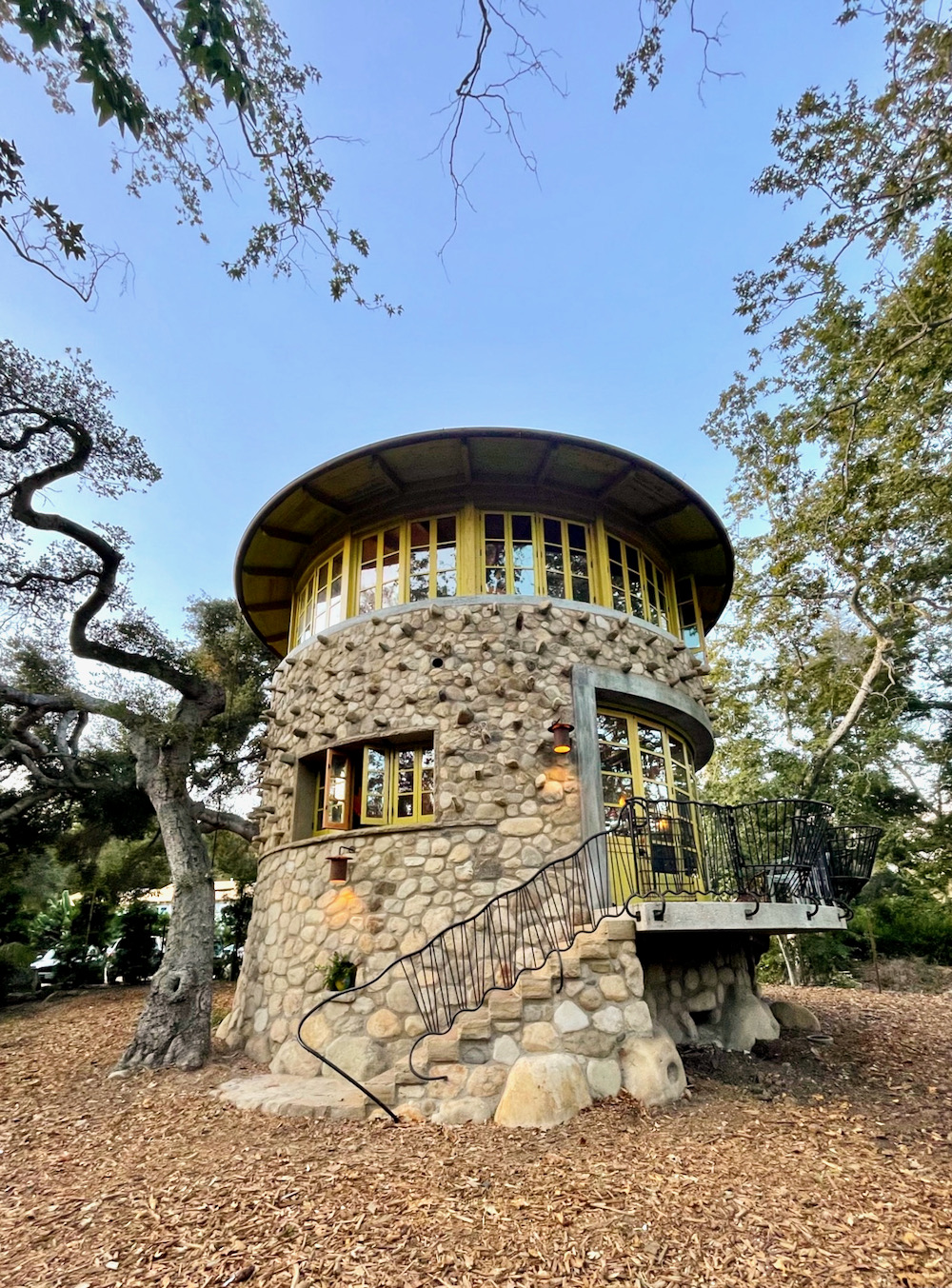
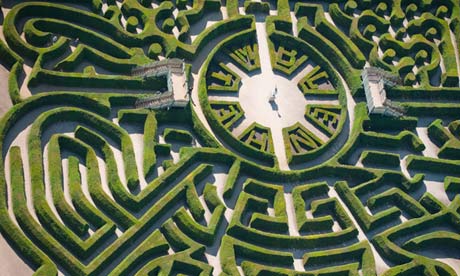
I made these posts before I read Harry and Meghan want to adopt Spence as a surname. This is – meant to be! In my letter to Governor Newsom, I suggest a Labyrinth be built around the Magicians Tower, because I have employed Getty’s Muse to recreate Rosamond Clifford’s bower that was located at Woodstock on the ground of Blenheim palace, where Churchill grew up. Winston and Eisenhower formed the British Defense Staff of Washington that Rena’s husband was the head of. Rena is my muse who I employed in my unfinished painting of Fair Rosamond. Spy centers all over NATO are studying the damage to Putin by the incursion of Wagner. Putin, and Patriarch Kirill, were restoring the Romanov Monarchy and the Society Union. Harry and his children are related to Csar Nicholas. Demand they be protected. They need to be safe in a tower.
“When I awoke yesterday, Mary Ovington White – was in the thoughts. She was inspired by Jack London and William Morris. Morris inspired J.R. Tolkien. I want the Tower of the Magician to be called Rosemond Tower, and the park around it to be named Rosemond Park. I want the three Jankes in that hole in Redwood City – interred in the bottom floor of the tower that will be the new Janke family crypt I’m going to employ the photo of Talitha above, to render my version of Fair Rosamond.. How about a Labyrinth around the Rosy Tower? ”
Five days ago I discovered Paul and Talitha Getty lived on Cheyne Walk in Chelsea. How did I miss this. I am certain Joaquin Miller had dinner on Cheyne Walk in the home of Dante Gabriel Rossetti. Joaquin carried my father’s mother on the trolley from Oakland to San Francisco. We owned a farm below The Hights, a Bohemian Mecca. William Stuttmeister developed property in the Laurel area of Oakland, and married Augustus Janke at Ralston Hall in Belmont. She died before William, and holds the place of honor in the Janke crypt in Colma. There are three generations of the Janke family in the a place I brought my daughter and newborn grandson. I found out before memorial day, that two more generations were dug up from their graves in Belmont and dumped in a hole in Redwood City. Add to this the digging up…
We have arrived. Here is the post that got Alley Valkyrie and her lover, John Monroe, all shook up. They launched their Campaign of Hate on Facebook days after I posted this. Belle asked me to remove all mention of her mother, yet she asked me for more personal information. Catherine Vandertuin was a public figure and is pleased I am raising her Labyrinth Walk form the dead. Belle had a great story – under her nose! Our story…..lives!
With the discovery of the Labyrinth and Lands End, I can build my Time Portal into the future, so, I can go home. My work is almost complete. No artist and writer has ever been so oppressed in the history of art. There is a reason for this. I am……The Collector!
I just discovered Belle’s mother, Catherine Vandertuin, brought Gamelan music to the UofO. My surrogate daughter studied this music, and played it when she attended the UofO. Her uncle, Ron Ramus taught Tai Chi here. Belle’s father, Jeffrey Burch, introduced a Labyrinth Walk that was accompanied by Belle’s mother.
My autobiography is about making my way into the center of Rosamond’s Labyrinth, where I find her, Mon Belle. Belle Burch is at the epicenter. In Friday she will pose for my rendition of Belle Rosamonde in the Labyrinth.
It is uncanny to discover this Labyrinth Walk conducted by Belle’s mother and father whom she talked about briefly. This post shows two painting of Fair Rosamond being found via the clue of the red thread. The Rosamond cote of arms depicts a weaving needle made into a cross with two roses to the side.
Belle’s mother died nine years ago when my muse was fourteen. There is something being reborn here, are awoken. The Descent of Innana (1997) is like Pan’s Labyrinth. (2005). “There will be signs.”
“Catherine brought Javanese gamelan music to Eugene in 1992 with the founding of Gamelan Nuju Laras, well known for accompanying labyrinth walks created by her partner, Jeff Burch.”
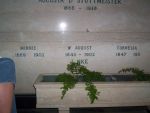
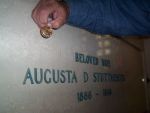
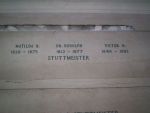
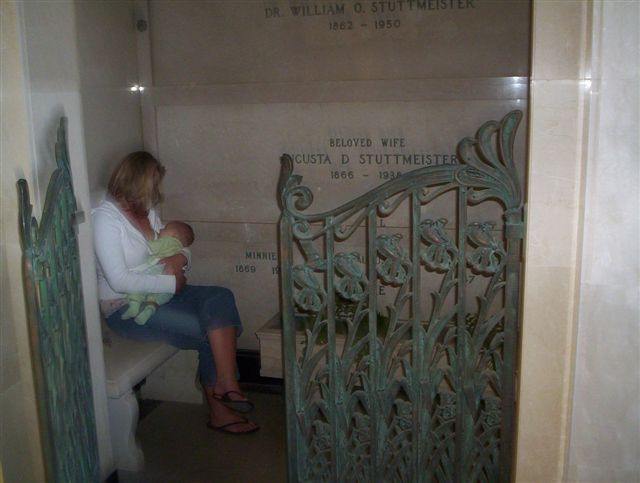
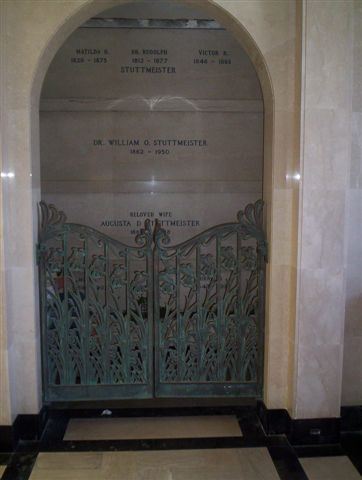
Months after my sister’s death I went to the Sacramento Library and looked at microfish about a legal battle between the heirs of Carl Janke’s estate in Belmont that appeared in the San Francisco Call. I lost the copy I made of that article that I am certain mentioned William O. Stuttmeister, and the sisters of Augusta Stuttmeister-Janke. Carl’s sons did not want Minni and Cornillia, to have anything, and one brother (or cousin) took their side, and was cut out. This has to be William, or W. JANKE. “The bride was attended by Miss Alice Stuttmeister, a sister of the groom, and Miss Minnie Janke, a sister of the bride, as bridesmaids, and Dr. Muldownado and Wm. Janke, a cousin of the bride, were groomsmen.” When Victor Presco turned twenty-one, the the Janke spinsters offered him a moving company in San Francesco. Apparently they saw him as the heir to the Stuttmiester legacy, and the Hope of a return to former glory because they had no children. How about their brother, William? Rosemary said this; “Your father was a made man.” Two days ago, in an e-mail, my cousin Daryl Bulkley confirmed my suspicions that ‘Stuttmeister’ was not the original name of the folks from Berlin. I suspect they were a branch of the Glucksburg family who became Calvinist Evangelicals, and perhaps Rosicrucians. In the top photo we see Minni and Corniallia Janke in the family vault that William Stuttmeister purchased for $10,000 dollars to put the reains of the Jankes and Stuttmeisters in after they were evicted from the Oddfellow cemetery. That William Ralston was a Oddfellow that put up a large sum of money to establish the Oddfellows in Germany – and perhaps elsewhere – makes me wonder about his alleged suicide by plunging into the bay. I am reading articles on the internet about the Oddfellows being the founders of the Welfare State in America, where being charitable to the poor, the infirmed, and the widows, was paramount. They also paid much attention to burying their dead, which suggests they believed in a different hereafter. As a theologian I have pointed out the strange raising of the dead in Matthew 27:53 at the very moment of Jesus’ alleged death.
I suspect Judas was given thirty pieces of silver to purchase Jesus’ tomb, and Jesus was about to practice the ancient Judaic ritual called of the RESUSCITATION, where the soul of the diseased enters the body of another. I believe this is why those who take the Nazarite Vow are bid to keep their distance from the dead. That the Oddfellows titled women as Rebekahs, suggests they are Rechabites, who have been associated with the Nazarites who composed the first Christian church called “The Church of God”. That Jesus came to be seen as God “the Father” is a usurption that began with Paul of Tarsus. That the fall of the Oddfellows in the Bay Area happened overnight, and all traces of their demise, all but disappeared, tells me there was a real Judas and purge. That Daryl pointed out in her research that we knew next to nothing about the Stuttmeisters, whose tomb was lost until seven years ago, tells me William Stuttmeister retired to the Geronimo Valley a disillusioned man, who played a rare violin, and left his Stuttmeister-Janke legacy to his housekeeper. And then he is dead, his remains put in the vault that I went to visit with my daughter and grandson. Before I left for California I told my friend Joy Gall, that I wanted a AA coin to put in this tomb in honor of Christine Rosamond Benton whose funeral fell on he first sober birthday in AA. As I lined up to view my sister in her casket, I did consider the Nazarite Vow I took in 1989. As fate would have it, I ended up putting this coin in William Oltman Stuttmeisters crypt because there was an opening made by the earthquake of 1989.
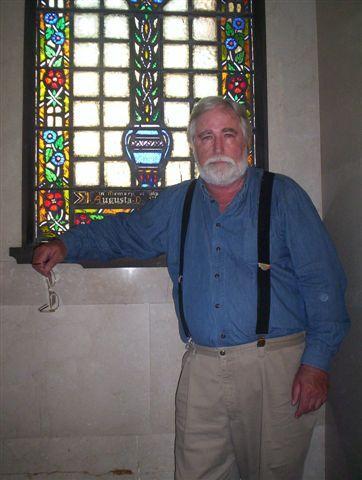
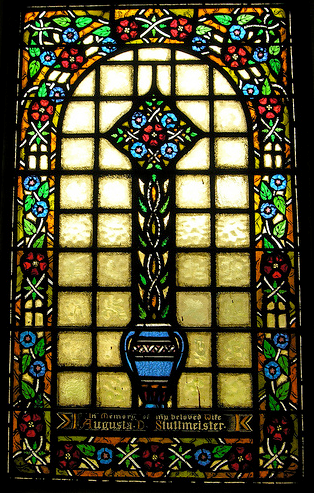
On this coin is an Angel. In 1992 I began a biography of my family called ‘Bonds With Angels’. It begins with an account of the Blue Angel that appear at the foot of Christine’s bed that woke her and Vicki, who crawled into Christine’s bed and beheld her. Vicki was six years of age, and is clean and sober this day. The Nazarite Vow bids one to not ingest alcohol, not get drunk, so that the Holy Spirit may speak through you, use you as a Horn of Power to broadcast the Word of God. When I entered the tomb of my ancestors and sat down on the marble bench, I noticed the letter A made of brass lying behind the faux fern plant. I picked it up. It was the A in JANKE that had come lose in the earthquake. I looked up at the stained glass window and read; “In loving memory of my beloved wife, Augusta Stutteister,” Was Augusta the Angel that came to visit my sisters? May our bonds with Angels continue – forever more! Amen! Jon Presco Daily Alta California, Volume 42, Number 14175, 24 June 1888 STUTTMEISTER-JANKE. One of the most enjoyable weddings of the past week took place at Belmont, Wednesday morning last, the contracting parties being Miss Augusta Janke, daughter of Mr. and Mrs. August Janke of Belmont, and Dr. Wm. Stuttmeister of San Francisco. The house was handsomely decorated with a rich profusion of ferns and flowers, and at the appointed hour was filled with the relatives and intimate friends of the contracting parties. At 11 o’clock the wedding march was played and the bridal party entered the parlor. The bride was attended by Miss Alice Stuttmeister, a sister of the groom, and Miss Minnie Janke, a sister of the bride, as bridesmaids, and Dr. Muldownado and Wm. Janke, a cousin of the bride, were groomsmen. The Rev. A. L. Brewer of San Mateo performed the beautiful and impressive ceremony under an arch composed of flowers and greens very prettily arranged, after which the guests pressed forward and offered their congratulations. The bride was attired in a very pretty and becoming costume of the crushed strawberry shade, and wore a corsage bouquet of orange blossoms. She carried a handsome bouquet of white flowers. After the guests had paid their compliments the bride and groom led the way to the dining-room, where the wedding dinner was served and the health of the newly married pair was pledged. The feast over, the guests joined in the dance, and the hours sped right merrily, interspersed with music singing and recitations, until the bride and groom took their departure amid a shower of rice and good wishes. Many beautiful presents were received. Dr. and Mrs. Stuttmeister left Thursday morning for Santa Cruz and Monterey, where they will spend the honeymoon. On their return they will make their home in Belmont. 1911: Dr. Willian O. Stuttmeister was practicing dentistry in Redwood City, CA. (Reference: University of California, Directory of Graduates,
1864-1910, page 133). Records from Tombstones in Laurel Hill Cemetery, 1853-1927 – Janke – Stuttmeister Mina Maria Janke, daughter of William A, & Cornelia Janke, born February 2, 1869, died March 1902. William August Janke, native of Hamburg, Germany, born Dec. 25, 1642, died Nov. 22, 1902, son of Carl August & Dorette Catherine Janke. Frederick William R. Stuttmeister, native of Berlin, Germany, born 1612, died January 29, 1877. Mrs. Matilda Stuttmeister, wife of Frederick W.R. Stuttmeister, born 1829, died March 17, 1875, native of New York. Victor Rudolph Stuttmeister, son of Frederick W.R. & Matilda Stuttmeister, born May 29, 1846, died Jan. 19, 1893, native of New York.
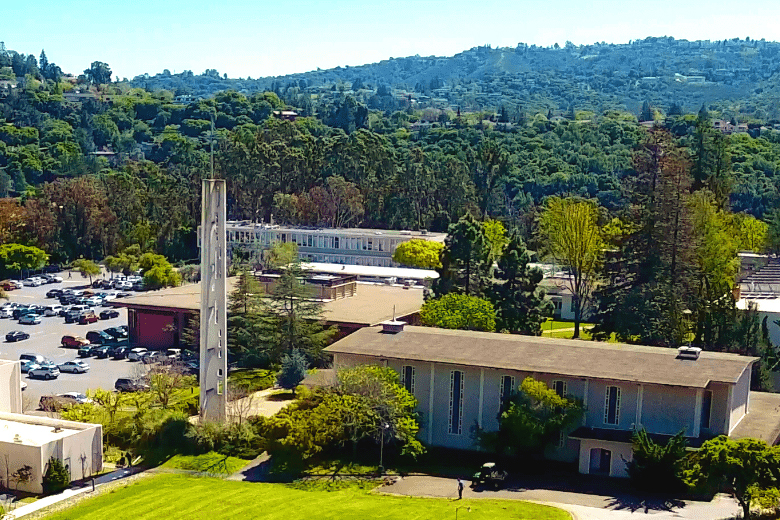
There is something archaic, even mystical, about going through an old trunk with an old Nun, especially when that trunk is full of valuable, lost, history. Janke von Stuttmeister felt he was in a the basement of the Vatican, where the Pope hoards the most precious secrets of the world. In the case of Carl Janke’s Trunk, one could see there had been a religious schism and the surviving information of a great purge had been squirrelled away in the attic of the Ralston House on the grounds of Norte Dame de Namur, that had just been sold to Stanford University.
“You arrived in the nick of time. No telling what Stanford would do with this trunk! said Sister Victoria.
“You’re talking but a very prestigious university!” Janke offered, with his head cocked to the side.
“When they came around to inspect our college, I told three of them there was something fishy going on with the land in Twin Pines Park. A Deed that was filed in the Belmond City archives – is gone! One gentleman, cringed! This was the last thing Stanford needed was a controversy over land they are hungry to own!”
“Whoa! What is this?” exclaimed Janke. They had just started to go through a stratum of old photographs that recorded the history of the Piest Templers in Jerusalem.
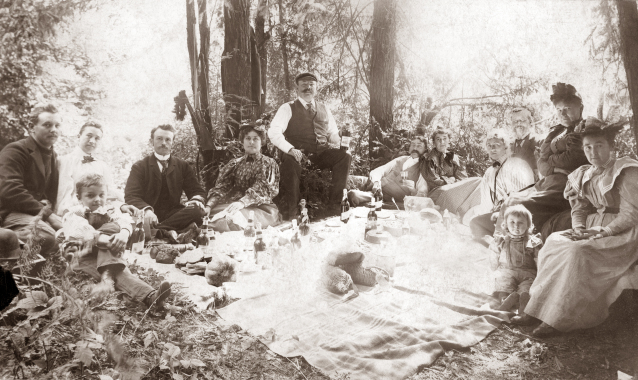
“I have a photograph just like this. My mother said it was taken in the Oakland Hills. Look. This is my blog! “
Sister Victoria gasped as she looked at the family gathered between two trees.
“That’ not the Oakland Hills. These photos were taken at Twin Pines Grove, and were at the epicenter of Belmond.”
Were? Are they still there?”
“No! They cut them down in the middle of the night. The city put up notices saying they had to come down because they had grown too close to one another!”
“What a shame!”
“There’s more. They cut these trees down in the middle of the night. They had spotlights that woke me. I came down here and a back-hoe was digging deep holes all around where the trees stood.”
“Why did they do that?”
“I asked he foreman, and he said it was none of my business. “Go back to bed Old Woman!” Janke, I suspect your family were Evangelical Lutheran Piests – who may have gone to Israel. Prussia wanted to purchase California. They wanted to build a Templer Kingdom on this very land. Belmond was going to be the Capitol. There were going to be……Twin Kingdoms…..Twin Fish!”
Victoria saw that Mr. Stuttmeister was not listening. In his hand he had old maps that were signed by
Gottlieb Schumacher
“Oh my!” Sister Victoria made the sing of the cross. “These are illustrations of the Holy Land.
“These are archeological maps. Gottlieb was looking for something – very important?”
“Mr. Stuttmeister. I have to tell you something very dreadful. In the morning after they cut down the pine trees, and went to look at the damage. All the holes were filled in. Then, I went to look at the tombstones of Carl Janke and his wife, but, they were gone!”
What!!! They dug up my great grandparents? Where did they put them?”
“I asked, and they refused to tell me. I suspect they were looing for….gold!”
Janke picked up a journal written by Gottlieb.
“They were looking for King Solomon’s gold. Gottlieb had a theory the Jews came across the water and found the Incan Kingdom – that was covered in gold. But, there was another Eldorado, “
Sister Victoria picked up another pamphlet, and crossed herself again.
“Gottlieb suspected the people who wrote the Torah, lived amongst the Incans. There was a Jewish Colony!”
“In 1936, high ranking Nazis came to California to look for a lost gold mine – and temple!. Is it possible the descendants f these Nazis – disappeared my ancestors?”
“Look. Here are maps of Tel Megiddo better known as…..ARMAGEDDON!’
“What are they doing? Looks like they are building a cover over a deep hole!”
To be continued!
John Presco
President: Royal Rosamond Press
Hoffmann’s literary output focusses on his vision of a New Jerusalem, a community based Kingdom of God that would eventually spread over all the nations:
Tel Megiddo (Hebrew: תל מגידו; Arabic: مجیدو, Tell el-Mutesellim, lit. “Mound of the Governor”; Greek: Μεγιδδώ, Megiddo) is the site of the ancient city of Megiddo, the remains of which form a tell (archaeological mound), situated in northern Israel near Kibbutz Megiddo, about 30 kilometres (19 mi) south-east of Haifa. Megiddo is known for its historical, geographical, and theological importance, especially under its Greek name Armageddon. During the Bronze Age, Megiddo was an important Canaanitecity-state and during the Iron Age, a royal city in the Kingdom of Israel.
Megiddo drew much of its importance from its strategic location at the northern end of the Wadi Aradefile, which acts as a pass through the Carmel Ridge, and from its position overlooking the rich Jezreel Valley from the west.
Numerous waves of Old Lutherans immigrated to the United States as well during this time period. Among them was a group from Prussia of about 1000 Old Lutherans. They were from Erfurt, Magdeburg and the surrounding area, led by J. A. A. Grabau. They emigrated to the United States in summer 1839. Grabau and his friends founded the “Synod of Lutherans immigrated from Prussia”, afterward known as the Buffalo Synod.[10]
Thousands of other Old Lutherans settled in the Midwest and Upper Midwest of the United States during this period. In addition to Old Lutherans there were also Neo-Lutheran immigrants from the German Kingdom of Saxony, where there was no evangelical union. Lutheran pastor Martin Stephan and nearly 1100 other Saxon Lutherans left for the United States in November 1838, eventually settling in and around St. Louis, Missouri in the Saxon Lutheran immigration of 1838–39. These were the predecessors to the Lutheran Church–Missouri Synod.[7]
Gottlieb Schumacher
From Wikipedia, the free encyclopedia
Gottlieb SchumacherGottlieb Schumacher at Tel MegiddoThe theodolite used by Gottlieb Schumacher in the museum of the German Protestant Institute in Jerusalem
Gottlieb studied engineering in Germany, and then returned to Palestine in 1881.
He quickly became a leading figure in the construction of roads and houses. He was appointed Chief Engineer for the Province of Akko by the Ottoman government. Among his many works were the Scottish hostels in Safed and Tiberias, the Russian hostel in Nazareth, the cellars of the Rothschild winery at Rishon LeZion, and the bridge over the Kishon River.
One of his most important projects was the survey of the Golan, Hauran, and Ajlun districts, in preparation for the construction of the Damascus–Haifa railway, which branched off from the Hejaz railway at Deraa. As part of the same development he also extended the mole of the port of Haifa. In the course of this survey he produced the first accurate maps of these regions, along with detailed descriptions of the archaeological remains and the contemporary villages.
From 1886 he published articles reporting his discoveries in the Zeitschrift des Deutschen Palästina-Vereins. These articles were reprinted in translation by the Palestine Exploration FundQuarterly Statement. He published a series of books, also reprinted in English by the Fund.
From 1903 to 1905 Schumacher carried out excavations at Tell el-Mutesellim, the mound containing the ruins of the ancient city of Megiddo. The first volume of his report on Megiddo, covering the stratigraphy and the architecture, was published in 1908. The second volume, a study of the small finds, was published in 1929 by Carl Watzinger and contained the material which survived destruction during World War I.
Schumacher’s approach to excavation was, like most of his contemporaries, based on the careful clearance of architectural horizons, rather than the dissection of layers of earth. However, by the standards of the day the work was carefully recorded. His report is illustrated with a wealth of photographs of the excavated areas. It also includes simple but beautifully drawn sections, both a main section across the site from north to south and smaller ones to illustrate detailed stratigraphic points.
His main excavated area at Megiddo was a trench 20–25 metres (66–82 ft) across, running north–south through the center of the mound, a method widely used in those days[1] and influenced by Heinrich Schliemann‘s digs at Troy,[2] but considered unfortunate by later archaeologist due to the very large amount of soil removed in a manner that offers little stratigraphic information to future researchers. The massive intervention in this relatively small tell led for instance to overlooking the potentially very important stele fragment of PharaohSheshonk I, usually identified with biblical King Shishak, which was later found in the pile of dump created by Schumacher’s trench, thus out of its original stratigraphic context and rendered almost useless for dating purposes. If found in situ, the stele would have provided chronological evidence about the city from the time of Sheshonk’s campaign, related to the disputed historical existence of King Solomon (1 Kings 14:25; 2 Chronicles 12:1-12).[3]
In the trench Schumacher identified eight strata, which he numbered from bottom to top. Most of them may be dated, by the pottery found in them, to the Middle Bronze Age II–Iron Age II periods. His work was the basis for later excavations by the Oriental Institute of the University of Chicago in 1925-1939.
Schumacher uncovered a number of important buildings at Megiddo.
Part of the Early Bronze Age palace later fully uncovered in Stratum XII of the Chicago excavations.
An Iron Age IIA palace on the south side of the tell (called building 1723 by the Chicago excavators), from which he recovered a seal with a beautifully depicted lion and the words “Shema servant of Jeroboam”.
Corbel vaulted tombs with no parallels in the southern Levant, in Stratum IV.
With the outbreak of World War I, some members of the Templer community returned to Germany. Schumacher remained there until 1924, when he returned to his home on Mount Carmel near Haifa, where he died in 1925.
Key to Schumacher’s maps of Transjordan and the Golan
Schumacher’s maps of Transjordan and the Golan, prepared on behalf of the German Society for the Exploration of Palestine, were the first detailed maps of the area.
Gottlob Christoph Jonathan Hoffmann (December 2, 1815 – December 8, 1885) was born in Leonberg in the Kingdom of Württemberg, Germany. His parents were Beate Baumann (1774-1852) and Gottlieb Wilhelm Hoffmann (1771-1846), who was chairman of the Unitas Fratrum congregation in Korntal. Gottlieb’s theological thinking was inspired by reading the works of Johann Albrecht Bengel, whose studies had led him to the conclusion that Christ would return in 1836.[1]
Christoph Hoffmann had a Pietist-Christian background and enjoyed a Christian education with the Brethren congregation in Korntal.[2] As a young man he studied theology in Tübingen. An opponent of the much better known liberal theologian David Friedrich Strauss, Hoffmann was elected to the First National German Parliament, which met in Frankfurt am Main in 1848.
The failure of his efforts to create a better Christian State through politics caused him to return to the roots of Christianity as expressed by Jesus. He became convinced that Jesus had called for a radical change of attitude in people. The better state of being after such a change of attitude he saw as the Kingdom of God which was to be established. To this end he applied for the position of a missionary inspector with the ProtestantSt. Chrischona Pilgrim Mission of Basel in 1853, but left the position after two years.[3]
Hoffmann dedicated his life to collecting people striving for such a “kingdom” and setting up communities in which their striving would express itself in daily life. Initially (1854) known as the Friends of Jerusalem, the group in June 1861 formed itself into an independent Christian religious organisation known as Deutscher Tempel, its members identified themselves as Templers. In 1868 the Templers started to create settlements in Palestine.
The Templers could buy in Jaffa some houses and land from failed colonists around George Adams, returning to the USA in 1869. On 5 March 1869 also Peter Martin Metzler, a missionary of St. Chrischona and personal acquaintance of Hoffmann from his times at the Pilgrims’ Mission, sold his Jaffa-based mission station, including an infirmary and most of his real estate and other enterprises to the new colonists, before he left Jaffa.
Hoffmann fell out with the Temple Society‘s co-leader Georg David Hardegg (*1812-1879*), so that in June 1874 the Temple denomination underwent a schism with Hardegg and about a third of the Templers seceding from the Temple Society and later mostly returning to an official German Protestant church body.[6] Hoffmann died in the Templer settlement Rephaim near Jerusalem on 8 December 1885.
Hoffmann’s literary output focusses on his vision of a New Jerusalem, a community based Kingdom of God that would eventually spread over all the nations:
The liturgical agenda was subsequently modified to appease many of the objections of the dissenting Lutherans, and in 1830 Frederick William ordered all Protestant congregations in Prussia to celebrate the Lord’s Supper using the new agenda.
Rather than having the unifying effect that Frederick William desired, the decree created a great deal of dissent among Lutheran congregations.[4]
In a compromise with dissenters, who had now earned the name “Old Lutherans”, in 1834 Frederick William issued a decree which stated that Union would only be in the areas of governance and liturgy, but the respective congregations could retain their confessional identities. In addition to this, dissenters were forbidden from organizing sectarian groups.[3]
Upon Frederick William’s death in 1840, persecution of the Old Lutherans eased substantially. However, Old Lutherans continued to find themselves marginalized, especially the clergy who did not have many of the same rights and support accorded to clergy of the Union church.
The Lutherans in South Australia established the Killalpaninna Mission (Bethesda) Station at Cooper’s Creek. Johann Flierl, the pioneer missionary of German New Guinea, served there for seven years (1878–1885).[8] When he left for Kaiser-Wilhelmsland in 1885, his cousin, also named Johann Flierl, replaced him at the mission.[9]
There have been five waves of migration into the Lutheran Church in New Zealand:[citation needed]
My name is John Presco. I am President of Royal Rosamond Press ‘A newspaper for the Arts. Several months ago I tried to speak at the council meeting held to discuss Stanford buying Notre Dame de Namur, but my voice could not be heard after I was called upon due to technical difficulty.. I tried to speak at the last meeting, but it was canceled. For two weeks I have been working on a vision for the future of Twin Pines Park – knowing when Stanford moves in – they are going to want more land. I have more land to give them, on the condition I am on the team who designs a Inner City Park and Bohemian Mercantile Mecca – that will be a showcase to other city all over the world!.
I am the great grandson of Carl Janke the co-founder of Belmont. whose remains were dug up in the middle of the night and put in a mass grave in the Union Cemetery. I am asking the Mayor and City Council to help me get more information on how this could have happened. On August 27th. I became a Odd Fellow so I can honor my ancestors, who were dug up from their final resting place in the Oddfellow Cemetery in San Francisco. After the initiation ceremony, a brother told me there was a fight over the Oddfellow Cemetery next to the University of Oregon, that bid lawmakers to pass Bills so they could dig up more dead people and move them elsewhere. Those Bills – failed!
I was going to postpone my request due to the horrific news being name in Israel and the Gaza Strip, but I began to hear plea after plea for the return of bodies, some of them mutilated, so they can be buried, so the families of the dead can find closure. I have no closure, and I feel my dead have been taken hostage.
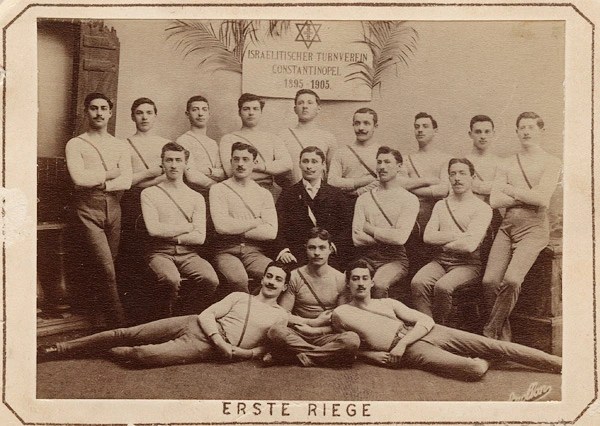
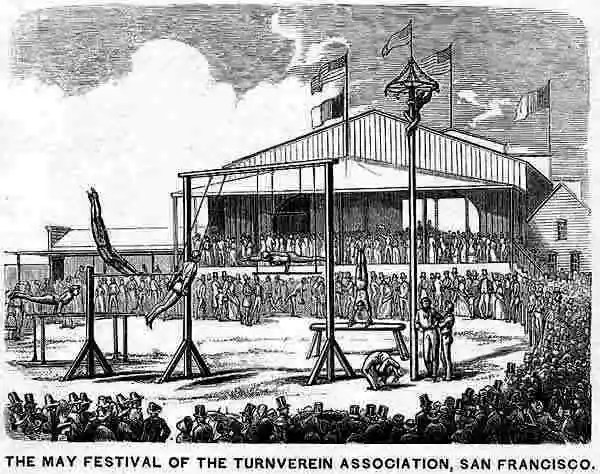
When I contacted the Belmont Historical Society, I was hoping to begin a genealogical-historical research that would lead me own more information about the Turnverein Jews who formed a bond with the Turnverein Gentiles in the City of Berlin, where my Stuttmeister ancestors have a magnificent monument in a cemetery. They were Evangelicals who sailed to all parts of the world. They may have known German Templers who founded colonies in Israel. My great grandfather married Augusta Janke at Ralston Hall and took a stage to Santa Cruz for their honeymoon. The Janke family owned that stage?
“Dr. and Mrs. Stuttmeister left Thursday morning for Santa Cruz and Monterey, where they will spend the honeymoon. On their return they will make their home in Belmont.”
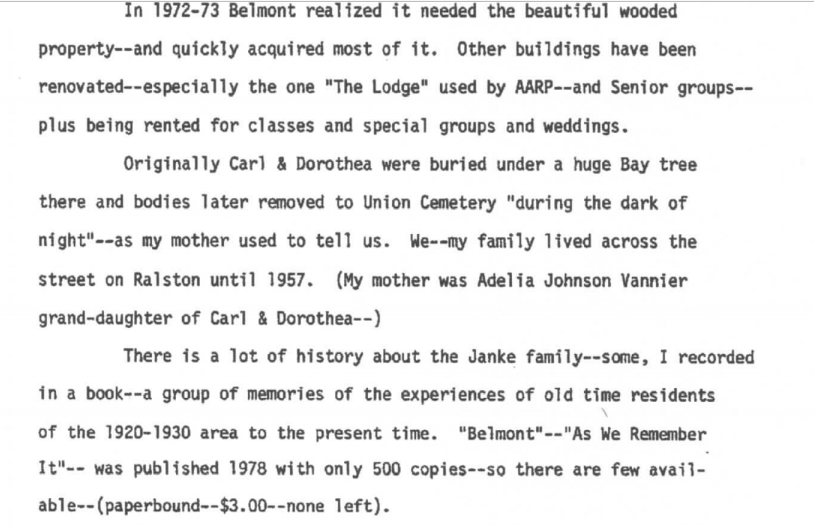
.Four Generations of the Carl Janke Family were dug up from their final resting place – and put somewhere else. This is a Forty-niner Family. Dorothy Janke’s mother was born on the island of Heligoland, that means Holy Land. Heinrich Mutter may be her father. There should be a brass plaque on this island telling Dorothy’s People she was part of the Gold Rush, and was a California Pioneer. Did the Heligolandians pool their money together to go West and secure more land for future generations? People all over the world heard the gold was just lying there – in the streets! If the Belmont City Planners and Government – had not respected the dead for all those years – then there would not have been free land to grab and make a city park! Shall we title this….The Second Gold Rush….considering the price of real estate? Let us pray all the caring offspring of Carl and Dorothea – are dead – and don’t show up out of the blue to reclaim what is rightfully theirs to enjoy.
Help me complete the Janke Family Dream. Bring Carl and Dorette Catherine Janke – back home, so they can be honored in the way the Belmont City of Ol – agreed to honor them. If everything meets to my specifications, then I will give written permission for Belmont and Stanford to exand their vision onto Sacred Ground, in the most honorable, and respectful way possible.
John Presco
President :Belmont Soda Works
I just found a letters I wrote to Mr. White, the President of Namur College. Scroll down.
Dear Mr. White; My name is John Presco and I am the great, great grandson of Carl Janke, who brought six portable houses around the Cape in 1849. It appears that one of these portable houses is inside Ralston Hall – that was built around the small houses that Count Cipriani allegedly had shipped from Italy. I doubt this is true. I would conduct a study by archeological historians who can test the wood – that may not be cut from foreign trees? How about the screws that put this house together?
Three days before Memorial Day I discovered Carl Janke, his wife, and his mother-in-law were dug up from their graves in the middle of the night, and put in the same hole in Redwood City. This was done in 1972. I wonder if this religious activity is recorded in the archives of ND? The sacred ground reserved for the Jankes was located in Twin Pines Park that is next to ND – that might have purchased some of the original land owned by Carl. Can you check? You have a team of scholars and researchers at your disposal. Do you teach local history, or, is your main field – psychology? If so, then an analysis of City Planner’s is called for, being, Stanford purchased ND and is going to make big changes. Can we rest assured new planners – won’t do something crazy? There are rules and laws for exhuming the dead – and reburying them. Would you like to be thrown in a grave with your mother-in-law?
(What would Freud say about this – recurring nightmare?)
Let me begin my proposal this way….I want your assistance in returning my great grandparents to their original burying grounds, and installing me as a professor and theologian in residence. My kindred, Dominica Wieneke founded Briarcliff College. Other family members became a priest and nuns in the Oder of Saint Francis. My alleged ancestor, Godeschalk Rosemondt, was the Master of Louvain and the Falcon Art College in Holland. He was Pope Adrien executor, and found the Pope’s College for poor boys. My kin commissioned the artist Hieronymus Bosch, whose art should be taught at NM, as well as Artificial Intelligence in the World of Art, a course I will design. I would like to found a school of spies and augurs, in Ralston Hall where my great grandfather, William Stuttmeister, got married to Augustus Janke, the daughters of Carl, I am kin to John Fremont, the first to emancipate slaves. I became a Nazarite in 1987, and am steeped in Biblical knowledge. I alone figured out what Jesus wrote in the dust. I can teach a course in religion – that will change Christianity as we know it.
I am seventy six years of age, and do not feel safe where I am. I believe you should follow religious traditions, and have me be The Monk in Residence until it is time for me to go to a just reward. My blog, Royal Rosamond Press may be the largest blog in the world, and should be archived. Today is Father’s Day. Any books that come out of this Journey to The Past will be donated to an Art Program for poor children. I taught my late sister how to paint and she became the famous artist ‘Rosamond’. She is a great granddaughter of Carl Janke, and married into the Benton family.. We are kin to John Fremont who emancipated slaves. Carl built two Turnverien Halls and may be a Fourty-Eighter. Our history has much to do with the celebration of Juneteenth. This was not the first time members of the Janke family were dug out of their graves. Four of them were removed from the Oddfellows graveyard in SF. Member of the LDS church offered to help me research the Janke family. I went to their event.. I believe my Civil Liberties are being violated considering the classes you offer to minorities, where discovering their past – is vital! Freedom of religion involves – our dead! Jesus, and other Jews, raised people from the dead. I declared my self Nazarite in 1987.
Last night I researched getting a Getty Grant. There is a residency program attached to the Getty Villa. My late brother-in-law did the murals here. He and Christina Rosamond Benton were friends of Ann and Gordon Getty and did a mural in their home. Consider all the great murals in churches. I believe I am the exception. I was forced to drop out of high school. A watercolor I did toured the world in a Red Cross show. I believe I am a National Treasure and will say so in my message to Gavin Newsom who has been close the the Getty family his whole life.
I ran for Governor of Oregon last year and and am a Republican Candidate for President. For years I have ordered the Evangelical Politicians who subscribe to the false teaching of John Darby and Tim LaHaye – to get out of my families party! I figured out why Jesus said;
“I’ve come for the sinner – and not the righteous!”
The author Damon Knight did a study of Bosch and found to figures in The Wedding Feast at Cana – that were removed – and replaced with a dancing dog. I believe those men are Pope Adrien and Godeschalk Rosemondt. The other figures are members of the Swan Brethren. Everyone and everything is pointing to the foundation of the Brotherhood of the Swan at Notre Dame de Namur.
It is 4:38 A.M. in Springfield Oregon. I just woke from the most arduous dream of my life where I was REBORN, into the flesh, into the spirit, into the plan God made for me. On this day I found The Falcon Art College At Belmont. I will write a letter to Pope Saint Francis and asking him for his blessing and support in the fulfilment of a Prophecy.
Today is October 7, 2020. I believe it is God’s will that the Falcon Art College of Belmont be located inside Ralston Hall, that I believe is one of the portable buildings brought around the Cape on a Clipper Ship by my great grandfather, Carl Janke, the founder of a soda works in Belmont, and a German Theme park. The Ralston house was a portable house put together by 5,000 screws. I am now convinced that Gottschalk Rosemondt is my great ancestor, and appeared in a Bosch painting with his best friend, Pope Adrian. I believe it is the Fair Lady of the Swan Brethren who is my guardian angel and angelic guide.
John Gregory Presco
President: Royal Rosamond Press and Falcon Art College at Belmont
Someone on the Belmont Historical Society suggested I have violated their copyright, by posting an image of William Janke, who may be in a family photograph this is posted on their facebook page. About twelve of my posts have been removed, which alarms me, because I offer NEW family information – that could be used without my permission! Being related this famous family does not rate with this clic who are described as “we”. To be invited by an origination connected with the City of Belmont, to contribute your family history, then be treated like you are a outsider and parasite – is outrageous! This goes against the tradition of other Historical Societies – who encourage descendant of famous people to contribute – because there is no telling what they have, or, if they are going to put that Society in their will. I demand a full investigation. I would like to see your bi-laws.
“Dr. and Mrs. Stuttmeister left Thursday morning for Santa Cruz and Monterey, where they will spend the honeymoon. On their return they will make their home in Belmont.”
When I awoke from my Old Man Nap yesterday, I wept when I saw the words I composed to my friend, Ed Howard, as to why our quest to get funding for the preservation of the History of Black Oakland – was sabotaged – by white citizens of Belmont, who loved my families White History, but hated my White Integrated History, especially my Turnverein Forty-Eighter History. I have been looking at the real possibility Rudolph Stuttmeister was a Berlin Turnverein, and he fled to the New World before the Revolution of 1948? This very wealthy family saw what was coming. Were they conservatives who took the side of the radicals? Germans were killing Germans.
Name:Rudolph Stuttmeister Arrival Date:12 Jul 1843 Age:27 Gender:M (Male) Port of Arrival: New York Port of Departure: Hamburg, Germany Place of Origin: Deutschland Ship: Stephani
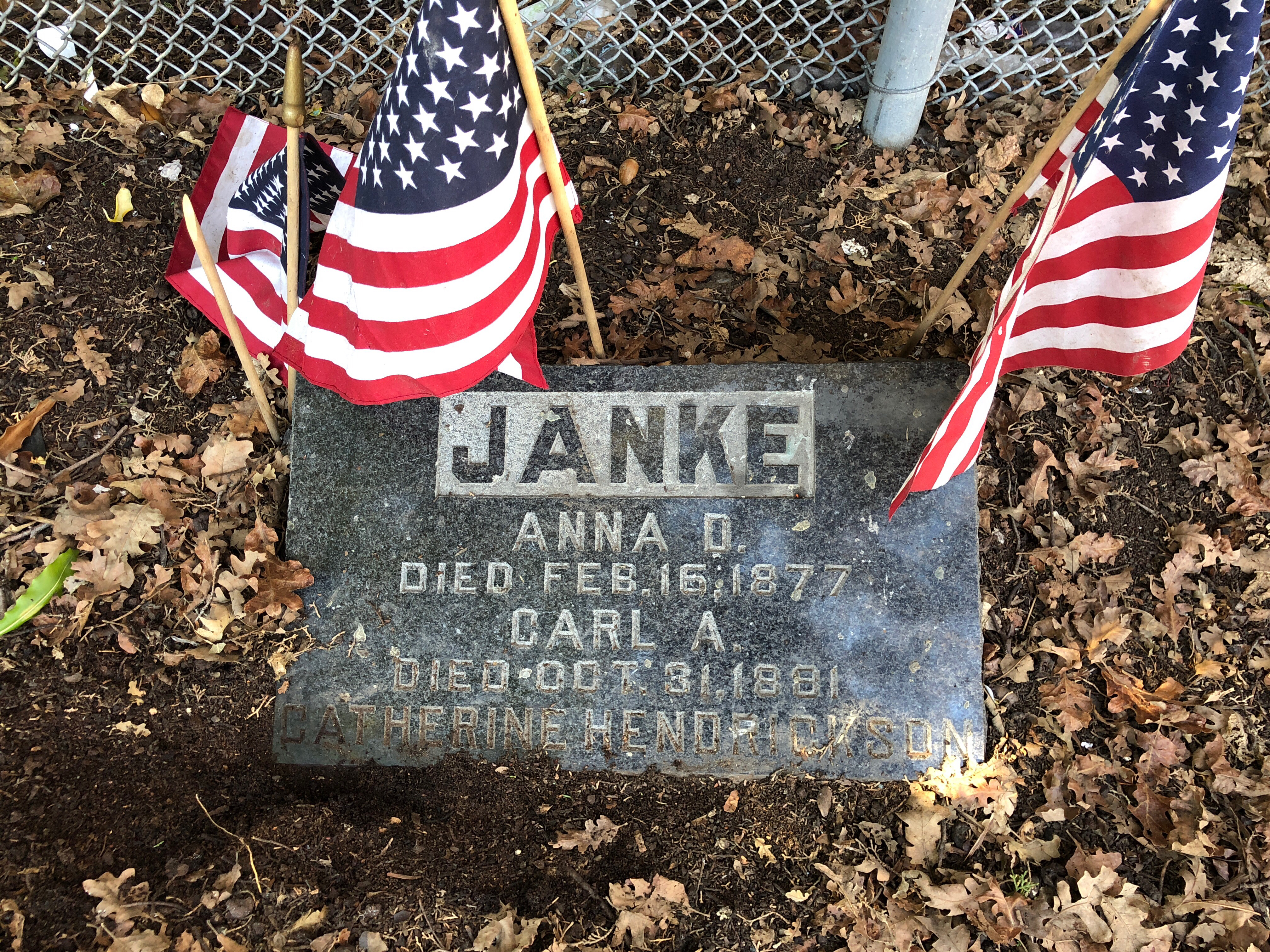
It is 8:33 A.M. May 27, 2023 – and I am still in shock having discovered my grandparents are buried in the same grave! I saw TWO flags put on one gravestone. That was a half hour ago. THEN – I see another flag! There are three of my ancestors buried in the same grave! WHY? Did the caretakers conclude this was a very poor family? William Stuttmeister knew they were Belmont before he died. At great expense to himself, he moved the Jankes to Colma after they were evicted from the Odd Fellow cemetery – at great expense! This was a wealthy pioneer family whose graves keep being defiled! They were moved to the Union cemetery i 1972?
I found Carl and Dorothea (also and Doretta) are buried at the Union Cemetary in Redwood City.
Carl_August_Janke Names Listed on the Marker: Janke, Carl August Janke, Dorette Catherine Janke, Mutter Heinrich Inscription: — From the 1937 headstone survey — Carl August Janke, born in Dresden, Germany Oct. 1806, died Belmont, Calif. Sept. 2, 1881 Dorette Catherine, wife of Carl August Janke, born in Hamburg, Germany, July 21, 1813, died in Belmont, California, Feb 16, 1877 Mutter Heinrich, mother of Dorette Catherine Janke, born in Island of Heligoland, Germany, 1781 died in Belmont, California 1876 NOTE: In 1937 the Daughters of the American Revolution recorded all the headstones.
RELOCATION AND DEVELOPMENT STUDIES FOR THE PIONEER MEMORIAL CEMETERY, EUGENE, OREGON, BY LUTES AND AMUNDSON FOR THE UNIVERSITY OF OREGON
Up in the Air
THE UNIVERSITY OF OREGON HAS A COMPLICATED HISTORY WITH EUGENE’S PIONEER CEMETERY, AND COMPLICATED RELATIONSHIPS WITH ITS OWN BUILDINGS TODAY
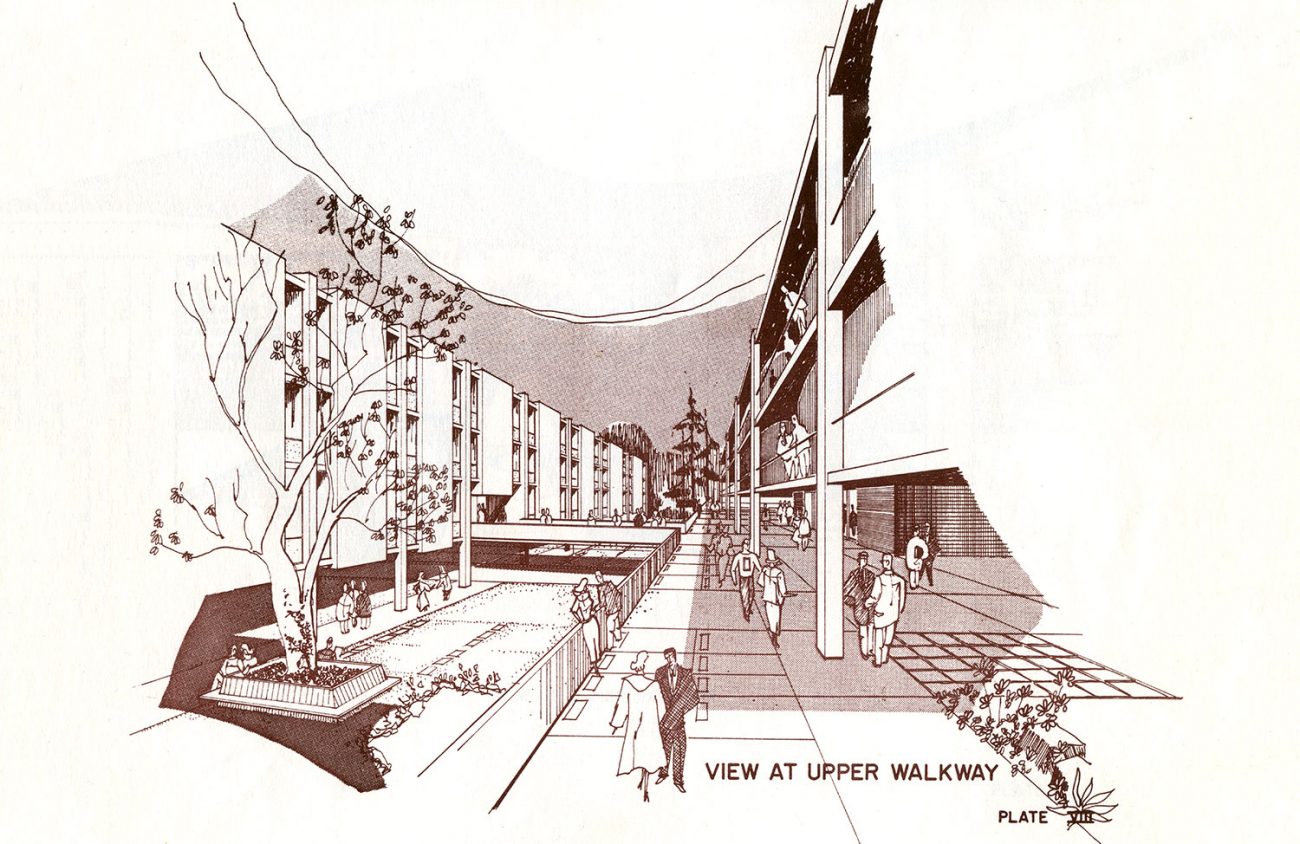
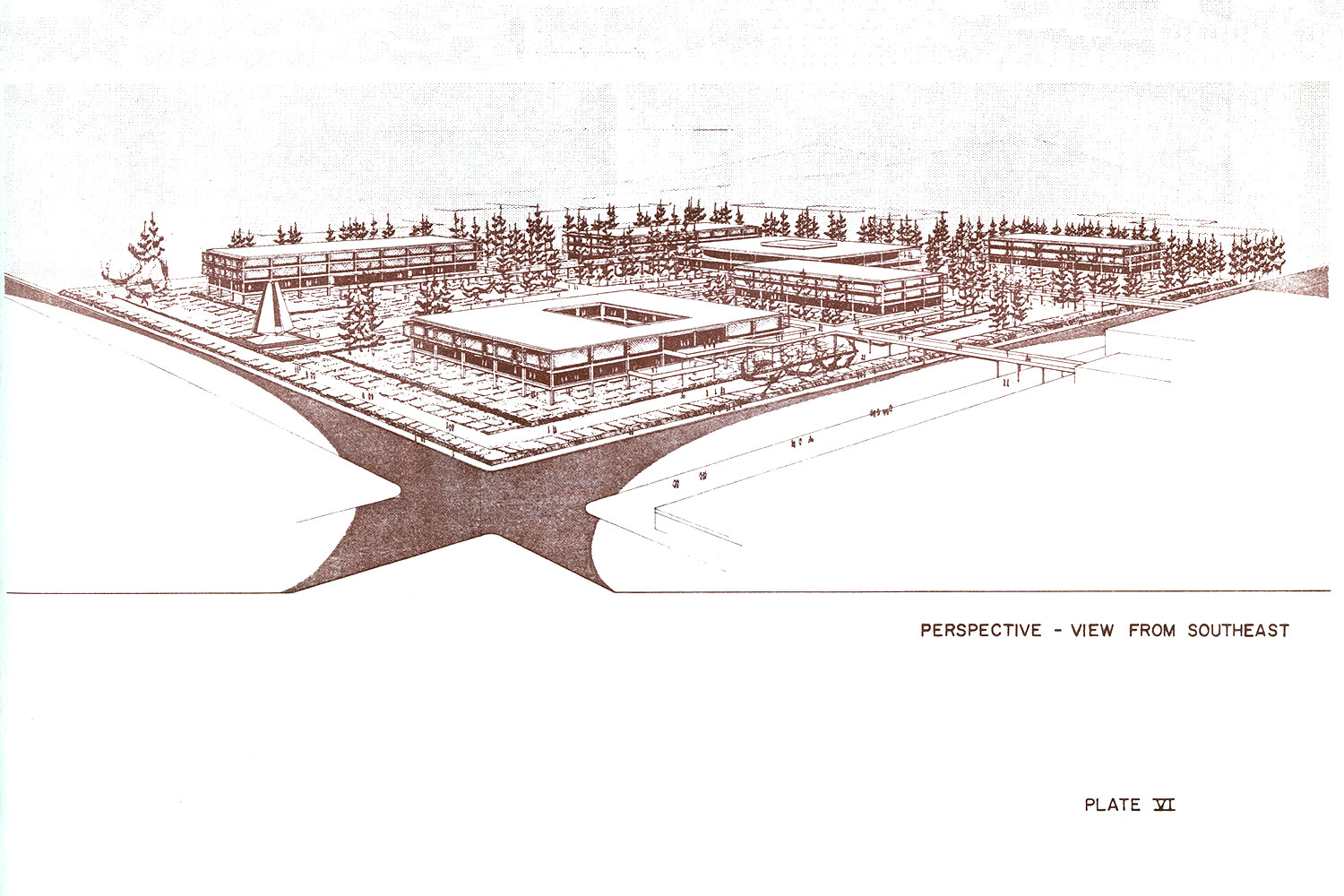
Students happily mill past cemetery markers, while buildings rise high above the graves. This surreal scene appears in drawings from 1963 showing a proposed addition to the University of Oregon campus: structures sitting on pilings over the Pioneer Cemetery.
The idyllic sketches make the cemetery on the south edge of campus look almost parklike beneath the edifices, with the long-buried dead a minor afterthought to the aspirations of higher education.
It’s sketches like these, as reported in the Daily Emerald back in the 1960s as well as a couple of student theses on the topic, that allowed Eugene Weekly to piece together the University of Oregon’s buried history with the Pioneer Cemetery — a moment when the UO decided it was a good idea to erect buildings over the dead.
Roxi Thoren, associate professor and department head of Landscape Architecture at the UO, sheds light on the architectural thinking. She says, cemetery aside, the idea of an elevated building was “standard architecture of the time.”
She says the idea comes from French architect and modern architecture pioneer Le Corbusier’s idea of a tower in the park. It’s “supposed to be a continuous horizontal green plane, and the city will be this expansive garden,” she says.
She calls the thinking of the time progressive and technocratic. “It’s about technology freeing us from the vicissitudes of nature,” Thoren says.
But looking back, the plans look strangely out of touch.
Although a bit weird, the university’s aspirations probably don’t shock anyone familiar with the “University of Nike.” Even before being flooded with Phil Knight’s money, the UO was ambitious. The university in 1963 was doing exactly what it’s doing now: casting its gaze on nearby land, seeking to acquire real estate and build not only new academic buildings, but its reputation as well.
In 1963, the architecture firm Lutes and Amundson created five plans for the UO to expand onto the land occupied by the Pioneer Cemetery. The most ambitious — and most unbelievable — was an idea to construct buildings over existing graves, presumably without disturbing them.
Thoren says the tower-in-a-park idea is a nice one, but she calls some of the unbuilt design examples, such as the plan for the cemetery, a bit extreme. “A tower in a park is one thing,” she says. “A tower in a cemetery is another.”
She adds that architects of the period often did not think about the world as it existed around them. They saw their desire to build as something paramount to the needs and limitations of the space it would inhabit.
The non-engagement with pre-existing conditions seems to have been at play with Lutes and Amundson and the UO. The plan depicts a landscaped graveyard with footpaths for students to walk on. Above them are buildings vaulted and supported by beams. Skybridges direct students from other areas of campus to their over-the-cemetery classrooms.
Basically, the UO wanted so badly to expand that it was willing to put buildings on stilts over a graveyard.
“That is shocking,” says Ocean Howell, associate professor of architectural history at the University of Oregon Clark Honors College, looking at the architectural drawings. He’s shocked not only by the premise of the plans themselves, but also by the fact that they were seriously considered in 1963.
Whose Cemetery?
Long before plans were made for grand buildings and skybridges above the cemetery, quieter plans arose to challenge the governing body of the Pioneer Cemetery. A fracture within the Odd Fellows Cemetery Association led to more than a decade of disputes over the land, many of them involving the university. The Odd Fellows Lodge owned the cemetery at the time.
The association split into two groups: the Odd Fellows Cemetery Association and the Pioneer Memorial Park Association. The Odd Fellows believed the new Pioneer Association wanted to hand over rights to the university.
Down the line the Odd Fellows changed the name of their association to the Eugene Pioneer Cemetery Association in hopes of disassociating with the Lodge and getting the rights to the property back.
The two groups went to court and, at one point, the Eugene Pioneer Cemetery Association argued that the Pioneer Memorial Park Association had allowed the cemetery to become so overgrown that it “constituted a fire hazard besides having an unsightly appearance.”
The five plans created by Lutes and Amundson called for the university to convert the cemetery into usable academic space. The strangest of them was the Le Corbusier-esque tower-in-the-cemetery idea.
This idea was backed by state Rep. Ed Elder and was known as Elder’s Compromise.
The plan included utility tunnels and vehicular circulation that “could be located within 30 feet of roadways where excavation without disturbing graves would be possible.” The plans also say “some ground floor service areas and stairways could be located in vacant grave areas.”
Howell told EW that it would, in fact, not be possible to construct to this scale above a cemetery without disturbing graves.
Much of the record over the debate comes fromthe Daily Emerald’s assiduous reporting on the university’s interest in the cemetery for several months.
In 1969, a bill was introduced in the Legislature that would allow for the cemetery to be condemned, then absorbed into the university and built over. It was not the first bill of its kind and, like the others, the bill did not pass.


,_attributed_to_Michael_Dahl_91996.jpg)













 Rosamond Press
Leave a comment