I am the Duke of the Woods!
I run with the wolves of Benjamin, and play the lyre at night around our fire.
Wolf House
Posted on September 13, 2012 by Royal Rosamond Press

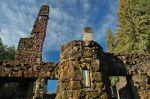




When my grandson, Tyler Hunt, were doing a painting together, Patrice Hanson, looked on with disgust. This goes back to our conversation at the ruins of Jack London’s Wolf House where I told my wife to be my families creative legacy was falling into the hands of outsiders the same way London’s legacy came to be owned by hostile outsiders. I told Patrice I am authoring a biography, and my rivals are inventing lies in their biogrphy of my famous sister, Rosamond. All of a sudden, Patrice says;
“Are you saying our daughter get all her talent from you?”
I got angry, for this woman, who had two sons by two fathers, did not allow me to be a father for sixteen years, and did her damnedest to have Heather believe she got all her gufts from her utterly un-gifted mother, who never was an artist, poet, or, writer. Patrice and her family are the people the Seer saw that come into my being and take – via my newborn daughter who Patrice put in the arms of famous parasite convicted of impersonating Bob Weir – twice!
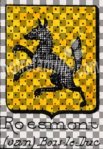
The Rosemondts owned Wolf House in Brambant, and were part of a restoration of Frankish rule in theat area, which suggests they might be descended from Merovingians.
Jon Presco
The Wolf House
“Jack and his second wife Charmian’s dream home was planned even before their marriage. Actual work on it began April 1911. Albert Farr of San Francisco was the architect who transferred Jack’s ideas into blueprints. For earthquake protection, the building was put on a huge floating slab large enough to support a forty-story building. Redwood trees, fully clothed in their own bark, deep chocolate-maroon volcanic rocks, blue slate, boulders and cement were chosen for primary building materials. The roof was of Spanish tile and came from the N. Clark and Sons Pottery, built on the old Davenport place in Alameda. Large redwood trees, with the bark still intact, formed the carriage entrance, the pergolas, and porches. The rafters were of rough-hewn, natural logs. Tree trunks in the gables and balconies were interlaced with fruit twigs for a beautiful effect.”
“Wolf House was not a castle in any sense of the term, though Jack and others referred to it as that. It was big, unpretentious, open, natural, and inviting, just like its builder. It was designed as a busy author’s workshop, and as a home big enough for the many needs of the Londons, and for the entertainment of their friends.
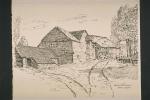
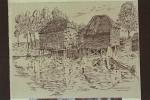
The Wolfswinkelse Water Mill was a watermill on the Dommel. The watermill is located in the municipality of Sint-Oedenrode Breugel Nijnselbetween and. This mill Shop mill may have ever known.
“Your family is dead!”
Posted on September 13, 2012 by Royal Rosamond Press






Last night I watched Excalibur on T.V. I turned it off in order to go to the store. When I came home I turned on my T.V. and there is Mordred at the gate of Camelot telling his father he is dead, his kingdom is dead, and he has come for Arthur’s Dream so he can destroy it once and for all.
When my daughter, Heather Hanson, accused my grandson of urinating in the car seat her wicked drunken aunt, Linda Comstock, urinated on, I told her she is a liar on her way to becoming an alcoholic.
“Your family is dead!” Heather said, she telling me we were not fun now that we were sober. She went on to describe what fun Bill Cornwell was, he having a thousand friends.
“I am on the verge of disowning you!” Was my response to this mother who had a illegitimate son by a drinker and has now bonded with a animal who boasted on Facebook about his black-out drunks.
“Don’t you want someone to be there for when you die?” asked my disloyal daughter, then, realizing how that sounded, she said;
“I don’t want to be in your Will!”
My daughter was once my Sober Miracle who came into my life when she was sixteen. She was once the miraculous end to my story ‘Capturing Beauty’. My daughter and my beautiful grandson, Tyler Hunt, have been captured by evil people.
Heather is a liar! My family is not dead. I am alive. My two siblings, Mark and Vicki Presco are alive, as is Drew Benton, who is now living in Vicki’s house in Bullhead City working on her art. There are four of us. I would like to say Drew has taken Christine’s place, but, she is her own person, and creative heir to her late parents. Drew suffered greatly due to he mother’s alcoholism, as did the four Presco Children.
I paid hundreds of dollars out of the Vincent Rice Trust to make Heather Hanson my Heir. I had to dismiss her when she refused to perform her duties as my Trustee, she and her evil boyfriend calling me a “parasite” because he is a Tea Bagger – who refused to help his own mother bound in a wheelchair for over ten years!
It has cost me $3,000 dollars to remove Heather as my Trustee. I have a new Heir that I will name in my next post.
I hereby DISINHERIT my daughter, Heather Hanson. She will have no part of my legacy, or claim to my intlilectual property.
John Presco
September 13, 2012
Copyright 2012
MordredFrom Wikipedia, the free encyclopediaJump to: navigation, search
For other uses, see Mordred (disambiguation).
“Sir Mordred” (1902) by H. J. FordMordred or Modred (/ˈmoʊdrɛd/; Welsh: Medraut, Medrod, etc.) is a character in the Arthurian legend, known as a notorious traitor who fought King Arthur at the Battle of Camlann, where he was killed and Arthur fatally wounded. Tradition varies on his relationship to Arthur, but he is best known today as Arthur’s illegitimate son by one of his half-sisters, Morgan le Fay or Morgause. In earlier literature, he was considered the legitimate son of Morgause, also known as Anna, with her husband King Lot of Orkney. His brothers or half-brothers are Gawain, Agravain, Gaheris, and Gareth. The name (from either Old Welsh Medraut, Cornish Modred, or Old Breton Modrot) is ultimately derived from Latin Moderātus.[1]
Content
[hide]
1 Etymology
2 History
2.1 Glory Wolfswinkel until 1604
2.2 from 1604 until 1795
2.3 Of 1795 to the present
3 Nearby watermills
4 external link
[Edit] Etymology
In the name means Wolfswinkel Shop an angle. The element can be in multiple ways, however, Wolf explained. Many think it first to the animal name, but it can also save on a field curvature . That seems like a meaningful declaration because such terrain shape in the environment explicitly to designate falls (namely a strikingly high steep banks along the Dommel, half a kilometre to the North).
[Edit] History
[Edit] Glory Wolfswinkel until 1604
The mill was around 1200 by Duke Henry I of Brabant donated to the Priory of Postel. Later it became a little glory, consisting of a omgrachte hofstede (the Water hoof), a farm and water mill. This area was by the Ducal couple Johanna van Brabant and Wenceslas I of Luxembourg in 1381 in leen issued to the nobleman Edmund d’Aquis. There would then also a padlock are built. The oldest known occupant, after which her son would Agnes van Wolfswinkel Colen of Dijnter has inherited the property, after which the owners were Emont of Geerke and Dijnter. In 1450 the glory was in possession of the family of Rosemont, and afterwards the families Coensborgh and Molenpas. The lock was already gone. In the 15th and 16th century followed by the families mentioned families, The Huyoel, Of Broekhoven, Bogaers Cocq and Thielemans.
[Edit] From 1604 to 1795
The mill was In 1604 , los of the estate, as a separate fief sold to Coenraedt Jan Adriaens. In 1628 the mill was in the possession of Jhr. Jeger 1650 a oil mill with the original corn mill had built. We Around 1720 was the mill in the possession of Lord Lambert, count of Berlo, and after his death the mill was sold to Johan Carel de Jeger, who was Lord of Eckart .
During the French period, at the end of the 18th century, the mill was burned by the English and German troops, in order in this way, the English army, that was contracted on the Nistelrooise Heide, to warn of the approaching French. The remnants were then sold in 1795 to Widow of schalkwijk, which the mill Raon 50 metres upstream left a rebuild.
[Edit] From 1795 to the present
After the rebuilding the mill has known many owners. She was under during the 19th century more used as the volmolen by Geldropse and the Tilburg textile manufacturers. Although the mill was still in operation in 1878 , she hit soon afterwards in decline. In 1928 the Dommel and fell the lock in the water mill was sold to waterboard De Dommel. After 1945 the watermill was demolished, despite efforts to preserve it.
Nowadays rest on this picturesque place only the Mill House. In addition, reminds the Water farm to the former glory. Furthermore, reminds a small monumentje to the water mill, as well as the path that leads there, which still bears the name Watermolen Street . The cycle path network along The Peel performs there.
Gerlach de Roovere, Knight, Lord of Waalwijk, Drunen, Vlijmen, “Honsoirde” (Onsenoort) Rixtel, Someren, Lierop and Wets. According to a manuscript of the genealogy of 1266 is Gerlach Arnold Son de Roovere (genus of Red) married Oda, daughter of Jan van Megen. One of their many children was Willem de Roovere.
The Brabantse noble genera that the 3 are all descendants of the mill irons, counts of Red. These old genera are named after the name of villages, Hamlets, neighbourhoods or estates under the old Taxandrie such as Asdonck, Stackenburgh, Van der van Vlierden, van Lierop, of Vladeracken, of, of, of Hove, Hersel, Breugel of Wette, Rinckveld, van Lieshout, of IJllingen, of veenhuizen, van den, van Wolfswinkel, Bolck of Broekhoven. But also Straeten, Kuysten, van Loon, of Orthen, van Mierlo, at Heerenhoven, of the fields, van den Heuvel and to d Boirschot ´ Erp.
When one wants to demonstrate that it has the right to a particular good or right, we need evidence. If they are missing, one can resort to falsifying or fabricating evidence itself that. Forgery is, however, not something today or yesterday. Certainly in times, which by war or fire more often than now, as in the middle ages pieces were lost, grabbed one to this medium.
We see, therefore, that ordinary people, noble families but also monasteries and abbeys not schroomden for den day to come up with the finest “evidence” of own fabrications. Such a collection of false or falsified documents can put a contemporary historian on the wrong leg and that is done repeatedly. The medieval family Stakenborch is an eloquent example. Purpose of the following is not to write a history of this interesting and for Lierop, Asten and Someren extremely important family, but to an old misunderstanding about to eliminate her.
Historical is of the family of Stakenborch the following known with certainty. Circa 1350 was Willem van Someren Stakenborch substantial man in inter alia, Asten and Lierop. He and his family owned, as owner or tenant, as many real estate throughout Brabant, including the good Vladeracken or Vlerken under Someren. William was also lessee of important goods of the Priory of Postel, namely the Windmill in Someren and water mill of Strip donk under Lierop. A mill was a huge source of income and Willem van Stakenborch and his brothers Henry I, Jan and Mathijs also to great success and brought it great prestige. Henry was even prior or prosiver (head) of the godshuis in Postel. Because this monastery with financial problems faced, borrowed it from the Stakenborch family of considerable sums of money. Postel gave them tithes and goods as collateral. For any goods it went, evidenced by a document from 1401. It says that Henry II of Stakenborch, son of William, inherited from his father all the rights on the goods pledged by the Priory of Postel to William, namely four farms in Someren, the tithes and the Windmill van Someren and goods Moorsel, Dot donk and Lierop.
In addition, did Henry I of Stakenborch, prior of Postel, some donations to the monastery. However, when he died in or before 1359 there arose a conflict. The only remaining brother, Willem, apparently, found that he was disadvantaged by Hendriks donations. Recalling also the large debts which Postel had to the family. There was, however, a referee and enabled 1359 legden Willem van Stakenborch on 10 January and the Priory of Postel in their dispute. Mathijs van Asten ceased In 1364 of Boescot, also of William of Stakenborch, for its part, intensify the process nephews against the then prior of Postel.
The descendants of the Brothers Of Stakenborch however showed sit at. Because according to them had not repaid the loan Postel and they therefore still entitled to the pledged goods, flared again in 1426 the fight in all vehemence. Jan van Stakenborch meeting and threatened to strip the possessions of the monastery in Postel even fire. The Duke of Brabant issued an arrest warrant against him and Jan had to leave the country. Thirty years later, in 1456, it came to a process, when John’s heir, weather of a claim made on all Mathijs Bois shot, Someren, tithing, the Windmill to van Someren in Someren and the mill law and four hooves to Someren Lierop. He did this on the basis of old usage rights, arising from the pecuniary obligations (debts) which Postel had towards the family. Mathijs claimed goods and rights that were around 1350 by the Priory of pledged to his ancestor William of Postel Stakenborch.
The Priory had been clean enough of Postel. Around 1360 the had acknowledged that all goods and rights of Stakenborchs still in Someren Postel were, but one nutrok and Lierop this fact again in doubt! The monks therefore decided to manufacture a number of effective evidence. A cumbersome procedure, but not directly on the basis of real instruments would always weather can lead to evidentiary again in doubt pull of the ownership rights of Priory Postel. Therefore the monks arrived in 1456 up with three instruments from 1243, 1266 and false 1311. These were to prove that the early Stakenborchs Of all their rights on tithes, a mill and four farms in Someren and the mill law in Lierop Postel to the monastery had donated and that they therefore had no rights more on. In the three forged charters is a very sex to emerge of the aforementioned brothers William, Henry trooped, Jan and Mathijs. Apparently it was the family of Stakenborch, formerly leaseholders of the monastery, in the fifteenth century the Premonstratensians grown above the head, such that even the clergy saw no other way out than Postel more counterfeiting. In the pedigree of the family of Stakenborch we come in the forged charters as forefathers souped-up Gerlach and Willem de Rover often against. It is quite possible that the fact of them descended but the false Stakenborchs Of instruments should not serve as proof. Also, Gerlach and Willem instruments in the “Lord of Stakenborch in Someren” and that is in the real pieces never the case.
The Stakenborchs Of their pretensions towards Postel gave after 1456 on but the story is not yet out. A smart descendant has the counterfeits of Postel in the seventeenth century once used and even supplemented with still a forgery. In 1656 namely claimed French of Bois shot of noble descent. He wanted to prove this by pointing to his descent from the chivalrous Of the noble Stakenborchs and the robbers. But he had not enough to the false Postelse charters. That is why a Charter, which was produced from 1308, on the one hand, the relationship between Of Bois shot and Of the Lords of Stakenborch and of Stakenborchs to Asten and Lierop and escharen were promoted. Names of actual gentlemen of Asten (and Lierop?), members of the family of Cuijk, were incorporated in the pedigree. All this was, of course, completely false, but like Postel in 1456, reached the forger also this time the desired result: his claims to nobility was recognized.
Later chroniclers made the matter still further complicated by the pedigree to fill in fanciful. Result, interesting but volsterkt unhistorical pedigrees. So Stakenborchs on the basis of the counterfeits were Of considerable leaseholders in Someren, Lierop and upgraded from Asten to gentlemen of Asten and Lierop, which they never been. Coppens and Schutjes know even to report that Henry of Stakenborch, before if Postel “Norbertijner the white habit” provisor, the Lordships Lierop, Stakenborch, Someren, Asten and escharen sold to the Duke of Brabant. It has therefore thought that his municipality weapon, the three mill Lierop irons, to the identical coat of arms of this family. The Priory would have this weapon also postel inherited from Henry of Stakenborch, which was around 1350 prior Postel. Whom the weapon is now the question of whom took over to the chicken and the egg. The most obvious, however, that it is and that it is both the oldest Postelse weapon by Lierop if by Stakenborchs is inherited.
NUTS
Source: “Lierop ‘n image of a village”
1. the following is almost entirely based on the diplomatic considerations of H.P.H. in the instruments at the Camps Camps on ONB, ONB, nr 199 d.d. p. 277; No. 305 pp. 917-920 dated; No. 863 dated 1052-1055 pp.
2. a. j. stakenburg Teychiné, “The Brabantse genus stakenburg in the XIVe – XVIIIth century”, Yearbook of the Centraal Bureau voor Genealogie 15 (1961) 118-146, m.n. 120-121 (= idem, the family stakenburg (Rotterdam1961). See for his further studies on this family the footnotes 4 and 7
3. Henry amused in 1401 these goods in turn to his sister Margriet (the archives of Th.L.Welvaarts, Zomeren Postel’s Abbey (Helmond/Turnhout 1892) 65-66)
4. Notarized deed dated 1364 July 20 (RANB, old inv.nr.Aanwinsten 1885/27bis/g, temporarily: dossier Church Asten deed g), mentioned in Camps, ONB p. 1054; Teychiné stakenburg facsmile: A.J., the oldest generations der family stakenburg (Rotterdam 1980) 15.
5. In the beginning of the 17th century one manufactured a false deed in Postel, yet supposedly from the year 1357, which a defence work recorded against the so-called claims of Willem van Lierop and Stakenborch on the mills of Someren (Someren 9bis Abbey-archive Postel, charters; see Camps, ONB, p. 1054 and n. 1)
6. J.A. Coppens, New description of the Diocese of ‘s-Hertogenbosch in response to the Meijerijsch in his book of a. Kath Pleading van Gils, (4 din; “s-Hertogenbosch 1840-1844) III. 1 302-303: Schutjes, history of the Diocese of ‘s-Hertogenbosch l.h.c., (5din; St. Michiels-Gestel 1870-1876) III, 144; IV, 669; A.F.O. Sasse van Ysselt, of “the glory Asten”, Taxandria 22 (1915) 3-9, 65-73, 121-129.
7. Unfortunately is also the serious researcher of the family of Teychiné, Stakenborch, A.J. stakenburg in this trap cases. This is the case in his study from 1961, “The Brabantse genus stakenburg”, pp. 118-122, in which he mainly based on a manuscript of the nineteenth-century Archivist of Postel, Th.L.Welvaarts, “the family of Stakenborch 1343-1626 to the archives of the Abbey of Postel” still vooert “Willem de Rovere in 1980 he Stakenborch, Lord of Asten and escharen (and Lierop?)”, which therefore never existed, as ancestor of the genus (see Teychiné, “the oldest generations stakenburg”, 5; and idem “The Brabantse genus stakenburg” complements the genealogy, the Brabant Lion 31 (1982) 85-86
8. see e.g. f. Prince, the onze-Lieve-Vrouwe-Norbertine Postel Abbey der to (Antwerp 1935) 46-47.
Joisting Tournatment at Rougemont Castle
Posted on September 13, 2012 by Royal Rosamond Press

In Bullhead City at Linda Cornwell’s house, Bill told me he wants my grandson to be a race car driver like himself. He and Tyler Hunt are watching a car race on T.V.
Heather’s mother, Patrice Hanson, was in Bill’s home when his father came to visit from Texas. Heather, Bill, his father, and Patrice authored the new order in the presence of my six year old grandson whom Bill wanted to be like a son to him, he not having a child at forty years of age. Tyler Hunt is one of my Heirs, but, he will not know his grandfather, he already being turned against me by drunks and two witches. However, when Tyler Hunt is a young man, he will google his NAME and find his lost kingdom – and a sword in the stone.
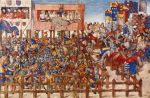
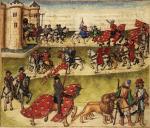
Here are the accounts of Joisting Tournaments held at Rougemont castle where my Rosemont kindred might hail
Jon Presco
After Easter of the year of the Lord 1172, the same count came to
>make a tournament in Burgundy between Montbard [ Coast-in Or ]
and Rougemont, with approximately hundred knights with his costs. The
count of Nevers, which had the castle of Rougemont in its field, had
prohibited to make the tournament with all those which would come
and it refused to lodge the count in his castle of Rougemont. But the
count de Hainaut, in spite of this prohibition was made lodge
with the castle. The following day, as the count de Hainaut was on his
side accompanied by five knights of his ground and than on other
side came with the duke from Burgundy [ Hughes III ] much from knights
filled of pride, escorted sergeants with foot, the count de
Hainaut, full with prudence and of courage, made its riders and with its
servants of people of foot, armed them as it could and prepared
them to defend oneself against a great number; it resisted to the
unfavourable, many and strongly organized knights, and pushed
back them. On its return, it made a tournament with Rethel, thus
spending five weeks in comings and goings, with approximately hundred
knights with its costs.
The Pas d’Armes of Charlemagne’s Tree, 1443
Some Knights and Gentlemen of the Duke of Burgundy’s Court Hold a Tournament Near to Dijon
During the duke of Burgundy’s residence in that duchy several gentlemen of his household, with his permission, and for his amusement, had proclaimed throughout Burgundy, and in other countries, that if there were any men of name desirous of gaining honour and renown by deeds of arms, there were gentlemen, whose names shall be presently declared, who offered to receive and furnish them with arms suitable for the enterprise. The challenges shall likewise be mentioned that were dispersed through divers countries for this purpose, by Sir Pierre de Bauffremont lord of Chargny, who was the chief of the enterprise.
The Challenges for the Tournament and the Names of the Champions
In honour of our Lord, and of his most glorious mother, of my lady Sainte Anne, and of my lord St. George, I, Pierre de Bauffremont lord of Chargny, of Monliet and of Montfort, knight, counsellor and chamberlain, to the most high, most puissant and excellent prince the duke of Burgundy, make known to all princes, barons, knights and esquires, without reproach, with the exception of those of the kingdom of France and of the countries in alliance, or subjects to my said sovereign lord, that for the augmentation and extension of the most noble profession and exercise of arms, my will and intention is, in conjunction with twelve knights, esquires and gentlemen, of four quarterings, whose names follow,-Thibault lord of Rougemont and Mussy, Sir William de Bresremont lord of Sees and of Sonnegnon, William de Brene lord of Mombis and of Gilly, John lord of Valengon, John lord of Rap and of Tirecourt, William de Champdivers lord of Chevigny, John de Chiron lord Rancheineres, Antony de Vaudray, lord of Aille, William de Vaudray lord of Collaon, James de Challant lord of Ainville, Sir Amey lord of Espirey, and John de Chavigny-to guard and defend a pass d’armes, situated on the great road leading from Dijon toward Exonne, at the end of the causeway from the said town of Dijon, at a great tree called the Hermits
Tree, in the form and manner following.
“In the first place, two shields (one black besprinkled with tears of gold,–the other violet, having tears of sable), shall be suspended on the tree of the Hermit, and all those, who shall, by a king at arms or pursuivant, touch the first shield, shall be bounden to perform twelve courses on horseback with me, or with one of my aforesaid knights or esquires, with blunted lances.– Item, if either of the champions, during their twelve courses, be unhorsed by a direct blow with the lance on his armour, such person, thus unhorsed, shall present to his adversary a diamond of whatever value he please.– Item, the champions may arm themselves according to their pleasure, double or single, but without any wicked intentions, having their rest similar to the usual custom in war.– Item, each person shall make provision of lances,– but the rondelle, which lies on the hands, shall be only four fingers broad, and no more.-Item, the lances shall be all of similar length, from the point to the rest.– Item, for the accomplishment of these feats of arms on horseback, I will supply all who may come without lances, precisely like to my own and to those of my companions.— Item, these deeds of arms on horseback shall be performed a la toille which shall be six feet high.”
Here Follow the Articles for the Deeds of Arms on Foot
” Those princes, barons, knights, and esquires, of the rank before-mentioned, who shall rather take their pleasure in performing feats of arms on foot, shall touch the violet shield, and shall perform fifteen courses with battles-axes or swords, as may be most agreeable to them.”
” Item, if, during these courses, any champion shall touch the ground with his hand or knees, he shall be bounden to present his adversary with a ruby of whatever value he please.- Item, each champion shall be armed with the accustomed armour for combating in lists- Item, should any person be unprovided with battle-axe or sword, I will furnish him with the same, similar to my own or to those of my companions. These axes and swords are not to have anything extraordinary in their make, but such as are usual in these kind of combats.”
” Item, he that shall have engaged himself to fight with me, or either of us, and shall throw the other to the ground, the person so thrown shall be obliged to surrender himself a prisoner whithersoever the conqueror shall order him.– Item, the person thus made prisoner shall pay for his immediate ransom, to whomsoever the conqueror shall direct, any sum above five hundred crowns.”
” Item, foreigners need not seek for particulars from me, or from my companions; for they will find persons ready to deliver such at the usual hours and places.– Item, no stranger will be permitted to enter the lists with me or with any one of my companions, for more than one course at arms, namely, once on horseback and once on foot,– and no one can require more of any of us during the present undertaking.”
“Item, the aforesaid feats of arms, on Horseback and on foot, shall be performed on the following days: those on horseback on Mondays, Tuesdays, and Wednesdays,-those on foot, Thursdays, Fridays, and Saturdays.– Item, this pass d’armes shall commence on the first day of July, in the year 1443, and shall last forty days, exclusive of feast days and Sundays, and the feasts commanded to be kept by the court of Rome.”
“Item, no prince, baron, knight, or esquire, shall pass within a quarter of a league of the spot assigned for these combats without entering the lists and taking part, or otherwise leaving as pledges his sword or spurs, according, to his pleasure.”
” Item, for the accomplishment of these feats of arms, as well on horseback as on foot, to the articles above specified, I have most humbly supplicated and entreated my aforesaid sovereign lord, that he would grant me his licence and permission to perform them, he has most benignantly assented to. He has likewise most graciously appointed, as judge of the lists, that puissant prince and my most redoubled lord the count of Nevers and of Rethel, –and, in his absence, the lord marshal count of Fribourg and of Neufchatel.”
” In order that this my intention of performing these deeds of arms in the manner before specified may be men fully declared, I have affixed my seal to these presents, and signed with my own hand, this 8th day of March, in the year 1442.”
” Item, I beseech all princes, barons, knights, and esquires, not to construe this my intention as proceeding from any presumption on my part; for my sole motive is to exalt the noble profession of arms, and to extend the exercise of it,- and also to make acquaintance by arms with such renowned and valiant princes and nobles as may be pleased to honour me with their company. — Item, all noble foreigners shall have sure and loyal passports from my aforesaid sovereign lord, or, in his absence, from his marshal,”
From: Monstrelet, Enguerrand de, The Chronicles of Enguerrand de Monstrelet. trans.
Thomas Johnes, two vols., (London, 1877), Book II, Chapter cclxix-cclxxi
***
Monstrelet’s Chronicle
Monstrelet’s Chronicle began where Froissart’s ended, in 1400, and he carried it up through the year 1444. He died in 1453, and continuations by other hands brought the Chronicle up to 1516. While less lively and anecdotal than Froissart, he does not seem to have shared Froissart’s apparent willingness to freely invent plausible details as needed. His work is probably a better record of what is known of the events he records, even if it is less engaging as literature or as a record of contemporary customs, manners, and daily life. He leave us with a number of valuable accounts of chivalric deeds of arms.
Thomas Johnes’ 1877 translation is neither lively nor particularly accurate, but, as for Froissart, at this writing it remains the only complete English translation. Spelling of the Johnes translation has been standardized on modern American English.
 Rosamond Press
Leave a comment