
Letter To: Governor Kotek and Senator Ron Wyden.
Good morning my lawfully elected Representatives chosen by the People of Oregon, who are so blessed, because the late Senator Mark Hatfield laid the groundwork for our fellow citizens to begin the rebuilding. Senator Hatfield is the continuing drama of the making of nuclear bombs, and the dropping of these bombs on Hiroshima and Nagasaki, Mark was in Hiroshima shortly after Oppenhiemers bomb was dropped. Before that, he was on the beaches at Iwo Jima.
“Like every other man, I knew fear and terror on a level I couldn’t even fathom. As soon as the Marines disembarked, my tiny boat all but drowned. We took on water and my crew bailed as fast as they could, frantic, under fire every minute, deafening artillery right over our heads.”
After four days and five nights of delivering Marines to the beach and returning to their ship with their boat loaded with grievously wounded Marines, Hatfield and his men went to the beachhead to help with the wounded, and after several days of doing this, their ship departed from one of the Marines’ costliest battles in their history. Later, Hatfield recalled, “Iwo Jima was never far from my mind. The bloodiest battle in the Pacific, we ultimately lost over 6,280 troops–with over 19,000 wounded–on that tiny island alone.
Democratic President, Harry Truman, knew the American People, and the parents of these young soldiers, would not tolerate these outgoes casualties. When Oppenhimers’s Atomic Bomb Makers told Truman what could be done, he approved.
It is 7:59 A.M. March 17, 2024b
On this day I am calling for an investigation as to why Israel began dropping large bombs on Gaza – without consulting The People of The United States, who pay taxes, and, that tax monies went to buying bombs for the IDF. I suspect the bombing has not stopped because Israel hates losing troops. Only four Israeli soldiers died in both Iraq Wars. It appears Hamas planned to kill a lot of Israel soldiers with the help of their vast network of tunnels. Hamas wanted to enrage Israel so they would attack on the ground. The Enola Gay dropped its bomb from – the heavens!
“When he felt the concussion of the bomb hit his plane and then saw the mushroom cloud rising over the city, the co-pilot of the Enola Gay, Captain Robert Lewis, asked, “My God, what have we done? If I live a hundred years, I’ll never quite get these few minutes out of my mind.”
I took a brak to have breakfast, and watched Netanyahu on CNN. This Israeli leader made all the great points that Hatfield made, being….WAR IS NOT THE ANSWER! WAR DOES NOT WORK! To listen to a fellow human being, who had NO EMPATHY for the loss of human life, and the starvation of innocent citizens, is all the proof any Anti-War Demonstrator would need.
I’m calling upon elected officials in Oregon to found The Oregon Peace Plan, that will be the official stance Oregon will take in regards to all the wars in the future. When it looked like Britain was going to invade the Oregon territory on 1812, John Astor had his attorney, Thomas Hart Benton, negotiate the sale of Oregon to the British. After the war was over, Jessie Benton negotiated with the British to buy Oregon back. I read the letter where she assured THE ENEMY her father was not Pro-Slavery. Only then, was the deal done. John Astor is our role model. He avoided – the cost of war! The British conducted an amphibious landing – and burned much of our Nations Capital. It was rebuilt as part of the City Beautiful Movement, that Joaquin wrote about. He admired Moses Montfrate, and John Fremont, and erected two crude monuments to them on his property in Oakland. His brother platted the city of Fairmont, and Florence. The Miller brother were citizens of Oregon.
This is the first of three letters, where I will put forth a plan to create an Oregon Think Tank, where battles and war happens in the world of Artificial Intelligence – before there is a real war. If the outcome is to always rebuild destroyed cities, even the cities of your enemy – why not declare VICTORY in a whole new way, and use the money to REALLY HELP HUMANS! Let’s find a shortcut, and leave the miming, killing, and starving out, not to mention…..THE DAMN STUPIDITY!
“Just because he’s Jewish doesn’t give him a pass to advocate something that’s completely inconsistent with our past approach to democratic countries,” McConnell said about Schumer, whose speech he watched as it was delivered from his office in the Capitol.
“Making peace is more than avoiding war. For war is changing, and we can no longer rely on simple solutions based on the assumption of unambiguously ‘good’ nations and ‘bad’ nations. Those times have not entirely vanished—there are still very guilty nations and less guilty nations, though I doubt if there are any innocent nations. The real innocents are the people who had no voice in initiating or even supporting war but suffer its harms nevertheless.
Sincerely
John Presco
President: Royal Rosamond Press


Portrait of Moses Montefiore
Here
https://en.wikipedia.org/wiki/City_Beautiful_movement
The attack was in part a retaliation for prior American actions in British-held Upper Canada, in which U.S. forces had burned and looted York the previous year and had then burnt large portions of Port Dover.[6] Less than four days after the attack began, a heavy thunderstorm, possibly a hurricane and a tornado, extinguished the fires and caused further destruction. The British occupation of Washington, D.C. lasted for roughly 26 hours.[7]
President James Madison, along with his administration and several military officials, evacuated and were able to find refuge for the night in Brookeville, a small town in Montgomery County, Maryland; President Madison spent the night in the house of Caleb Bentley, a Quaker who lived and worked in Brookeville. Bentley’s house, known today as the Madison House, still exists. Following the storm, the British returned to their ships, many of which required repairs due to the storm.
The City Beautiful movement was a reform philosophy of North American architecture and urban planning that flourished during the 1890s and 1900s with the intent of introducing beautification and monumental grandeur in cities. It was a part of the progressive social reform movement in North America under the leadership of the upper-middle class, which was concerned with poor living conditions in all major cities.[1] The movement, which was originally associated mainly with Chicago, Cleveland, Detroit, Kansas City and Washington, D.C., promoted beauty not only for its own sake, but also to create moral and civic virtue among urban populations.[2]
Advocates of the philosophy believed that such beautification could promote a harmonious social order that would increase the quality of life, while critics would complain that the movement was overly concerned with aesthetics at the expense of social reform; Jane Jacobs referred to the movement as an “architectural design cult.”[3]
The popularization begun by the World Columbian Exposition was increased by the Louisiana Purchase Exposition of 1904, held in St. Louis. Its commissioner of architects selected Franco-American architect Emmanuel Louis Masqueray to be Chief of Design. Within three years he designed the following fair buildings in the prevailing Beaux Arts: the Palace of Agriculture; the cascades and colonnades; the Palace of Forestry, Fish, and Game; the Palace of Horticulture; and the Palace of Transportation. All these were widely emulated in civic projects across the United States.[4] Shortly after the fair opened in 1904, Masqueray resigned, having accepted an invitation from Archbishop John Ireland in St. Paul, Minnesota to design a cathedral there in the Beaux-Arts style. Other celebrated architects of the fair’s buildings—notably Cass Gilbert who designed the Palace of the Fine Arts, now the Saint Louis Art Museum, applied City Beautiful ideas from the exposition throughout their careers.
https://archive.org/details/buildingofcitybe00mill
https://en.wikipedia.org/wiki/Moses_Montefiore
Sir Moses Haim Montefiore, 1st Baronet, FRS (24 October 1784 – 28 July 1885) was a British financier and banker, activist, philanthropist and Sheriff of London. Born to an Italian Sephardic Jewish family based in London, after he achieved success, he donated large sums of money to promote industry, business, economic development, education and health among the Jewish community in the Levant. He founded Mishkenot Sha’ananim in 1860, the first Jewish settlement outside the Old City of Jerusalem.
As President of the Board of Deputies of British Jews, he corresponded with Charles Henry Churchill, the British consul in Damascus, in 1841–42; his contributions are seen as pivotal to the development of Proto-Zionism.[1][2] Queen Victoria’s chaplain, Norman Macleod said of Montefiore: “No man living has done so much for his brethren in Palestine as Sir Moses Montefiore”.[3][4] He stated in an interview in the 1860s that “Palestine must belong to the Jews”.[5][6]
Marriage and Baron Nathan Mayer Rothschild[edit]
In 1812, Moses Montefiore married Judith Cohen (1784–1862), daughter of Levy Barent Cohen. Her sister, Henriette (or Hannah) (1783–1850), married Nathan Mayer Rothschild (1777–1836), for whom Montefiore’s firm acted as stockbrokers. Nathan Rothschild headed the family’s banking business in Britain, and the two brothers-in-law became business partners. In business, Montefiore was an innovator, investing in the supply of piped gas for street lighting to European cities via the Imperial Continental Gas Association. In 1824 he was among the founding consortium of the Alliance Assurance Company (which later merged with Sun Insurance to form Sun Alliance).[19][20]
Mitch McConnell ramps up his criticism of Chuck Schumer in CNN interview


By Manu Raju and Ted Barrett, CNN
4 minute read
Updated 2:03 PM EDT, Fri March 15, 2024
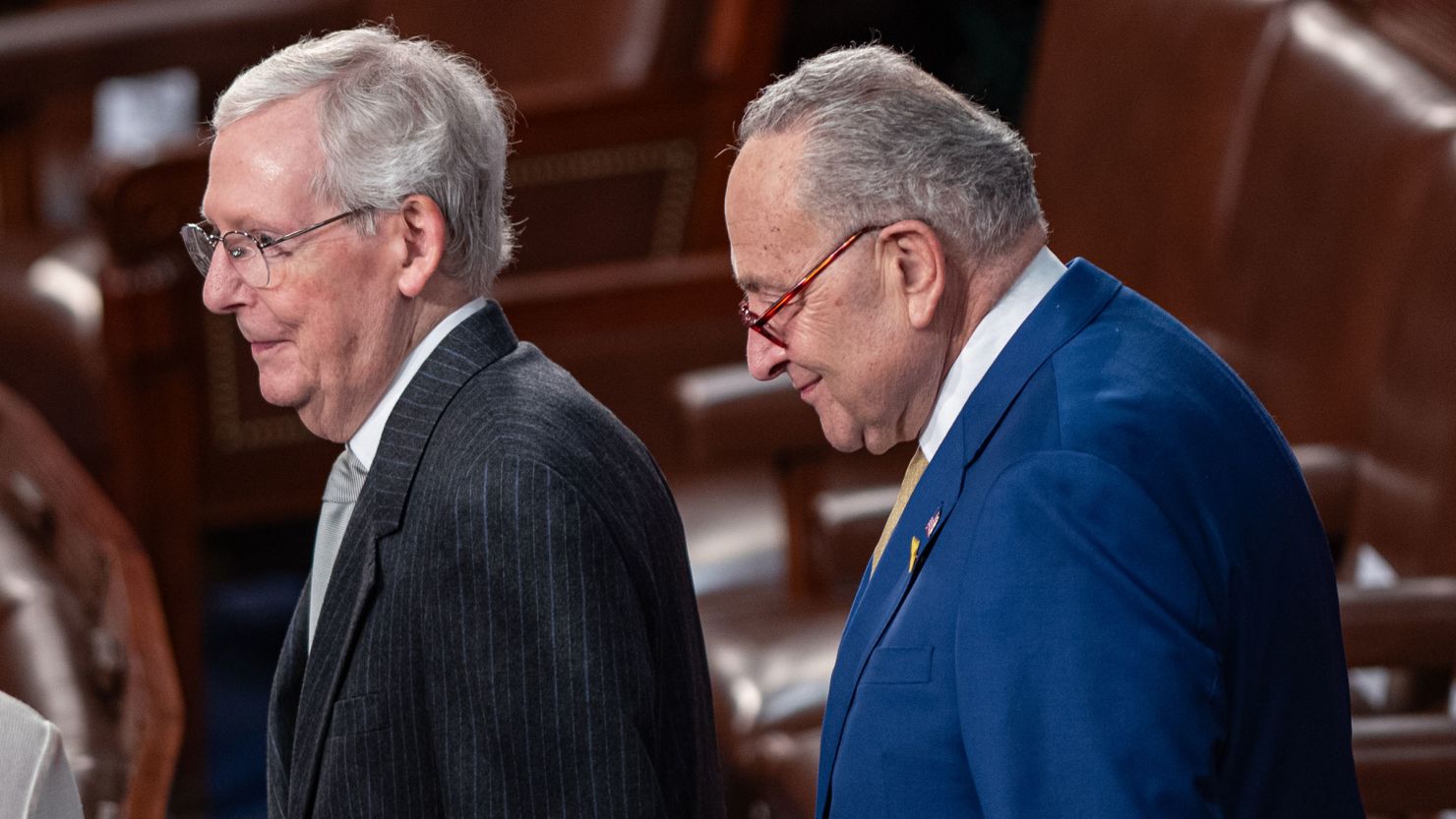
Senate Minority Leader Mitch McConnell and Senate Majority Leader Chuck Schumer enter the chamber at a joint session of the US Congress before United States President Joe Biden delivers his State of the Union address in Washington, DC on Thursday, March 7. Annabelle Gordon/Sipa USA/Reuters/File
Senate Minority Leader Mitch McConnell ramped up his scathing criticism of Senate Majority Leader Chuck Schumer in the aftermath of the New York Democrat’s stunning call for a new leadership in Israel amid the brutal war in Gaza, underscoring the growing partisan divide over Israel – a rare issue that had long unified the two parties.
In an interview with CNN, McConnell said Schumer’s speech was a direct contradiction of US policy and called on the White House not to go down that road.
“You can’t spend years hyperventilating about foreign interference in our democracy and then turn around and tell allies, particularly democratic allies, who their leader should be and when they should have elections,” McConnell said. “It’s just completely at variance with the way we typically operate in a foreign country, which is to deal with whatever government has been chosen in a democracy.”
For a long time, Schumer has aligned himself with Benjamin Netanyahu, but broke with him Thursday on the Senate floor as he characterized the Israeli prime minister as an obstacle for peace.
“As a lifelong supporter of Israel, it has become clear to me: The Netanyahu coalition no longer fits the needs of Israel after October 7. The world has changed, radically, since then, and the Israeli people are being stifled right now by a governing vision that is stuck in the past,” Schumer said.
Asked if Schumer being the first Jewish Senate majority leader in US history – who has been outspoken on Israel for years – gives him the right to call for a change in leadership there, McConnell pushed back.

RELATED ARTICLEA speech that sent shockwaves from Washington to Jerusalem
“Just because he’s Jewish doesn’t give him a pass to advocate something that’s completely inconsistent with our past approach to democratic countries,” McConnell said about Schumer, whose speech he watched as it was delivered from his office in the Capitol.
McConnell rejected calls for conditions on military aid to Israel – something some Democrats have called for in an effort to tamp down civilian deaths.
In his speech, Schumer explained his deep misgivings about the toll on innocent people in Gaza.
“I am anguished that the Israeli war campaign has killed so many innocent Palestinians,” he said. “I know that my fellow Jewish Americans feel this same anguish when they see the images of dead and starving children and destroyed homes.”
McConnell didn’t offer any criticism of the Israeli government, even as a growing number of Democratic leaders and voters have called for an immediate ceasefire.
“I’m not here to criticize our democratic ally and what they feel they need to do to settle things down. This is, if you’re looking for a parallel, what do you think we would do if we were attacked by the Mexicans or the Canadians? They have to live next door to this. Completely inappropriate for us to be dictating these policies for certainly the government of a democratic ally,” he said.
McConnell blamed the Biden administration for micromanaging the war in Gaza and said Schumer’s calling for “regime change” in the wrong country.
“They’ve also been guilty of trying to micromanage the war for the Israelis, which I think is also a mistake. And look, if we were gonna call for a regime change, why don’t we call for a regime change in Iran, for example,” he said.
And he said the US should approve more money for Israel by passing a supplemental spending bill but then “butt out” when it comes to Israel’s leadership.
“I think we should pass the supplemental, give them the financial assistance they need, and butt out when it comes to telling them who their government ought to be, or what their tactics ought to be, with this atrocity,” he said. “It’s almost like everyone forgot what happened on October 7th.”
Schumer’s office did not comment on McConnell’s criticism but pointed to a post from Israel opposition leader Yair Lapid who said Schumer’s speech is “proof that one by one Netanyahu is losing Israel’s biggest supporters in the US.”
In the first address of his campaign for U.S. Senate, former Maryland governor Larry Hogan promised he would be the state’s “pro-Israel champion” in Washington and called for Hamas to immediately release the hostages still held in Gaza.
Hogan (R) used a speech Friday to the influential Jewish Community Relations Council of Greater Washington to emphasize that Hamas must be held accountable for the Oct. 7 attack that killed roughly 1,200 people in Israel. Any cease-fire, he said, would depend upon the return of those taken during the attack.
https://en.wikipedia.org/wiki/Police_action
WASHINGTON — The White House is considering options for how to respond if Israel defies President Joe Biden’s repeated warnings against launching a military invasion of Rafah without a credible plan to protect Palestinian civilians, according to one former and three current U.S. officials.
The discussions are taking place amid growing concern in the administration and frustration among congressional Democrats that the president’s pleas will simply be ignored. Israel this week inched closer to initiating an incursion into the southernmost city in the Gaza Strip.
Washington — President Biden praised Senate Majority Leader Chuck Schumer’s speech that criticized Israeli Prime Minister Benjamin Netanyahu, calling it “a good speech,” though he declined to elaborate.
Mr. Biden said Friday the White House was given advance notice of Schumer’s speech, in which the New York Democrat and highest-ranking Jewish elected official in the U.S. called Netanyahu a “major obstacle to peace” and said he “lost his way by allowing his political survival to take the precedence over the best interests of Israel.”
“He has been too willing to tolerate the civilian toll in Gaza, which is pushing support for Israel worldwide to historic lows,” Schumer said Thursday in a speech on the Senate floor. “Israel cannot survive if it becomes a pariah.”
Top senator calls on Biden to ‘use all levers’ to pressure Israel over Gaza
Democrat Chris Van Hollen says Biden must cease giving arms to Israel until it lifts restrictions on aid and does more to protect lives
Lauren Gambino in WashingtonSat 16 Mar 2024 10.42 EDTShare
Joe Biden should use his leverage and the law to pressure Israel to change how it is prosecuting the war in Gaza, the Democratic senator Chris Van Hollen said.
Van Hollen, a Maryland Democrat, is among a group of senators urging Biden to stop providing Israel with offensive weapons until it lifts restrictions on the delivery of food and medicine into Gaza, where children are now dying of hunger and famine looms.
“We need the president and the Biden administration to push harder and to use all the levers of US policy to ensure people don’t die of starvation,” Van Hollen said in an interview on Friday.
This week, Van Hollen and seven of his colleagues sent a letter to the president arguing that Israel was in violation of the Foreign Assistance Act, a section of which prohibits the sale and transfer of military weapons to any nation that restricts the delivery of US aid.
Their call comes as the administration faces mounting domestic and international pressure over what critics have described as an “absurd” and “inherent contradiction” at the heart of US policy on Israel’s war against Hamas: while the US attempts to ease the deepening humanitarian crisis caused by Israel’s military campaign in the Palestinian territory, it continues to arm the country.

In a sign of the widening rift between Israel and its most important ally, Van Hollen said Benjamin Netanyahu, the Israeli prime minister, was openly defying Biden’s pleas that Israel do more to protect civilians in Gaza and work toward a long-term solution to the conflict that includes the establishment of a Palestinian state.
“Prime Minister Netanyahu has been an obstacle to the president’s efforts to at least create some light at the end of this very dark tunnel,” Van Hollen said.
In recent weeks, Biden has escalated his criticism of Israel’s military offensive, saying last weekend that Netanyahu was “hurting” his country’s standing by failing to prevent more civilian deaths in Gaza. But the US president has so far resisted Democrats’ calls to leverage future military aid as a means of reining in Israel’s conduct in the war.
The United Nations warned last month that more than a quarter of the 2.3 million Palestinians living in Gaza face “catastrophic levels of deprivation and starvation”. It said without action, widespread famine would be “almost inevitable”. Israel’s military campaign, which came in retaliation for the Hamas attack on 7 October that killed about 1,200 people, has devastated Gaza and killed more than 30,000 people, most of them civilians.
With the prospects of a truce elusive and far too little aid trickling in, Biden has authorized airdrops and the construction of a maritime corridor to deliver desperately needed food and medicine to the Palestinian people living in the besieged territory. But critics say those methods are less effective, less efficient and more dangerous than the unhindered delivery of supplies by land.
“The very fact that the United States is airlifting humanitarian supplies and is now going to be opening a temporary port is a symptom of the larger problem, which is [that] the Netanyahu government has restricted the amount of aid coming into Gaza and the safe distribution of aid within Gaza,” Van Hollen said.
Israel, which tightened its already strict controls on access to the enclave after 7 October, has denied that it is impeding the flow of aid.
Amid intensifying international pressure, Israel said this week it would expand the amount of supplies into the country. A small convoy of six trucks, coordinated by the Israeli military, brought humanitarian aid directly into the isolated northern Gaza earlier this week. Separately, an aid ship loaded with 200 tons of rice, flour, chicken and other items arrived in Gaza on Friday, in the first test of a new sea route.
But that is a far cry from what is needed, humanitarian workers say. Before the five-month-old conflict began, roughly 500 truckloads of humanitarian aid per day crossed into the territory. Now the number is far less, sometimes peaking above 200 trucks per day but often well below, according to UN figures.
Van Hollen’s insistence that the US do more to push Israel on humanitarian aid was informed by his visit to the Rafah crossing from Egypt in January, and the onerous Israeli inspection process he witnessed.
“You witnessed these very, very long lines of trucks trying to get in through Rafah and through the Kerem Shalom crossing, and quite an inspection review, including arbitrary denials of humanitarian aid being delivered into Gaza, which just makes the process even more cumbersome,” he said.
“For example, we visited a warehouse in Rafah that was filled with goods that had been rejected at the inspection sites. The rejected goods included things like maternity kits, included things like water purification systems.”
Van Hollen said no specific reason was given as to why the items were rejected, but said Israel has broadly claimed that they could be considered “dual use” or having a civilian or military purpose. The maternity kit, Van Hollen said, contained a “teeny little scalpel” that he speculated was the reason the package was turned back.
Across the border in Gaza, the situation is dire. UN agencies have estimated that 180 women give birth every day, sometimes without access to adequate pain medication, food or hygiene products. Malnourished, dehydrated and increasingly anemic, many pregnant women in Gaza face elevated risks of postpartum hemorrhaging.

Another problem, Van Hollen said, is that so many of the people delivering aid or accompanying the aid convoys have been killed, making coordination and distribution of the aid that does enter difficult.
Netanyahu and his government, the senator said, “need to open more crossings, they need to end the arbitrary rejection of goods like maternity kits and solar powered desalinization units, and they need to make sure that food can be safely delivered within Gaza without people getting killed.”
Van Hollen’s comments came the day after Senate majority leader Chuck Schumer, the highest-ranking Jewish elected official in the US and a longtime ally of Israel’s, was unsparing in a speech in which he declared that Netanyahu had “lost his way”, and urged Israelis to hold elections to replace him. Biden, who has been increasingly open about his frustration with Netanyahu, called it a “good speech”.
Van Hollen called Schumer’s speech an “important moment” that made clear the US believes “there needs to be a change in course” in the way Israel is conducting the war.
‘The administration will have to decide’
In the letter to Biden earlier this week, Van Hollen and his colleagues wrote: “According to public reporting and your own statements, the Netanyahu government is in violation of [the Foreign Assistance Act]. Given this reality, we urge you to make it clear to the Netanyahu government that failure to immediately and dramatically expand humanitarian access and facilitate safe aid deliveries throughout Gaza will lead to serious consequences, as specified under existing US law.”
Van Hollen also argued that the Israeli government is “not in compliance” with a national security memorandum (NSM 20) issued by the president last month that requires any country that receives US military assistance to provide written assurances it will “not arbitrarily deny, restrict, or otherwise impede” the delivery of humanitarian aid.
Israel reportedly provided that commitment in a letter to Biden signed by Israeli defense minister Yoav Gallant on Thursday, according to Axios. Van Hollen said the onus is now on the US to assess the credibility of Israel’s assurances.
“Part of that evaluation will depend on what’s happening on the ground right now, and their assessment of whether or not, in fact, the Netanyahu government is meeting that requirement,” he said. “And if the signatures and commitments are found to be lacking, then the administration cannot provide military assistance until they determine that they’re credible.”
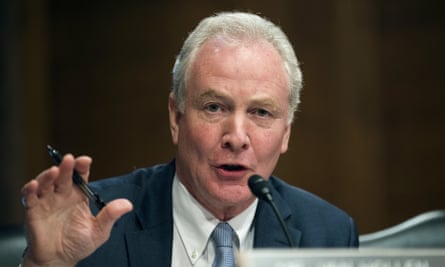
Van Hollen stressed that enforcing the statute would not prevent the US from continuing to send defensive military assistance to protect Israeli citizens from rocket attacks, such as the Iron Dome.
The memorandum was issued last month, after Van Hollen and more than a dozen Democratic senators introduced an amendment to a wartime aid package that included military assistance for Ukraine, Israel and other US-allies. The senators’ proposal, which would have required any country receiving US weapons to comply with humanitarian laws, risked a messy floor fight among Democrats divided over the US’s approach to the war amid Gaza’s rising death toll.
Instead, Van Hollen said, the administration offered to turn the amendment into a memorandum that, with the force of law, would apply the terms to the sale and transfer of all US military aid. Biden issued the memorandum, and the Senate later approved the foreign aid package, with Van Hollen’s support. That measure is now languishing in the House.
Biden has warned that Israel would cross a “red line” if it proceeded with a large-scale invasion of the southern city of Rafah, where the war has pushed nearly half of Gaza’s population. Reports suggest Netanyahu has approved a plan to invade the city, setting him up for direct conflict with the US president.
Biden has not made clear what consequences Netanyahu might face if he ignores the US’s position. An invasion of Rafah, Van Hollen said, would present “one of those moments where the Biden administration is going to have to decide whether it’s going to back up the president’s strong words with the leverage that it has”.
Congratulations on being one of our top readers globally – you’ve read 67 articles in the last year
Article counton
I hope you appreciated this article. Before you move on, I wanted to ask if you would consider supporting the Guardian’s journalism as we enter one of the most consequential news cycles of our lifetimes in 2024.
With the potential of another Trump presidency looming, there are countless angles to cover around this year’s election – and we’ll be there to shed light on each new development, with explainers, key takeaways and analysis of what it means for America, democracy and the world.
From Elon Musk to the Murdochs, a small number of billionaire owners have a powerful hold on so much of the information that reaches the public about what’s happening in the world. The Guardian is different. We have no billionaire owner or shareholders to consider. Our journalism is produced to serve the public interest – not profit motives.
And we avoid the trap that befalls much US media: the tendency, born of a desire to please all sides, to engage in false equivalence in the name of neutrality. We always strive to be fair. But sometimes that means calling out the lies of powerful people and institutions – and making clear how misinformation and demagoguery can damage democracy.
From threats to election integrity, to the spiraling climate crisis, to complex foreign conflicts, our journalists contextualize, investigate and illuminate the critical stories of our time. As a global news organization with a robust US reporting staff, we’re able to provide a fresh, outsider perspective – one so often missing in the American media bubble.
Around the world, readers can access the Guardian’s paywall-free journalism because of our unique reader-supported model. That’s because of people like you. Our readers keep us independent, beholden to no outside influence and accessible to everyone – whether they can afford to pay for news, or not. If you can, please consider supporting us just once from $1, or better yet, support us every month with a little more. Thank you.
Betsy Reed
Editor, Guardian US

Contribution frequency
One-time
Monthly
Annual
Contribution amount
$5 per month
$13 per month
Other
ContinueRemind me in April

This Moses was not so heroic after all
SHARE VIA


By Abigail Green
Harvard University Press, £24.95
The commanding figure of Moses Montefiore dominated the Jewish world for much of the 19th century. Born into a family of Italian-Jewish merchants, he made a great deal of money in business but he also married a great deal of money – his wife Judith was a daughter of Levi Barent-Cohen, from whom practically the entire Anglo-Jewish “cousinhood” was descended.
Montefiore pursued three careers: as a businessman and stockbroker; as lay leader of British Jewry; and as an “interceder” on behalf of oppressed Jewish communities worldwide. It was primarily on the basis of these overseas interventions that his great reputation was based. His 100th birthday in 1884 was an occasion of nationwide rejoicing.
How genuine were the grounds upon which this reputation rested? Since Montefiore’s death, a number of scholars have tried to answer this question, but most have been fatally inhibited by the bonfire that his nephew and heir, Joseph Sebag-Montefiore, deliberately made of his papers. Undaunted by this act of censorship, Abigail Green (an Oxford don who is also a Sebag-Montefiore) has brilliantly synthesised a wealth of other sources, many of them never before used by Montefiore scholars. The picture that emerges is sombre and in some respects shocking.
Moses and Judith were childless. This led him to engage in extra-marital affairs, and her to become spiritually obsessed. As a youngster, Moses was not at all observant, and scarcely knew Hebrew. But after their first visit to Jerusalem, in 1827, he became punctiliously frum. Thereafter, he consciously re-prioritised his life, putting good works first and business second.
Yet, however noble his intentions, his heroic efforts bore little fruit. Most positive was his intervention in the Damascus blood-libel of 1840, when, having assisted in securing the release of imprisoned Jews, he travelled to Constantinople and persuaded the Sultan to issue a decree condemning the libel.
His journeys to Palestine were controversial. He knew how to dispense charity to Jewish communities living there but not how to secure their long-term prosperity. Even in dispensing charity, he was unable to distinguish between the genuinely needy and the charlatan. He understood little of the religious politics of Jewish Jerusalem, and cared less. His attempt to provide secular education for Jewish girls ended in his stoning (by boys, naturally) and virtual excommunication by the Sephardi chief rabbi of the city.
Montefiore insisted on blundering into situations he did not understand. He failed to comprehend the antisemitism of the Tsarist autocracy. In Vilna, a Lubavitcher is reported to have told him, to his face, that his money (distributed as charity) would have been better spent bribing the government.
In Morocco, in 1864, he claimed to have obtained from the local sultan an edict giving the Jews civic equality. In reality, the document merely restated the position of Jews under Sharia law. In Romania, three years later, his unilateral intervention made things demonstrably worse, not better.
But, in history, perception is everything. Montefiore died a Victorian hero. Dr Green has shown him to have had feet of clay.
Geoffrey Alderman is a historian and JC columnist
Editor’s note: Dan Caldwell is a superb teacher, a prolific author, and a wonderful friend. At this time of remembrance of those who have served in harm’s way on distant battlefields, I am reprinting Dan’s remarks on the occasion of the Mark O. Hatfield Lecture on Capitol Hill on October 6, 2014. The messages he conveyed then are timeless and worth hearing again. Mark Hatfield was a Republican Senator from Oregon who, along with many others, including two other future Senators, Dale Bumpers, a Democrat from Arkansas and Charles “Mac” Mathias, a Republican from Maryland, were on their way to participate in the invasion of the home islands of Japan when the war was abruptly ended by the bombings of Hiroshima and Nagasaki. Senator Hatfield was instrumental in Congressional efforts to halt US nuclear testing. Dan’s family connections and remembrances make for a compelling story on this Memorial Day weekend. — MK
At the end of World War II, a number of American military personnel saw first-hand the devastation that the United States had wrought at Hiroshima and Nagasaki, and the human and physical destruction that they saw deeply and profoundly affected some for the rest of their lives. Among these were Senator Mark O. Hatfield, Los Angeles businessman and peace activist Harold Willens, and Harvard Professor John D. Montgomery.
War can, and often is, mentally, emotionally, and/or physically disabling; however, for Hatfield, Willens, and Montgomery, the indelible memories of Hiroshima proved to be enabling rather than disabling. This talk traces their transformation from warriors into peacemakers.
When Mark Hatfield signed up for the Navy, he was following the precedent set by his father who had also been a Navy man. After completing his training and earning his officer’s commission at Lake Champlain, the Navy sent Ensign Hatfield to Coronado, California, and assigned him to be a “wave commander.” At first, the young officer thought that he had received the best assignment in the Navy: to command a group of Navy women, then called the WAVES, but this was far from the case.
Ensign Hatfield soon learned that a wave commander was the officer in charge of a twenty-five foot long amphibious landing craft, officially called a LCVP (Landing Craft Vehicle Personnel) or more colloquially a “Higgins boat,” named after the inventor of the new craft. As Hatfield and other young sailors discovered in the harrowing amphibious invasions of World War II, being a wave commander was one of the most dangerous jobs in the Navy.
Anyone who has seen the first twenty minutes of Steven Spielberg’s moving film, Saving Private Ryan, depicting the landing on Omaha Beach in Normandy, has some sense of the danger, terror, death, and destruction of opposed amphibious landings. This is how Senator Hatfield remembered his participation in the battle for Iwo Jima:
“Like every other man, I knew fear and terror on a level I couldn’t even fathom. As soon as the Marines disembarked, my tiny boat all but drowned. We took on water and my crew bailed as fast as they could, frantic, under fire every minute, deafening artillery right over our heads.”
After four days and five nights of delivering Marines to the beach and returning to their ship with their boat loaded with grievously wounded Marines, Hatfield and his men went to the beachhead to help with the wounded, and after several days of doing this, their ship departed from one of the Marines’ costliest battles in their history. Later, Hatfield recalled, “Iwo Jima was never far from my mind. The bloodiest battle in the Pacific, we ultimately lost over 6,280 troops–with over 19,000 wounded–on that tiny island alone.”
In the pre-dawn hours of August 6, 1945, three B-29 bombers took off from their Pacific island airbase for a five-and-a-half hour flight to Japan on what was rather blandly called “Special Mission 13.” Their primary target that morning was Hiroshima, an army logistics center in southern Japan that had been put off-limits for bombing by the Joint Chiefs of Staff. One of the B-29s was flown by Colonel Paul Tibbets. Named Enola Gay in honor of his mother, Tibbets carried “Little Boy,” a 10-foot-long, 9,000-pound uranium fission bomb. With a destructive yield equal to 15,000 tons of TNT, it was the most destructive weapon ever used in warfare to that time.
At 8:15 in the morning, Enola Gay dropped the bomb. Forty-three seconds later it detonated, and in one second, the temperature at ground zero—the point directly below the detonation—reached 3,000 to 4,000 degrees Centigrade, two-thirds the surface temperature of the sun. The heat was so intense that birds burst into flame in mid-air.
The effects on the residents of Hiroshima were horrific. One eyewitness reported, “Men whose whole bodies were covered with blood, and women whose skin hung from them like a kimono, plunged shrieking into the river. All these become corpses and their bodies were carried by the current toward the sea.” The official estimate of the number of people killed was 70,000, although more recent estimates indicate that by the end of 1945, 140,000 died.
When he felt the concussion of the bomb hit his plane and then saw the mushroom cloud rising over the city, the co-pilot of the Enola Gay, Captain Robert Lewis, asked, “My God, what have we done? If I live a hundred years, I’ll never quite get these few minutes out of my mind.”
The Hiroshima bombing did not end the war. The Japanese government was still debating, torn between civilian leaders who wanted to sue for peace and military leaders who preferred death to the disgrace of surrender. In the early morning hours of August 9 another “Special Mission” of three B-29s took off for Japan led by a bomber nicknamed Bock’s Car and carrying “Fat Man,” an 11-foot-long, 10,000-pound plutonium fission bomb with a destructive yield nearly twice that of the “Little Boy” bomb. Their primary target was Kokura, another city the Joint Chiefs had put off-limits to bombing. Fortunately for Kokura, the city of Yahata, about 4 miles away, had been fire-bombed the day before, and smoke from the fires made it impossible for the Special Mission to find its target. After trying three times, the crew decided to bomb their back-up target: Nagasaki, and just after 11 a.m. the world’s second nuclear weapon was detonated above the city, creating temperatures of about 4,000 degrees Centigrade and winds over 600 miles per hour.
The day after the bombing of Nagasaki, Emperor Hirohito, despite the continuing opposition of Japanese military leaders, surrendered unconditionally, and the most costly war in human history ended. But, while the development and first use of nuclear weapons ended the war, they raised profound questions, questions that have remained to this day like shadows of the mushroom clouds that rose ominously over Hiroshima and Nagasaki.
Nuclear weapons are the most powerful weapons devised, built, and used by human beings. To give you an idea of the power of the new, fearsome weapons, consider these facts. Most people have seen a building being imploded on television news. Entire buildings collapse within seconds. Demolition engineers generally use 300 to 500 pounds of TNT—less than a quarter of a ton–to accomplish this task. The fifteen kiloton “Little Boy” bomb was 50,000 times as powerful. A bomb of this size releases sixty-three terajoules of energy, which would power the average American home for approximately 1,500 years. The power of these weapons is beyond comprehension.
Although more Japanese were killed by conventional incendiary bombs, nuclear weapons made it dramatically easier and faster to do so. More people were killed in the March 1945 fire bombing raids on Tokyo or the February 1945 bombing raids on Dresden than were killed in either Hiroshima or Nagasaki, but those earlier attacks had involved hundreds of planes dropping thousands of bombs.
In the first issue of Time magazine published after the bombings, writer James Agee noted:
“The greatest and most terrible of wars ended, this week, in the echoes of an enormous event—an event so much more enormous that, relative to it, the war itself shrank to minor significance. The knowledge of victory was as charged with sorrow and doubt as with joy and gratitude. More fearful responsibilities, more crucial liabilities rested on the victor even than on the vanquished…With the controlled splitting of the atom, humanity, already profoundly perplexed and disunified, was brought inescapably into a new age in which all thoughts and things were split—and far from controlled.”
One month after the war ended, Mark Hatfield’s ship went to Hiroshima where he saw first-hand the destruction wrought by the world’s first nuclear weapon. Hatfield recalled:
“The devastation lay indiscriminate and the people cowered at our arrival, garbed in patchwork clothes. Well over 100,000 of their neighbors had been incinerated by one bomb…I had been trained to hate these Japanese. I would have almost relished killing them in battle. War created such a raw, stripped-down human being…I lifted a small, Japanese child and was purged, spiritually renewed as hate flowed from my system. I had been a victim of this, my own hate…I stood awash, clean in an epiphany which has never deserted me…Hiroshima would forever mark my deepest thinking. I had seen the unbelievably destructive power in our possession: nuclear attack. And it was not good.”
Lieutenant Hatfield was not the only one deeply affected by Hiroshima; many other American officers served in Hiroshima and Nagasaki, including another Naval Officer who, like Hatfield, subsequently became a United States Senator, Charles Mathias. In addition, a young Marine officer, Harold Willens, and an Army Officer, John D. Montgomery, served in Hiroshima, and that service was to have a life-long impact on each of these men.
Following the attack on Pearl Harbor, Harold Willens volunteered for the Marines and was assigned to learn Japanese as an intelligence officer. After his graduation from language school, Lieutenant Willens was sent to Hiroshima and Nagasaki to serve as a translator. In letters to his wife, Willens recalled, “I stood where buildings had once stood—buildings that the blast had transformed into powder I could sift through my fingers. Not mounds of rubble, but piles of powder.”
Like most members of his generation, Willens did not talk about his experiences in World War II—even with his family. So, although four Japanese samurai swords hung in the Willens’ living room, his family had no idea of their origin. They later learned that at the end of the war, the U.S. military ordered the confiscation and destruction of all weapons held by the Japanese, including even antique, ceremonial samurai swords. A young Japanese man came to Willens and told him that the swords that were to be destroyed had been in his family for more than a century and that it would be devastating to his family to have them destroyed.
Willens was moved by the young man’s plea and pledged to find the four swords and take them to America. Willen’s daughter, Michele, recalled, “That seemed to satisfy the Japanese father and son, who claimed that just knowing they would be safe would be enough. The swords were eventually identified and made their way to our wall [at the Willens’ home in Santa Monica].”
In 1973, the Willens family made plans to go on a family trip to Asia, and Harold came up with an idea. He had kept the young Japanese man’s name, and he contacted local Japanese officials and the NBC news bureau in Tokyo. When the Willens family arrived, they were met with the bright lights of television cameras and the Japanese man who had pled with Captain Willens to save his family’s swords. Michele recalled, “That formerly young Japanese man—now a distinguished businessman close to 60—greeted us with a kind of emotion that I had not seen before—or since. I truly didn’t know a human being could bow so low.”
The day after their arrival, the swords were formally presented. Michele recalled, “My father remembered enough Japanese to tell the story in their native tongue. A country that had attacked us, gotten us into a world war, and to whom we had done incomparable damage—was weeping with gratitude. Those four swords seemed to accomplish what presidents and emperors could not.”
In his book, Harold Willens noted, “I have searched for ways to convey with sufficient force, intensity, and urgency the unparalleled significance that took place with the first atomic explosion.” His search was fruitful. He helped to found the Center for Defense Information, a Washington think-tank that provides information about military and defense issues. In addition, he supported the founding of the Interfaith Center to Reverse the Arms Race, Business Executives Move for Vietnam Peace, and the California Nuclear Freeze Campaign. In 1987, Willens went to the Soviet Union with his business associate, Wesley Bilson. This visit led to the conversion of a Soviet army base near Leningrad into a children’s clothing factory, a quintessential swords into plowshares project.
John D. Montgomery had just completed his master’s degree in municipal administration when he received his draft notice from the U.S. Army during World War II. He entered the Army as an enlisted soldier, a private, but because of his education, he was selected for Officer Candidate School and became an Army officer. Because of his field of expertise, the Army assigned him to a civic affairs company. Montgomery was sent to language school and took a crash course in Japanese.
When he was twenty-five years old, the Army sent Montgomery to Kure, Japan, which is about an hour away from Hiroshima. Soon after he arrived in Japan, the mayor of Hiroshima sent a letter to the occupation forces commanded by General Douglas MacArthur requesting an advisor for Hiroshima’s City Reconstruction Planning Commission. Hearing about the mayor’s request, Montgomery did the unthinkable in the military: he volunteered for an assignment. In essence, Lieutenant Montgomery became the emissary to convey Hiroshima’s reconstruction and re-building requests to the American and Japanese authorities in Tokyo. Montgomery found that General MacArthur’s headquarters in Tokyo was “not at all sympathetic to our plans, and for its part the Imperial Japanese Government decided it could do nothing for Hiroshima…”
Despite this lack of American and Japanese cooperation, Montgomery persisted. In June 1946, Montgomery appealed to residents to “make Hiroshima a symbol of international peace…the memorial tower is for me, not for commemoration…but should stand for the baptism of the first dropping of the A-bomb, ending of World War II and creation of eternal peace.” Montgomery was the first person to suggest building a museum and memorial at ground zero, a proposal that soon gained international support and resulted in the building of the Hiroshima Peace Park and Museum.
When Montgomery got out of the Army, he went to Harvard where he earned a masters degree in 1948 and a PhD in 1951. Over the next decade, he was a Guggenheim Fellow, researcher at Johns Hopkins University, Dean of the Faculty at Babson College, Director of Research on Africa at Boston University, and Chief Academic Advisor for the National Institute of Public Administration in Saigon, Vietnam. He also wrote a book based in part on his experience in Hiroshima. He then returned to Harvard where he was the Ford Foundation Professor of International Studies until he retired in 1987. Even though he was retired, however, Hiroshima remained in his thoughts. But, like Mark Hatfield, Harold Willens, John Montgomery, and my father, Dr. Montgomery did not talk about his experiences. A good friend of mine, Dick Swanson, served as Professor Montgomery’s research assistant for two years at Harvard and during that time, Montgomery never mentioned World War II or Hiroshima.
SGI, an organization affiliated with Soka Gakkai, the Japanese Buddhist sect, invited Dr. Montgomery to direct the Pacific Basin Research Center of Soka University of America. Montgomery directed the center for ten years and initiated studies in human rights, social capital, globalization, and responses to its challenge to sovereignty. For his work, Montgomery was awarded the Ikeda Center’s Global Citizen Award and the Hiroshima Peace Award. Montgomery’s own reflections on war and Hiroshima speak powerfully:
“Making peace is more than avoiding war. For war is changing, and we can no longer rely on simple solutions based on the assumption of unambiguously ‘good’ nations and ‘bad’ nations. Those times have not entirely vanished—there are still very guilty nations and less guilty nations, though I doubt if there are any innocent nations. The real innocents are the people who had no voice in initiating or even supporting war but suffer its harms nevertheless.
Sixteen million Americans served in World War II, and many of them saw death, destruction, disorder, and devastation; that is one of the main reasons why many of the “greatest generation” of veterans chose not to speak of the war and what they had seen. Hundreds, if not thousands, of them saw the catastrophic results of the nuclear weapons dropped on Hiroshima and Nagasaki. Seeing the destructiveness of nuclear weapons had a life-long impact on many, including Mark Hatfield, Harold Willens, and John D. Montgomery. After visiting Hiroshima, each of these leaders sought to reduce the probability of war and its destructiveness: Hatfield in politics, Willens in business and public advocacy, and John Montgomery in academia. Each of these men in their own ways in their chosen professions sought to make the world a better, more peaceful place.
Almost two and a half million Americans have served in Afghanistan and Iraq. What lessons and motivations will they draw from their service and sacrifices? War elicits very different, even contradictory, reactions from those who participate in it. The veterans of World War II had very different reactions ranging from supporting the use of military force to halt aggression, to rejecting all forms of violence.
I don’t know if Hatfield, Willens, and Montgomery ever met each other or discussed their reactions to Hiroshima, but they drew similar lessons from their experiences.
• First, they turned what could have been a disabling experience into an enabling experience. I had the great honor of attending the dedication of the memorial to American Veterans Disabled for Life in Washington, D.C. last October. It was, quite simply, one of the most moving ceremonies I have ever attended both for what was said, but also because of the presence of hundreds of disabled veterans going back to World War II. As I saw these heroes, it occurred to me that their service in Hiroshima could have been so deeply disturbing to Hatfield, Willens, and Montgomery that they were prevented from addressing the problems of war, peace, and nuclear weapons. But their experiences enabled these men to work for peace and a better world. I wonder how many Hatfields, Willens’, and Montgomerys are among the four million living American disabled veterans?
• Second, they were deeply and profoundly influenced by what they had seen, which affected them the rest of their lives.
• Third they rejected the use or even the threat to use nuclear weapons.
• Fourth, they rejected the hyper-nationalism, be it Japanese or American, that resulted in hate.
• Fifth, they each worked for reconciliation among people.
• And, last, they cared about seemingly little things like helping a veteran to keep his ID card and a Japanese family to preserve ceremonial swords of great symbolic meaning.
And those are good lessons for all to remember and think about.
 Rosamond Press
Leave a comment