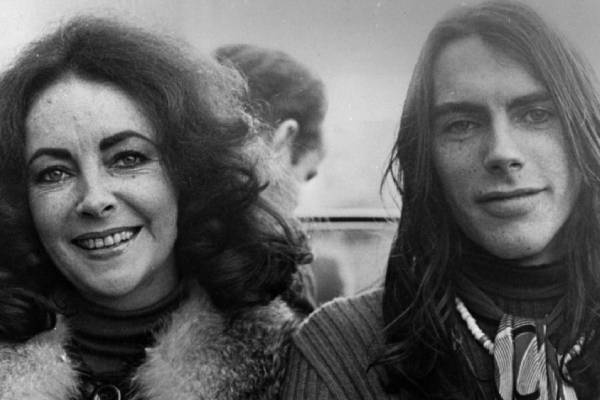
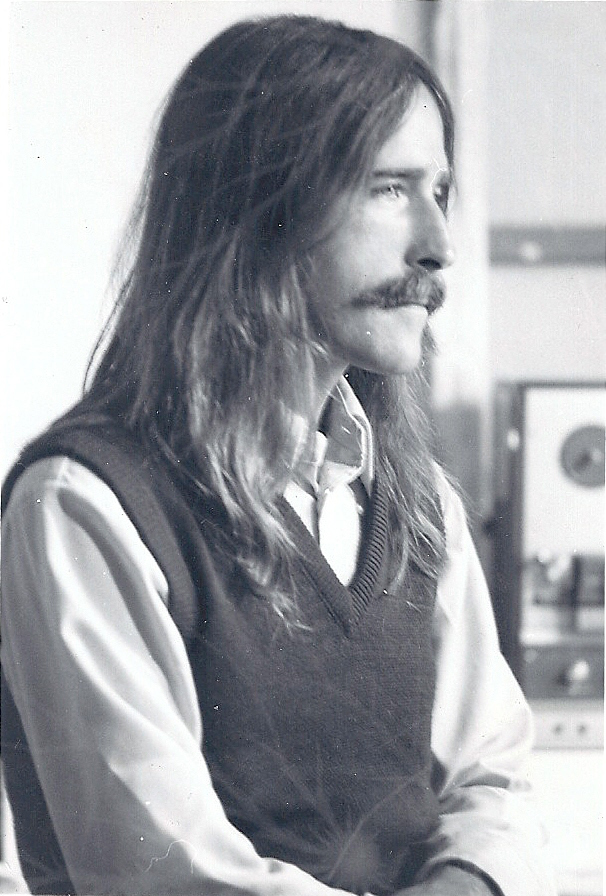
My cousin, Elizabeth ROSEMOND Taylor converted to Judaism. I made an attempt to become a Jew in 1992. Below is an article about a rabbi asking if there are “too many Jews” in 2013. Today, this question is the hottest topic – ever! American bombers and British missiles are striking at Muslims who say Israel does not have the right to exist. Why would my cousin say, if she were alive today. How about her son, who looks like he adopted Hippie Ways?
John Presco
Since writing “The Da Vinci Code,” American author Dan Brown has certainly proven that he is not afraid of creating controversy. His 80 million-copy bestselling novel that follows a quest for the “Holy Grail” touched more than just a nerve among devout Christians by concluding (spoiler alert!) that the Holy Grail itself amounted to a century-old conspiracy theory protecting the secret bloodline of Jesus and his wife, Mary Magdalene.
As Jews, I believe that Brown’s arguments about population control run counter to our values. Jews have the right and God-given responsibility to procreate and to grow our people. Nonetheless, that does not mean that his work should not give us pause to think long and hard about the choices we make, and the impact those choices will have on others and the world around us.
Were The Merovingians Nazarites
Posted on January 4, 2012 by Royal Rosamond Press
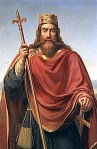
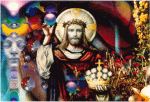

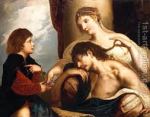

In 1987 I declared myself a Nazarite. Two years later I read the Book ‘Holy Blood Holy Grail’ The authors who inspired Dan Brown suggest the Merovingians were Nazarites. The word comb comes from comet. Consider the starry crowns the Frankish kings wore – with their long hair trailing from the stars above their heads. The Philistines found out the secret of their power through the betrayal of Samson the Nazarite after Delilah got him drunk.
Jon the Nazarite
It’s been called an “imposter Christianity,” a heretical faith that “sanctifies lies,” and “the most serious threat” to democracy in America.
That’s how critics have described White Christian nationalism, a deviant strain of religion that has infected the political mainstream. White Christian nationalists believe the US was founded as a Christian nation, although the Constitution never mentions God and enshrines the separation of church and state. Its adherents twist biblical language to justify violence, sexism and hostility toward people of color.
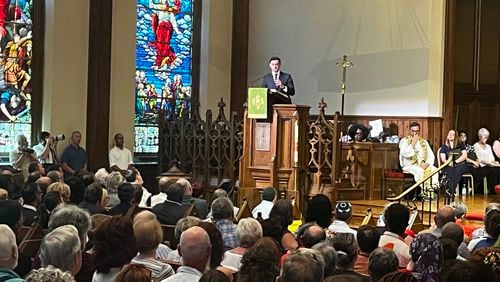
U.S. Sen. Jon Ossoff addresses a crowd at Mulberry Street United Methodist Church in Macon after an antisemitic attack targeted a nearby synagogue.
July 2, 2023
A few days after neo-Nazis menaced worshippers at an east Cobb synagogue, Rabbi Dan Dorsch scanned the faces of hundreds who packed a Methodist sanctuary in Smyrna and marveled at the outpouring of support.
“This is the first time in the seven years,” he said, “that I’ve been here that the Jewish community did not have to organize its own response.”
Her
Too Many Jews Be a Bad Thing?
Are we at risk of alienating the mitzvah of tending to the earth in order to promote the mitzvah of procreation?Share in FacebookShare in TwitterShare in WhatsApp
Send in e-mailSend in e-mailSaveSave article to reading listZen ReadPrint articleRabbi Dan DorschGet email notification for articles from Rabbi Dan Dorsch Follow
Jun 13, 2013
Since writing “The Da Vinci Code,” American author Dan Brown has certainly proven that he is not afraid of creating controversy. His 80 million-copy bestselling novel that follows a quest for the “Holy Grail” touched more than just a nerve among devout Christians by concluding (spoiler alert!) that the Holy Grail itself amounted to a century-old conspiracy theory protecting the secret bloodline of Jesus and his wife, Mary Magdalene.
Yet now, after reading Brown’s new novel “Inferno,” I am wondering how it might now be the Jewish community’s turn to cry foul.
As Jews, since the moment of the very first commandment given by God to Adam and Eve in the Torah, “pru u’rvu u-milu et haaretz,” we have been given carte blanche to be fruitful, multiply and to fill up the earth. Dan Brown, however, clearly does not think this is a good idea. In an interview with Time Magazine, Brown reflects on the theme of curtailing population growth as a major controversy in his book. Throughout Inferno, several characters repeatedly take the position that if we do not lower our birthrates, the planet will eventually be led down a road to mass-starvation and environmental catastrophe. At times while reading the book, it seemed to me that Brown makes this case so persuasively that even I was left wondering whether or not the villain, who wishes to decimate a part of the world population to save the future, might not be so evil after all.
As Jews, I do not think there is a reason to confuse Haman with Mordechai in this story. Jews unequivocally believe that populating the world is not an evil endeavor, but rather an opportunity to make the world a better place. There can theoretically be no such thing as too many Jews. The Talmud reminds us that procreation is more than just filling up the world: procreation gives our lives legacy, and meaning (Nedarim 64a). And the fact of the matter is that as our demographic lot presently stands, the Jewish people seem to have the exact opposite problem of population growth: we stand at a meager 0.2 percent of the world’s population.
Israel At War: Get a daily summary direct to your inbox
Email *
Please enter a valid email addressSign Up
However, a part of me still feels that Brown’s book has some other instructive value by reminding us that living as socially and environmentally conscious persons is also a mitzvah. When Adam and Eve were commanded to fill up the world there were a handful of people on the planet and we lived more sustainably. Now, according to Brown in “Time,” a person aged 85 years old lives in a world that is two thirds larger than when he or she was born. Today, we live at risk of ruining our world through excessive procreation. And so what are we to do when the mitzvah of priah urviah, our sacred charge to procreate, comes into conflict with the other famous mitzvah given to Adam and Eve in Genesis: “le-ovdah u-leshamra,” to tend and to till the earth in a responsible way?
Recently, there was a rather strong opinion piece written in the Jewish Daily Forward by Jay Michelson that speaks to the risks surrounding the unsustainable Jewish growth in the Haredi community. Interestingly, the author points out that this growth is not only dangerous for ideological reasons, but because it is socially and environmentally unsustainable. If Jews procreate repeatedly without really taking into true consideration how their choices might impact others who will need to provide for them, Dan Brown’s book encourages us to ask ourselves, “Are we at risk of alienating one mitzvah in order to promote another?”
As Jews, I believe that Brown’s arguments about population control run counter to our values. Jews have the right and God-given responsibility to procreate and to grow our people. Nonetheless, that does not mean that his work should not give us pause to think long and hard about the choices we make, and the impact those choices will have on others and the world around us.
Rabbi Dan Dorsch is the Assistant Rabbi of Temple Beth Shalom in Livingston, New Jersey. You can follow him on twitter @danieldorsch.
https://www.jewishvirtuallibrary.org/elizabeth-taylor
https://en.wikipedia.org/wiki/Merovingian_dynasty
The Merovingians’ long hair distinguished them among the Franks, who commonly cut their hair short. Contemporaries sometimes referred to them as the “long-haired kings” (Latin reges criniti). A Merovingian whose hair was cut could not rule, and a rival could be removed from the succession by being tonsured and sent to a monastery. The Merovingians also used a distinct name stock. One of their names, Clovis, evolved into Louis and remained common among French royalty down to the 19th century.
Best Actress, winning the Oscar finally for “Butterfield 8.”

Taylor’s third marriage was to film producer and entrepreneur Mike Todd, who had been born Avrom Hirsch Goldbogen to Jewish immigrants from Poland. The couple was married in February 1957, in a small civil ceremony in Acapulco, Mexico, with their best friends Eddie Fisher and his wife Debbie Reynolds among the few in attendance. A newspaper account said they had planned to follow the civil vows with a Jewish ceremony but were unable to find a rabbi in the vicinity.
Thirteen months later, Todd was killed when his private plane crashed in bad weather in New Mexico in 1958. He and Taylor had one child, a girl.
It was apparently in the period following her husband’s death that Taylor decided to convert. Rabbi Nussbaum, a Bukovina (Romania)-born Holocaust survivor, had her attend services over the course of a year and assigned her a number of secondary sources about Judaism to read, including Milton Steinberg’s “What Is Judaism” and Abram Leon Sachar’s “History of the Jews.” She took the Hebrew name Elisheba Rachel.
https://www.jewishvirtuallibrary.org/elizabeth-taylor
EXTRA! I just discovered that The Zionist Gang, tried to pass a law against proselytizing, by Christians. Will Netanyahu block this law? I believe the real Jesus was an Abolitionist like Moses, and thus was oppressed by Roman and Jewish SLAVE OWNERS. This is it! We have gone back in time to deal with The Holy Abolitionist Movement – that was all but destroyed. I have raised it from the dead!
“In January, ultra-Orthodox Jewish lawmakers allied with Prime Minister Benjamin Netanyahu proposed imposing jail time for Christian proselytizing, although after a global outcry, Netanyahu said he would block the bill.”
Although they blame a minority of Jewish extremists for the attacks, they say Israel’s far-right government has fostered a culture of impunity for attacks on non-Jews, emboldening the nation’s most extreme elements.
In January, ultra-Orthodox Jewish lawmakers allied with Prime Minister Benjamin Netanyahu proposed imposing jail time for Christian proselytizing, although after a global outcry, Netanyahu said he would block the bill.
Dimitri Diliani, head of the Palestinian National Christian Coalition, said he felt “more threatened” now by “Israeli policies than any other time.”
“Staying here and protecting our heritage is becoming more difficult,” he said.
In Christianity’s holiest city, churches have been graffitied and clergy who live and work here report being frequently spit on, harassed and even physically attacked by extremist Jews. Christian leaders say most incidents are never thoroughly investigated.
Exact numbers for anti-Christian incidents are hard to come by. But data compiled by Tag Meir, a Jewish group that opposes racism and violence against Israel’s minorities, suggest that there has been a dramatic rise in attacks by Jewish civilians on cemeteries, churches, monasteries and mosques in Israel and the occupied West Bank. The group has documented six such incidents in the first three months of 2023 alone, compared to just two in all of 2022 and three in 2021.
The relentless focus on White Christian nationalism is spreading a racist myth
Analysis by John Blake, CNN
9
It’s been called an “imposter Christianity,” a heretical faith that “sanctifies lies,” and “the most serious threat” to democracy in America.
That’s how critics have described White Christian nationalism, a deviant strain of religion that has infected the political mainstream. White Christian nationalists believe the US was founded as a Christian nation, although the Constitution never mentions God and enshrines the separation of church and state. Its adherents twist biblical language to justify violence, sexism and hostility toward people of color.
But there is another cost to the spread of White Christian nationalism that no one mentions.
The relentless coverage of White Christian nationalism is spreading a racist myth: that Whiteness is the default setting for evangelical Christianity.
This is one of the unintended consequences of the media and public’s fascination with the subject. Feeding this perception is an avalanche of books, articles and now a Hollywood film on the beliefs of White evangelical Christians — the biggest followers of Christian nationalism. In a February 2023 survey, nearly two-thirds of White evangelical Protestants qualified as sympathizers or adherents to Christian nationalism.
The constant linking of Whiteness with evangelical Christianity, though, obscures another major story. There are millions of Black, Latino, African and Asian evangelical Christians who are already profoundly changing America. They represent what one scholar calls the “de-Europeanization of American Christianity.”
And these non-White evangelicals will likely not only save the American church but transform the nation’s politics.
This future will belong to people like Pastor Peter Lim, founder of a growing congregation of Asian-Americans called “4Pointes Church of Atlanta.” Lim, a Korean American evangelical, says the media’s hyperfocus on White Christian nationalism often renders communities like his invisible.
He says he’s attended evangelical conferences where the only people who are featured onstage are White pastors or leaders. He wrote in an essay that Asian-American evangelicals often experience “perpetual invisibility” — akin to what Asian Americans encounter more broadly in this country.
Enter your email to subscribe to the CNN Five Things Newsletter.

You give us five minutes, we’ll give you five things you must know for the day.Sign Me Up
By subscribing you agree to our
“You just feel overlooked — your story or your experience is minimized,” he says. “It’s not done intentionally. But you don’t feel like you belong. It tells you that your stories don’t belong. It does hurt.”
Lim’s experience is the result of a passive form of racism. It’s not deliberate or malign; it’s a sin of omission rather than commission by many journalists, church leaders and commentators who rightly warn about the dangers posed by White Christian nationalism.
I’ve done it myself: In the past, when I thought about evangelicals, I only saw White Christians.
Why evangelical Christianity may become less conservative

Carolyn Chen, co-director of the Berkeley Center for the Study of Religion, says the growth of non-White evangelicals will change the American church and the nation’s politics. Courtesy Ella Sophie Bessette
The true definition of “evangelical” has nothing to do with a color or a political party. Evangelicals are loosely defined as Christians who share a “born-again” dramatic personal conversion, who take the Bible seriously or literally and believe they’re supposed to spread their faith to others.
Today, however, the definition of an evangelical Christian has been reduced to one category: a White conservative Republican.
Click on any story about evangelicals and you’re liable to see a White person, usually a man, clutching a Bible.
But it may surprise some people to learn that in 2024, the face of evangelical Christianity in the US is more likely to be brown than White.
The numbers tell the story:
—According to a 2017 survey, one in three American evangelicals is a person of color.
—A higher number of Black Christians — 41% — identify as evangelicals than their White Christian counterparts.
—The fastest-growing segment of evangelicals in the US are Latino Americans.
—And at least 80% of the members of evangelical student groups at competitive universities like Princeton, Harvard and Stanford are Asian-American, according to one estimate.
As Carolyn Chen, a professor at UC Berkeley who is an authority on Asian American religion, said during a 2022 speech: “Today’s evangelical leaders are not just White men with degrees from Oral Roberts University.”
Two Asian Americans, for example, hold leadership positions at major evangelical organizations. Walter Kim, a Korean American, is the president of the National Association of Evangelicals (NAE). And Tom Lin, a Taiwanese American, is the president of InterVarsity Christian Fellowship/USA, a nationwide campus Christian ministry.
The Rev. William Barber II, a Black pastor and activist who has been called the “closest person we have to MLK in contemporary America,” also identifies as an evangelical Christian.
This change of complexion often produces a change in political perspective. Scholars say non-White evangelicals tend to be conservative on issues like sexuality and abortion but more progressive in politics. A majority of Black evangelicals, for example, say that opposing racism is an essential part of their faith.
Chen predicts that “America will become more secular, and Christianity less conservative” as non-White evangelicals increase in number.
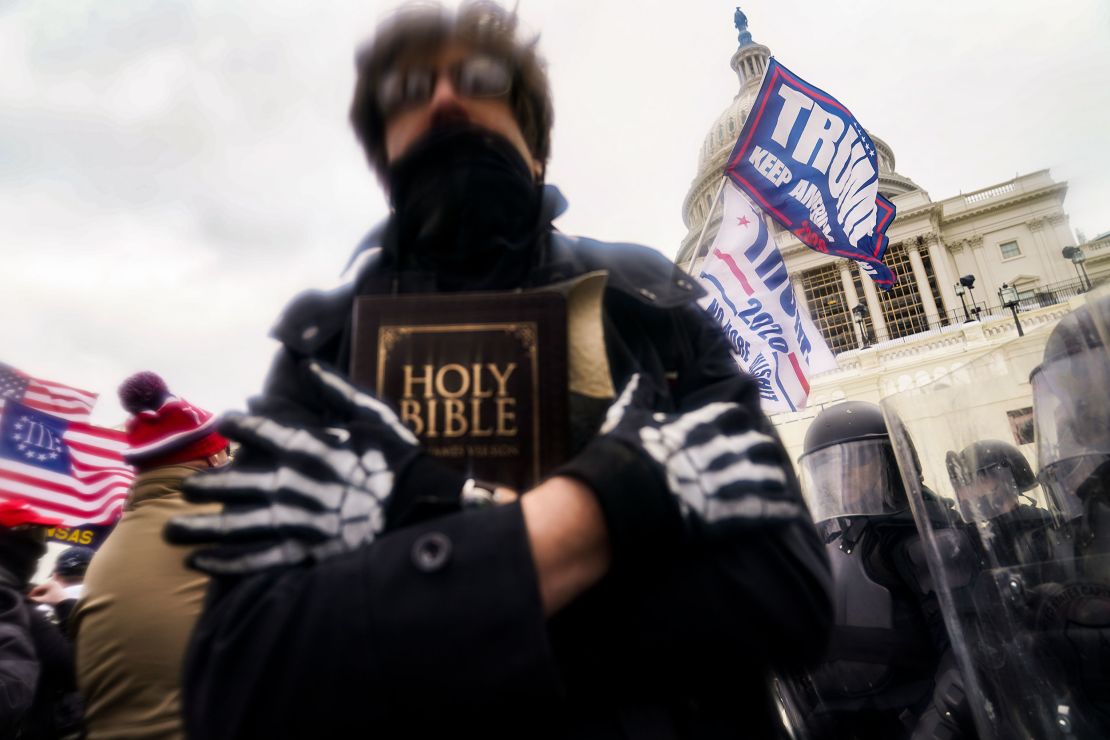
The spread of White Christian nationalism was on display during the January 6 insurrection, which featured many White Christians, like the one above, carrying Bibles and crosses as they rallied in support of former President Trump. John Minchillo/AP
Chen says the browning of Christianity in the US owes much to the passage of the 1965 Immigration and Nationality Act. That law paved the way for millions of immigrants from Asian, Africa, and Latin American countries to come to the US.
“When we tell the story about American Christianity, we might start with the Puritans — it’s basically a European story,” says Chen, author of “Work Pray Code: When Work Becomes Religion in Silicon Valley.” “But what if we were to tell the story of American Christianity by what it’s starting to look like and how it’s changing today? That story begins in a place like Taiwan, Korea, or Mexico.”
How it feels to belong to a church that does not see you
The focus on White evangelicals presents their non-White counterparts with a challenge: How do you reconcile belonging to a church that often doesn’t see you?
That’s a problem Black evangelicals have faced for centuries, says the Rev. John C. Richards, Jr., a Black evangelical pastor at Saint Mark Baptist Church in Little Rock, Arkansas. He wrote in a 2017 essay that “White Christians have historically controlled the evangelical narrative.”
“Black Christians have always lived in the peripheral vision of White Evangelicalism — our stories remaining unearthed and untold,” he wrote.
But Black evangelicals have been in the US since the country’s birth. Richards says they have been the “moral compass of our nation,” clinging to their faith during slavery and Jim Crow. He cited the evangelical scholar Mark Noll, who once said:
“Black Christians are the ones who have experienced the cross most traumatically in American history yet have not been included in the stories of Evangelicalism.”
Richards deals with this challenge by asserting his evangelical identity in any forum he can. He uses social media, sermons and his “The Questions Worth Answering” podcast to highlight the faith and contributions of Black evangelicals.
And he continues to claim the term “evangelical,” despite its association with conservative White Americans.
“I’m not ready to abandon it just because someone co-opted it and just because people are misusing the word,” he says.
The Rev. John Onwuchekwa, a pastor and entrepreneur based in Georgia, has a different response.
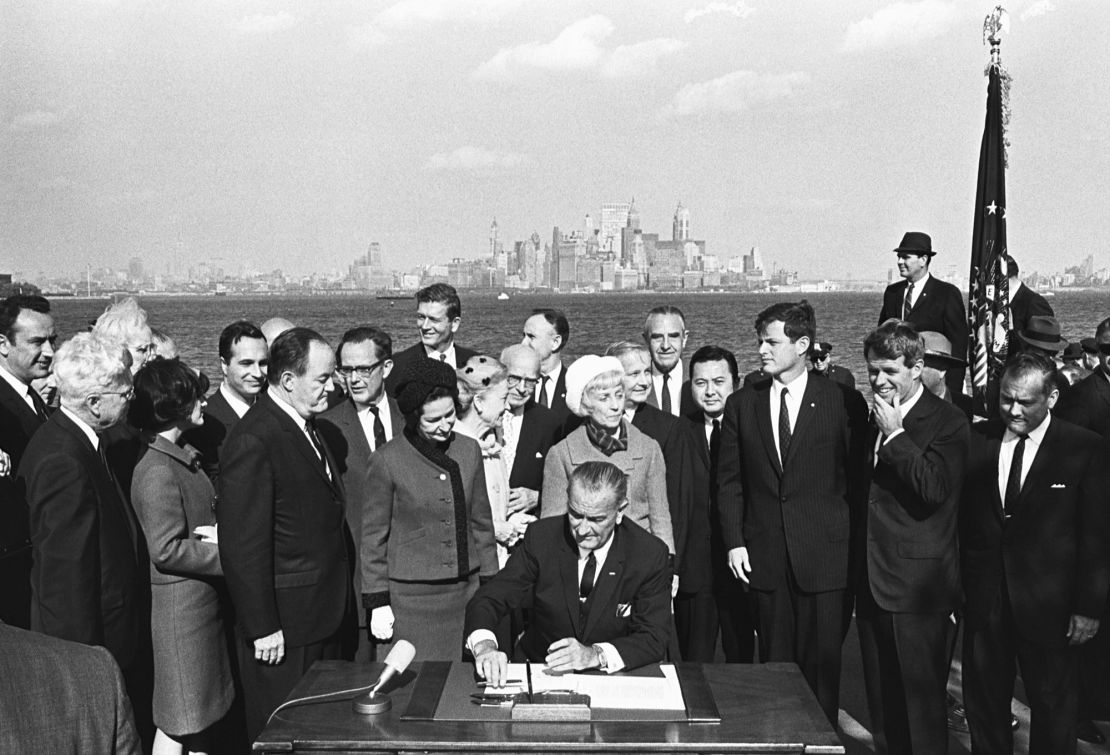
President Lyndon B. Johnson signs the Immigration Bill of 1965 on Liberty Island in New York Harbor with a view of the New York City skyline in the background. Next to the president on his right are First Lady Lady Bird Johnson and Vice President Hubert Humphrey. To the president’s left are Senator Edward Kennedy (third from right) and Robert Kennedy (second from right). Corbis Historical/Getty Images
The son of Nigerian immigrants, he says he grew exhausted trying to defend his perspective on race while he was a pastor with the Southern Baptist Convention, an ultra-conservative, predominately White evangelical denomination.
Onwuchekwa and the congregation he co-founded, the Cornerstone Church, eventually left the Southern Baptist Convention.
Onwuchekwa says he no longer uses the term “evangelical” to describe himself.
“It’s become an unhelpful label,” he says. “It’s almost become an exclusively political term. The point of a label is to reduce the time it takes to communicate. Whenever you use the term ‘evangelical’ in public discourse, it achieves the opposite because you have to say, ‘Oh, but wait, here’s what I mean.’ ’’
This pastor wants the ‘full intricacies’ of his humanity to be seen
Some non-White evangelicals are ignored in a more subtle way. Their perspective is only sought on issues related to race, like Christian nationalism.
Onwuchekwa says he was once participating in a panel discussion on theology at a large evangelical conference with another Black pastor. Both answered questions about race for 15 minutes. When the other panelists turned the conversation to other theological matters, no one had a question for either of them for the remaining 45 minutes.
Sometimes your race or ethnicity is ignored; at other times, that’s all White people see.
“It made me feel belittled, used and it made me feel like this isn’t the space for me,” says Onwuchekwa, author of “We Go On: Finding Purpose in All of Life’s Sorrows and Joys.”
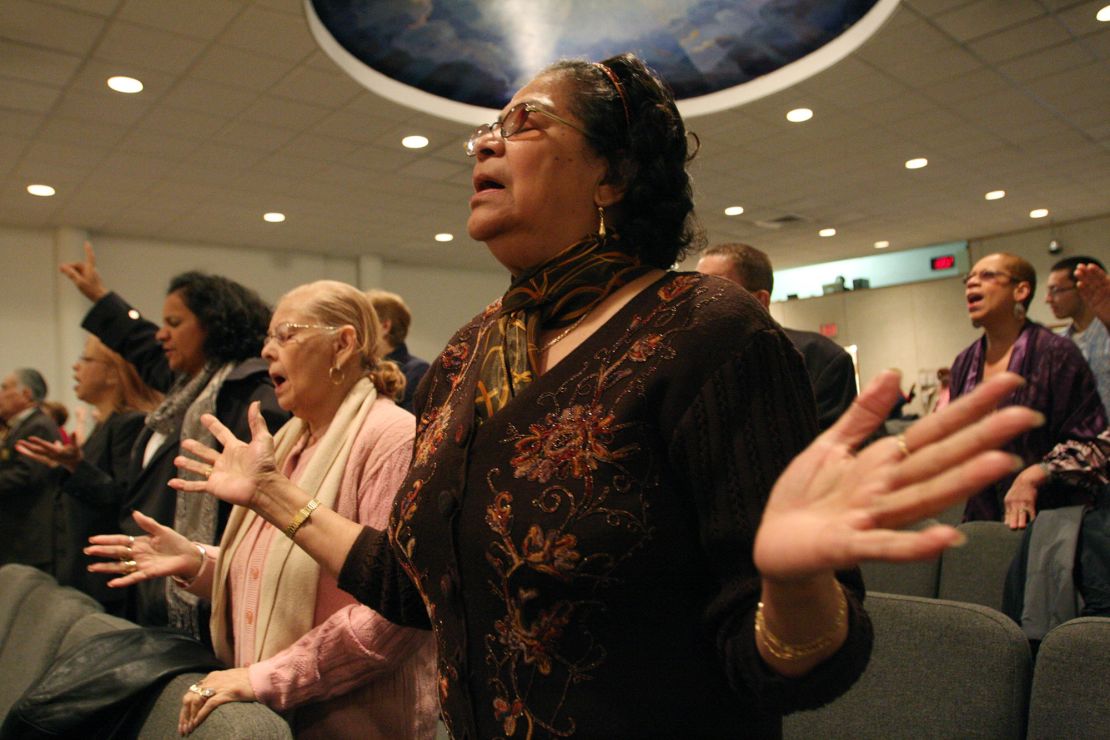
Maria Antonetty, foreground right, joins other worshipers at a Spanish Easter service at the Primitive Christian Church in New York. The fastest growing segment of evangelicals in the US are Latino Americans. Tina Fineberg/AP
“There need to be spaces where the full intricacies of my humanity are more fully appreciated,” says Onwuchekwa, who is also a co-founder of the Crete Collective, which opens churches in communities of color.
Some non-White evangelicals feel overlooked because church leaders don’t acknowledge their pain.
Lim, the Korean-American pastor, says several Asian-American families joined his church following a 2021 tragedy that rocked Atlanta’s Asian community. A man entered several Atlanta-area spas and shot and killed eight people, including six Asian women. The shooting underscored a recent surge in hate crimes against Asians in the US.
Some of the new members of Lim’s church had been congregants in large, White evangelical churches. They told him they left because of the spa shootings, he says.
“It wasn’t addressed at the churches; it wasn’t even talked about,” Lim says. “These Asian Americans, who were key members of the church, felt invisible. Their hurt was overlooked. That was the final straw for them.”
Non-White evangelicals may save the American church
It may soon be impossible to ignore the importance of non-White evangelicals because of one reason: demographics.
At first glance, the numbers don’t look good for Christians in America. Commentators have longed warned that Christianity in the US is dying.
Church membership in the US has been declining and in 2020 fell below 50% for the first time. Church leaders fret that the American church is poised to follow the path of West European churches: soaring Gothic cathedrals with empty pews and shuttered church sanctuaries converted into nightclubs.
The numbers look grim for White evangelicals as well. They are the oldest religious group in America, and their numbers are declining, Chen, the UC Berkeley professor, says.
But for evangelicals, the migration of non-White immigrants to the US from Latin America and Asia could represent a more earthbound form of salvation.
The US has more immigrants than any country. Many of them are evangelicals and they, along with their children, are bringing their religious fervor with them and planting churches.
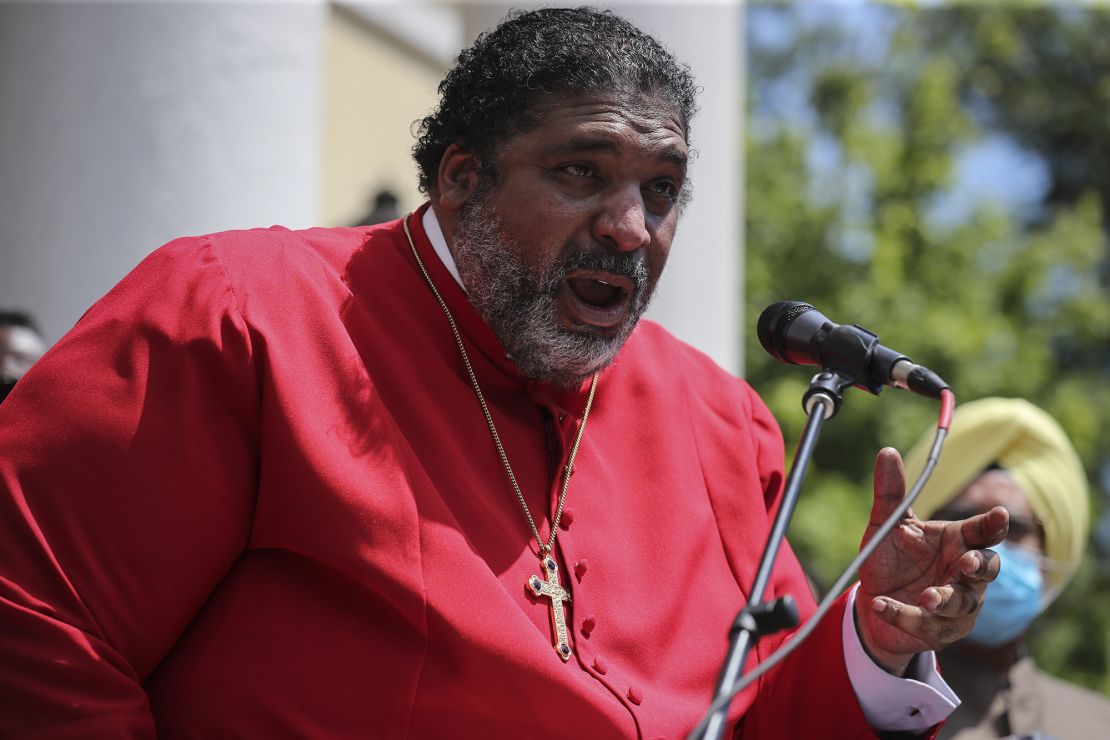
The Rev. Dr. William J. Barber II , seen above speaking in Washington, DC, is an activist and civil rights leader who identifies as an evangelical Christian. However, he rejects the political beliefs associated with White Christian nationalism. Oliver Contreras/For The Washington Post/Getty Images
“For so long we’ve talked about Christianity or evangelicalism as a White phenomenon,” says Chen, who is also the executive director of the Asian Pacific American Religions Research Initiative.
“We’re on the cusp of this demographic change and there’s evidence of it all over. But we don’t even see it because we’re so focused on this population that’s dying out.”
No one is saying there will be a “great replacement” of White evangelicals by hordes of brown or Black migrants elbowing them out of the pews. White evangelicals will remain a potent political force in American politics.
But there is a rich and vibrant world of non-White evangelicals in America whose stories remain “unearthed and untold.” Not every discussion of evangelicals should feature White faces.
It’s time to bury the myth that White Americans have a monopoly on evangelical Christianity.
John Blake is the author of “More Than I Imagined: What a Black Man Discovered About the White Mother He Never Knew.”
 Rosamond Press
Leave a comment