
Is Netanyahu extending the Gaza War in hope Donald Trump is reelected? Does Bibi believe President Biden stole the election? How many Christian Zionist took part in the Jan.6 Insurrection? We need a study to see how much religion plays a role in the growing violence. Perhaps Bill Ackman will pay for one. Does Big A know Reverend Hagee who believes God wants a divine crusade? Prove it!
There is evidence my 9th. grandfather, John Wilson. and the Puritans, were Christian Zionists; therefore I get to discuss Zionism without being title a “anti-Semitic”.
John Presco
‘Defender of Harvard’
https://en.wikipedia.org/wiki/Christian_Zionism
What’s Next for Christian Zionists?
The backbone of Israel’s support in the United States is a group of evangelical Christians, but their power is threatened by the changing of the political guard.
JULY 19, 2021, 7:42 AM
By Colum Lynch
My FP: Follow topics and authors to get straight to what you like. Exclusively for FP subscribers. Subscribe Now | Log In
 Christian followers of the American evangelical pastor John Hagee cheer in Israel
Christian followers of the American evangelical pastor John Hagee chant slogans in support of Israel as they wave Israeli and U.S. flags during a rally in Jerusalem on April 7, 2008. GALI TIBBON/AFP VIA GETTY IMAGES
For Mike Evans, a Christian Zionist pastor in the United States, the fall of Israeli Prime Minister Benjamin Netanyahu was more than a political setback for a movement that had forged deep ties with the former Israeli leader. It was a bitter betrayal of biblical prophecy by Israeli voters and a new generation of political leaders. In a rancorous, profanity-filled missive, Evans excoriated Israel’s new Prime Minister Naftali Bennett for joining a coalition of Israeli centrists and Arab Israelis who he fears may support a Palestinian state.
“We gave you four years of miracles under Donald Trump and this is how you show your appreciation,” Evans wrote, vowing that he and his followers would join the outgoing prime minister in opposition to the government. His outburst reflected anxiety among American Christian leaders who fear the outsized influence they exercised in the era of former U.S. President Donald Trump and Netanyahu will be severely diminished, renewing prospects for a Palestinian state, which many see as antithetical to God’s plan for a Greater Israel.
The changing of the political guard in both countries comes at a time when evangelical Christians had reached the zenith of political power in Washington, shaping U.S. policy on human rights, abortion, reproductive health care, LGBT rights, and increasingly Israel, where they helped build political support for Trump’s decision to move the U.S. Embassy from Tel Aviv to Jerusalem. It also coincides with a growing generational split in the evangelical church, with an increasing proportion of younger evangelicals viewing Israel more critically than their elders.
An increasing proportion of younger evangelicals are viewing Israel more critically than their elders.
In an exit interview with Israeli television, Netanyahu’s U.S. envoy Ron Dermer said that the evangelical Christian community had far eclipsed the American Jewish community as Israel’s most important political allies in the United States.
“People have to understand that the backbone of Israel’s support in the United States is the evangelical Christians,” Dermer said. “About 25 percent [of Americans] … are evangelical Christians. Less than 2 percent of Americans are Jews. So if you look just at numbers, you should be spending a lot more time doing outreach to evangelical Christians than you would do to Jews.”
In Israel[edit]
The government of Israel has given official encouragement to Christian Zionism, allowing the establishment of the International Christian Embassy Jerusalem in 1980.[citation needed] The embassy has raised funds to help finance Jewish immigration to Israel from the former Soviet Union, and has assisted Zionist groups in establishing Jewish settlements in the West Bank.[citation needed]
The Third International Christian Zionist Congress, held in Jerusalem in February 1996, issued a proclamation which said:[80]
God the Father, Almighty, chose the ancient nation and people of Israel, the descendants of Abraham, Isaac and Jacob, to reveal His plan of redemption for the world. They remain elect of God, and without the Jewish nation His redemptive purposes for the world will not be completed.
Jesus of Nazareth is the Messiah and has promised to return to Jerusalem, to Israel and to the world.
It is reprehensible that generations of Jewish peoples have been killed and persecuted in the name of our Lord, and we challenge the Church to repent of any sins of commission or omission against them.
The modern Ingathering of the Jewish People to Eretz Israel and the rebirth of the nation of Israel are in fulfilment of biblical prophecies, as written in both Old and New Testaments.
Christian believers are instructed by Scripture to acknowledge the Hebraic roots of their faith and to actively assist and participate in the plan of God for the Ingathering of the Jewish People and the Restoration of the nation of Israel in our day.
Popular interest in Christian Zionism was given a boost around the year 2000 in the form of the Left Behind series of novels by Tim LaHaye and Jerry B. Jenkins.[81] The novels are built around the prophetic role of Israel in the apocalyptic end times.
Catholic Church[edit]
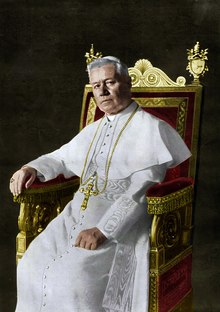
The Catholic Church—the largest branch of Christians in the world—does not endorse the theological premises underlying millennialist Protestant Restorationism and it has generally inveighed against the prospect of Jewish governance over Holy Places in Palestine which it deems of importance to Christianity.[86][87] Theodor Herzl, the secular Jewish founder of modern political Zionism, had an audience in the Vatican with Pope Pius X in 1904, arranged by the Austrian Count Berthold Dominik Lippay, seeking out the position of the Catholic Church on Herzl’s prospective project for the establishment of a Jewish state in Palestine. Pope Pius X stated “We cannot prevent the Jews from going to Jerusalem—but we could never sanction it. The soil of Jerusalem, if it was not always sacred, has been sanctified by the life of Jesus Christ. As the head of the Church I cannot tell you anything different. The Jews have not recognized our Lord, therefore we cannot recognize the Jewish people.”[87] After Herzl explained that his reasoning behind the project for the creation of a Jewish state was not a religious statement, but interest in secular land for national independence, Pope Pius X replied “Does it have to be Gerusalemme?”[87]
https://en.wikipedia.org/wiki/Christian_Zionism
Christian Zionism is an ideology that, in a Christian context, espouses the return of the Jewish people to the Holy Land. Likewise, it holds that the founding of the State of Israel in 1948 was in accordance with Bible prophecy: that the re-establishment of Jewish sovereignty in the Levant — the eschatological “Gathering of Israel” — is a prerequisite for the Second Coming of Jesus Christ.[1][2] The term began to be used in the mid-20th century, in place of Christian restorationism, as proponents of the ideology rallied behind Zionists in support of a Jewish national homeland.[3][4]
Advocacy on the part of Christians for a Jewish restoration grew after the Reformation, and is rooted in 17th-century England.[1] Contemporary Israeli historian Anita Shapira suggests that England’s Zionist evangelical Christians “passed this notion on to Jewish circles” around the 1840s,[5] while Jewish nationalism in the early 19th century was largely met with hostility from British Jews.[6]
Christian pro-Zionist ideals have generally been common among Protestants since the Reformation. While supporting a mass Jewish return to the Land of Israel, Christian Zionism asserts a parallel idea that the returnees ought to be encouraged to reject Judaism and adopt Christianity as a means of fulfilling biblical prophecies.[7][8][9][10] Polling has suggested a trend of widespread distrust among Jews towards the motives of evangelical Christians.[11]
Christian Zionism is an ideology that, in a Christian context, espouses the return of the Jewish people to the Holy Land. Likewise, it holds that the founding of the State of Israel in 1948 was in accordance with Bible prophecy: that the re-establishment of Jewish sovereignty in the Levant — the eschatological “Gathering of Israel” — is a prerequisite for the Second Coming of Jesus Christ.[1][2] The term began to be used in the mid-20th century, in place of Christian restorationism, as proponents of the ideology rallied behind Zionists in support of a Jewish national homeland.[3][4]
Advocacy on the part of Christians for a Jewish restoration grew after the Reformation, and is rooted in 17th-century England.[1] Contemporary Israeli historian Anita Shapira suggests that England’s Zionist evangelical Christians “passed this notion on to Jewish circles” around the 1840s,[5] while Jewish nationalism in the early 19th century was largely met with hostility from British Jews.[6]
Christian pro-Zionist ideals have generally been common among Protestants since the Reformation. While supporting a mass Jewish return to the Land of Israel, Christian Zionism asserts a parallel idea that the returnees ought to be encouraged to reject Judaism and adopt Christianity as a means of fulfilling biblical prophecies.[7][8][9][10] Polling has suggested a trend of widespread distrust among Jews towards the motives of evangelical Christians.[11]
In the decades since the establishment of Israel, and especially since the 1967 Six-Day War, the most prominent American Christian supporters of Israel have come from the evangelical wing of American Protestantism. American evangelicalism itself underwent significant changes in the years surrounding Israel’s birth, as a “new” evangelicalism led by figures like Billy Graham emerged from Protestantism and came to cultural prominence.[74] It was among these new evangelicals that the contemporary movement that most commonly associated with the term “Christian Zionism” originated.[75]
Many new evangelicals adhered to dispensationalism or at least, they adhered to beliefs which were inspired by it—most especially, they adhered to the dispensationalist understanding that Jews remained in a special covenantal relationship with God. Most important to the development of Christian Zionism as a movement, though, was the fact that American evangelical leaders began to build relationships with American and Israeli Jews and they also began to build institutional connections with Jewish organizations and the Israeli government itself. Crucial to the building of these relationships was a motivated coterie of American evangelicals who resided in Israel, most notably, the founder of the American Institute of Holy Land Studies, G. Douglas Young. Through his institute, Young worked to convince American Christians that it was their biblical duty to support the Jewish people and the Jewish state. He also worked as a go-between for Jewish organizations and Israeli government agencies which were seeking to build relationships with American evangelicals.[76] Such activism provided the basis for the development of Christian Zionism as a movement.
 Rosamond Press
Leave a comment