
Senator Scott may be a running mate for the Republican presidential nominee. Scott contends our Founding Fathers created a Democracy to protect Christians from THE STATE. What state? King George was a devout member of the Anglian church. There was no SECULAR GOVERMENT in the Colonies thus, there was no PERSECUTION of Christians – who did persecute the Mormons – who retaliated, resulting in the slaughter of unarmed human beings. Because of the slaughter of unarmed human beings in Israel and Gaza, Jesus will not be going to Israel, or inside a new temple, to save evangelicals. The real Jesus is done with all that religious propaganda, and is COMING BACK to the United States to help SAVE this Democracy from religious zealots – and liars!
I will prove Jesus PROMOTED A DEMOCRACY that the God of the Jews established with His prophet Moses - who Christian teachers ignore! Moses is coming to America to minister to the American Jews and to members of Reformed Judaism. Below is a good article on the RELIGIOUS STRIFE that permeated the founding or our Democracy – that Christians are claiming as THEIR’S ALONE. This is another LAND GRAB by aggressive and violent Christians. I’m sure Christians hate the claim by the Mormons Jesus came to America. Christianity has no record of this – visitation! When did Mormons become ABOLITIONISTS? When did Utah become a State, and thus subject to our Constitution?
John Presco
“We must tell the story of our Constitution that the First Amendment was written to protect the church from the state, not the state from the church,” he said last month.
https://en.wikipedia.org/wiki/Utah_War
Mountain Meadows massacre[edit]
Main article: Mountain Meadows massacre
The widely publicized Mountain Meadows massacre occurred on September 11, 1857, during a period of escalating tensions between Mormons and the United States which Mormons viewed from an apocalyptic lens. It was a mass killing of about 130 emigrants, mostly from Arkansas, who were passing through the Utah territory on their way to California. The massacre was influenced, in part, by unfounded rumors that some of the emigrants had previously persecuted Mormons. Leading the massacre were William H. Dame, regional church president and colonel of the Mormon militia, and his battalion leaders Isaac C. Haight (also a regional church president), John D. Lee, and John H. Higbee. The militia surrounded the emigrants and laid siege, and after forcing them to surrender, the militia systematically executed all of them except the youngest children, who were taken and adopted by nearby residents. The militia covered up the massacre by blaming it on largely uninvolved Native American tribes. Though Dame, Haight, and other leaders were indicted in the 1870s for their roles in the massacre, John D. Lee was the only participant who stood trial, where he was ultimately convicted and executed.
Scott emphasized his belief that America today is focused on spirituality but is moving away from traditional organized religion. He said this is the main reason “why our nation is experiencing high levels of instability.”
When asked about the future of faith in America, Scott said he predicts more assault on religion paired with “the indoctrination of our kids from kindergarten through college.”
“I think we will see some of the greatest assaults on religious liberty that we’ve ever seen,” Scott said. “We’re seeing it today around the world, but we’re seeing a lot of it at home as well. People want to challenge whether or not your faith should be a part of the public form. They forget the fact that our founding fathers founded this nation upon the rock of Judeo Christian ethos. It is that rock that allows this nation to be the city on the hill.”
“We must tell the story of our Constitution that the First Amendment was written to protect the church from the state, not the state from the church,” he said last month.
Those words are identical to what Scott said during a formative fight nearly three decades ago as a new member of the Charleston County Council when he made national headlines for posting the Ten Commandments at the local legislative body’s building.
“I see myself first as a biblical leader and not as a Republican or conservative leader,” Scott said during a 2020 video conference with students at Bob Jones University, which is known for its conservative cultural and religious positions.
“I am first a Christian,” he added. “And it is the thing I have chosen to be above all other things.”
A state is a political entity that regulates society and the population within a territory.[1] Government is considered to form the fundamental apparatus of contemporary states,[2][3]
Most often, a country has a single state, with various administrative divisions. It is a unitary state or a federal union; in the latter type, the term “state” is sometimes used to refer to the federated polities that make up the federation. (Other terms that are used in such federal systems may include “province“, “region” or other terms.)
Most of the human population has existed within a state system for millennia; however, for most of prehistory people lived in stateless societies. The earliest forms of states arose about 5,500 years ago[4] as governments gained state capacity in conjunction with rapid growth of cities, invention of writing and codification of new forms of religion.
Over time, a variety of forms of states developed, which used many different justifications for their existence (such as divine right, the theory of the social contract, etc.). Today, the modern nation state is the predominant form of state to which people are subject.[5] Sovereign states have sovereignty; any ingroup‘s claim to have a state faces some practical limits via the degree to which other states recognize them as such.
https://en.wikipedia.org/wiki/State_(polity)
The 16th and 17th centuries saw horrific conflicts spawned by the religious disputes known as the Reformation. By the 18th century, these conflicts switched to disputes of a more economic and political nature. Most of us don’t think of the American Revolution as a religious conflict and yet religion was a major bone of contention throughout the engagement.
This all seems rather odd when you consider that the American Revolution was more of a civil war than a traditional revolution. English people were fighting English people. War was waged by people who had a shared language, a shared history and, to a large degree, similar religious viewpoints. The disagreements over religion were no more acute between American Colonists and the Mother Country than they were between citizens living in England.
When we consider the conflicts that caused America to declare independence, we often think of taxes. The famed slogan attributed to James Otis; “no taxation without representation,” is usually considered the main rift between King George III and his subjects across the Atlantic. We recall the various acts that placed duties on items like tea and stamps but, in reality, the average Colonist paid less in taxes than their counterparts in London. It is the last part of the slogan that comes closer to achieving the true sticking point: Representation.
The Colonists cared more about their lack of involvement in making decisions than in the actual decisions themselves. Many of the decisions that the Colonists were most concerned about regarded religion. In the Colonies, where the Established Church of England was dominant, taxes were levied to pay for the services of ministers and the work of the church. Even English subjects from a different religious tradition were subject to those same taxes. If you wanted to hold public office in many of the Colonies, you had to be part of the Church of England. But no Bishops were ever sent over to the Colonies which created a shortage of clergy and a feeling that their spiritual care was less important than citizens living in England.
In the early 17th century, the Great Awakening spurred many Colonists to believe that the most important relationship in faith was between God and the individual and that no government should be given authority over that relationship. Many colonial clergymen were known to give sermons insisting that fighting against tyranny was the duty of Christian people. Not all Colonists shared this ideal.
The clergy were largely loyalist when hostilities broke out in April of 1775 and many returned to England rather than break their oath of loyalty to the Head of the Church, King George III. If God appointed Kings and other authority figures, a dominant belief at the time, then how could someone support the overthrowing of that divinely elected authority? Thomas Paine’s “Common Sense” reads much like a sermon on the Exodus story, how God is want to deliver oppressed people. George Washington enlisted the help of chaplains to help keep the morals of the soldiers respectable as well as encouraging them to hold fast to their enlistment obligations. Both sides were convinced that God was present during this conflict and, of course, on their side.
During the American Revolution, the Anglican churches were largely in disarray as taxes were no longer collected and church properties were forfeited. With clergy few and far between, the Church of England in the U.S. was on life support. In 1783, the Treaty of Paris ended the war and the United States officially became a sovereign nation. What was a good Anglican American to do? The first step was to try and find a source for the consecration of Bishops.
Samuel Seabury was elected by the Anglicans living in Connecticut, but bishops in England were precluded from consecrating anyone who did not take an oath of loyalty to the King. Seabury sought and was granted his consecration through the nonjuring line in Scotland in 1786. Shortly thereafter, Parliament granted exemptions for Anglicans living outside of Great Britain and William White, Samuel Proovost, and James Madison were all made bishops through the Archbishop of Canterbury for Pennsylvania, New York, and Virginia respectively. Thus, the Protestant Episcopal Church in America was born.
The fledgling church had an uphill battle. Americans largely had a distrust for all things British and the close connection between Anglicans in America with those in England was considered suspect. Episcopal priests had to teach their parishioners the joys of tithing as taxation was no longer imposed. Some northern states held on to the ideals of establishment well into the 19th century but, by in large, the notion of separating church and state was taking hold.
Unfortunately, much of the early history of the Protestant Episcopal Church is clouded because of the confusion of those rocky times. Bishop William Meade, the third Bishop for the Diocese of Virginia, wrote in 1857; “Had I kept a diary for the last fifty years, and taken some pains during that period to collect information touching the old clergy, churches, glebes, and Episcopal families, I might have laid up materials for an interesting volume; but the time and opportunity for such a work have passed away. The old people, from whom I could have gathered the materials, are themselves gathered to their fathers.”1 Bishop Meade’s lament is that of every church historian since that time regarding the challenges and conflicts of the Episcopal Church in America coming into its own.
What we do know is that religion had far more to do with the American Revolution than most of our history classes taught us and new religious bodies like the Protestant Episcopal Church and the Methodist-Episcopal Church were born in the soil of the new republic.
https://en.wikipedia.org/wiki/State_(polity)
https://en.wikipedia.org/wiki/Mormonism_and_violence
On August 6, 1838, in Daviess County, a brawl erupted between a group of Mormons and non-Mormon residents during election day. The perception that Mormons intended to vote as a bloc clashed with the opposition of non-Mormons who sought to prevent them from casting their ballots.[5] Meanwhile, the siege of DeWitt unfolded in Carroll County. As tensions mounted, a large mob of non-Mormons encircled the settlement, cutting off its supplies and demanding the Mormons’ departure. Outnumbered and fearing violence, the Mormons sent appeals for assistance to other Mormon communities in nearby counties. The siege ultimately ended when a state militia unit arrived, and the Mormons agreed to evacuate the town.[6]
https://en.wikipedia.org/wiki/Anti-Mormonism
Secular anti-Mormonism[edit]
Opposition to Mormonism has been more prominent in the 21st century from New Atheism perspectives. Richard Dawkins, Bill Maher and John Dehlin are among those who more prominent individuals who have used media appearances or podcasts to oppose the Institutional LDS Church and its doctrines and policies.[citation needed]
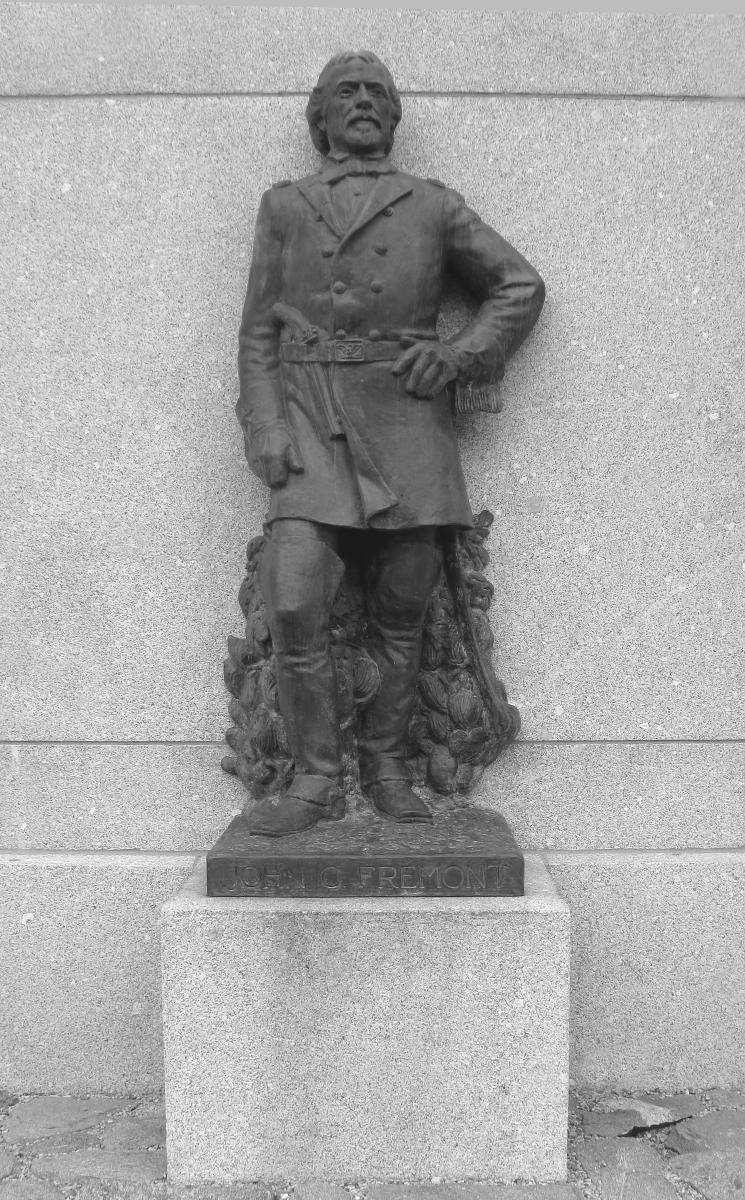 Bronze figure representing John C. Frémont by Mahonri M. Young, part of This Is the Place Monument, situated on the east bench of Salt Lake City, July 2012. Photograph by Alexander L. Baugh.
High on the bench east of Salt Lake City is the This Is the Place Monument, erected and dedicated in 1947 as part of the centennial celebration commemorating the arrival of the Mormon pioneers in July 1847. Featured on the granite base and tower are a number of bronze-cast figures created by the renowned Latter-day Saint sculptor Mahonri M. Young (grandson of Brigham Young). Most notable are the large statues of Mormon leaders Brigham Young, Heber C. Kimball, and Wilford Woodruff, who stand atop the centerpiece while gazing to the west over the Salt Lake Valley. In addition, nearly twenty other figures are situated around the monument’s base, including one representing John C. Frémont. A plaque, placed in front, provides a fitting tribute highlighting the contributions of the explorer to the Utah region and his influence upon the Mormon populace:
John C. Fremont
1813–1890
Pathfinder, explorer, soldier, statesman. Led five significant exploring and scientific expeditions to the West, 1842–54, three of which traversed the Great Basin to California. Conducted the first scientific exploration of the Great Salt Lake in 1843 and was the first to traverse the treacherous Great Salt Lake Desert directly westward from [the] Great Salt Lake to the site of modern Elko, Nevada. His report and map published in 1845 were invaluable to the Mormon pioneers in their westward journey.
 Rosamond Press
Leave a comment