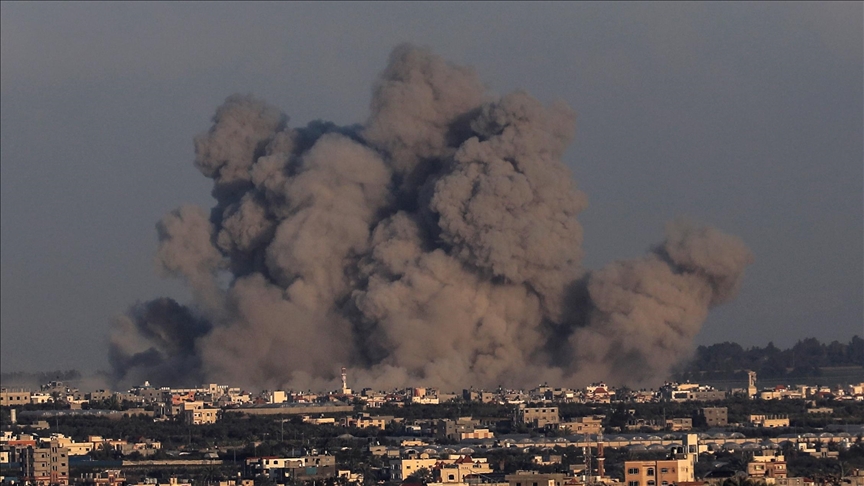
Israeli attacks continue on Gaza ( Abed Rahim Khatib – Anadolu Agency )
I watched the CNN special in the Jan.6th. Insurrection, and could not help wonder, what others have wondered….If Trump wins, will there ever be a national election again? You have to ask what Republicans believe is more important than American Democracy, and the only answer can be…
JESUS!
This makes sense, because intelligent Americans are choosing not to be believe FACTS and THE TRUTH, and they believe Secular Democrats are out to destroy their – FAITH! Are Christian Democrats trying to destroy Christian Republicans because they still believe Biden stole the election, and, they will vote for Trump again – even though they have heard rumors, he may be President till he dies. Will Trump live twelve years? How will his successor be chosen – if there is no more voting?
Netanyahu said the insurrection was wrong. Today he as assembled “crack teams”. Because religious fanatics are running Israel, and RF’s tried to take away democratic freedoms using secular court. With the attacks on our colleges, black studies, and LGBTQ people, it looks to me we are on the verge of another Spanish Inquisition, where Israel and the U.S, will be looking for allies that strengthen the Religious Aristocracy. I am sure other foreign intelligence is looking at this – like I am!
I suggest the International Court of Justice RULE on what happened to Israel and the U.S. it looks like they have gone….DANGEROUSLY INSANE!
What if Trump wins, and because of his promise to be a vindictive dictator, Biden and Democrats show fake evidence – he lost again! What if Trump loses? I’m sure all members of NATO are very concerned.
John Presco
Crack legal teams are being assembled, countries are issuing statements in support of South Africa, and Israel has said it will defend itself in court, reversing a decades-old policy of boycotting the UN’s top court and its 15 elected judges.
But putting aside whether Israel would comply with any ICJ order to change its military tactics and desist from any act ruled as genocide, the reputational damage to Israel of such a ruling would be substantial, and at minimum may produce a modification of its military campaign. The very fact that Israel has chosen to defend itself at the ICJ – a UN sponsored body – and is a signatory to the genocide convention makes it harder for it to brush aside an adverse finding.
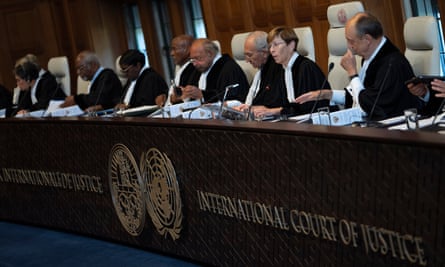
The International Court of Justice (ICJ; French: Cour internationale de justice; CIJ), also called the World Court,[1] is one of the six principal organs of the United Nations (UN).[2] It settles disputes between states in accordance with international law and gives advisory opinions on international legal issues. The ICJ is the only international court that adjudicates general disputes between countries, with its rulings and opinions serving as primary sources of international law (subject to Article 59 of the Statute of the International Court of Justice).
The Inquisition was originally intended primarily to identify heretics among those who converted from Judaism and Islam to Catholicism. The regulation of the faith of newly converted Catholics was intensified following royal decrees issued in 1492 and 1502 ordering Jews and Muslims to convert to Catholicism or leave Castile, resulting in hundreds of thousands of forced conversions, the persecution of conversos and moriscos, and the mass expulsions of Jews and of Muslims from Spain.[3] The Inquisition was abolished in 1834, during the reign of Isabella II, after a period of declining influence in the preceding century.
https://en.wikipedia.org/wiki/International_Court_of_Justice
Stakes high as South Africa brings claim of genocidal intent against Israel
Patrick WintourDiplomatic editor
Israel’s decision to defend itself at the international court of justice will make it harder for it to brush aside any adverse findingThu 4 Jan 2024 00.00 EST
South Africa’s request for an interim measure by the international court of justice to prevent Israel from committing acts of potential genocide – primarily by calling for a halt to combat operations – has suddenly taken on an urgency and relevance that seemed implausible a fortnight ago.
Crack legal teams are being assembled, countries are issuing statements in support of South Africa, and Israel has said it will defend itself in court, reversing a decades-old policy of boycotting the UN’s top court and its 15 elected judges.
The first hearing in The Hague is set for 11 and 12 January. If precedent is any guide, it is possible the ICJ will issue a provisional ruling within weeks, and certainly while the Israeli attacks on Gaza are likely to be still under way.
The wheels of global justice – at least interim justice – do not always grind slowly.
South Africa’s request for a provisional ruling is in line with a broader trend at the ICJ for such rulings. Parties have been seeking – and obtaining – provisional measures with increasing frequency: in the last decade the court has indicated provisional measures in 11 cases, compared with 10 in the first 50 years of the court’s existence (1945-1995).
Like interim injunctions issued by national courts, ICJ provisional measures seek to freeze the legal situation between parties to ensure the integrity of a future final judgment. For a while doubt persisted as to whether these measures were deemed binding by the ICJ. But the court put those doubts to rest in the LaGrand judgment in June 2001, where it held that the rulings were binding, given the court’s “basic function of judicial settlement of international disputes”.
They are intended to be binding, but are they in practice?
One assessment prepared by a US lawyer, Mattei Alexianu, suggested that the court’s measures were complied with by the state parties in only 50% of cases, while in some – normally the most high-profile recent cases, including Ukraine v Russia in 2022, the Gambia’s claims of genocide against Myanmar in 2020, Nagorno-Karabakh, and US sanctions on Iran – the losing state party simply defied the court.
Not surprisingly, the more intrusive an adverse ruling to a country’s sense of national sovereignty, the less likely they were to comply.
But putting aside whether Israel would comply with any ICJ order to change its military tactics and desist from any act ruled as genocide, the reputational damage to Israel of such a ruling would be substantial, and at minimum may produce a modification of its military campaign. The very fact that Israel has chosen to defend itself at the ICJ – a UN sponsored body – and is a signatory to the genocide convention makes it harder for it to brush aside an adverse finding.
It is a high-risk move by Israel. What are the chances of an adverse finding being made?
First, it should be said that although the South African claim to the ICJ seemed to come out of the blue on 29 December, it is not something its lawyers cobbled together while wrapping up Christmas presents.
It is a substantive, tightly argued 80-page claim, replete with detailed references to senior UN officials and reports, which only rarely strays from its chief necessary purpose of seeking to prove Israel’s genocidal intent. The lawyers South Africa is sending to The Hague are its best. Much of South Africa’s argument is derived from the ICJ judgment on provisional measures it issued in the Gambia v Myanmar case in 2020.
According to the application, “acts and omissions by Israel … are genocidal in character, as they are committed with the requisite specific intent … to destroy Palestinians in Gaza as a part of the broader Palestinian national, racial and ethnical group” and that “the conduct of Israel – through its state organs, state agents, and other persons and entities acting on its instructions or under its direction, control or influence – in relation to Palestinians in Gaza, is in violation of its obligations under the genocide convention”.
By seeking provisional relief under article 74 of the court, as opposed to a definitive ruling, South Africa can lower the threshold of what it is required to prove before the court provides interim relief, and possibly minimise some of the prime facie jurisdictional issues facing the court.
Indeed, South Africa argues “the court is not required to ascertain whether any violation of Israel’s obligations under the genocide convention has occurred.
“Importantly, as previously held by the court, ‘such a finding, which would notably depend on the assessment of the existence of an intent to destroy, in whole or in part, the group … [of Palestinians] as such, could be made by the court only at the stage of the examination of the merits of the present case.’
“Instead, ‘what the court is required to do at the stage of making an order on provisional measures is to establish whether the acts complained of … are capable of falling within the provisions of the genocide convention’.
“The court does not have to determine that all of the acts complained of are capable of falling within the provisions of the convention.” It suffices that “at least some of the acts alleged … are capable of falling within the provisions of the convention”.
Equally, the court does not need to ascertain whether the existence of a genocidal intent is the only inference to be drawn from the material before the court, as “this requirement would amount to the court making a determination on the merits”.
South Africa seeks to prove that the measures Israel has taken go beyond self-defence and into the destruction of the Palestinians.
The claim details the familiar, if shocking, death toll, forced displacement, deprivation of food, and the restrictions on births, through attacks on hospitals, saying they are sufficient evidence to infer plausible genocidal intent.
The claim adds two other elements – the degree to which the Palestinian cultural life has been targeted, and the degree to which Israeli officials without reproach have repeatedly advocated for the destruction not just of Hamas but of Palestinians.
South Africa details numerous examples of “direct and public incitement to commit genocide by Israeli state officials”, including by the prime minister, Benjamin Netanyahu. The threats to make Gaza permanently uninhabitable, the references to Palestinians as human animals, are all documented in the claim. The calls by the far-right ministers Bezalel Smotrich and Itamar Ben Gvir to resettle Palestinians outside Gaza are also cited.
Inside Israel itself, former officials have written to the attorney general, Gali Baharav-Miara, asking that action be taken against public officials and elected politicians who have called for ethnic cleansing. The signatories on this letter include the former ambassador Dr Alon Liel, Prof Eli Barnavi, Ilan Baruch and Suzie Bachar.
“The explicit calls to commit atrocities against millions of people have become, for the first time that we can recall, a legitimate and ordinary part of the Israeli dialogue,” they state.
It is this kind of evidence, perhaps born of a new Israeli pessimism about the possibility of peace, that may sway judges to assess that Israel believes its security is dependent on the removal of Palestinians from Gaza. But there have been many statements by Israeli officials countering that view, which the court will have to balance. The reluctance of the Netanyahu government, partly for internal political reasons, to discuss its plans for the “day after” at minimum complicates the court’s task to discern Israel’s collective intention.
In a rhetorical tour de force, Israel’s spokesperson Eylon Levy previewed Israel’s response on Tuesday, focusing on its right to self-defence and the innovative measures taken to reduce civilian casualties.
But he started by questioning whether South Africa had a genuine dispute with Israel and challenging the country’s bona fides as an opponent of genocide given its support in Darfur for the former Sudanese president Omar al-Bashir. It was South Africa that was acting as the pro-bono advocate of a genocidal rapist Hamas machine, he said.
South Africa has sought to protect itself from this line of attack by criticising Hamas for the massacre on 7 October and by sending a formal note to Israel in advance of the claim, to which it says Israel did not reply. It says both countries are signatories to the 1948 genocide convention, which stipulates that they accept the ICJ jurisdiction with respect to adherence to that convention.
Levy said that Israel had taken measure unprecedented in the history of warfare to minimise civilian casualties.
“We have been clear in word and in deed that we are targeting the 7 October monsters and are innovating ways to uphold international law, including the principles of proportionality, precaution and distinction in the context in a counter-terror battlefield no army has faced before.
“That is why we spent weeks urging residents in northern Gaza to evacuate before the ground offensive. To warn civilians we placed over 70,000 phone calls, sent 13m text messages, left 14m voice messages and dropped nearly 7m leaflets urging civilians to evacuate temporarily for their safety, informing them about humanitarian pauses and precise evacuation routes.
“That is why we secured humanitarian corridors for civilians to escape Hamas, set up helplines for Palestinian civilians to tell our army if Hamas was stopping them fleeing, and that is why we designated a humanitarian zone in one of the only places in Gaza where Hamas was already hiding behind civilians.
“The Hamas rapist machine bears full moral responsibility for all the casualties in this war that it launched on 7 October and is waging inside and under schools, mosques, homes and UN facilities.”
South Africa can argue these precautionary steps have been performative at best, and knowingly ineffective at worst. But the limited reference to Hamas fighters embedding themselves in civilian life, or to Israel’s right to self-defence may make it hard for the court to accuse Israel even on a preliminary basis of the crime of crimes.
The Tribunal of the Holy Office of the Inquisition (Spanish: Tribunal del Santo Oficio de la Inquisición), commonly known as the Spanish Inquisition (Inquisición española), was established in 1478 by the Catholic Monarchs, King Ferdinand II of Aragon and Queen Isabella I of Castile. It began toward the end of the Reconquista and was intended to maintain Catholic orthodoxy in their kingdoms and to replace the Medieval Inquisition, which was under papal control. It became the most substantive of the three different manifestations of the wider Catholic Inquisition, along with the Roman Inquisition and the Portuguese Inquisition. The “Spanish Inquisition” may be defined broadly as operating in Spain and in all Spanish colonies and territories, which included the Canary Islands, the Kingdom of Naples,[citation needed] and all Spanish possessions in North America and South America. According to modern estimates, around 150,000 people were prosecuted for various offences during the three-century duration of the Spanish Inquisition, of whom between 3,000 and 5,000 were executed, approximately 2.7 percent of all cases.[1] The Inquisition, however, since the creation of the American courts, has never had jurisdiction over the Indians. The King of Spain ordered “that the inquisitors should never proceed against the Indians, but against the old Christians and their descendants and other persons against whom in these kingdoms of Spain it is customary to proceed”.[2]
The Inquisition was originally intended primarily to identify heretics among those who converted from Judaism and Islam to Catholicism. The regulation of the faith of newly converted Catholics was intensified following royal decrees issued in 1492 and 1502 ordering Jews and Muslims to convert to Catholicism or leave Castile, resulting in hundreds of thousands of forced conversions, the persecution of conversos and moriscos, and the mass expulsions of Jews and of Muslims from Spain.[3] The Inquisition was abolished in 1834, during the reign of Isabella II, after a period of declining influence in the preceding century.
 Rosamond Press
Leave a comment