

There are sixty million human beings in South Africa. There are nine million human beings in Israel. There are two million human beings in Gaza. Most of the human beings in the world condemned Hamas for murdering children, and wished they could have STOPPED the horror.
Alas there are questions about why it took Israel soldiers so long to come to the murder scene = and stop the slaughter. Most of the human beings of the world – are horrified to see Israeli bombs murdering children. All but a handful of human beings – desperately want to STOP the murder of children – in Gaza! Why is it taking so long! STOP!
Tens of thousand of Black Voters in America are threatening to not vote for Biden – unless he STOPS the murder of babies in Gaza. If they do, then Trump will be president again. Putin will let out a war whoop, and murder more children in Ukraine. The objective of most human beings, is to have the armies of Israel and Russia – STOP murdering children – AND GO HOME!
In 1989 I declared myself a Nazarite and became a member of the Shembe Zulu Nazarite/Nazareth Baptist church of South African. I was driven out of the Christian church I tried to join. When I told my friends and family I was a Shembe Zulu Nazarite – they were pleased because they were able to dismiss me, even title me “odd” and – INSANE! One racist’ acquaintance is trying to take over my history and much of my blog in order to save the white race. I made Starfish a South African Nazarite and Lesbian who marries James Bond’s granddaughter. Bond lovers HATE my book. Pope Francis just blessed Gay Marriages.
When I titled myself The Third Christ, who owns proof Jesus was a Nazarite, I was EXCOMMUNICATED. There was no Nazareth when Jesus walked the earth. Unless he was a Nazarite – he is a fictional person. And, that is that!
This is a Jubilee year. King Herod did not order the murder of innocent babies in order to get rid of a Rebel that would throw Herod off his throne. You Christians need to – retreat and take a deep breath. You need to put down Putin and Trump, and support the Democracy of the United States of America!
John ‘The Nazarite’
EXTRA! I saw this right after this post. Zionists still hold a grudge that the ally armies did not do more to save the Jews. President Truman signed a paper allowing the Jews to form the nation of Israel – so they could form an army – and protect themselves! WHAT HAPPENED? As fifteen hundred Jews got murdered and kidnapped – THE ISRAELI ARMY DID NOTHING for ten hours!! It was – right there – very close by! The U.S, gave billions for it to be – READYTO DEFEND JEWS! Instead, the War Hawks gave Hamas billions – that could have been spent to hire mercenaries, like Black Hawk. They could have guarded the Nova Trance Dancers – FOR MONEY! Demand the Republicans launch a investigation – NOW!
https://www.rawstory.com/nick-fuentes-trump-2658827118/
https://apnews.com/article/israel-hamas-palestine-putin-xi-brics-0c070286b154198a36f0cf7440f973b5
BY GERALD IMRAYUpdated 1:49 PM PST, November 21, 2023Share
CAPE TOWN, South Africa (AP) — South African President Cyril Ramaphosa accused Israel of war crimes and acts “tantamount to genocide” in Gaza during a virtual meeting Tuesday of leaders of developing countries, including Russia’s Vladimir Putin and China’s Xi Jinping.
Ramaphosa also condemned Hamas for its attack on Israeli civilians that sparked the war in Gaza and said both sides were guilty of violating international law.
“The collective punishment of Palestinian civilians through the unlawful use of force by Israel is a war crime,” Ramaphosa said at the start of the meeting of leaders and top diplomats from the BRICS bloc of countries. “The deliberate denial of medicine, fuel, food and water to the residents of Gaza is tantamount to genocide.”
Here
South African sympathy for the Palestinian fight for an independent state goes back to the days of late anti-apartheid icon Nelson Mandela.
He famously said in 1997, three years after he became the country’s first democratically elected president after decades of struggle against white-minority rule: “We know too well that our freedom is incomplete without the freedom of the Palestinians.”
“He’s really putting a stain on his presidency that I don’t think will be easily washed away,” said Briscoe, adding that Biden and fellow Democrats in Maryland should urge more action. “If the Democrats call for a cease-fire it may save the Democratic Party from, I think, a wave of young people not voting for them.’’
One issue expected to haunt Biden with younger Black voters like Briscoe is whether he has done enough to demand more protections for Palestinians, some young people and political experts said. They argue Biden’s positions, including not calling for an immediate cease-fire, could cost him support from African Americans, traditionally a loyal voting bloc for Democrats.
One place where there are early signs of waning support is among young Black people, experts said.
The war between Israel and Hamas has exposed deep divisions in South Africa, with the government’s staunch support for the Palestinians coming in for criticism from leaders of the country’s Jewish community, among others.
The government has announced the withdrawal of its diplomats from Israel, and suggested that the position of Israel’s ambassador to Pretoria was becoming “untenable”.
This has been sharply criticised by the country’s Jewish Board of Deputies which has called for an urgent meeting with President Cyril Ramaphosa.
South African sympathy for the Palestinian fight for an independent state goes back to the days of late anti-apartheid icon Nelson Mandela.
He famously said in 1997, three years after he became the country’s first democratically elected president after decades of struggle against white-minority rule: “We know too well that our freedom is incomplete without the freedom of the Palestinians.”
The Third Christ and The Zulu Nazarites
Posted on June 18, 2020 by Royal Rosamond Press
There will be a total eclipse of the son. In this post you see me at the Cog’s house that is not far away from the Mimm’s house.
John ‘The Baptist’
I Am a Zulu Nazarite Prophet
Posted on November 23, 2018by Royal Rosamond Press

I stuck my neck out. People called me insane and wanted me locked up in a mental ward. They gave proof I am a Prophet by persecuting me. They harassed me and tried to take away all my Human and Civil Rights. Umbrella Properties should evict them.
/ 2 APRIL 2015
Holy hair: The long and short of it
Members of the Shembe faith walk towards the Nhlangakazi Mountain during their annual pilgrimage near Inanda
If you watch any crowd of Nazareth Baptist Church members, such as the throngs who make their weekly ascent to Ebuhleni to observe the Sabbath, those with the unkempt look suggested by the old Nazarite oath are few and far between. In fact, many adherents of the church are distinguishable by their combed hair that is trimmed regularly too.
Members of the Nazareth Baptist Church, which is also known as kwaShembe, should neither trim nor shave the hair on the face and head, according to biblical texts related to Nazaritism.
ADVERTISING
But in the present-day church, it is those who keep to the vow who stand out. Most acutely isolatable is the smattering of “dreads”, or Rastafari, who belong to the church or attend its services.
“The verses usually cited to substantiate adherence to the Nazarite pact among Rastas and members of the Nazareth Baptist Church are the same,” explains one Rasta, who is wearing the flowing white gowns donned by members of the church. “They are taken from the biblical book of Numbers.”
He was on his way to the Sabbath service at Ebuhleni in Inanda, north of Durban. Ebuhleni sits on a plateau separated on its north and south sides by deep valleys, and has the largest congregation of the Nazareth Baptist Church, founded by Isaiah Shembe.
It is Saturday morning and the lone Rasta is hurrying towards the gates of the church village for the morning service. In the wave of white robes that has slowly waned to a trickle, the man stands in contrast to his fellow churchgoers neither for his stark barefooted limp nor for the fact that he is late. It is his hair: the healthy, shoulder-length, thick-as-a-pen strands, matted by time into triplets and quadruplets. Their lower ends, burnt the colour of copper by the sun’s rays, match the man’s complexion.
Yearning for a deeper connection
Although interpretations of the scripture, the pervading influence of Western modernity and the observation of cultural rites seem at the heart of the disjuncture between Rastas and Nazarites (Shembe), most Rastas are drawn to the church by a yearning for a deeper connection with their ancestral lineage and the need to observe customs. The church becomes the Rastas’ gateway for doing this without relinquishing the belief in their God.
Mduba ka Khoza, a Rastafari who is a sangoma and a member of the Nazareth Baptist Church, says when he first came to Ebuhleni he was there to observe the ritual of umdedelo, in which one atones for the omissions of one’s deceased family members.
That day, a loud voice called out from behind him, as if aware it was his first time at the church site. ” Phathani kahle lowoRasta ngoba uyabuya,” the voice declared. “Treat that Rasta with kindness, because he shall return.” Khoza says he was startled, just as he would be at a later date when a visiting preacher told him to cut his locks off.
Khoza says he did return to the church and eventually became a member because an ancestor, his namesake, asked him “to place a prayer mat” in the temple for him.
“People, especially from certain quarters of power, always find a reason to exclude others. And that is not Shembe’s fault because Shembe actually goes even beyond race.
“Shembe, like Rasta, are both orders of peace. But [metaphorically speaking] people who carry izihlangu nemi khonto [large war shields and spears] can handle you with rough hands.”
For others, the church represents a stateliness that offsets Rastas’ contempt for hierarchy. “I was in search of a royalness that I just couldn’t find with Rasta,” says Mbali Thwala, a high school English teacher turned Nazarite member.
“When I knelt in front of the king, Unyazi Lwezulu [the Shembe leader at Ebuhleni], or when I’d kneel in church, it felt like it was more than just my body submitting but my entire being, the very core of me. Singing those hymns in Zulu raised feelings of profound transcendence.
“Also with the Nazarite church, you are dealing with people who really keep the Sabbath, every week. With Rastas, it’s not really structured.”
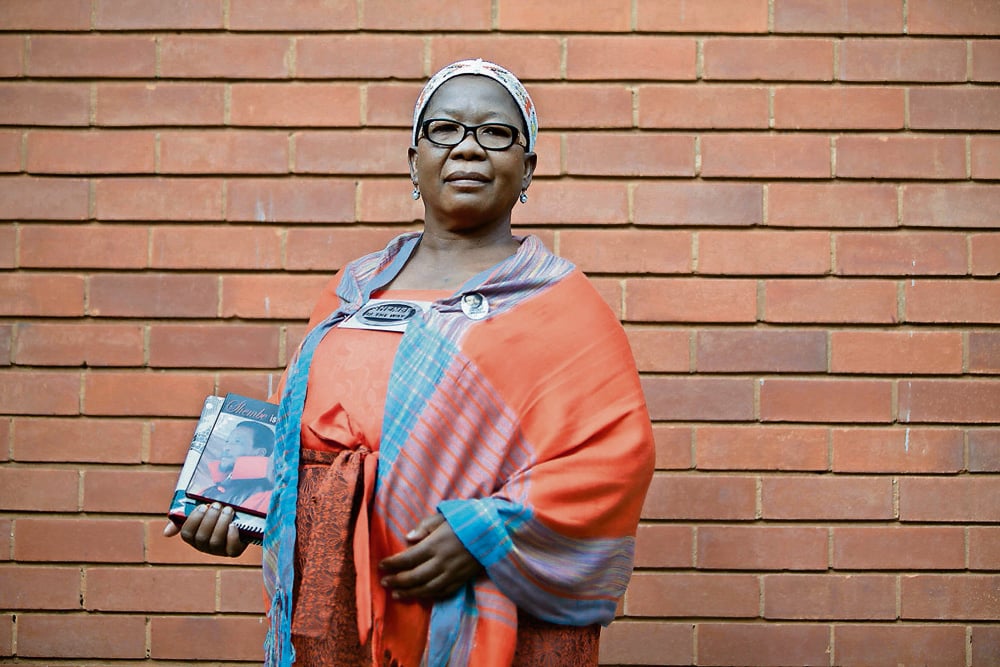
Sizakele Ngcobo says these days “men put all manner of gels and oils on their hair”. (Oupa Nkosi)
A deeper irony, perhaps, can be observed in the fact that neither the Nazareth Baptist Church nor the Rasta movement, both of which emerged in the early 20th century, have observed static practices when it comes to the tailoring of hair.
“In the church back then, you had men who were so fond of the sight of their own hair that they would grow it really long, comb it and then push it backwards,” says a lifelong member of the church. “Overnight, they would wear it in a wrap so that the following day it would retain its shape.”
She says that, as time wore on, this ritual attracted ridicule. “Later it was considered an antiquated style preferred by older men, so much so that women of marrying age in the church would often joke that they would never let a malaleshuqula [a man who wraps his head at night] approach them for their hand in marriage.”
Sizakele Ngcobo, another church member, says: “These days, of course, men put all manner of gels and oils on their hair. They loosen their Afros and trim their hair as they please.”
The ritual of combing is also of obscure origin and has, with time, become part of the church’s folklore.
“Not combing is still associated with being disturbed in the head,” says Ngcobo. “If you’re uncombed in church, people will want to know why that’s the case.”
She says legend has it that at Ekuphakameni, the church’s hilly headquarters in Inanda, the progenitor Isaiah Shembe would carry an iron comb with which he would jocularly groom amasheshakungena, the prepubescent church members. “They would follow him around as he rode his horse,” Ngcobo says. “For these children, they were just happy that the father had touched them and even combed their hair.”
A nonissue for women
Ngcobo says that, with women, hair is a nonissue – much like Samkelo Qwabe, a youngster sporting black jeans, a tucked-in white shirt and a blown-out Afro, explains his understanding of the church rules regarding dreadlocks. “If you have dreads already, usually it’s fine, but you can’t grow them in the church,” he says. “With women it’s okay because their heads are covered anyway; you can’t really see.”
Mbhekeni Makhanya, a Rasta poet who also attends the Nazareth Baptist Church, says that biblically, a Nazaritic order existed before Shembe and was less “churchical” and more “cultural”. “That’s why in Zulu you have the expression, used on someone’s birthday: ‘ Ngikufisela unwele olude [I wish you long hair],’” he says. Hair in this instance refers to time and maturity.
Incidentally, dreadlocks were not always the staple feature in the Rasta way of life that they now are. Jamaican social anthropologist Barry Chevannes writes in his book Rastafari: Roots and Ideology that the dreadlocks trend in Rastafari emerged in the 1940s with a camp of Rastas known as the Youth Black Faith. They institutionalised the ritualistic use of cannabis along with growing dreadlocks. This militant band of reformists, Chevannes writes, were sometimes known as warriors.
“The ‘Warriors’ or ‘Dreadfuls’ were so vociferous that a split developed in which those who could not take the new order … departed their various ways,” writes Chevannes. “The two houses that separated in the 1950s were the House of Dreadlocks and the House of Combsomes. In 1961, when an official government mission was sent to Africa to explore the possibilities of migration for Rastafari brethren, the leader of the three Rastafari members of the delegation was a Dreadlock. Less than a decade later, the Combsomes had all but vanished.”
Although these two movements seem to have moved in opposite directions in terms of how the strictures about hair have been interpreted, with the early trajectory of Rastafari suggesting a bent towards a stricter adherence and the Shembe church the converse, members of both churches suggest that the “human temple” is becoming the site of tacit battles for philosophical supremacy.
What the “dreads” lack in numbers they compensate for in quiet resolve. I ask Khoza, with his long, waist-length hair, whether it matters at all what one looks like when dealing with matters of the soul. After a short pause, he responds: “I’d say image is everything, but at the same time, image is nothing.”
The unprecedented Hamas attack on Israel, which killed some 1,400 people, has not changed the position of the country’s ruling party, the African National Congress (ANC), even though two South African nationals were among the dead and another is among the more than 230 people taken hostage.
President Ramaphosa has pledged the ANC’s solidarity with the Palestinians, saying their history had echoes of apartheid – and South Africa’s struggle against white-minority rule.
Although he did condemn the Hamas assault, a week later he led 60 party leaders as they waved Palestinian flags, while wearing the traditional chequered black and white Palestinian scarf, the keffiyeh.
“They are people who have been under occupation for almost 75 years,” he said of the Palestinians. “They have been waiting and waging a war against a government that has been dubbed an apartheid state.
“We have always pledged our solidarity, and have always insisted that the only solution, especially with the issues of Palestine, is a two-state solution.”
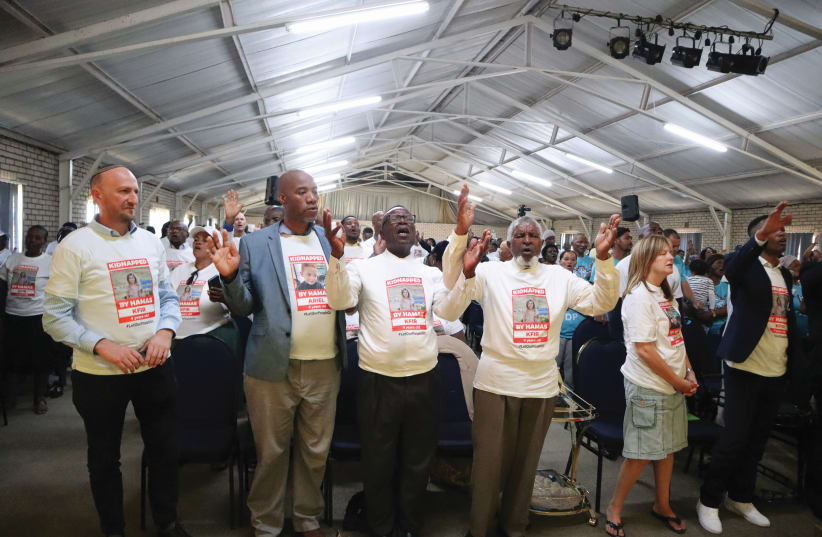
South Africa is an anomaly among the world’s democracies. Last Friday we woke up to another vicious and hate-filled march on the Israeli Embassy by the ruling African National Congress (ANC) party. And yet, it was also a day when 500 Church leaders around Gauteng (the province in which Johannesburg and Pretoria sit) gathered in Katlehong in the east of Johannesburg to pray for the release of the hostages being held by Hamas and to show their support for Israel.
The past two weeks have been deeply painful for South African Jewry. We have joined our brothers and sisters in Israel in mourning the horrific loss of innocent Jewish lives and are praying for those injured, have seen with horror the unbridled cruelty of the murderers that is even now being revealed, and of course, share the sleepless nights of those being held captive in Gaza. And we share the anxiety of our friends, family, and all the people of Israel who have been plunged into war following the heinous massacre of 7 October. There are few South African Jews who are not in some way connected to someone who died, was wounded, or even taken hostage.
What is different in South Africa is that, unlike other diaspora countries, our government’s initial reaction to the Hamas atrocities was not in any way to condemn them. It further refused to show sympathy for Israel or even for its own Jewish community which is experiencing such trauma. Our families, friends, and colleagues in Israel were and are deeply impacted by the massacre and the war that has ensued. Yet our government couldn’t bring itself to reach out to its Jewish citizens by expressing its condolences. It didn’t even reach out to the families of the two South African victims who were killed.
The Zulu African Nazarites
Posted on December 4, 2022 by Royal Rosamond Press
In 1987 I became a Nazarite. In 1990 I talked to rabbi at the Hillel Center in Eguene, about converting to Judaism. Here is what a Nazarite is about.
John
https://en.wikipedia.org/wiki/Nazirite
The Great Reversal Has Arrived
South Africa’s Zulu King Remembered as ‘True Friend’ to Israel
 by Algemeiner Staff

Zulu King Goodwill Zwelithini arrives to hear Former US President Barack Obama delivering the 16th Nelson Mandela annual lecture, marking the centenary of the anti-apartheid leader’s birth, in Johannesburg, South Africa July 17, 2018. REUTERS/Siphiwe Sibeko
The South African Jewish community and Israeli officials honored on Friday King Goodwill Zwelithini, the longtime leader of South Africa’s Zulu nation who died at the age of 72.
The South African Jewish Board of Deputies (SAJBD) extended “sincerest condolences to the Royal Family and the Zulu nation,” praising Zwelithini’s ties to the country’s Jewish population.
“In a reign spanning half a century, King Zwelithini was the recognized representative leader whose royal stature embodied the greater history, heritage and culture of the Zulu people in South Africa. Appointed to that position at the height of the apartheid era, he helped to unite and encourage his followers during the difficult years leading up to the democratic transition and in adapting to the new challenges of healing and nation building,” the group, an umbrella organization for the country’s Jewish groups, said in a statement.
“King Zwelithini will also be gratefully remembered by the Jewish community, particularly in his home province of KwaZulu-Natal, as a warm and generous friend whose door was always open. Over the years, successive generations of Jewish communal leaders, businessmen and philanthropic organizations in KZN enjoyed his support in a range of far-reaching initiatives that brought lasting benefits to the people of the province and further afield,” the SAJBD continued.
Israeli diplomatic officials also remembered Zwelithini, the monarch of South Africa’s largest ethnic group for 50 years, who had supported close ties between the country’s ruling African National Congress party and Israel. In 2018, after the party voted to downgrade relations with Israel, he lauded the Jewish state’s water management technology and his work with local pro-Israel groups on combating HIV.
Lior Keinan, the Israeli Ambassador to South Africa and several other countries in the region, extended “heartfelt condolences to the Royal family and the Zulu Kingdom.”
“We are deeply saddened to hear of the passing of His Majesty King Goodwill Zwelithini kaBhekuzulu. King Zwelithini was a great leader to the Zulu Nation and a true friend of the State of Israel who always looked for a way to create dialogue between our two nations,” he wrote on Twitter.
Yaakov Finkelstein, the Israeli Consul General in Mumbai who has previously served in the South African embassy, also tweeted his condolences.
Zulu King Misuzulu ka Zwelithini crowned in South Africa
20th August 2022, 08:30 PDTShare
By Nomsa MasekoBBC News, KwaNongoma
1:03Thousands gather for the coronation of the new Zulu king
After a year-long family feud, Misuzulu ka Zwelithini has been crowned Zulu king in a traditional ceremony in South Africa.
The 48-year-old is the son of the previous king, but some royals had argued he was not the rightful heir and that the late king’s will was in fact forged.
Thousands of people gathered at Saturday’s traditional coronation at KwaKhangelamankengane Palace, where the king entered the sacred cattle kraal to invoke his ancestors before being announced to both the living and the dead as the new Zulu monarch.
He was expected to wear the hide of the lion that he hunted for the royal event, a key feat in proving he is indeed the chosen one. More than 10 cows were slaughtered in preparation for the festivities.
Next month, he is to be hosted by the government for a state ceremony.
The throne has no formal political power, but a fifth of South Africa’s population is Zulu and its monarchy remains hugely influential with a yearly taxpayer-funded budget of more than $4.9m (£3.5m).
The Zulu kingdom has a proud history. It is world-famous for defeating British troops during the 1879 battle of Isandlwana.
Its succession battles have always been fierce – and at times, bloody. The legendary King Shaka ka Senzangakhona killed his brother in 1816 in order to take the throne, then was himself assassinated in a plot masterminded by his nephew years later.
But this latest saga, following the death of King Goodwill Zwelithini ka Bhekuzulu more than a year ago, has been an embarrassing public spectacle.
Various royal family factions continued to champion their preferred candidates through several legal challenges.
By the time he died last year, King Zwelithini had six wives and had ruled for more than half a century.
 Sowetan/GettyKing Goodwill Zwelithini was on the throne for more than 50 years
In his disputed will, he named his third wife Queen Mantfombi Dlamini Zulu as regent – a sort of caretaker role pending the appointment of a successor.
Queen Mantfombi held the highest status among the king’s wives, because she came from royalty – her father was the late King Sobhuza II and her brother was King Mswati III of Eswatini.
Her marriage to the Zulus came with the condition that her first-born son would be first in line for the throne on her husband’s death.
So when she died a month after becoming regent, their son Misuzulu ka Zwelithini was seen as the obvious choice to take power. He had also been named as successor in his mother’s will.
What’s more, the fact that Prince Misuzulu was the only person to inherit the traditional weapons of his grandfather King Cyprian Bhekuzulu ka Solomon was seen as an endorsement that he would eventually take over from his father.
However, two more of the late king’s sons have been staking their claim to the throne.
The royal family has split into three factions, each backing their preferred prince – Misuzulu ka Zwelithini, Simakade ka Zwelithini and Buzabazi ka Zwelithini.
Back in March, South Africa’s president formally recognised Misuzulu ka Zwelithini as the new Zulu king, but a legal challenge was mounted by Misuzulu’s brother, Mbonisi Zulu, who asked the court to halt the coronation.
However, the court dismissed his application and allowed coronation proceedings to continue.
Exactly a week before King-to-be Misuzulu’s traditional coronation, his half-brother Prince Simakade was announced as the new monarch by a handful of supporters within the royal family.
His backers say he is the obvious choice as the late king’s first-born son, but traditional Prime Minister Mangosuthu Buthelezi has described this as a “foolish provocation”.
Meanwhile, three of King Zwelithini’s brothers called a news conference on Thursday to announce Prince Buzabazi as their choice, claiming he of all sons had the closest relationship with his father.
Even on the day of the crowning ceremony, the new king’s half-sisters filed an urgent motion at the high court in Pietermaritzburg to try to stop the coronation. Princesses Ntandoyenkosi and Ntombizosuthu said their late father’s will may have been forged. The challenge was dismissed by the court.
Misuzulu has received strong support from other family members, who argue that customs dictate he is the rightful heir.

Some believe tribalism could be at the heart of this battle. King-to-be Misuzulu’s maternal heritage is from Eswatini, meaning he is not 100% Zulu and that’s why some in the royal family never fully embraced his mother as the Great Wife.
While the battle rages on for now, many believe the throne will find a way of cleansing itself and that the rightful king will be officially installed at a public coronation on 24 September – a public holiday in South Africa – ending the long-running feud.
https://www.middleeasteye.net/opinion/israel-genocide-against-palestinians-colonial-tradition
https://www.tandfonline.com/doi/full/10.1080/03057070.2018.1461457
The Black House’, or How the Zulus Became Jews
Pages 401-411 | Published online: 14 May 2018

Abstract
In the now standardised collection of the James Stuart Archive (JSA), there is an odd mention by Zulu informants of the speculation that the Zulus were descendants of the Jews, or that they are one of the lost ten tribes of Israel. Historians who have sourced the JSA have largely ignored this discourse, preferring to read the archive as a repository of Zulu history and cultural knowledge. This article is an exploration of the notion of a ‘diaspora’ and of how literate Zulus of the 19th century read the Bible as implying an affinity between the cultural identities of Zulus and Jews. These literates constituted themselves into reading publics, and the biblical narrative of the dispersal of the Jews became one of the most popular and hotly debated topics. Literate Zulus were actively involved in biblical exegeses, not only allowing them to read biblical passages together on the pages of the newspapers but also opening up the Bible to novel interpretations and ‘refashioned’ prophetic traditions. The ‘Israelite’ or ‘diaspora’ narrative was appealing, since they used it to write about their own origins. These accounts are related in truncated ways to James Stuart by his literate informants, but their appeal – maybe even enigma – is that they are explicitly speculative, religious, fantastical, magical and ultimately destabilising, suggesting that ‘religiosity’ and ‘reading’ were synonymous (at least in the minds of Zulu or African literates). This article will demonstrate how the Judaic diaspora functioned as a template by which Zulu literates of the 19th and early 20th centuries reconstructed stories of migration, origins and history in the service of a re-imagined Zulu diaspora; what they called indlu emnyama (‘the black house’).
https://repository.nwu.ac.za/bitstream/handle/10394/10907/No_69%282014%29_5_Morton_B.pdf?sequence=1
 Rosamond Press
Leave a comment