:max_bytes(150000):strip_icc()/woman-arranging-oil-lamps-on-rangoli-during-diwali--874915360-5a2aad7ec7822d0037130683.jpg)
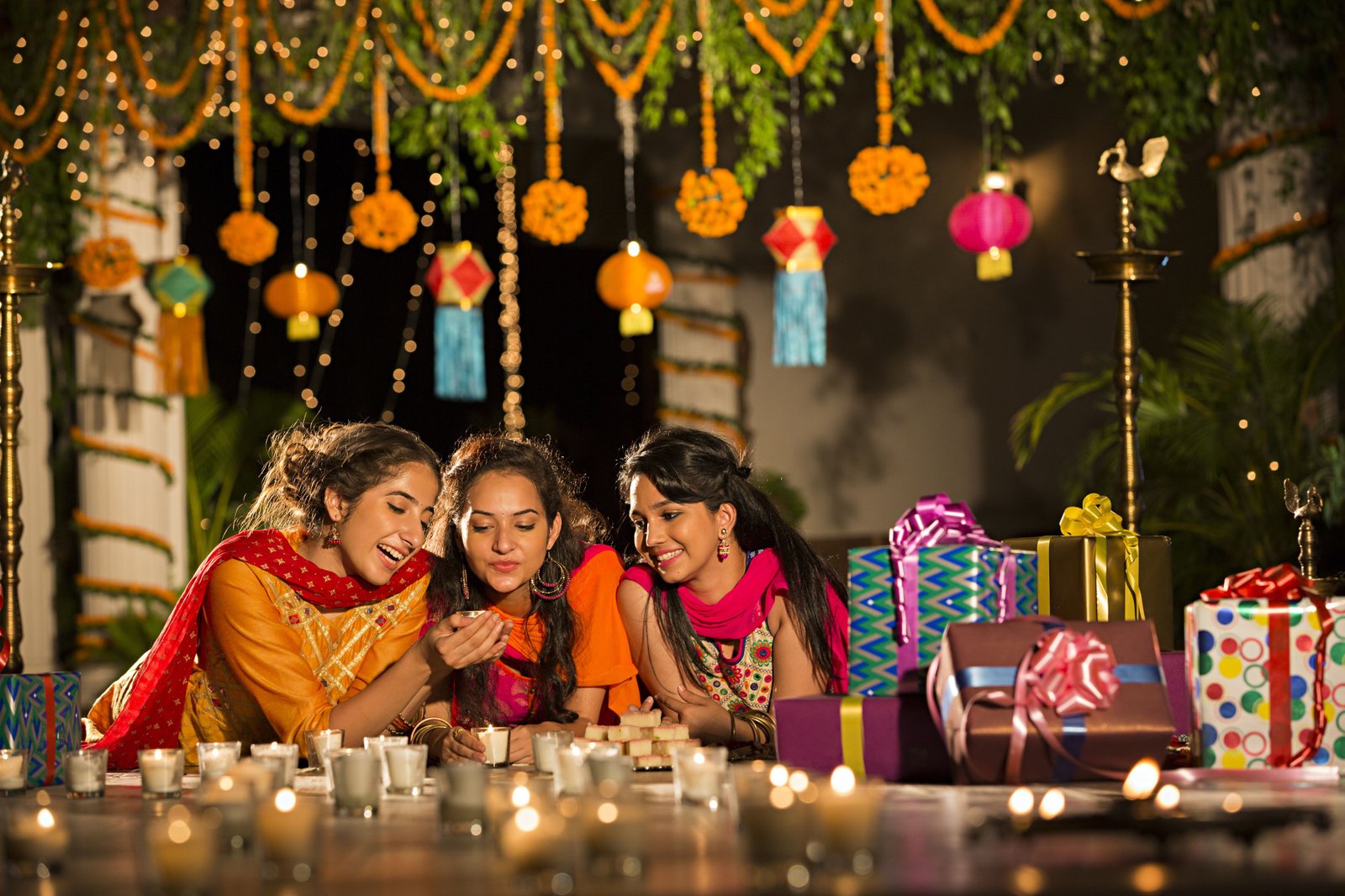
Diwali (English: /dɪˈwɑːliː/; Deepavali,[3] IAST: Dīpāvalī, Nepali: Tihar) is the Hindu festival of lights with its variations also celebrated in other Indian religions.[a] It symbolises the spiritual “victory of light over darkness, good over evil, and knowledge over ignorance”.[4][5][6][7] Diwali is celebrated during the Hindu lunisolar months of Ashvin (according to the amanta tradition) and Kartika—between around mid-September and mid-November.[8][9][10][11] The celebrations generally last five or six days.[12][13]
Diwali is connected to various religious events, deities and personalities, such as being the day Rama returned to his kingdom in Ayodhya with his wife Sita and his brother Lakshmana after defeating the demon king Ravana.[14] It is also widely associated with Lakshmi, the goddess of prosperity, and Ganesha, the god of wisdom and the remover of obstacles.[15] Other regional traditions connect the holiday to Vishnu, Krishna, Durga, Shiva, Kali, Hanuman, Kubera, Yama, Yami, Dhanvantari, or Vishvakarman.
Primarily a Hindu festival, variations of Diwali are also celebrated by adherents of other faiths.[12] The Jains observe their own Diwali which marks the final liberation of Mahavira.[16][17] The Sikhs celebrate Bandi Chhor Divas to mark the release of Guru Hargobind from a Mughal prison.[18] Newar Buddhists, unlike other Buddhists, celebrate Diwali by worshipping Lakshmi, while the Hindus of Eastern India and Bangladesh generally celebrate Diwali by worshipping the goddess Kali.[19][20][21]
During the festival, the celebrants illuminate their homes, temples and workspaces with diyas (oil lamps), candles and lanterns.[7] Hindus, in particular, have a ritual oil bath at dawn on each day of the festival.[22] Diwali is also marked with fireworks and the decoration of floors with rangoli designs, and other parts of the house with jhalars. Food is a major focus with families partaking in feasts and sharing mithai.[23] The festival is an annual homecoming and bonding period not only for families,[14][15] but also for communities and associations, particularly those in urban areas, which will organise activities, events and gatherings.[24][25] Many towns organise community parades and fairs with parades or music and dance performances in parks.[26] Some Hindus, Jains and Sikhs will send Diwali greeting cards to family near and far during the festive season, occasionally with boxes of Indian confectionery.[26] Another aspect of the festival is remembering the ancestors.[27]
Diwali is also a major cultural event for the Hindu, Sikh, and Jain diaspora.[28][29][30] The main day of the festival of Diwali (the day of Lakshmi Puja) is an official holiday in Fiji,[31] Guyana,[32] India, Malaysia,[b][33] Mauritius, Myanmar,[34] Nepal,[35] Pakistan,[36] Singapore,[37] Sri Lanka, Suriname, and Trinidad and Tobago.[38]
https://en.wikipedia.org/wiki/Diwali
City of Belmont CA – Government
eSodrspontcc ecf4h74 0 te mf8Mgh1N1turub801ac4cg13:i88mohgAv ·
Mark your calendars for our #diwalicelebration right here at #TwinPinesPark on Sunday, Nov. 19.
From 1:30-5 p.m., you can participate in this special celebration of light.
We’re partnering with #BelmontLibrarySan Mateo County Libraries to bring this event to #BelmontCA. …
See more

Psychedelic trance, psytrance, or psy is a subgenre of trance music characterized by arrangements of rhythms and layered melodies created by high tempo riffs.[2][4] The genre offers variety in terms of mood, tempo, and style. Some examples include full on, darkpsy, forest, minimal (Zenonesque), hitech psy, progressive, suomi, psy-chill, psycore (fusion of psychedelic trance and hardcore), psybient (fusion of psychedelic trance and ambient), psybreaks, or “adapted” tracks from other music genres. Goa trance preceded psytrance; when digital media became more commonly used psytrance evolved. Goa continues to develop alongside the other genres.[2]
History[edit]
The music has its roots in the popularity of Goa, India, in the late 1960s and early 1970s as a hippie capital, and although musical developments were incorporating elements of industrial music, New beat and electronic body music (EBM), with the spiritual culture in India throughout the 1980s, the actual Goa trance style did not appear until the early 1990s.[2][4]
The music played was a blend of styles loosely defined as techno, New beat and various genres of “computer music” (e.g., high energy disco without vocals, acid-house, electro, industrial-gothic, various styles of house and electronic-rock hybrids). It arrived on tape cassettes by traveller-collectors and DJs and was shared (copied) tape-to-tape among Goa DJs, in an underground scene not driven by labels or the music industry.[citation needed]
Prior to the 1980s, the music played at parties was performed by live bands and tapes were played in between sets. In the early 1980s, sampling synth and MIDI music appeared globally and DJs became the preferred format in Goa, with two tape decks driving a party without a break, facilitating continuous music.[citation needed]
https://en.wikipedia.org/wiki/Re%27im_music_festival_massacre
On 7 October 2023, the Palestinian Islamist militant group[a] Hamas initiated a surprise invasion of Israel from the Gaza Strip and massacred 270 civilians, wounded many more, and took an unknown number of hostages at the “Supernova Sukkot Gathering”, an open-air psychedelic trance music festival celebrating the Jewish holiday of Sukkot near kibbutz Re’im.[4][5][6] This massacre was part of a series of coordinated Hamas attacks on Israel that day, which included targeting Israeli civilians for mass killings in the nearby communities of Netiv HaAsara, Be’eri, Kfar Aza, Nir Oz, Holit at the start of the 2023 Israel–Hamas war.[7]
PLAY BOTH VIDEOS AT SAME TIME AND PRAY FOR ALL HOSTAGES TO BE FREE!

Eugene HOLI: All Ages Festival of Colors | Bollywood Party with DJ Prashant
Come dressed in white and play with colors at our family-friendly Bollywood party, outdoors with your favorite DJ: Prashant.
http://psypressuk.com/2011/10/12/literary-review-the-peyote-dance-by-antonin-artaud/
Originally published in France under the title ‘Les Tarahumaras’ (1947), ‘The Peyote Dance’ by Antonin Artaud describes the author’s experiences with Peyote and the Tarahumara in Mexico, in 1936. Written over twelve years and covering Artaud’s stay at a psychiatric hospital in Rodez, the book is an important work of drug literature, so far as it provides an intriguing discourse on a possible essential value in psychedelic drugs.
rtaud’s assertion is so explicit that it can be taken as a veritable declaration of principles, especially when one considers the fact that his text “On the Balinese Theater” was, of all the articles collected in The Theater and Its Double, the first to be written. The last to be written, on the other hand, was the emblematically titled “Oriental and Western Theater,” written in December 1936, shortly before Artaud’s departure for Mexico. All the other texts in The Theater and Its Double fall in between, from “Metaphysics and the Mise-en-Scène” (December 1931) and “The Alchemical Theater” (September 1932) to “The Theater of Cruelty (First Manifesto)” (October 1932) and “Theater and the Plague” (April 1933).
http://en.wikipedia.org/wiki/Blows_Against_the_Empire
http://www.youtube.com/watch?v=fB0GepZMzKU

https://rosamondpress.wordpress.com/2013/11/10/muse-of-the-love-dance/
https://rosamondpress.wordpress.com/2013/07/27/all-muses-come-to-helicon/
https://rosamondpress.wordpress.com/2013/05/26/the-dharma-bum-fashion-dance/
Play both with sound off on first video.
 Rosamond Press
Leave a comment