My Promised Land
Posted on May 19, 2021 by Royal Rosamond Press

I am not a believer in Jesus Christ. I am not alone. There are nine million souls in Israel – who do not believe in Jesus! Pope Francis is calling for major shift in Catholic teaching to make new converts. Does this include turning Jews into Catholics?. I suggest Pope Francis declare the Zionist Movement – A HUGE FAILURE – and point to me as the Prophet of the New Exodus to South Dakota.
This morning I declared once again that I am the embodiment of John the Baptist, Saint Francis – and Elijah. I have come for the Secular Citizens of Israel who marched in the streets to protest the ruling that did away with much Democracy, thus breaking any covenant the Jews made with God, because our President, Harry Truman helped the Jews return. We practice Separation of Church and State that has to be taken into consideration. Did the Roman Catholic Church play a big role in our War of Independence? How about the roll of the Mormon Jesus – who came to America? Was he a Freedom Fighter? How about the Pope, LDS Prophets, and Pope Francis – condemning the bombing and murder of children before our very eyes! Did Putin condemn Israel – as he calls in more bombs on children?
I watched Blinkin straddling the fence. He has no solution. I do! Stop tying to please the Zion Apologists who carry on the Jewish need to be blameless for worshipping false gods, and is the reason their God let His People – BE DEFEATD – and taken into captivity numerous times. Secular Zionists do well in the Diaspora, and are addicted to Zionist Arguments. Let them carry on in East South Dakota. I know the Secular Democratic Jews would be happy with the New Exodus – surrounded by Lovers of Democracy! A Constitution will be written – that will be better than ours, because it wont condone slaver, and will allow women the right to vote. Cone on! We can do better!
John Presco
Francis also said theology needs to be “open to the voice of the peoples, thus a ‘popular’ theology addressed mercifully toward the open wounds of humanity and of creation and within the wounds of human history.” That includes, he said, theologians’ privileging knowledge derived from the “common sense of people.”
Thus, “theological reflection is called to a turning point, a paradigm change” that commits it to “be able to read and interpret the Gospel in the conditions in which men and women daily live, in different geographical, social and cultural environments.” That includes, Francis continued, being able to “enter in the culture, in the vision of the world, in the religious tradition of a people.”

VATICAN CITY — Pope Francis is pressing Catholic theologians to be more in tune with the challenges of ordinary people and urging them to dialogue with non-believers as well as believers of various religions.
Thus, “theological reflection is called to a turning point, a paradigm change” that commits it to “be able to read and interpret the Gospel in the conditions in which men and women daily live, in different geographical, social and cultural environments.” That includes, Francis continued, being able to “enter in the culture, in the vision of the world, in the religious tradition of a people.”
Theology must develop within a culture of dialogue that includes “different Christian confessions and different religions, confronting itself openly with all, believers and non-believers,” Francis wrote.
Theology, he said, must not “close itself up in reference to oneself, which leads to isolation and insignificance.”
Francis also said theology needs to be “open to the voice of the peoples, thus a ‘popular’ theology addressed mercifully toward the open wounds of humanity and of creation and within the wounds of human history.” That includes, he said, theologians’ privileging knowledge derived from the “common sense of people.”
When, four months ago, he chose a theological advisor from his native Argentina to lead the powerful Vatican watchdog office ensuring doctrinal orthodoxy, Francis issued a reminder that that department has as its “central purpose” safeguarding church teachings to “give reason for our hope, but not as enemies who point out and condemn.” The Dicastery for the Doctrine of the Faith can discipline theologians deemed to have strayed from Catholic teaching in their writings or speeches.
In his 10-year-old papacy, Francis has repeatedly said the Catholic church must be more attentive to suffering, especially to those living on the margins of society, and, in general, merciful in outlook.
The Pontifical Academy of Theology, an advisory body that occasionally hosts conferences or other gatherings, was established in the early 18th century.
Several justices enumerated the view that the Knesset’s authority to legislate derives from the 1948 Declaration of Independence, which defines Israel as a Jewish and democratic state. Arguing that the Knesset cannot legislate laws — even Basic Laws — that erode Israel’s Jewish or democratic character, the judges indicated that the court thus had the authority to police those guardrails.
But Ilan Bombach, the attorney who is representing the government in the High Court since Attorney General Gali Baharav-Miara has refused to do so, replied that the signatories of the foundational document were unelected and that it was “unthinkable” to say the declaration must “bind all future generations.”
“Because 37 people were authorized to sign the hasty Declaration of Independence, which was still being drafted until the last moment, this should obligate people who came later?” Bombach responded.
The New Israel
Posted on October 31, 2023 by Royal Rosamond Press
God wants me to put the New Israel in South Dakota that has 860,000 people. I say God, even though God might be dead. There will be a East and West Israel. The Orthodox Jews will live East of the Missouri river, and the secular Jews live West of the Missouri. Because they can not get along is why the Old Israel – is doomed – along with having hostile neighbors.
I Am The American Crusader King of Jerusalem
Posted on October 30, 2023 by Royal Rosamond Press

Karlskirche in Vienna in possession of the Knights of the Cross with the Red Star
At 6:00 P.M. PST, I John Presco read the Baldwin and his wife were crowned King and Queen of Jerusalem in Bethlehem on Christmas Day. Baldwin and Alice are the great grandparents of Agnes of Bohemia, who founded the Knights of the Cross and the Red Star, which is the Star of Bethlehem. Because I am an expert in Family Trees, I found out Agnes descends from Alice, the daughter of Baldwin .The citation for the Knights of the Cross and Red Star, says this…
“Traditionally its roots were traced back to Holy Land. Nevertheless, in a parchment Breviary of the Order, dated 1356, the account of foundation contains no allusion to such a crusader lineage.[3]“
How wrong can you be – unless this order is hiding the real possibility – it is at the foundation of the Knights Templar – who may have been put up in a royal palace on Christmas Night.
“Baldwin temporarily lodged the knights in the royal palace on the Temple Mount and they became known as the Knights Templar.”
I alone discovered that the Red Cross represents the Knights Templar of Bethlehem. I declare myself the American Crusader King of Jerusalem for the reason the Knights of the Cross and the Red Star of Bethlehem considered moving to the United States.
Mt first duty is to the children who are threatened with death, and have been injured in the Israeli Hamas War. My second duty is to protect all religious peoples in Jerusalem. I’m calling for the release of all children taken hostage, and the evacuation of all children from the Gaza. They will need to be treated for PTSD. I suggest the castle of Bohemia be transformed into treatment centers.
John Presco ACKJ
Christian Zionism is an ideology that, in a Christian context, espouses the return of the Jewish people to the Holy Land. Likewise, it holds that the founding of the State of Israel in 1948 was in accordance with Bible prophecy: that the re-establishment of Jewish sovereignty in the Levant — the eschatological “Gathering of Israel” — is a prerequisite for the Second Coming of Jesus Christ.[1][2] The term began to be used in the mid-20th century, in place of Christian restorationism, as proponents of the ideology rallied behind Zionists in support of a Jewish national homeland.[3][4]
Advocacy on the part of Christians for a Jewish restoration grew after the Reformation, and is rooted in 17th-century England.[1] Contemporary Israeli historian Anita Shapira suggests that England’s Zionist evangelical Christians “passed this notion on to Jewish circles” around the 1840s,[5] while Jewish nationalism in the early 19th century was largely met with hostility from British Jews.[6]
Significance in Jewish history[edit]

In the Hebrew Bible, the captivity in Babylon is presented as a punishment for idolatry and disobedience to Yahweh in a similar way to the presentation of Israelite slavery in Egypt followed by deliverance. The Babylonian captivity had a number of serious effects on Judaism and Jewish culture. For example, the current Hebrew alphabet was adopted during this period, replacing the Paleo-Hebrew alphabet.[citation needed]
This period saw the last high point of biblical prophecy in the person of Ezekiel, followed by the emergence of the central role of the Torah in Jewish life. According to many historical-critical scholars, the Torah was redacted during this time, and began to be regarded as the authoritative text for Jews. This period saw their transformation into an ethno-religious group who could survive without a central Temple.[30] Israeli philosopher and Biblical scholar Yehezkel Kaufmann said “The exile is the watershed. With the exile, the religion of Israel comes to an end and Judaism begins.”[31]
This process coincided with the emergence of scribes and sages as Jewish leaders (see Ezra). Prior to exile, the people of Israel had been organized according to tribe. Afterwards, they were organized by smaller family groups. Only the Tribe of Levi continued in its temple role after the return. After this time, there were always sizable numbers of Jews living outside the Land of Israel; thus, it also marks the beginning of the “Jewish diaspora“, unless this is considered to have begun with the Assyrian captivity.[citation needed]
In Rabbinic literature, Babylon was one of a number of metaphors for the Jewish diaspora. Most frequently the term “Babylon” meant the diaspora prior to the destruction of the Second Temple. The post-destruction term for the Jewish Diaspora was “Rome“, or “Edom“.[citation needed]
https://en.wikipedia.org/wiki/Babylonian_captivity
Discover the Four Exiles of the Jewish People
The history of galut

Art by Sefira Lightstone
For almost as long as the Jewish nation has existed, it has been persecuted and forced to wander from land to land: starting with slavery in Egypt, to the destruction of both temples in Jerusalem, to the Crusades, the pogroms, the Holocaust, and finally, modern day anti-Semitism.
These times of national displacement are known in Hebrew as galut, exile. The four primary periods of exile are known as “arba galuyot” (the four exiles).1
The Beginning: Egypt (1523 BCE – 1313 BCE)
The beginning of all galut, the root from which it grew and branched off, was when Jacob and his children left Canaan (as Israel was then called) because of famine and traveled to Egypt for food.2 There they settled, prospered and began to grow numerous.3 Fearing the growth of this nation, Pharaoh enslaved the children of Israel.4 After a period of 210 years, G‑d sent salvation through His servant Moses, smiting the Egyptians with the ten plagues.5 The Jewish people were redeemed and started their 40-year journey in the desert on their way back home to the Land of Israel.
The Egyptian exile served as the forerunner, and the prototype, for the four exiles that the Jewish people were later to endure.6 7

Art by Sefira Lightstone
The Four Exiles
The prophet Daniel had a vision that subtly hints to the four exiles of the Jewish nation:
I saw in my vision by night…four great beasts…The first was like a lion…and behold, another beast, a second one, similar to a bear…Afterwards I beheld, and there was another, similar to a leopard…After that, as I looked on in the night vision, there was a fourth beast—fearsome, dreadful and very powerful.8
In Daniel’s prophecy, each creature symbolizes an exile that the Jewish people were to undergo. The first was Babylon, the second Media/Persia, the third Greece, and finally Edom, commonly identified as Rome.9
Babylon (423 BCE – 372 BCE)
Art by Sefira Lightstone
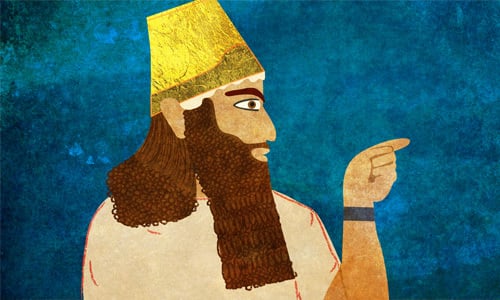
Babylon was the first exile. Until then, the Holy Temple stood in the heart of Jerusalem, and G‑dliness and miracles were still apparent and abundant. And then, what had been the bustling, lively and vibrant Jewish nation was no more. In the year 3338 (423 BCE), Nebuchadnezzar, the king of Babylon, lay siege to Israel and laid it to waste.
When Nebuchadnezzar destroyed the Holy Temple, he exiled 10,000 of the brightest and most promising of the Jewish nation (including Daniel, Chananya, Mishael and Azariah), leaving behind the labourers to work the fields. The Jewish people who remained in Israel under the rule of King Zedekiah began rebelling against Nebuchadnezzar. The prophet Jeremiah begged the king to end this foolish rebellion and submit to Nebuchadnezzar before it was too late,10 but his warning fell on deaf ears. The remainder of the Jews in Israel were crushed and sent into exile: “By the rivers of Babylon, there we sat down, we also wept, when we remembered Zion.”11
However, even in the darkest night there was a glimmer of hope, as the Jewish people began to adapt to their new surroundings. The Jews began to flourish in Babylon, setting up communities, building ritual baths and establishing study halls.
Persia/Media (372 BCE – 348 BCE)
Art by Sefira Lightstone
In 3389 (372 BCE), King Darius I of Persia conquered Babylon, thus starting the second exile for the Jewish people. He was favorably inclined toward the Jews, and appointed Daniel the prophet as chief minister of the realm. (The famous story of Daniel being accused of rebelling against the king and being thrown into the lion’s den occurred during this time period.12) After ruling for just one year, Darius died in 3390 (373 BCE).
The crown was then passed on to Cyrus the great. He too favored the Jewish people, and under his rule they were given permission to return to Israel to rebuild the Holy Temple. When Cyrus gave this authorization, 42,360 Jews went to Jerusalem and began the work. King Cyrus ruled for three years, from 3390-3393 (373 BCE – 370 BCE).
Then King Ahaseurus stepped in, and the Purim story began. Construction of the Temple was stopped by Ahasuerus and did not continue during his lifetime. Shortly after the end of the Purim story, in 3406 (355 BCE), Ahasuerus died and was succeeded by Darius II (his son from Esther). Two years later, in 3408 (353 BCE), the Jews were given permission to resume work on the Temple, and in 3412 (349 BCE) it was completed.
(See here for a full historical account on the Babylonian and Persian exiles.)
Greece 371 BCE – 140 BCE

Art by Sefira Lightstone
Persia, once the strongest empire, then fell to the mighty hands of Alexander the Great in the year 3390 (371 BCE). This meant that Israel was now under Greek rule. The rulers of Greece did not displace the Jewish people or destroy the Temple. However, that is not to say that many Jews were not influenced by the Greek lifestyle, one of indulging in physical delights and glorifying the body. In fact, many Jews began to assimilate and conform to the Greek way of life.
In the year 3413 (348 BCE), Ezra the Scribe13 (who preceded the Greeks and lived during the Persian exile) led many of the Jewish people back to Israel in an attempt to rejuvenate both the land and the Jewish way of life. Many rabbinic enactments were instituted at this time to accomplish this goal.14
Alexander’s reign was short, and after his death his empire was divided among his four generals who ruled over different areas of the kingdom, one of which was Egypt. In the year 3515 (246 BCE), the ruling Ptolemy (as most kings were so named) of Egypt gathered 72 Jewish elders and forced them to translate the Torah into Greek. This was a major tragedy for the Jewish people, as until this point G‑d’s Torah had always been written in the holy language of Hebrew, and to make any slight change or mistranslation would leave room for grave errors.15
Antiochus IV soon succeeded to the throne in 3586. Unlike his predecessors, Antiochus did not take kindly to the Jewish people. He murdered thousands of them and imposed harsh decrees, suppressing many Jewish laws such as circumcision and Shabbat.
In the year 3621 (140 BCE), a small group of Jews known as the Maccabees stood up against the tyrant and defeated his armies, driving him out of Israel. The Jewish people were free from foreign rulership once more. We celebrate this miraculous victory with the holiday of Hanukkah. (See here for a full historical account of the Hanukkah story.)
Rome (69 CE – Present)
Art by Sefira Lightstone
The Roman Empire brought the final blow for Jewish sovereignty in Israel and the final exile for the Jews, one that has lasted for nearly 2,000 years and has not yet ended.
The Jewish people during that time were split into four factions: the Pharisees, Sadducees, Sicarii and Zealots. Some of these groups began rebelling against the mighty empire.
The Emperor Nero saw this as treason and sent his best general, Vespasian, along with his son, Titus, and 60,000 Roman soldiers to quell the revolt.
Finally, in the year 3829 (69 CE), an oppression that started with heavy taxes ended with mass murder. The Jewish people were butchered and slaughtered, their homes ransacked and the Holy Temple burnt to the ground. And since then, the Jewish people have been persecuted and exiled. (See here for a full historical account on the Roman exile.)
In the year 1096, the First Crusade destroyed Jewish communities across Europe and in Israel. In 1144, the first recorded blood libel took place. In 1190, Jews were massacred in England during the Third Crusade. A public burning of the Talmud took place in Paris in 1242. In 1290, all Jews were expelled from England.16 The Spanish Inquisition occurred in 1478. In 1648, Jews were massacred by Chmielnitzki’s forces (what is known as gezeirat tach v’tat). In 1918, over 60,000 Jews were killed during the Russian revolution. Finally, during the Holocaust: six million Jews were slaughtered.
In the words of Mark Twain:
The Egyptians, the Babylonians and the Persians rose, filled the planet with sound and splendor, then faded to dream-stuff and passed away; the Greeks and Romans followed and made a vast noise, and they were gone…The Jew saw them all, survived them all.
For a chassidic perspective on the four exiles, see here.
The Dispute of Exiles
So what exactly constitutes an exile? As mentioned above, the Jewish people were exiled from a few countries in Europe. Why don’t they fall into the count?
All opinions agree with the identities of the first three exiles, as they are clearly inferred from the book of Daniel.17 The controversy revolves around the identity of the fourth and final exile, which is referred to as “Edom.”
All the sages agree that the word “Edom” typically refers to the Romans.18 However, there are certain prophecies in which the word “Edom” is used, not necessarily in reference to Rome, but in reference to other nations, such as in Daniel’s prophecy.
Bearing this in mind, Avraham Ibn Ezra believes that the fourth kingdom to place the Jewish people in exile (“Edom”) were the Yishma’eilim, i.e.,those who follow Islam. The reasoning behind this is that the fourth animal in Daniel’s prophecy is described as a fearsome and powerful beast, and he viewed the Islamic rulership as the most severe towards the Jews.19
In contrast to this, Nachmanides maintains that the Empire of Rome was the last exile the Jewish people endured. Nachmanides explains that the four kingdoms are not defined by their power or strength, but by the fact that they placed the Jews in exile in the first place. He comes to this conclusion because, despite the many other threats to our existence that came after the Romans, we have not yet been redeemed from this specific exile.20,21
In his work Ner Mitzvah, the Maharal of Prague observes that though the Islamic empire was a “strong and mighty” nation, it is not included among the four exiling empires. He explains that the four empires included in the count actually wrested kingship and power from Israel, thus enabling these nations to delay the redemption. For as long as they ruled, the nation of Israel’s dominion was not restored.
Islam on the other hand, notwithstanding it’s greatness and superiority, did not deny Israel’s kingship, and is therefore not considered an exiling nation.
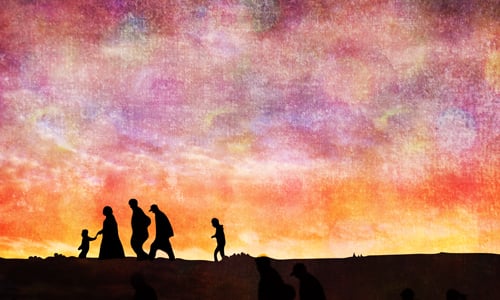
Art by Sefira Lightstone
Exile as a Remedy
The question remains: Why? For what purpose did G‑d place the Jewish people in exile, not once but four times?
“Because of our sins we were exiled from our land,” the verse states.22 The “sins” referred to here weren’t mere wrongdoings or mistakes.
The Talmud relates a story: During the destruction of the Holy Temple, G‑d found our forefather Abraham standing in the ruins. Abraham began to plead on behalf of the Jewish people:
[G‑d] said, “What is My beloved doing in My house?”
Abraham replied, “I have come concerning the fate of my children.”
[G‑d] said, “Your children sinned and have gone into exile.”
“Perhaps,” said Abraham, “they only sinned in error?”
He answered, “She has wrought lewdness.”
“Perhaps only a few sinned?”
“With many,” came the reply.
“Perhaps if You had waited for them, they would have repented,” he pleaded.
And He replied, “When you do evil, then you rejoice!”23
From this story, we can see the gravity of the sins committed, and that exile was necessary to cleanse the Jewish nation of these sins. However, punishment was not the only item on G‑ds’ agenda. There is a grander master plan behind the four exiles.
The Talmud offers the following explanation for the phenomenon of galut: “R. Eleazar also said: The Holy One, blessed be He, did not exile Israel among the nations save in order that proselytes might join them.”24
We can deduce from here that exile serves a dual function: Firstly, to serve as a punishment for our sins. Secondly, so we can be a light unto the nations and inspire the world for the better.25 (See here for more on this topic.)
May it be in this merit that G‑d will take us out of galut and gather us from the four corners of the earth to the Land of Israel, Amen.
FOOTNOTES
All historical dates are taken from Mattis Kantor’s Codex Judaica.
Ibid., 1:9.
Ibid., 7:17.
Vayikra Rabbah 13:5: “Rabbi Jose b. Hanina said, ‘All governments may be called by the name Mitzrayim (Egypt) since they oppressed (in Hebrew, meitzerin, the same root as Mitzrayim) Israel.’”
See Zohar Section 2, 6:1. There it explains that these nations came into power only as a result of the Jewish population living in those countries.
Daniel 7:1. A name is not given to the fourth beast due to the intensity of its nature.
Vayikra Rabbah 13:5. See there for other verses in that correspond to the four Exiles.
Psalms 137.
Ezra was named “The Scribe” due to his great work in writing many scrolls of the Torah.
See tractate Bava Kama 82A for 10 ordinances instituted by Ezra.
See tractate Megillah 9A for more details of the story and of the great miracle that occurred.
The edict was issued, July 18th, the 9th of Av in the Hebrew calendar.
Daniel, ch.7; Rashi, Metzudat David and Vayikra Rabbah, etc.
See Radak on Ovadya 1:1, Ibn Ezra on Isaiah 63:1 and Ramban Sefer Hageulah p.238.
Maimonides, Sefer Ha’Geulah, Gate 3, p. 238.
Ibid.
There are various opinions on the matter. See Maimonides in Iggeret Taiman where he writes that the fourth exile is both Roman and Muslim empires.
This verse is read in the Musaf service of the three foot festivals.
Tractate Menachot 53b.
Tractate Pesachim 87b.
Ibid. See Marashah there who explains that if G‑d had merely meant to punish us, He wouldn’t have exiled us among the nations. The fact that He did so was to serve another purpose.
 Rosamond Press
Leave a comment