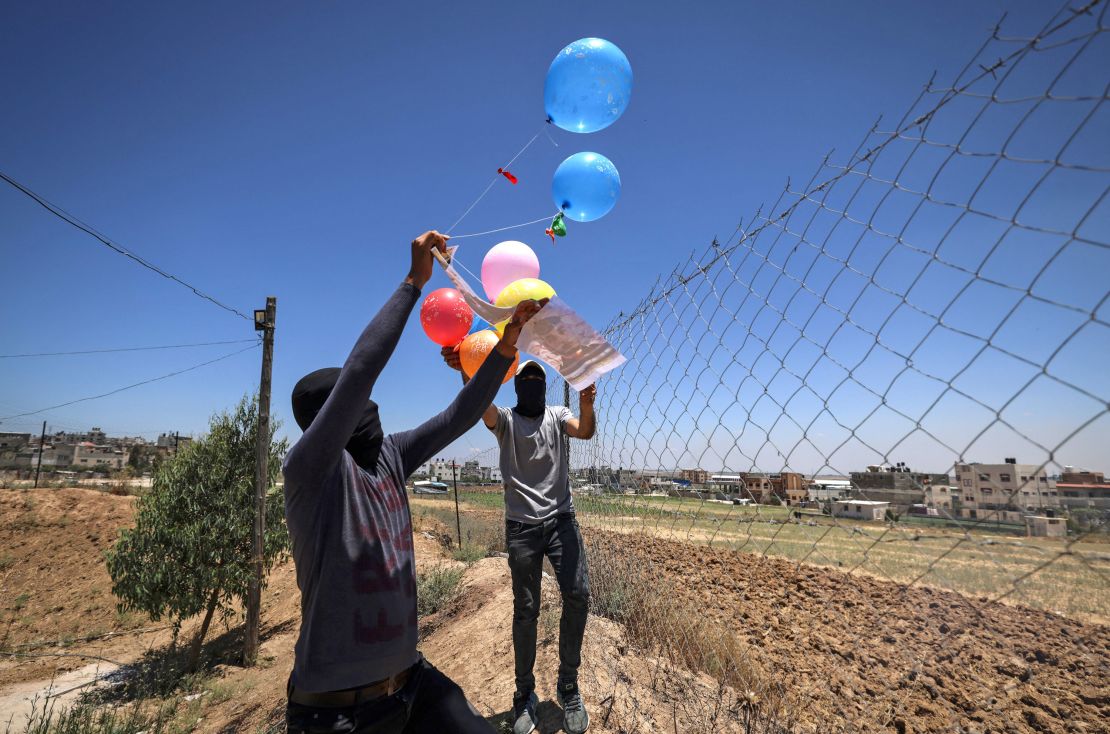
Masked Palestinian supporters of the Islamic Jihad movement prepare incendiary balloons on Tuesday.Mahmud Hams/AFP/Getty Images
Former finance minister Israel Katz, who was in the cabinet during the most recent conflict with Gaza last month, said that after that operation, “we decided to change the rules.”
“For every attack in Israel, targeted assassinations and widespread attacks on Hamas targets will be carried out,” he tweeted.
https://www.cnn.com/2021/06/16/middleeast/israel-gaza-incendiary-balloons-cmd-intl/index.html
Satellite imagery and drone videos show damage to infrastructure along the Gaza border shortly after the assault began.”
Satellite imagery and drone videos show damage to infrastructure along the Gaza border shortly after the assault began.”
Satellite imagery and drone videos show damage to infrastructure along the Gaza border shortly after the assault began.”
How come we have not seen these videos of late? The eighty-five year old released prisoner complains about the IDF not heeding their warnings. She said Hamas released fire balloons. Did these Alarm Towers detect them – and video them? Does Hamas have SATALITES and DRONES? Did Israel attack these towers – and blame Hamas?
Why didn’t Hamas – and Israel – record Hamas fighters coming across the border. There was a tank blown up. Why not film a aerial propaganda video of that – and the bulldozer. If Israel OWNS the satellite, then they can see this is serious. Why not send – their own armed drones -or any drones?. Why not send a drone with a loudspeaker on it ti warn people?
John Presco
How Hamas Attacked Israel’s Communications Towers
Satellite imagery and drone videos show damage to infrastructure along the Gaza border shortly after the assault began.


By Aric Toler
- Oct. 10, 2023
Hamas fighters launched coordinated attacks on at least four communications towers close to the Gaza border in the initial phase of their cross-border assault on Israel — the most sophisticated operation yet to disrupt the infrastructure in the area.
The attacks occurred within a few hours Saturday morning, alongside strikes on observation towers, according to a New York Times analysis of propaganda videos and satellite images.
Footage posted online on Saturday by the Al Qassam Brigades, Hamas’s military wing, showed a quadcopter drone hovering near a communications tower before it dropped an improvised explosive munition on generators at the base of the tower. The video also showed heavy smoke billowing from the area in the apparent aftermath of the attack. The sun is just rising over the horizon in the video, indicating the tower was struck shortly after Hamas began firing rockets at Israel.

A breach in the border fence is visible in the video, about a thousand feet from the communications tower. The tower is two-and-a-half miles west of the Be’eri kibbutz, near the northern end of Gaza, where Hamas fighters massacred more than 100 Israelis and took others as hostages on Saturday.
The other three towers — which are spaced between one and three miles apart along Israel’s border with Gaza — are seen smoking in satellite imagery captured at 11:31 a.m. on Saturday, several hours after Hamas’s attack on Israel began. It is unclear whether drones or some other weapon caused the damage.
From satellite imagery, all four of the communications towers look similar. But they could be used for different purposes, said Michael Armstrong, an associate professor of operations research at Brock University in Canada and an expert in military strategy.
Some may be for border surveillance, while others could be involved in the transmitting and receiving of data, such as military communications, he said.
The tower in the Qassam footage may be used for collecting intelligence as well as for facilitating cellular service, according to a former U.S. defense official who reviewed the video and spoke on the condition of anonymity to discuss Israel’s surveillance capabilities. The former official added that the height of the towers, and their proximity to the border, indicates that they are used to monitor Gazans.
Mr. Armstrong said Hamas most likely targeted these towers to “blind Israeli commanders and prevent communication among their units.” He added that the munitions used would not need to be complex — they would just need to create shrapnel that could damage infrastructure like antennas, cameras and cables.
The attacks also included multiple strikes on Israeli observation towers used for visual surveillance along the border. The impact of the attacks on the towers’ functionality is not yet known.

In another video shared by Al Qassam, the same improvised munition delivered by drone near the Be’eri kibbutz was used to blow up a machine gun turret on one of the Israeli Defense Forces’ observation posts along the border.
Hamas has tried low-tech methods of attacking communications towers in the past — in 2018, a tower was targeted with a flaming kite in the Gaza Strip — but Mr. Armstrong said the attacks on Saturday were its first successful deployment of armed drones that he had seen.
Reporting contributed by John Ismay in Washington. Graphics by Aaron Byrd.
I teach courses on quality improvement, game theory, and operations management. I hold a PhD in management science from the University of British Columbia, an MBA from the University of Ottawa, and a BSc from the Royal Military College of Canada. Before my academic career, I worked as an aircraft maintenance manager. My professional certifications from the American Society for Quality include a Six Sigma Black Belt in quality improvement.
My awards include a Fulbright Scholar Research Chair and a Chancellor’s Chair for Teaching Excellence. I have been a visiting chair in war and peace studies at Norwich University, a visiting professor at the U.S. Naval Postgraduate School, an associate professor at Carleton University, and an assistant professor at the Royal Military College of Canada.
In addition to my academic research, I have written more than 100 commentary columns for newspapers and online news sites. These include Canadian outlets like the Globe & Mail, National Post, and Toronto Star, as well as international ones like the New Zealand Herald, Jerusalem Post, and Denmark’s Berlinske. I also have given more than 500 interviews to radio and print news media. These include U.S. outlets like the New York Times, the Wall Street Journal, and USA Today; European ones like The Daily Telegraph, Le Figaro, and El Pais; and those elsewhere, like Radio New Zealand, the Australian Broadcasting Corporation, and Al-Jazeera.
My professional opinion has occasionally been sought by government organizations like the Canadian Senate’s Finance Committee and the German Health Ministry’s cannabis legalization review panel.
RESEARCH AREA
SELECTED PUBLICATIONS
- Israel forms a unity government and bombs Gaza after the Hamas attacks.
- A service in Manhattan mourns the dead in Israel and Gaza, and protests the war.
- Biden vows to focus on U.S. hostages and mourns the ‘deadliest day for Jews since the Holocaust.’
- Here’s why the scale of the hostage situation in Gaza has no recent precedent.
- Egypt refuses to allow Palestinians to seek refuge in the Sinai Peninsula.
 Rosamond Press
Leave a comment