An Act of Passionate Madness – One
Posted on July 6, 2023 by Royal Rosamond Press

“Answerest thou nothing?”
“You have said it”
“In the Gospel accounts, Jesus speaks very little and gives very infrequent and indirect answers to the priests’ questions, according to John 18:22, prompting an officer to slap him”
: “I am now going to Washington, D.C., to be arrested for having challenged a corrupt, rigged & stolen election. It is a great honor, because I am being arrested for you.”
Here is an article by a Christian saying Trump bids Christians to – ANSWER!
“It will be tempting for Christians to fall in line with the prevailing partisan sentiments. Yet we should confidently reject this temptation—choosing instead to approach the political sphere with consistency, discernment, and a humility not of the world, but from the mind of Christ.“
Around 2:36 P.M. I realized that the reason Jesus speaks very little at his trial, is because Saul-Paul denounces the Laws of the Torah in regards to circumcision, and wishes those Christians who are promoting THE LAW – castrate themselves! Paul says faith and love is the only way. Why then have millions of Christians become obsessed with Constitutional Laws – and now a Federal Court of Law? Trump has made it clear he is being arrested FOR his evangelical base. If Trump was a Christian and believer in Paul – he should have kept his mouth shut – and taken his punishments like a man!
When I first read the Bible at forty, I wondered why Jesus, as the Son of God, did not offer a Divine Defense, explaining in much detail why He came to rid the Jews of the Laws He gave to Moses. Any learned Jew of the day knew this is what Paul-Jesus was preaching, and they would try to stop him? Surely a Pharisee would defend Jesus and the Abolitionist God from the Roman Slavemasters? Why didn’t God give His People a chance t defend themselves? What if the Jews and the Romans could not shut Jesus up? What then happened to his Amazing and Enlightened Defense?
In the next 400 days I will spread the message that every Christian who votes for Trump – is going against the Teaching of Paul and Jesus – and will be CUT OFF FROM THE AFTERLIFE! They will go to hell. Repent of your Love of Voting Laws – now!. As for Christians who donate to Trump in order to pay for his attorneys, you have bought a ticket to hell. There is no redemption for you. If Trump had just kept his mouth shut – there was hope for you! How…….sad.
John Presco
Republican Candidate For President
Paul Did Not Preach Circumcision
Yes, Paul followed the Torah, “walking orderly, keeping the Law” among the Jews (Acts 21:17–26), when among the Jews.* We know this was not a matter of obedience for all followers of Christ at all times because he also says in 1 Corinthians 9 that he became “as without law” “to those who are without law”; and even when he says he became “to those who are under the Law, as under the Law,” he adds, “though not being myself under the Law.” In fact, he chastises the Galatians who were insisting that Christians needed to be circumcised (something required by the Law), saying,
If you receive circumcision, Christ will be of no benefit to you. And I testify again to every man who receives circumcision, that he is under obligation to keep the whole Law. You have been severed from Christ, you who are seeking to be justified by law; you have fallen from grace…. [I]n Christ Jesus neither circumcision nor uncircumcision means anything, but faith working through love….
[T]he one who is disturbing you [by saying you need to be circumcised] will bear his judgment, whoever he is. But I, brethren, if I still preach circumcision, why am I still persecuted? Then the stumbling block of the cross has been abolished. I wish that those who are troubling you would even mutilate themselves. (Gal. 5:2–12)
In other words, Paul says he is being persecuted because he’s not requiring obedience to the Torah. This was the source of his persecution. He calls the idea that we are under the cross rather than the Torah “the stumbling block of the cross.” Then he says that those who say we need to be circumcised should go all the way and cut it all off! Serious words, indeed.
Criminal or Not, Trump’s Case Is a Moral Test for Christians
https://www.washingtonexaminer.com/policy/courts/donald-trump-indictment-i-am-being-arrested-for-you
Former President Donald Trump fired off a series of Truth Social posts on Thursday ahead of his commute to Washington, D.C., for his third arraignment this year, saying, “I am being arrested for you.”
“I need one more indictment to ensure my election!” he wrote before noon on Thursday, adding in a later post: “I am now going to Washington, D.C., to be arrested for having challenged a corrupt, rigged & stolen election. It is a great honor, because I am being arrested for you.”
Donald Trump has always been a bit of a history maker.
In 2016, he was the first person elected US president without prior government or military service. His three Supreme Court appointments in four years were the most in half a century. He was the third president to be impeached, and the first to be impeached twice. And this month, Trump became the first president to be indicted on federal criminal charges.
To be clear, these charges are different from those announced in March by New York prosecutor Alvin Bragg. That state indictment centered on Trump allegedly paying an adult film star to keep their relationship secret during the 2016 presidential campaign, and then effectively laundering the payment as a business expense.
The New York Times’s David French—hardly a Trump apologist—cast doubt on the wisdom of Bragg’s prosecution, describing that legal process as “one that [Bragg’s] predecessor didn’t choose to seek and that relies on federal criminal claims that the Department of Justice declined to prosecute.”
The federal indictment, on the other hand, is based on Trump’s handling of classified documents after leaving the White House. Specifically, federal prosecutors allege Trump took a trove of documents with him from the White House to his estate in Florida.
Some of these documents, they charge, contained classified and sensitive information—including about military readiness and possible attack plans. When asked to secure and return these documents, the indictment says, Trump refused and obstructed government officials’ efforts to reclaim them.
Make no mistake: These charges are serious.
Compared to the New York indictment, these federal charges are not just better documented; they highlight far more serious legal infractions. Yes, if the charges in the New York case are true, then Trump broke the law to conceal immoral activity. But if the charges in the federal indictment are true, then not only did Trump break the law, but he did so in a way that may have exposed America and its allies to serious harm.
William Barr, who served as attorney general in the Trump administration, admitted as much in an interview on Fox News: “He is not a victim here. … Those documents are among the most sensitive secrets the country has.”
The response to this indictment was swift. Trump’s critics praised the Department of Justice as taking a necessary step to check lawless behavior from a former (and potentially future) president. Mitt Romney stated Trump “brought these charges on himself” and claimed his actions were “offensive to the national interest.”
Article continues below
Get the best from CT editors, delivered straight to your inbox!
This form is protected by reCAPTCHA and the Google Privacy Policy and Terms of Service apply.
Erick Erickson at World magazine connected the indictment to Trump’s “poor judgment” and “regular lack of impulse.” And CT editor in chief Russell Moore issued what has become his familiar two-word response: “Character matters.”
Trump’s defenders, meanwhile, blasted the indictment as politically motivated and dangerous. Senator Josh Hawley complained that the indictment was an effort by the Biden administration to “take out” Trump, the presumptive Republican nominee for president.
Senator J. D. Vance said the indictment amounted to illegal election interference and was further evidence of America’s transformation into a “banana republic.” And House speaker Kevin McCarthy predicted the indictment would “disrupt this nation because it goes to the core of equal justice for all, which is not being seen today.”
But if the reaction to Trump’s indictment was swift, it was also unsurprising.
Research on political polarization has routinely shown that most of us do not react to political developments in a vacuum. Instead, we tend to treat our preferred candidate or party with the utmost charity while casting our opponents in the harshest of lights. We are prone to judge the motives and actions of political elites through the lenses of ideology and partisanship, with truth and objectivity too frequently taking a back seat to whatever framing helps us beat our opponents.
Criminal or Not, Trump’s Case Is a Moral Test for Christians
The former president’s potential arrest shows that character does matter.
RUSSELL MOORE
This approach to politics may be the norm for our society, but that doesn’t mean it should be acceptable. This is especially true for Christians. Followers of Jesus should not be counted on to respond in predictable and scripted ways to the political and legal developments of our day. Just as we are called to bring salt and light to a flavorless and dark world (Matt. 5:13–16), we should also adopt a political presence markedly different from what is expected by the broader culture.
What does this mean considering the charges brought against Donald Trump? Among other things, it means confronting the seriousness of the indictment without pivoting to the misdeeds and failings of other political actors. It means distinguishing between what Trump is charged with and Joe Biden’s careless handling of classified materials—and, crucially, how both men acted following these revelations. And it means treating the evidence from this indictment objectively and dispassionately, letting the facts of this case lead where they may.
Article continues below
A distinctly Christian response to this indictment implicates both of our major political parties. For Republicans, it means admitting that even if Trump is preferable to Biden (or any Democratic candidate), he is far from the martyr he so often paints himself to be. And for Democrats, it means refusing to celebrate or revel in the indictment of a former president and instead treating it as the lamentable development it is.
As Christians, we must adopt a posture of humility and consistency when reacting to the failings—legal, moral, or otherwise—of our political leaders, along with the recognition that people on “our team” can be as flawed as those on the “other side.” Just as Trump voters should be honest about the ways in which Trump’s actions are to blame for his current predicament, Biden voters must pair their criticism of Trump with honesty about the ways in which Biden’s presidency has fallen short, particularly concerning the unborn and human sexuality.
We are less than 18 months away from our country’s next presidential election. And while it’s clichéd to say that this will be unlike any presidential election in history, it does feel particularly true now. How could it not be? In the likeliest scenario, one candidate will be nearly 82 years old on Election Day—with another four years of the most demanding job on earth in front of him—while the other could be engaged in not one but two criminal trials, with jail time a very real possibility.
The year ahead will likely be a stress test for American political institutions and the guardrails of our representative democracy. The loudest voices among us will be selling scripts of hyperbole, fear, and anger to a population increasingly hungry for this reactionary rhetoric. It will be tempting for Christians to fall in line with the prevailing partisan sentiments.
Yet we should confidently reject this temptation—choosing instead to approach the political sphere with consistency, discernment, and a humility not of the world, but from the mind of Christ.
Daniel Bennett is an associate professor of political science at John Brown University and assistant director at the Center for Faith and Flourishing. His forthcoming book is Uneasy Citizenship: Embracing the Tension in Faith and Politics.
Speaking Out is Christianity Today’s guest opinion column and (unlike an editorial) does not necessarily represent the opinion of the publication.
Evening inquest at Caiaphas’s palace[edit]
In the narrative of the synoptic gospels, after the arrest of Jesus, he is taken to the private residence of Caiaphas, the high priest. Matthew 26 (Matthew 26:57) states that Jesus was taken to the house of Caiaphas the High Priest of Israel, where the scribes and the elders were gathered together. Mark 14 (Mark 14:53) states that Jesus was taken that night “to the high priest” (without naming the priest), where all the chief priests and the elders gathered.
According to John’s gospel, Jesus was taken not to Caiaphas but to Annas,[3] who questioned him only privately. A former high priest and father-in-law of Caiaphas, Annas remained very influential. The fact that Jesus was taken not to Caiaphas but to Annas is explained on the ground that the latter’s palace was nearer the place of arrest than that of the former. Peter and other disciples, however, being ignorant of the state of affairs, went to Caiaphas’s house in the night.[4]
In all four Gospel accounts, the trial of Jesus before the priests and scribes is interleaved with the Denial of Peter narrative, where Apostle Peter, who has followed Jesus, denies knowing him three times.[5] The intercalated narrative of Jesus’ resolute determination offers contrast to the framing narrative of Peter’s aggrieved denials (Mark 14:53–54, 14:66–72).[6][7][8] Luke 22 (Luke 22:61) states that as Jesus was bound and standing at the priest’s house Peter was in the courtyard. Jesus “turned and looked straight at him”, and Peter remembered the words Jesus had spoken to him: “Before the rooster crows today, you will disown me three times.”[2][9][10][5]
In John 18 (John 18:24), Jesus is sent from Annas to Caiaphas the high priest. Both Matthew and Mark say that another consultation was held among the priests the next morning. The second interview with Jesus was “evidently held in the house of Caiaphas, rather than in the Chamber of Hewn Stone“.[11]
According to Luke 22:63, at Caiaphas’s house, Jesus is mocked and beaten. He is accused of claiming to be both the Messiah and the Son of God.[2][9][10] Although the Gospel accounts vary with respect to some of the details, they agree on the general character and overall structure of the trials of Jesus.[12]
Mark 14:55–59 states that the chief priests sought witnesses to testify against Jesus but did not find any. Matthew characterizes these as false witnesses. Many gave false witness against him, but their testimony did not agree. Finally two came forward and accused him of saying “I am able to destroy the temple and raise it again in three days”.[13] Theologian Eckhard J. Schnabel points out that if the Sanhedrin had wished to contrive false testimony they would have prepared the witnesses so that their statements would have confirmed rather than contradicted each other.[14]
In the Gospel accounts, Jesus speaks very little and gives very infrequent and indirect answers to the priests’ questions, according to John 18:22, prompting an officer to slap him. In Matthew 26:62, the lack of response from Jesus prompts the high priest to ask him, “Answerest thou nothing?” In the Gospel accounts, the men holding Jesus at the high priest’s house mock, blindfold, insult and beat him, sometimes slapping him and asking him to guess who had hit him.[2][9][10][15]
Mark 14:61 states that the high priest then asked Jesus, “Art thou the Christ, the Son of the Blessed?” And Jesus said, “I am”, at which point the high priest tore his own robe in anger and accused Jesus of blasphemy. In Matthew 26:63, the high priest said, “Tell us whether you are the Christ, the Son of God.” Jesus responded, “You have said it”, and added, “But I say to all of you: In the future you will see the Son of Man sitting at the right hand of the Mighty One and coming on the clouds of heaven”, prompting the High Priest to tear his own robe,[2][9][10] breaking Mosaic Law (Leviticus 21:10)[disputed – discuss], and to accuse him of blasphemy.
According to Luke, Joseph of Arimathea was a counsellor, a member of the Sanhedrin who dissented from the decision.[16] According to John, Nicodemus was with Joseph of Arimathea to recover and bury Jesus’ body,[17] leading to the inference that he also dissented.
Morning arraignment and trial[edit]
| Events in the |
| Life of Jesus according to the canonical gospels |
|---|
| showEarly life |
| showMinistry |
| showPassion |
| showResurrection |
| showIn rest of the NT |
| Portals: Christianity Bible |
Luke 22:66 states that, “as soon as it was day”, the chief priests and scribes gathered together and led Jesus away into their council.[2][9][10] John 18:28 states that, early in the morning, Jesus was led from Caiaphas to Pontius Pilate in the Praetorium.[2][9][10]
In Luke 22:67, Jesus is asked: “If thou art the Christ, tell us. But he said unto them, If I tell you, ye will not believe”. But, in 22:70, when asked “Are you then the Son of God?”, Jesus answers “You say that I am”, affirming the title Son of God.[18] At that point, the priests say “What further need have we of witness? for we ourselves have heard from his own mouth”, and they decide to condemn Jesus.[2][9][10]
Thereafter, in Pilate’s Court, the Jewish elders ask Pontius Pilate to judge and condemn Jesus, accusing him of claiming to be the King of the Jews. Such a claim would be considered treasonous for being a direct challenge to the Roman authorities.[10]
Putting Paul And Jesus On Trial
Posted on August 3, 2022 by Royal Rosamond Press

In this painting by Russian artist Vasily Surikov dated to 1875, the Apostle Paul speaks before King Agrippa II, his sister Julia Berenice, and the proconsul Festus
Like most people these days, I have been upset about the crises affecting our family, our
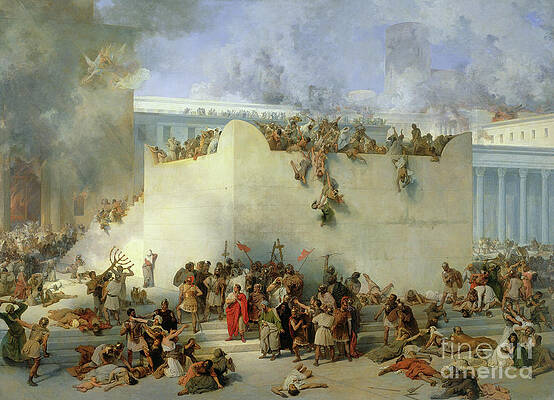
Destruction of the Temple of Jerusalem Painting

Supporters of U.S. President Donald Trump climb a wall at the Capitol during a violent protest against the certification of the 2020 presidential election. (Photo by REUTERS/Jim Urquhart)
“Then I went to Jerusalem and to every part of Judea and told the people there. I also went to the non-Jewish people.
“This is why the Jews grabbed me and were trying to kill me at the Temple.”
Paul of Tarsus
I am in profoundly unique position to CALL FOR THE TRAIL OF PAUL AND JESUS. I am steeped in Biblical knowledge, and I ran for Republican Governor of Oregon. I was also a write-in for Republican Candidate for President of the United States. I am kin to John Fremont the first Republican candidate for President, and co-founder of the Republican Party that appears to have been taken over by ‘Jesus Freaks’ – many who deny President Biden – WON!
Political Realities are being SEVERELY IGNORED, and replaced by what can be titled ‘Biblical Prophecy’. There is talk of Donald Trump going on trial. Millions of Christians are calling for the ex-President to SEIZE the reigns of power – and run in 2024. This time they know they GOT IT RIGHT and will not be calling for the release of the prisoner BARABBAS who means “Son of The Father” and “Son of The Rabbi”. Was Jesus’ father a rabbi? Was not Jesus called the Son of God The Father? Did not radical, but saintly Jews begin a TAX REBELLION that the powers in Rome wanted – CRUSHED? Did Pilate and his soldiers go to war with these Rebels? Did he crucify those rebels he captured? Were some of them – WOMEN?
When I saw the video and pics of The Trumpites storming Our Capitol, I thought of the painting of the destruction of the temple by Francesco Hayez. Timing is everything. I knew MY TIME HAD COME as a Nazarite Prophet. When I read the Bible for the first time at forty years of age, I was shocked when I read about Paul, and his alleged trial before Agrippa, his sister, and Festus. Paul says he murdered and tortured Jews – EVEN WOMEN – and got permission to hunt them down in foreign lands – FROM THE PRIESTHOOD – who did not want hint him to spread the teaching of Jesus outside of Jerusalem? Well, they did not want Jesus to spread his teaching – IN JERUSALEM! Surely the King and Queen of Jerusalem has a say so. They want to find Paul guilty of SOMETHING, but are afraid to, because Paul is threatening to talk to the Emperor of Rome – who might like Paul a whole lot – because it looks like he is hell bent on destroying the leaders and followers of…..A TAX REBELLION THAT IS SPREADING TROUGH THE ROMAN EMPIRE!
Was there a crowd outside the palace while Paul was being found NOT GUILTY of going into synagogues and arresting people he later put to death? Would Christians forgive gay people for going inside Churches and arresting people? How many Christian Ministers – forgive LGBTQ people? Was this crowd very angry, and were they shouting…
“GIVE US THE SON OF RABBI………..SO WE CAN HANG HIM FOR BETRAYING GOD1”
Was Paul THE SON of a famous Rabbi, who preached pro-Roman sermons? Is there anyone like this? YES. Didn’t Paul say he studied under Gamaliel? Which one, the one that bathed in a Roman bath house – with statue of Aphrodite? If so, why would Paul be arrested for giving a teaching to non-Jews” I will invite Jewish rabbis and scholars to take part in ‘The Trial of Paul and Jesus’.
John Presco ‘Nazarite Judge’
Rabban Gamaliel | My Jewish Learning
In the Christian tradition, Gamaliel is recognized as a Pharisee doctor of Jewish Law.[2]Acts of the Apostles, 5 speaks of Gamaliel as a man held in great esteem by all Jews and as the Jewish law teacher of Paul the Apostle in Acts 22:3.[5] Gamaliel encouraged his fellow Pharisees to show leniency to the apostles of Jesus Christ in Acts 5:34.[6]
9 “I used to think that I should do everything I could against Jesus from Nazareth. 10 And that’s what I did, beginning in Jerusalem. The leading priests gave me the authority to put many of God’s people in jail. And when they were being killed, I agreed that it was a good thing. 11 I visited all the synagogues and punished them, trying to make them curse[a] Jesus. My anger against these people was so strong that I went to other cities to find them and punish them.
30 King Agrippa, Governor Festus, Bernice, and all the people sitting with them stood up 31 and left the room. They were talking to each other. They said, “This man has done nothing worthy of being put to death or even put in jail.” 32 And Agrippa said to Festus, “We could let him go free, but he has asked to see Caesar.”
Then I went to Jerusalem and to every part of Judea and told the people there. I also went to the non-Jewish people.
“This is why the Jews grabbed me and were trying to kill me at the Temple.
Echoes are also to be found of the close relationship between the princes and the Romans. It is said, for instance, that many young men of the house of Rabban Gamaliel studied “Greek wisdom” (Sotah49b), a statement that was much discussed in the medieval debates on the study of philosophy. Gamaliel is also said to have bathed in a bath-house in which there was a statue of Aphrodite (Mishnah AvodahZarah3:4), which practice he defended on the grounds that the statue was purely decorative and in no way dedicated to the goddess.
Rabbi Joshua, who lived in the first to second centuries CE, was one of the most distinguished of the early Rabbinic teachers known as the Tannaim. Rabbi Joshua was a disciple of Rabban Johanan ben Zakkai and a colleague of Rabbi Eliezer; the debates between these two teachers are found throughout the Talmud.
Rabbi Joshua appears to have had a somewhat conciliatory attitude towards the Romans after the destruction of the Temple in 70 CE. In a famous parable attributed to him, a fox put his head into a lion’s mouth in order to remove a bone that had lodged in the lion’s teeth and was troubling the lion. When the fox demanded a reward for his pains, the lion replied that for a creature to have its head in a lion’s mouth and yet remain unscathed was in itself sufficient reward.
When some zealots wished to give expression to their mourning over the destruction of the Temple by abstaining from wine and from marriage, Rabbi Joshua is said to have advocated less severe tokens of mourning, since one does not impose on the community regulations impossible for the majority to follow (Bava Batra 60b).
On a number of occasions Rabban Gamaliel is said to have behaved in an autocratic manner towards Rabbi Joshua, as a result of which Rabban Gamaliel was deposed for a time from his position as Nasi and head of the Sanhedrin.
As tensions built toward war, Agrippa attempted to convince his fellow Jews not to revolt. In the end, he and his sister Berenice were expelled from Jerusalem and sided with Rome, fighting alongside Vespasian and Titus to put down the rebellion. For his loyal service during this crisis, he was rewarded with the title of praetor. After the revolt ended, he lived as a private citizen in Rome. The date of his death is uncertain, probably around 93-94 in Rome.
Agrippa II – New World Encyclopedia
Around 59, Agrippa and Berenice heard the case of the Apostle Paul at Caesarea Maritima, where the current Roman procurator, Porcius Festus, had attempted to induce Paul to return to Jerusalem for trial, but Paul insisted on his rights as a Roman citizen to be heard in Caesar’s court. The scene is recorded in considerable detail in Acts 25-26. Paul appeals to Agrippa as being well acquainted with Jewish affairs. Paul explains that he is of the party of the Pharisees and a believer in the resurrection of the dead, which his accusers, the Sadducees, deny. Paul goes on to testify to Agrippa about his conversion experience and his belief that Jesus, the Messiah, fulfilled the prophetic doctrine of the resurrection. Agrippa’s famous response in Acts 26:28 is a subject of much debate, translated in the King James Version as, “Almost thou persuadest me to be a Christian.” Modern renditions translate the same passage as “Do you think that in such a short time you can persuade me to be a Christian?” (NIV) More clear is Agrippa’s comment to Festus after Paul leaves, indicating that the apostle had made a serious tactical error by appealing to Rome: “This man could have been set free if he had not appealed to Caesar.” The point seems to be that Agrippa agreed with Festus that Paul had done nothing worthy of death and would have exonerated Paul if it had been left up to him. Paul went on to Rome where he was martyred.
In an attempt to prevent violence from further escalating, Agrippa assembled the populace and delivered a tearful speech to the crowd with Berenice by his side. In an oration preserved by Josephus, he employed substantial eloquence to warn the inflamed leaders against extremes, and counseled a return to calmness and deliberation (Josephus, Wars of the Jews ii. 16, §§ 4, 5). Things by this time had reached the point of no return, however, as the insurgents burned down the Herods’ palaces. Agrippa and Berenice barely fled with their lives to Galilee and joined the Roman cause. It was during this period that Berenice met and fell in love with Titus, who was ten years her junior.
According to Max Dimont, the story of Barabbas as related in the gospels lacks credibility from both the Roman and Jewish standpoint. The story, on its face, presents the Roman authority, Pontius Pilate, backed by overwhelming military might, being cowed by a small crowd of unarmed civilians into releasing a prisoner condemned to death for insurrection against the Roman Empire.[17] Further, Dimont argues against the believability of the Barabbas story by noting that the alleged custom of privilegium Paschale, “the privilege of Passover“, where a criminal is set free, is only found in the Gospels. Raymond E. Brown argued that the Gospels’ narratives about Barabbas cannot be considered historical, but that it is probable that a prisoner referred to as Barabbas (bar abba, “son of the father”) was indeed freed around the period Jesus was crucified and this gave birth to the story.[18]
Paul Before King Agrippa
26 Agrippa said to Paul, “You may now speak to defend yourself.” Paul raised his hand to get their attention and began to speak. 2 He said, “King Agrippa, I feel fortunate that I can stand here before you today and answer all the charges these Jews have made against me. 3 I am very happy to talk to you, because you know so much about all the Jewish customs and the things the Jews argue about. Please listen to me patiently.
4 “All the Jews know about my whole life. They know the way I lived from the beginning in my own country and later in Jerusalem. 5 These Jews have known me for a long time. If they want to, they can tell you that I was a good Pharisee. And the Pharisees obey the laws of the Jewish religion more carefully than any other group. 6 Now I am on trial because I hope for the promise that God made to our fathers. 7 This is the promise that all the twelve tribes of our people hope to receive. For this hope the Jews serve God day and night. My king, the Jews have accused me because I hope for this same promise. 8 Why do you people think it is impossible for God to raise people from death?
9 “I used to think that I should do everything I could against Jesus from Nazareth. 10 And that’s what I did, beginning in Jerusalem. The leading priests gave me the authority to put many of God’s people in jail. And when they were being killed, I agreed that it was a good thing. 11 I visited all the synagogues and punished them, trying to make them curse[a] Jesus. My anger against these people was so strong that I went to other cities to find them and punish them.
Paul Tells About Seeing Jesus
12 “One time the leading priests gave me permission and the authority to go to the city of Damascus. 13 On the way there, at noon, I saw a light from heaven, brighter than the sun. It shined all around me and those traveling with me. 14 We all fell to the ground. Then I heard a voice talking to me in Aramaic. The voice said, ‘Saul, Saul, why are you persecuting me? You are only hurting yourself by fighting me.’
15 “I said, ‘Who are you, Lord?’
“The Lord said, ‘I am Jesus. I am the one you are persecuting. 16 Stand up! I have chosen you to be my servant. You will tell people about me—what you have seen today and what I will show you. This is why I have come to you. 17 I will keep you safe from your own people and from the non-Jewish people, the ones I am sending you to. 18 You will make them able to understand the truth. They will turn away from darkness to the light. They will turn away from the power of Satan, and they will turn to God. Then their sins can be forgiven, and they can be given a place among God’s people—those who have been made holy by believing in me.’”
Paul Tells About His Work
19 Paul continued speaking: “King Agrippa, after I had this vision from heaven, I obeyed it. 20 I began telling people to change their hearts and lives and turn back to God. And I told them to do what would show that they had really changed. I went first to people in Damascus. Then I went to Jerusalem and to every part of Judea and told the people there. I also went to the non-Jewish people.
21 “This is why the Jews grabbed me and were trying to kill me at the Temple. 22 But God helped me, and he is still helping me today. With God’s help I am standing here today and telling all people what I have seen. But I am saying nothing new. I am saying only what Moses and the prophets said would happen. 23 They said that the Messiah would die and be the first to rise from death. They said that he would bring the light of God’s saving truth[b] to the Jewish people and to the non-Jewish people.”
Paul Tries to Persuade Agrippa
24 While Paul was still defending himself, Festus shouted, “Paul, you are out of your mind! Too much study has made you crazy.”
25 Paul said, “Most Honorable Festus, I am not crazy. What I am saying is true. It all makes perfect sense. 26 King Agrippa knows about all this, and I can speak freely to him. I know that he has heard about these things, because they happened where everyone could see them. 27 King Agrippa, do you believe what the prophets wrote? I know you believe!”
28 King Agrippa said to Paul, “Do you think you can persuade me to become a ‘Christ-follower’ so easily?”
29 Paul said, “It is not important if it is easy or if it is hard. I pray to God that not only you but that everyone listening to me today could be saved and be just like me—except for these chains I have!”
30 King Agrippa, Governor Festus, Bernice, and all the people sitting with them stood up 31 and left the room. They were talking to each other. They said, “This man has done nothing worthy of being put to death or even put in jail.” 32 And Agrippa said to Festus, “We could let him go free, but he has asked to see Caesar.”
Rabban Gamaliel is the name and title of six holders of the office of Nasi, Prince, in Palestine during the first five centuries CE. The title Rabban, “our master,” was used to distinguish the Nasi from other rabbis. The office of Nasi was primarily one of religious authority but the Nasi also played an occasional political role in representing the Jewish community to the Roman authorities.
Since practically all the references to the office are in sources compiled later and are far from being contemporary records, it is difficult to know for certain how the office came about and the precise way in which the affairs of the Nasi were conducted. From the later sources (Talmudic and Midrashic) it appears that the first Nasi was Rabban Yochanan Ben Zakkai, a disciple of Hillel, after whom Rabban Gamaliel, a grandson of Hillel, served as Nasi; the office then became a hereditary one held by Gamaliel’s descendants.
 Rosamond Press


Leave a comment