

“Willson School” Art Deco wing
.jpg)
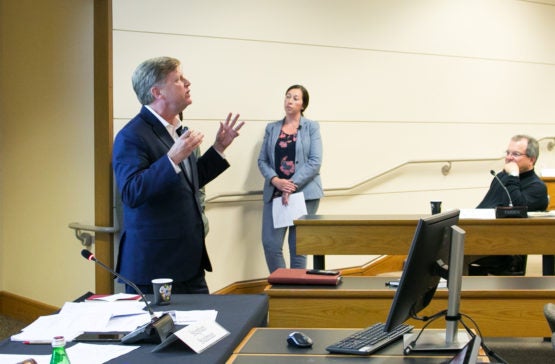
Michael McFaul, director of the Freeman Spogli Institute for International Studies, addressing the Faculty Senate on Thursday. (Image credit: Holly Hernandez)
“The Senate overwhelmingly approved a resolution on Thursday stating that the United States should refuse to make any current or former official available for questioning by Vladimir Putin’s government.“
Was Vice President Michael Pence “”deeply disturbed” when Putin asked President Trump if he could bring former Russian Ambassador, Michael Faul to Russia and have the Supreme Magistrate grill Faul, and perhaps put him on trial? Was Pence disturbed because he knew the FBI and DOA were not conducting an investigation, thus Faul would not be indicted – for crimes he did not commit? Pence knew this was a political stunt by Putin to show the world, and Ukraine, how much Trump is on his side, and how together they can go after all the Democrats – who they really hate? Were the Democrats aware THEIR President was treating the Russians better than citizens of the United States? They saw Putin do a Victory Lap when Hillary lost, and, the Russian people wanted her locked up – too! Failing to do that, best throw the Russian masses a bone by locking up the former Russian ambassador in a Russian prison. To hell with getting along with the Democrat and half the population. Putin doesn’t ant this. The Russians – want blood! So do the Republicans for what Obama did to them – and Russia!
Here is the High School Michael Faul attended. Did he dream of being President one day? Did Putin fear he would? Did Trump show any Top Secret Documents to Putin’s Goons, then – and after he left office? Imagine the Supreme Federation Magistrate coming to Bozeman Montana. In a way – he did! He couldn’t wait to get Faul on his turf. He was fuming after Pussy Riot mocked him.
John Presco
https://en.m.wikipedia.org/wiki/Gallatin_County_High_School_(Bozeman,_Montana)?fbclid=IwAR0U0B9ph1TD5-7fdndJH_gU2OD1MRGp2gWYie2QXQEgrrRi75qGDHI9-3Q
Former VP Mike Pence reacts to Trump indictment during campaign stops in NH
https://en.m.wikipedia.org/wiki/Yury_Chaika
On 1 December 2015, Alexei Navalny‘s Anti-Corruption Foundation (FBK) published a large investigation on Yuri Chaika, and his family. The Report comes with a 40-minute film Chaika.[19] An English version of the film was published two months later.[20] On 3 February 2016, the group Pussy Riot released a satirical music video titled Chaika, alluding to Navalny’s findings.[21]
On March 15, 2017, the Ministry of Justice in Russia filed a claim with the Supreme Court of the Russian Federation seeking “to declare the religious organization, the Administrative Center of Jehovah’s Witnesses, extremist, ban its activity, and liquidate it.”[22] Yury Chaika will be heading the prosecution
Less than 24 hours after Trump said he had been indicted and on the same day that the indictment was unsealed, Pence expressed deep skepticism of Special Prosecutor Jack Smith’s move to bring federal charges against a former president for the first time.
He called the day a “sad day in America.”
“Well, look, no one knows the facts,” he separately said when asked if he believes the indictment is political.
“It’s not just a sad day, it’s a troubling day for millions of Americans,” Pence said. “And it invites a divisiveness in this country that can only be answered with facts.
Senate fires bipartisan Russia warning at Trump

Senate Majority Leader Mitch McConnell (right) asked two committees to hold hearings on the implementation of last year’s bipartisan Russia sanctions bill, while Minority Leader Chuck Schumer focused on the president’s stated openness to allowing Russia’s government to question Americans. | Chip Somodevilla/Getty Images
By ELANA SCHOR
07/19/2018 11:55 AM EDT
Updated: 07/19/2018 03:54 PM EDT
The Senate overwhelmingly approved a resolution on Thursday stating that the United States should refuse to make any current or former official available for questioning by Vladimir Putin’s government.
The 98-0 vote amounts to a bipartisan slap at President Donald Trump, whose White House on Thursday reversed its previous openness to giving Moscow access to former U.S. ambassador to Russia Michael McFaul and other longtime Putin critics.
But beyond the lopsided vote to pass the symbolic resolution, proposed earlier in the day by Minority Leader Chuck Schumer (D-N.Y.), it remained unclear if the Senate would move ahead on any substantive action in response to President Donald Trump’s widely criticized appearance with Russian President Vladimir Putin.
Senate Majority Leader Mitch McConnell (R-Ky.) said after a meeting with Banking Chairman Mike Crapo (R-Idaho) and Foreign Relations Chairman Bob Corker (R-Tenn.) that he had asked their two committees to hold hearings on the implementation of last year’s bipartisan Russia sanctions bill “and to recommend to the Senate additional measures that could respond to or deter Russian malign behavior.”
Routing the matter through those committees, however, promises to slow down action on any potential legislation ratcheting up pressure on Moscow after Trump’s friendly overtures to Putin this week. The move also could sap momentum for a bipartisan Russia sanctions bill from Sens. Marco Rubio (R-Fla.) and Chris Van Hollen (D-Md.) that some of their colleagues worry could unduly impact U.S. and European businesses.
Schumer, for his part, focused on lining up bipartisan opposition to Trump’s consideration of a Putin offer that would allow his government to question McFaul and potentially others, including anti-Kremlin U.S. investor Bill Browder.
White House press secretary Sarah Huckabee Sanders said Wednesday that Trump would consider giving Russia access to McFaul and Browder in exchange for U.S. access to Russian nationals indicted for hacking the 2016 election. She later pulled away from the offer, made by Putin after he and Trump met Monday in Helsinki, saying Thursday it “was made in sincerity by President Putin, but President Trump disagrees with it.”
Even after that walkback, Trump’s third straight since his controversial meeting with Putin, senators in both parties consciously pressed ahead with their vote on Schumer’s resolution.
“This is one of those instances where having Congress speak is a good thing,” Sen. Thom Tillis (R-N.C.) told reporters. “It’s good that it’s redundant to the decision the president’s already taken, but I think it’s still worthwhile.”
Schumer announced his proposal urging bipartisan cooperation: “This body must agree on the importance of protecting our ambassadors,” he said on the floor. Two senators were absent for the vote: John McCain (R-Ariz.) and Richard Shelby (R-Ala.).
Another symbolic resolution offered Thursday, from Sens. Jeff Flake (R-Ariz.) and Chris Coons (D-Del.), would have put the Senate on record supporting U.S. intelligence agencies that have documented Russian efforts to sabotage the 2016 election and hailing the Justice Department for the work that led to special counsel Robert Mueller’s team indicting 12 Russian intelligence officers for cyber-meddling last week.
Trump has repeatedly sought to discredit Mueller’s investigation into Russian interference in the 2016 election as a “witch hunt.”
The duo sought unanimous consent to pass their proposal on Thursday, but Majority Whip John Cornyn (R-Texas) objected for his side of the aisle.
The Flake-Coons measure is “purely a symbolic act,” Cornyn said. “And what we need to do is not just offer symbolic resolutions on the floor; we need to do the hard work” of acting within Senate committees.
f American-British businessman Bill Browder is Russian President Vladimir Putin’s “public enemy no. 1,” then Michael McFaul, who served as President Barack Obama’s representative to Russia from 2012 to 2014 after helping him craft the “Russia reset” policy as a senior foreign policy adviser, is seemingly a close second. Along with Browder, McFaul was one of several people who Trump offered to hand over to Putin for interrogation at the Helsinki summit last July.
Salon spoke to McFaul last month. This interview has been lightly edited for clarity and length.
I have several questions pertaining to current events and your own role in recent affairs. First, looking back several months later, after the Helsinki summit, when President Donald Trump suggested handing you over to President Vladimir Putin, do you feel like that represented any kind of turning point in terms of the public’s understanding of the problematic nature of Trump’s ties to Russia?
Well, I hope so, because before the Helsinki summit, I think foreign policy elites on the outside were watching the development of the Trump administration’s policy towards Russia. It has this curious condition unlike any other policy I can remember of any other administration whereby the administration itself, the entire government, had one set of policies — I think they’re pretty good policies towards Russia by the way, a lot of continuity with the Obama administration in terms of trying to detain, contain, and deter Putin — but there’s been one person in the government that disagreed with that, and he happens to be the President of the United States.
I think you saw in Helsinki on the biggest stage you can imagine where that was on display and that was showed how with his own intelligence community he wouldn’t stand with them and stood with Putin instead. He entertained as a great idea, as I recall, the idea of handing over American diplomats and government officials to be interrogated by Putin. I think with everybody watching the world began to understand, and I hope most of America, the President’s particular strategy towards Putin and how irrational and irresponsible it is.
Can you contextualize that a little bit for lay people who aren’t familiar with what a diplomat’s job is, and the idea of being able to speak your mind freely as a servant of the American government particularly when you’re talking about a dictatorial foreign power? If Trump had succeeded in what he was proposing to do, what kind of precedent that would have established?
Well, it’d be a horrible precedent and not only for diplomats, although first and foremost for them, but for all Americans who serve abroad. I’m glad you asked the question. Let’s be clear what they were talking about.Michael Cohen on Trump: “He’ll be guilty”Keep Watching
Mr. Putin, Vladimir Putin has alleged in his government — and did the day after, he did a little bit in Helsinki, in a paragraph — but then his government, the prosecutor general’s office, spelled this out in detail at a press conference the following day. They are accusing a dozen Americans and one British citizen, Bill Browder, of conspiring to help Browder steal money, and then give it to the Hillary Clinton campaign in 2016. So, he is accusing us of crimes. In my particular case, by the way, it wasn’t even while I was serving as US Ambassador that I had allegedly committed this crazy crime. It was when I worked at the White House, in 2009 and 2010 as a member of the National Security Council.
So, think about that, Putin is accusing me as a White House official of breaking Russian law while I was conducting work on behalf of the President of the United States of America. So, to just say, “Oh, yeah, we’d love to hand you over and have you interrogated.” That would expose people all over the world to crazy allegations. Here, we’re talking about it from autocratic countries known to abuse the rule of law, and to harass and sometimes arrest people with no due process. We’re talking not just about diplomats, we’re talking about soldiers. We’re talking about intelligence officers, USAID, aid workers. That any time an autocratic regime doesn’t like what they’re doing, they could see the arrest of these people, and that is a really, really bad precedent.
SCROLL TO CONTINUE READING
Recently, there were high profile developments with former National Security Advisor Michael Flynn and Maria Butina, who seemed to be some kind of double agent infiltrating members of the far right within the Republican Party. How do you contextualize those developments within this broader narrative that seems to be emerging?
I would say two things. The first is to remember that these contacts that you were describing happened over many years. In my opinion, not my opinion, like my assessment, it was Putin’s multi-faceted strategy to one, just seek relationships with powerful, important people. That’s what governments do. That’s what intelligence agencies do all the time, but second, to also do it with an eye towards trying to influence the outcome of the 2016 presidential election.
That’s what’s new and novel about that strategy that we’ve never seen. Even during the Cold War, we’d never seen the Soviets try to do that. What impresses me in two ways is one, just how extensive it was. It’s on social media. It’s hacking, stealing data from the Democratic Party and publishing it. It’s sending representatives and emissaries to go meet with the Trump family and the Trump Organization to offer up compromising material on Clinton, it’s discussions about lifting sanctions, and it’s just multifaceted on the one hand.
The other thing that’s very striking to me is just how many Americans close to President Trump and then-candidate Trump are willingly engaged with the Russians when they were seeking do this. Again, I can’t ever remember so much activity between Russians and Americans during a presidential election.
Is there any precedent for someone like Michael Flynn having been so compromised by Russia someone with that much power?
I still don’t quite understand what General Flynn, somebody I used to work with in the government, was doing and why he chose to lie about what he was doing. I mean, on the one hand, we have a pretty firm norm that we have one government at a time, and that during transitions, we don’t start to make policy until the new government settles in.
I was part of the Obama transition in 2008 and we were not trying to make policy until we got to the White House on January 21, as it was for me. That was just an error in judgment, but why he then chose to lie about his meetings with Kislyak? I still don’t understand that to this d
Let’s look at the other example: Maria Butina. There you could argue there is a cautionary tale because the authorities seem to have said that they were wrong in asserting she had traded sex for power and influence. They’ve retracted that. Does that possibly serve as a warning sign about jumping to conclusions? Or do you think there might have been a deeper reason for the authorities essentially saying this?
That’s a great question. I don’t know the answer to that. I was very struck by how they did pull back on that. I don’t know if they did that because they’re cooperating with her or that they had an error in judgment. Just let me add, I want to show concern, and I want us as a nation to be concerned with criminalizing interactions with foreigners, Russians or anybody else. We don’t want to go back to that, as we did in the McCarthy era.
People should have a right to interact, as long as they’re not violating any laws. At the same time, we now know that she was violating at least one law at not declaring herself as a foreign agent. What the fine line is between those two things is a hard one, and I hope that we make sure we expose Russian subversive activities in our country, and at the same time, don’t make illegal any interaction with Russians for generally.
Advertisement:
Okay, now, I would like to get your thoughts about two observations I’ve had regarding how this period in our history might be viewed from a broader perspective. The first is that during the Cold War from the… or really since the presidency of Franklin Roosevelt during the New Deal, accusations always existed that Russian infiltration was coming through the left because Russia was inextricably linked with communism. Now it looks like a president is facing one of the biggest political scandals in American history because he really did have these elicit contacts with Russia, and it was a conservative Republican pushing the party and the country to the right. What does that say? How do you think someone looking at this from a distance will view that, aside from being ironic?
I hadn’t thought of it in those terms. Thanks for reminding me. That is an ironic twist, most certainly. I don’t have a great answer… I think it’s in part the nature of President Trump and the people around them that this is happening, and their kind of wheeling, dealing style. Obviously some people around him, including Michael Cohen, were trying to use his notoriety and his campaign to advance their financial opportunities. That’s something new to him, but there’s another piece, which is that there is an ideological affinity between Donald Trump and Vladimir Putin.
They’re both kind of a self-styled conservative, self-styled nationalist, anti-multilateralist, kind of “nation-state should come first.” I think that ideological affinity is also something that’s radically new in the era that we live in, not unlike the intellectual affinities that you had from people on the left with communist organizations and communist countries during the Cold War.
In a sense, you would say that Putin is trying to be a light-weight version of what Lenin was 100 years ago?
Yeah, I do. I call it the Illiberal International. Lenin and his comrades created the Communist International. I do think Putin is leading something akin to an Illiberal International, not only in our country, but trying to find like-minded individuals, and movements and parties first and foremost, in Europe, in the United States and he’s investing in those relationships, and he’s invest—
What happens if this succeeds? I’m sorry to interject, but this is something I find fascinating and terrifying. What happens?
I think it is terrifying.
Let’s say Vladimir Putin wins, what does that look like for America and for the world?
Well, for the free world, I’m trying to think where to pick up the story. I am optimistic that he eventually will fail. I think our ideas are better. I’m much less certain about that prediction than I was four or five years ago, because in the short term, he has achieved real successes with like-minded people in Hungary, and Italy, and in the UK, and now in the United States.
The consequence, I think, is the end of the liberal international order. If he succeeds, that’s what he’s aiming to do. The breakup of states as you have in the UK, the breakup of alliances and NATO, the breakup of the European Union, those are all things that Putin thinks are in his national interest. Tragically, he had some wins lately.
He wants to break up all of these multinational liberal organizations so that Russia can be the main world superpower. Did I get that right?
With one caveat.
Yes, he definitely wants to do that. Whether he aspires for Russia to be the world’s lone superpower, I don’t think he actually has that big an ambition. I think he just wants to weaken the West, and then after if everything worked out the way he liked – that we are just a collection of nation states – he will then forge bilateral relationships with Germany, with the UK, with United States, and with China. Which is to say that I think he’s sober enough about Russia’s potential in the next couple of decades to understand that in that world China would be first among equals. Key to his concept is that there would be several equals. It would become a multipolar world as opposed to a unipolar or bipolar world dominated by the United States and China.
What kind of a world do you think we have right now, both as Putin sees it and as you, Michael McFaul, see it?
Well, Putin, to use an old Soviet word/phrase, believes that the correlation of forces are on his side and that the moment for American uni-polarity hegemonic power in the world is changing. I think he feels pretty good about the trajectory of history.
The way I see it is, I remember previous predictions of American declined before. You had it in the ‘30s, during the Depression. You had it in the ‘50s, when China went communist and it seemed like the communists were on the rise. You had it again in the ‘70s, when we had a lot of internal troubles ourselves and communism was taking hold in Indochina and in southern Africa. It looked like the Soviets were anchoring this worldwide movement that was going to eventually take over the world. We know that all those predictions have not been proven to be true.
I’m not ready yet to say that this time around is the real end of America’s place in the world and the collapse of the liberal international order that we helped to create after World War II. I think it’s a very uncertain time. I don’t say that with the conviction that I would have just a few years ago.
Okay. I have a closing question now. What kind of Democrat do you think Vladimir Putin would not want to see run against Donald Trump or Mike Pence in 2020?
Oh, that’s a great question. Well, I think he… there are isolationist tendencies in both the Republican and Democratic Party. Any of those kinds of candidates that are considered isolationist in the Democratic Party, Putin’s comfortable with that. He wants us to isolate, he wants us to pull back, to withdraw in the same way that President Trump has been doing.
American relations with Russia are at their worst point in 30 years and Vladimir Putin has annexed a major part of Ukraine, but former U.S. Ambassador Michael McFaul says he remains optimistic that in the long run history is on the side of democracies, not empires.
McFaul, 51, said his interest in Russia was first sparked more than 30 years ago when he was on Bozeman High School’s debate team, partnered with Steve Daines, Montana’s new senator-elect.
McFaul stepped down in February after two tough years as ambassador to return to his job as a top political science professor at Stanford University. He gave a public talk Thursday at Montana State University on the Ukraine-Russia conflict and what it means for the United States
4:34
“I do think this is a really pivotal moment, in a negative way,” McFaul said in an earlier interview. “This feels very confrontational, on both sides.”
Forbes magazine just named Putin the most powerful person in the world for the second year in a row, largely for seizing Crimea from Ukraine. Forbes put President Barack Obama second as a man who has power but has been too cautious to use it.
McFaul disagreed, saying Putin doesn’t run the largest economy in the world, doesn’t command the most powerful army, and isn’t the world’s most respected leader. Yet, unlike a democratic president, he said, Putin doesn’t face checks and balances, and so has more power act as an individual.
The Obama administration and Europe have responded to Russia’s land grab with economic sanctions. McFaul said it was “absolutely right” to react punitively, and though we may not see the impact in the short run, he’s confident sanctions will work in the long run.
“I think sanctions have weakened the Russian economy,” McFaul said. Its total growth will be slight or zero this year, the ruble is falling rapidly and many Russians are nervous.
But, McFaul added, “It’s one thing to make an economy worse off, and another to change Putin’s behavior. … He’s dug in, he’s decided it’s a price he wants to pay.
“In the short term, yes, Putin has achieved some objectives and paid a small price,” he said, citing muted outrage from Europe and Putin’s high popularity inside Russia.
“In the long term, economic stagnation will cause people to doubt whether it is such a great thing,” McFaul predicted. “Over time, I think that is going to grow.”
Asked if Russia was going to seize more of Ukraine, McFaul said he has no crystal ball, but history has not been kind to the world’s empires.
A couple hundred years ago, the world had many empires and few democracies, he said. Today, empires are dying and seen as illegitimate, while a handful of democracies have grown to 120 or more across the globe.
“Putin is cutting against big historic forces,” McFaul said. “When you ask people around the world … should you vote in your leaders or should they be chosen by god or a party … the overwhelming majority believe the people should choose – not god or the communist party or the mullahs. That makes me optimistic in the long run about Ukraine.”
“Never in my wildest dreams,” he said, did he imagine Obama would ask him to move from being the top Russian advisory to ambassador. By the time he arrived in Moscow in January 2012, Russia had changed dramatically, massive demonstrations against falsified elections had broken out, and Putin’s regime blamed the West, blamed Obama “and they blamed me,” he said.
McFaul counted several accomplishments during his five years working in the Obama White House and in Moscow. The START treaty was ratified, decreasing nuclear weapons and allowing U.S. inspections inside Russia. The U.S. imposed comprehensive sanctions against Iran with Russia’s cooperation. Russia allowed the U.S. to transport as much as half the material and supplies for the Afghan war through a northern route, which was vital to the war effort. Russia was brought into the World Trade Organization.
McFaul said he enjoyed helping many American companies and farmers seeking trade with Russia. He worked without great fanfare to help many American families adopt Russian orphans, despite Moscow’s shutting the door to hundreds more, a “cruel and inhuman” move.
Being ambassador was “fantastic,” he said, and allowed him to meet, interact and even dance with Russian people.
McFaul, born in Glasgow, is a 1981 graduate of Bozeman High and was inducted into the school’s Hall of Honor in 2010. His parents live in the Bozeman area.
https://www.themoscowtimes.com/2012/03/28/mcfaul-tears-up-dance-floor-at-spaso-hootenanny-a13646
U.S. Ambassador Michael McFaul wowed guests with his polka steps at a country-western bash at his sumptuous residence on Tuesday night that featured a yodeler flown in from McFaul’s native Montana.
 Rosamond Press
Leave a comment