It is quite clear that Putin and Trump have rejoiced over the troubles Britain is having with the European Union. Before the ignorant neo-Confederate evangelical trolls of the John Darby heresy voted Trump into office, we Americans enjoyed a healthy and sane relationship with the EU. For the reason Churchill formed a Military Bond with the United States after WW2, and because this bond is threatened by the mutual love Trump and Putin have for one another, on this day, I found the American Order of the Knights of Gibraltar. I recognize John Dee, and Sir Francis Drake, as the Patron Sea Lords of Gibraltar.
I am going to write my Congressman, and the Governor of California, and bid them to began a Economic and Cultural Exchange with the Citizens of Gibraltar. May they live long and prosper.
Knights of this new order will be called ‘Sons and Daughters of the Sea Wolves’ named so after Sir Robert Wilson, Knight, and Governor of Gibraltar. The name Wilson means ‘Son of the Wolf’. This name came from Denmark to Orkney.
With Putin’s desire to restore the Russian Monarchy, aided by the Bombastic Reverend Bobo (Trump) of the Doomsday Rapture Cult, let us read the book that Sir Wilson gifted the world with, to understand the rightful place of this monarchy – the ash heap!
John
https://archive.org/details/asketchmilitary00wilsgoog/page/n23
https://www.westminster-abbey.org/abbey-commemorations/commemorations/sir-robert-thomas-wilson
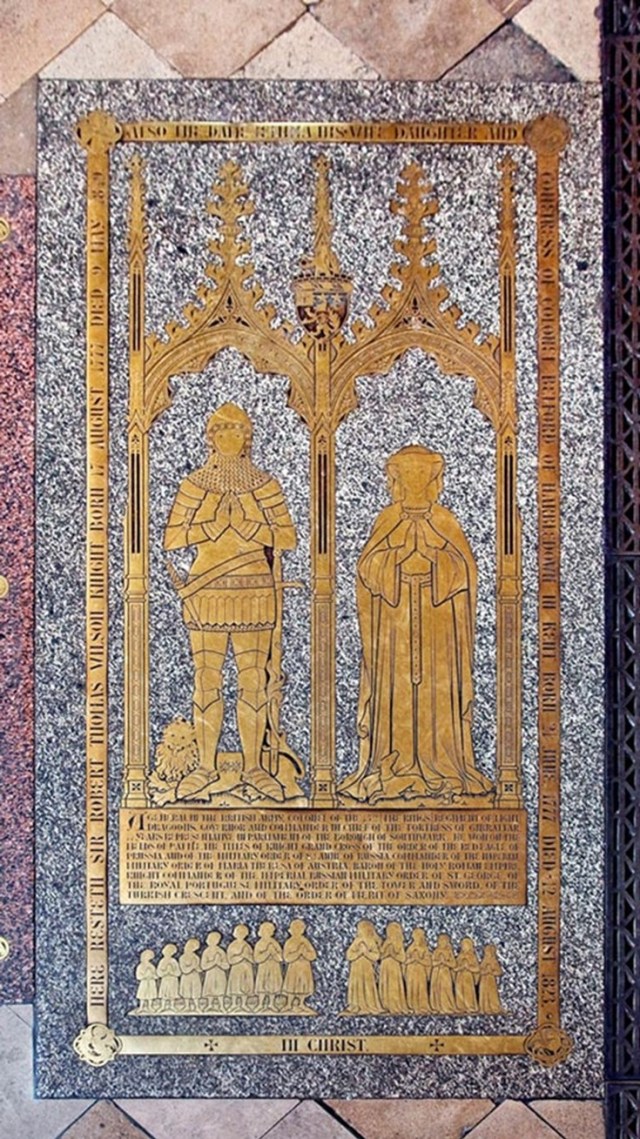
In the north aisle of the nave of Westminster Abbey is a brass covering the grave of Sir Robert Thomas Wilson and his wife. The stone is grey Cornish marble with brass made by Hardmans of Birmingham. The main figures are in the style of a medieval knight and his lady under a canopy with a lion at his feet and a dog at hers. Below are shown their seven sons and six daughters, again in medieval dress. In the canopy is a coat of arms: “a wolf rampant, in chief three stars of six points, on a canton an eagle displayed with two heads”, with a demi wolf holding a crescent as his crest. The inscription in the surround reads:
Here resteth Sir Robert Thomas Wilson, Knight, Born 17 August 1777. Died 9 May 1849. Also Dame Jemima his wife, daughter and co-heiress of Colonel Belford of Harbledown in Kent. Born 21 June 1777. Died 12 August 1823 in Christ.
https://www.vox.com/2019/3/27/18282509/trump-obamacare-lawsuit-health-care
General Sir Robert Thomas Wilson (17 August 1777 – 9 May 1849) was a British general and politician who served in Flanders, Egypt, Iberian Peninsula, Prussia, and was seconded to the Imperial Russian Army in 1812. He sat as the Liberal Member of Parliament (MP) for Southwark from 1818 to 1831. He served as the Governor of Gibraltar from 1842 until his death in 1849.
Contents
Early career[edit]
Born in London, he was the grandson of a Leeds wool merchant, and the fourth child of painter and portraitist Benjamin Wilson. Orphaned at the age of twelve he was raised and educated by his uncle and guardian, William Bosville, later attending Westminster School.
He eloped in his twenties with Jemima, the daughter of Colonel William Belford. She bore him thirteen children in the following 15 years.
Military life[edit]
He had a distinguished career in the Army and the diplomatic service. In 1794, as an ensign in the 15th Light Dragoons, Wilson fought in the celebrated Battle of Villers-en-Cauchies where a handful of cavalry smashed a much larger French force. He was made a Knight Bachelor in 1801.[1] In 1804 he became a lieutenant-colonel in the 19th Light Dragoons. He was expelled from Russia as a spy after the Treaty of Tilsit. During the Peninsular War he organized Portuguese soldiers into the Loyal Lusitanian Legion.[2] During the British retreat from the Iberian peninsula in January 1809, Wilson refused to comply with the withdrawal and instead decided to oppose the incoming 9,000-man corps commanded by the French General Pierre Belon Lapisse. He installed half of his 1,200 Lusitanian Legion in the fortress of Almeida and arranged the rest in a thin screen. He then harried the opposition with such remorseless energy that Lapisse, convinced he was confronted by a far more numerous enemy, switched entirely to the defensive.[3] In summer 1809, Wilson’s Legion again formed an important part of the Anglo-Portuguese network of advance posts and was placed on the Spanish frontier to provide early warning of French moves while the British commander Wellington advanced on Oporto.[4] In Wellington’s advance on Talavera in spring 1809, Wilson’s Lusitanians again formed a valuable flank guard. In the aftermath of the Battle of Talavera, when the French General Victor and his corps threatened to cut Wellington’s forces off from the south, Wilson’s small flank column of 1,500 men surprised Victor’s 19,600 men from the north. In the face of this unclear threat, Victor panicked and precipitously withdrew to Madrid.[5] On 12 August 1809, Wilson with 4,000 men, including two battalions of the Legion, was defeated by French forces under Marshal Michel Ney at the Battle of Puerto de Baños. Facing treble the number of French, Wilson nevertheless managed to maintain his position for nine hours.[6] He lost nearly 400 men while inflicting 185 casualties on the French.[7] Wilson returned to Russia in 1812 as a liaison officer. He was a sharp observer during the events of Napoleon‘s disastrous retreat from Moscow and was present at the Battle of Krasnoye. He also assisted in the November 1815 escape of the Bonapartist Lavalette from Paris.[8]
Parliament[edit]
In 1817, near the start of the Great Game, he published the anti-Russian “A Sketch of the Military and Political Power of Russia”.[9]
In 1818, Wilson became an MP for Southwark.[10] In 1821, now a Radical MP he attended the funeral of Queen Caroline (the wife of George IV), a very controversial figure whose treatment by her husband had led her to be celebrated by the ‘loud’ section of the general populace. Her supporters, considering that they were not being allowed by the authorities to celebrate this occasion as they wished, became unruly. Soldiers escorting the cortege but also on duty because of the Establishment’s fear of the mob, upon being stoned, fired over the heads of the crowd. Wilson strode up and stated that, “It is quite disgraceful to continue firing in this manner, for the people are unarmed. Remember you are soldiers of Waterloo; do not lose your honours gained on that occasion. You have had cannon shot at your head, never mind a few stones.” The firing ceased as the officer in charge recognised Wilson, and the troops, although maintaining their cohesion ‘retired’.[11] A few weeks later Wilson was dismissed from the Army by the Duke of York.[12] He was, however, to serve his country again.
Later career[edit]
Wilson was reinstated in the Army and promoted to lieutenant-general in 1830.[13] He reached the rank of full general in 1841 and was appointed Governor of Gibraltar in 1842. He wrote a great deal about history and politics.[2]
Death[edit]
Wilson died suddenly on 9 May 1849 at Marshall Thompson’s Hotel in Cavendish Square, London. He is buried along with his wife in Westminster Abbey.[14]

Britain’s Queen Elizabeth II sought to sweep differences with Spain aside on Wednesday (12 July) as she hosted a banquet for the country’s King Felipe VI, just hours after he called for a deal on the status of Gibraltar.
“With such a remarkable shared history, it is inevitable that there are matters on which we have not always seen eye to eye.
“But the strength of our friendship has bred a resilient spirit of cooperation and goodwill,” the Queen said at the Buckingham Palace banquet to mark the Spanish royals’ state visit.
While her government grapples with Brexit proceedings, the British monarch stressed that “whatever challenges arise” both her country and Spain will prosper.
Guests were served a three-course menu including Scottish beef with bone marrow and truffles, with a Madeira wine sauce.
The glitzy occasion closed the first day of the visit, which saw Felipe raise the issue of Gibraltar in an address to parliament.
“I am confident that through the necessary dialogue and effort our two governments will be able to work… towards arrangements that are acceptable to all involved,” he said.
Referring to the history of diplomatic relations between Britain and Spain, he added: “I am certain that this resolve to overcome our differences will be even greater in the case of Gibraltar.”

With a population of just over 32,000, Gibraltar has been a British overseas territory since 1713 but Spain has long laid claim to the rocky outcrop.
Unlike Britain, Gibraltar voted overwhelmingly to stay in the European Union in last year’s referendum, and it depends on an open border with Spain for its workforce and trade.
But Spain wants shared sovereignty and the EU has promised Spain a veto over the extension to Gibraltar of any future trade deal between Britain and the bloc, prompting outrage in London.
Gibraltar’s chief minister Fabian Picardo said that while the population wanted friendly relations with Spain, their position on sovereignty remains clear.
“In the times in which we live, territories cannot be traded from one monarch to another like pawns in a chess game,” he said in a statement.

World / Politics
British colony or not, people of Gibraltar worried about life after Brexit
Reuters
GIBRALTAR – With London fuming over whether Gibraltar should still be called a “colony,” residents of the British outpost on the southern tip of Spain are more worried about life after Brexit than about which word best explains their status.
In the latest Brexit quarrel between Britain and the European Union, the government in London complained last week that the peninsula of 33,000 residents should not have been described as a “colony” in a draft EU text on visa-free travel.
Britain itself called Gibraltar a “crown colony” for 268 years — from the time when it won the area in the 1713 Treaty of Utrecht, which ended the War of Spanish Succession, right up until 1981, when it came up with a new term: “dependent territory.” In 2002, the official term changed again to “British overseas territory.”
Until at least the 1980s, Gibraltarians carried passports that said “Colony of Gibraltar” right on the front cover. No matter.
“Gibraltar is not a colony, and it is completely inappropriate to describe it in this way,” Britain’s ambassador to the EU thundered. “Gibraltar is a full part of the U.K. family.”
Gibraltarians, whose economy depends on an open border with Spain, voted overwhelmingly to remain in the EU in Britain’s 2016 referendum but are due to leave the bloc anyway on March 29 along with the rest of Britain.
Their cultural Britishness was in full evidence on Wednesday, when the city on a rock rang out with a 21-gun salute in honor of the anniversary of Queen Elizabeth II’s accession.
Teacher Steven Grant did not seem much fussed about the terminology, provided that the border stays open.
“We’re still connected to them, maybe as a colony used to be, but we’re not governed by them,” he said of Britain.
“We just want to stay as we are, British. We don’t need anything to change. All we hope is that things on the frontier don’t change either.”
But others on the central shopping street shared London’s official umbrage at the EU’s choice of vocabulary.
“This isn’t the 1700s. … It’s 2019, and we’re a city, we’re Gibraltar — we’re not a colony,” said insurance salesman Jack Johnson.
Happy Birthday Your Majesty! (Please visit Gibraltar again)


The tiny territory at the foot of Spain is proudly British and enthralled with the monarchy, and the majority of the 32,000 population of the Rock think it’s time Her Majesty paid them another visit.
She was last there in 1954 when she toured the Rock with Prince Philip and young Prince Charles and Princess Anne, a visit that is still talked about.
Watch this clip of how Pathe news reported the visit back in 1954:
“I truly envy those of you who were here in Gibraltar in 1954 to see the arrival of this great dashing couple, the very beautiful and inspirational young woman who had just acceded to the throne two years earlier in 1952,” said Chief Minister Fabian Picardo in a birthday message to the Queen.
“I look at those black and white photographs of her being cheered by the entire community, everyone clearly jubilant and I am filled by a great sense of pride in the achievements of this nation under her reign.”
Gibraltar’s leader took the opportunity to express what all Gibraltarians long for.
“Like all of you, I wish she would find the opportunity to visit us here on the Rock,” he said.
Both Princess Anne and Prince Edward have made separate visits to Gibraltar in the last decade where they were greeted with flag waving patriotism from its residents.
Although the Rock was ceded to Britain by Spain under the 1713 Treaty of Utrecht, Spain still claims sovereignty over the disputed territory and diplomatic tensions continue to flare up over the matter.
Worried in the face of a possible Brexit and what it might mean for cross-border relations with Spain, Gibraltarians overwhelmingly fall in the Remain camp, with 88 percent backing continued EU membership in the June 23rd referendum, according to a recent poll in the Gibraltar Chronicle.
The population of 2.6-square-mile peninsula at Spain’s southern tip will celebrate the Queen’s birthday in much the same way as those at home, some 5,000 miles away, with a 12-gun salute and the lighting of a beacon, joining the dozens lit across the UK, British Overseas territories and the Commonwealth.
An image of Her Majesty will also be projected on the iconic north face of the Rock itself, clearly visible to those over the border in Spain, it will send a strong message.

A projection of the Queen onto the Rock to celebrate the diamond jubilee. Photo: AFP
“Whatever happens on June 23rd, we are and shall remain British and we shall keep our Queen. That is an adamantine pledge,” said Picardo.
“I know I speak with the strongest and most sincere congratulations of us all when I say: ‘Happy Birthday Your Majesty. Gibraltar loves you. Long may you live and reign over us’,” he said.
 Rosamond Press
Leave a comment