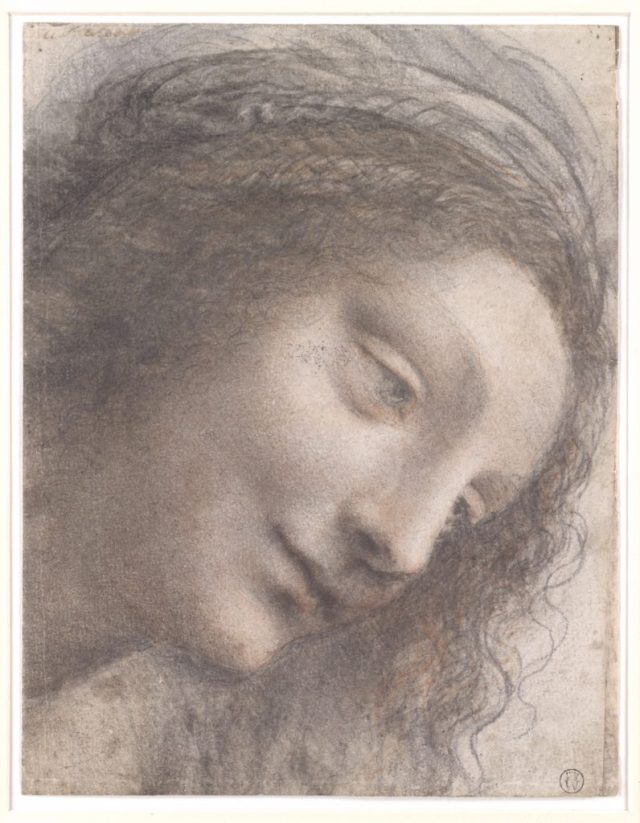


If the case of Belle verses Seer Jon, ever went to trial, all I need do is hold up the image I beheld this morning, of the beautiful woman drawn by Leonardo da Vinci, and, the image I captured of Belle Burch.
“This is the vision that overcame me, your Honor. My heart kept skipping a beat. It was like we knew each other in a past life, a life that I could now recapture when she modeled for me. May I dare add………………….once again?”
“Case dismissed! ”
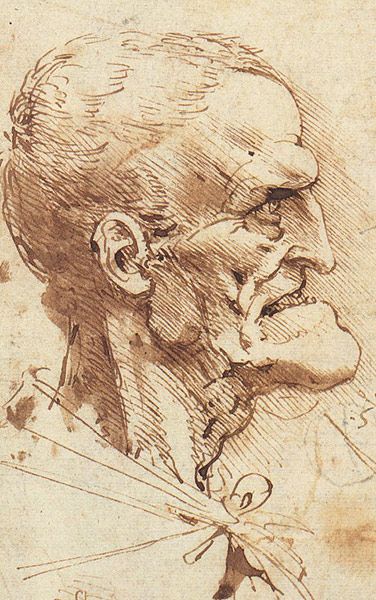
The image of the young man seducing a old person, for money, was rendered by Wenceslaus Hollar. He used a lost drawing by Leonardo, as a model. Right away I could see the old woman, was an old man. I suspect the young man, is the artist Raphael. Therefore, I suspect the old man is Raphael’s patron, Pope Julius 11. Julius is giving Raphael more Church money. The cleavage is wrong. It is anatomically incorrect. This crude cleavage was added by Hollar in order to turn the man into a woman. The feminine headdress is an addition. But, what gives the work away, is the hand on the face. Leonardo would never put a hand on one of his faces. What I believe, is the hand rested on the heart of the subject, and was spread like talons. This would depict the grip Raphael had on the old man, who is deeply in love with the beautiful youth.
Now for the placement of the other hand. I believe Leonardo put it under the table, and is on the member of the old man. This suggests they are having sexual relations. This is how Leonardo would deal with his young rival who was getting so many commissions from the Papacy, he had to hire a stable of young apprentices, that Leonardo might have compared to a whore house. Did Pope Julius stop by the Art Factory to watch the young boys at work? Did his heart skip a beat? Let us title this work ‘Beauty and the Beast’.
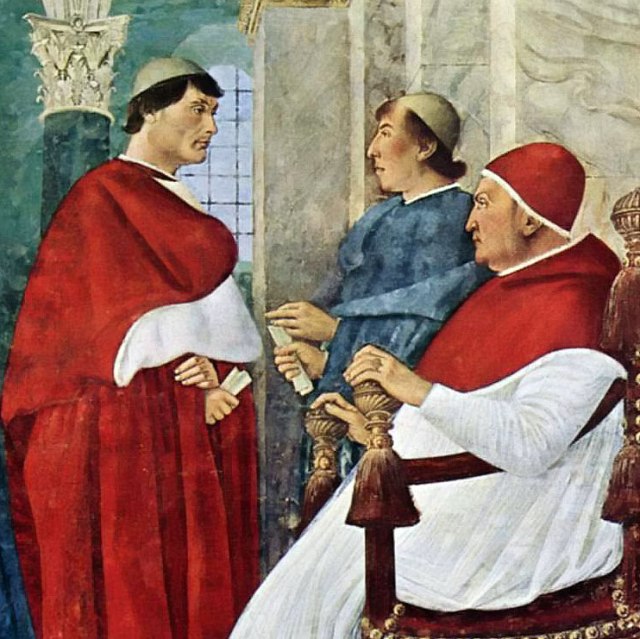
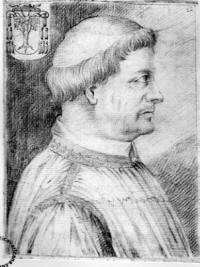
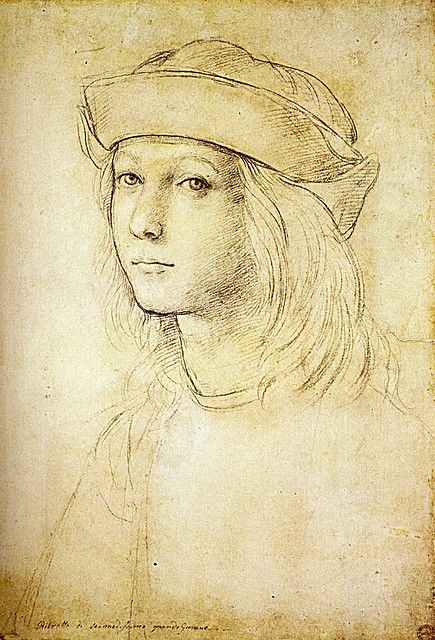
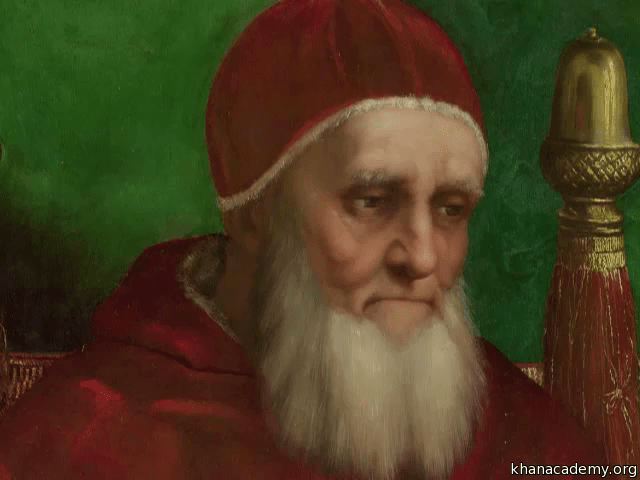
Let us compare the chins. Julius is on the left in the painting below. His cousin has the same pronounced chin. Is he partially bald. The Beast appears to be bald. What is truly astonishing is the alleged self-portrait of Raphael as a young man. I suspect Leonardo did this drawing because of its perfect 3/4 positioning. The upturned head is a perfection of balance and proportion that inspired Raphael, that he tried to duplicate in his drawing of the Mona Lisa. Leonardo has Beauty lifing his head to see the Beast, who is above him, which suggests his hand is reaching under the table to peasure the Beast. The lavacious smile on his face, says it all.
What Leonardo da Vinci is EXPOSING is the rampant homsexualty in the Church, that had married into the World of Art. How old is the Beautiful and Gifted Youth – thirteen? I suspect many powerful homosexual men beheld da Vinci’s portrait of Raphael, and, had to have him. In the end, it was Raphael ‘The Art Whore’ who had his way – with them all!
Of course Leonardo is jealous. Raphael was his discovery! Did Raphael seduce the Old Master who thought he had fallen in love with a virgin, an angel? Look at the look on the face of Pope Julius. It is the inward look of a man with a broken heart, a man who fell in love with a Beautiful Youth he could not possess. Note the protruding lower jaw. This is a underbite like the one the Habsburg’s owned. This grotesque jaw becomes the object of extreme hatred, that Leonardo thrusts in the face of his fallen angel, who asked if he could have the portrait The Master did of him. It was a ticket, a pass, The Key, that opened many doors. Raphael was a male version of a ‘Seductress’.
John Presco
Copyright 2019

https://news.artnet.com/exhibitions/met-leonardo-drawings-1447594
https://news.artnet.com/exhibitions/met-leonardo-drawings-1447594
As the 500th anniversary of the death of Renaissance great Leonardo da Vinci approaches, the Metropolitan Museum of Art in New York is reaching deep into its archive to exhibit four rarely shown drawings by the Old Master.
The incredibly fragile artworks, normally kept in storage due to their sensitivity to light, will go on view in the museum’s prints and drawings galleries on January 29. There, they will be joined by other works on paper by masters such as Rembrandt van Rijn and Wenceslaus Hollar to illustrate Leonardo’s lasting legacy. (A full-scale exhibition, “Leonardo da Vinci: A Life in Drawing,” is being held across 12 cities in the UK to mark the occasion.)
In his masterwork, The Lives of the Most Excellent Painters, Sculptors and Architects, first published in 1550, Giorgio Vasari is particularly effusive about the way that Raphael’s work was influenced by Leonardo da Vinci. Raphael went to Florence in the early years of the 16th Century with the intention of studying great artists and took the opportunity of observing Leonardo at work on, among other projects, the portrait of Lisa Gherardini, the young wife of Francesco del Giocondo.
“ … after seeing the works of Leonardo da Vinci, who had no peer in the expressions of heads both of men and of women, had surpassed all other painters in giving grace and movement to his figures, he [Raphael] was left marveling and amazed; and in a word, the manner of Leonardo pleasing him more than any other that he had ever seen, he set himself to study it, and abandoning little by little, although with great difficulty, the manner of Pietro [Perugino], he sought to the best of his power and knowledge to imitate that of Leonardo. But for all his diligence and study, in certain difficulties he was never able to surpass Leonardo; and although it appears to many that he did surpass him in sweetness and in a kind of natural facility, nevertheless he was by no means superior to him in that sublime groundwork of conceptions and that grandeur of art in which few have been the peers of Leonardo. Yet Raffaello came very near to him, more than any other painter, and above all in grace of colouring.”

Raphael’s ‘Young Woman on a Balcony’, pen and ink sketch, c. 1504.
The subject of the Raphael Sketch is treated at length [See ‘Historical Evidence’], but is re-emphasised here to underline how the ‘Earlier Mona Lisa’ likely not only spawned numerous copies that today are revered in museums and exclusive collections around the world, but possibly also inspired one of the most extraordinary Renaissance artists to follow and experiment with innovative compositions. This demonstration represents significant evidence, as previously mentioned, that Raphael’s decision to come to Florence and study the works and methods of Leonardo paid a handsome dividend for which he was grateful – he revered Leonardo until his own death. It would seem that these images are specifically derived from the ‘Earlier Mona Lisa’, the one on which he was working at the time of Raphael’s visit. It is further evident that there is little artistic connection between these Raphael works and the Louvre ‘Mona Lisa’.
 Rosamond Press
Leave a comment