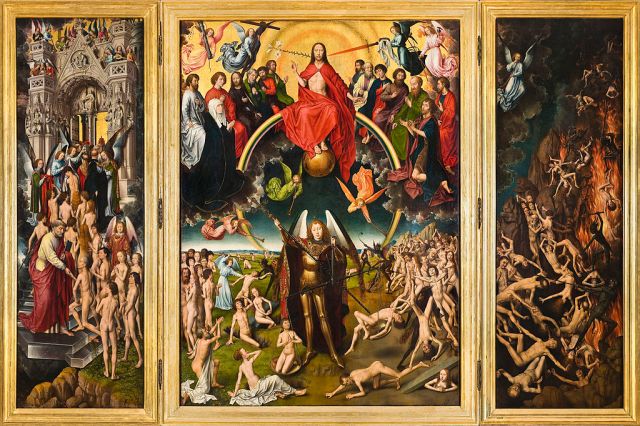
Judgement Day has arrived on the East Coast where are SEALED the fake investigation of the FBI. It is 12:01 A.M.
It is suggested one take the Vow of the Nazarite after hearing the accusations against the woman accused of adultery. Christine Ford was put on trial, and judged by Republican Christians. Their church, and our Democracy, will never be the same. That SEAL contains Doomsday. That SEAL will multiply. That SEAL……..belongs to the Judge of Judges.
John ‘The Nazarite Judge’
https://rosamondpress.com/2018/09/18/judging-the-adulteress-3/
Judging the Adulteress
Everything is accelerating at a fast clip. Why has no priest, minister, rabbi, or T.V. evangelical prophet solved the riddle of what Jesus wrote in the dust. Why me? Why did I discover the truth and not one else. Rabbi Irons knows very little about Christianity, and does know John was a Nazarite – for life! Jesus knew this. I had no problem reading Judaic teaching.
Judging the Adulteress
Jesus is judging the woman accused of adultery employing an ancient custom that was done away with before he was born. Being a candidate for the Messiah, Jesus must be WITHOUT SIN….without error. Sin means ‘missing the mark’. This is why Jesus pretends not to hear the accusations against the woman accused of adultery. When I read this lesson by Rabbi Eliezer Irons eight years ago, I got it, the answer to the riddle.
“Not only witnessing the actual criminal act, but even witnessing the
punishment and humiliation of the crime can have a deleterious
influence on the viewer.”Rabbi Jesus gives the same lesson to the witnesses and crowd, who are now all – with sin! Did he suggest they take the Oath of the Nazarite?
Jon Presco
Copyrigt 2015
“Parshas Naso :
Witness to Sin
By Rabbi Eliezer Irons
The Sotah, a woman suspected of adultery, is a topic in this week’s
Parsha. A Sotah must either confess her guilt, or suffer public
humiliation. The Sotah, upon denying her guilt, would be forced to
drink waters, in which G-d’s name was placed. If she were truly
guilty, her stomach would expand and burst.The Nazir (Nazarite) is discussed immediately following Sotah.
Nazir is a voluntary status that one pursues to attain greater levels
of holiness. A Nazir is forbidden to drink wine or eat grapes, cut
his hair, or become defiled by a human corpse.Rashi, quoting the Talmud, asks,
“What is the connection between these two topics?”
(A connection exists when the Torah places two topics sequentially.)
The Talmud answers that one who sees the humiliation of the Sotah
should abstain from wine, etc., and become a Nazir. If one sees a
Sotah, a woman who fell victim to her desires, it may influence him
to sin as well. In order to protect himself against the type of evil
inclination that corrupted the Sotah, he should become a Nazir.
Why would witnessing the humiliation of a Sotah influence one to sin?
Logic dictates that the exact opposite should occur! Onlookers
should be fearful when witnessing the consequences of the averah (the
sin).To answer this question, we must first examine a difficult
passage Sefer D’varim (12,17) in prohibiting the eating of maaser
sheni (the second tithe) outside Jerusalem. The verse uses the
curious terminology “you are not able to eat.” It would appear to
make more sense had the Torah said “You should not eat forbidden
food.” One is certainly able to eat forbidden food; it is among his
physical capabilities.The Telzer Rosh Yeshiva Reb Eliyahu Meir Bloch zt”l explains that
the Torah here teaches us that sin should be viewed as something
unimaginable and far removed from the realm of possibility. To
illustrate the point, consider this example: A man on a roof who is
ordered to jump is likely to respond “I can’t.” Of course, he is
physically able, but in his mind it is utterly unimaginable and
psychologically impossible.Based on this explanation, we can now proceed to our original
question. When one witnesses the humiliation of the Sotah, he
realizes that the averah he once thought to be unimaginable is now a
distinct possibility. In order to protect himself, the witness must
therefore become a Nazir and thereby elevate himself to his former
level.This idea parallels the concept of Chilul Hashem (a disgrace to G-
d) expressed by Tosafos Yom Tov, in Yoma 8:8. “Anyone who does an
averah (a sin) and others are influenced thereby to take the matter
lightly and to act likewise is committing the sin of Chilul Hashem.”
This week’s Parsha takes the Tosafos Yom Tov idea one step further.
Not only witnessing the actual criminal act, but even witnessing the
punishment and humiliation of the crime can have a deleterious
influence on the viewer.>From this we can derive a practical halacha (law) regarding the
law of lashon harah (talebearing and gossiping). Lashon harah is a
serious averah, but can one speak lashon harah about himself? The
Chafetz Chaim addresses self-abasing lashon harah in two places.
First, he warns that one cannot absolve himself from the guilt of
lashon harah by including himself in the story about a friend. One
may speak unfavorable about himself, but not about a friend.
In another instance, the Chafetz Chaim writers that if upon
hearing lashon harah, it is forbidden to believe it. However, if the
talebearer mentions himself in the story, it is permissible to accept
his story as true . . . but only about himself. It is forbidden to
believe what he says about his friend.From these two places one could possibly deduce that it is
permitted to speak lashon harah about oneself. *According to the
lessons of Parshas Naso, even though one may not be violating the
laws of lashon harah, it is forbidden to tell others of one’s own
sins, because by doing so, one is violating the law of chilul Hashem.
If one repeats tales of his own sins, he may entice a friend to sin.
It will show him that it is possible to commit the sin.May we be only good, positive influences on each other and all of
Kl’al Yisroel.”


“Judge not, lest thee be judged.”
On the temple wall, facing the courtyard, for all devout Jews to see, was placed the gifts that Queen Helena the Nazarite, gave. One was a gold Menorah that reflected the rising sun, and the words from Numbers on the judging of a Sotah, a woman accused of adultery. were not these words like molten gold when the sung rose?
Jews came from all over the world to the temple and read these words. Why is it that no Christian minister or priest knows what Jesus wrote in the dust?
How long must we wait for the truth and the answer? Not long!
Jon the Nazarite
Helena helped keep Hebraism alive. Talmud Tractate reads: “Helena had a golden candlestick made over the door of the Temple. When the sun rose its rays were reflected from the candlestick and everybody knew that it was the…
View original post 1,986 more words
 Rosamond Press
Leave a comment