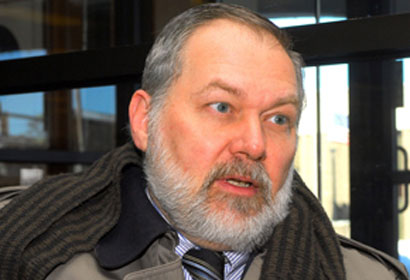
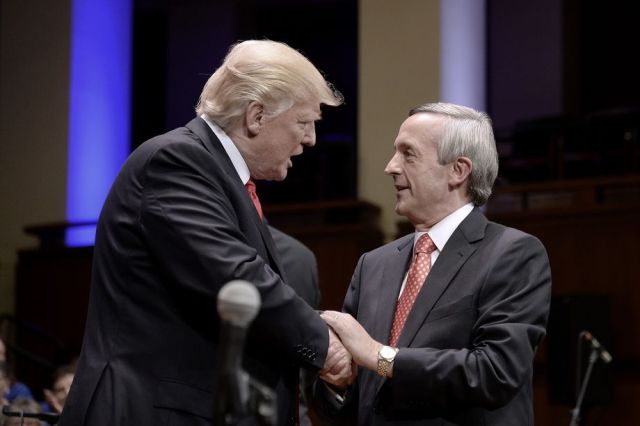
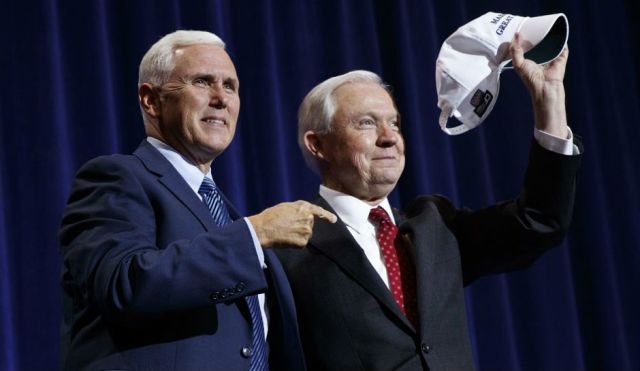
Pence has connections to Scott Lively, and, is extremely anti-Gay! These Bashers are very organized all over the world. It is coming back to me that in the battles I had on facebook, they would bring in a religious expert when I was besting them. I believe The Troll Factory is full of Russian Christians on a anti-gay crusade. These Trolls have taken over our Democracy. Putin could have introduced Donald to a very seductive gay man, a real flatterer. When did Pence, Sessions, and Lively, approach Citizen Trump? They knew of his desire to built Trump hotels in Russia. Did they have a video? Does Scott Lively know Roy Moore?
What we got here is a religious cult that is under scrutiny by the FBI and Mueller. Consider Jim Jones, David Koresh, and Patty Hurst. These CRIMINAL CULTS do not go down easy. They never believe they did anything wrong. The did it FOR OUR OWN GOOD, and are on a mission from God.
Take a good look at Pence and Sessions. They are the last of The Red-Hot Heterosexual Lovers who took over the United States of America – with Putin’s help!
Jon Presco
“You see?” Trump reportedly said to Pence. “You’ve wasted all this time and energy on it, and it’s not going to end abortion anyway.”
And when the meeting began to focus on gay rights, Trump reportedly pointed to Pence, joking, “Don’t ask that guy — he wants to hang them all!”
One Trump campaign staffer also told The New Yorker that Trump used to ask people leaving meetings with Pence, “Did Mike make you pray?”
http://fortune.com/2018/02/18/a-russian-troll-in-his-own-words/
This rising Russian social conservative movement frequently invokes the argument that pro-gay and women’s rights groups are puppets of the West, which is seeking to undermine Russian autonomy and interfere in the country’s internal affairs. At an annual meeting of journalists and academics presided over by Vladimir Putin in Valdai in September, the Russian president said that European countries had strayed from their roots by legalizing gay marriage. He urged Russians to embrace the conservative values of the Orthodox Church and other traditional religions and issued a warning to those who might want to challenge those values. “Russia’s sovereignty, independence, and territorial integrity are unconditional—these are red lines no one is allowed to cross,” he declared.
“We want to promote the idea of the unity between the West and Russia on the basis of common Christian roots,” Sevastianov told Inside the Vatican magazine in 2009. “We believe in this alliance among traditional Christian countries…and we believe that, with a united voice, we can be a strong force against the radical secular world which has become dominant in our societies.”
The church’s close ties with American evangelicals reflect a shift in policy. For much of the post-Soviet period, the Russian Orthodox Church held evangelical denominations at arm’s length, fearing that they would compete for influence within Russia. But as the church has consolidated its power, it has come to view the evangelical community as a partner. “The ROC realizes that the evangelical denominations are not their opponents but rather their allies in the relations between the church and the secular population,” says Olga Kazmina, a professor of ethnology at Moscow State University.
“It’s a re-envisioned paradigm,” says Father Leonid Kishkovsky, head of the Orthodox Church in America’s Department of External Affairs. In many ways, it makes sense, he adds: both religious groups share an ideological commitment and have grown disillusioned with the way mainline churches have dealt with issues like gay marriage and abortion. “But what I’m quite nervous about is the ideological core which actually motivates both sides,” Kishkovsky says. “Where is the motivating force? Is it in faith? Or is it in political ideology?”
On Friday, a new indictment by special counsel Robert Mueller provided a comprehensive overview of a picture that had been emerging for months. Russia’s Internet Research Agency, with backing from the Kremlin, ran huge “troll factories” where commenters using fake identities manipulated Americans’ online political debates.
New insight into the details of that operation came Saturday, when the Washington Post published an interview with a man who says he worked at one of those ‘factories.’
The Post’s informant, Marat Mindiyarov, is not one of the 13 mostly high-level operatives named in the latest Mueller indictment. Instead, he was one of the rank-and-file workers who advanced Kremlin talking points in online discussions, working from a facility in the St. Petersburg area. He says he worked primarily in a department aimed at manipulating Russian citizens, for instance by leaving comments downplaying the impact of international sanctions on the Russian economy.
 Rosamond Press
Leave a comment