
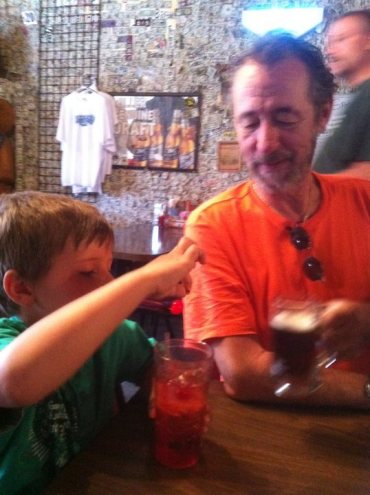
Christian Missionary work is being threatened. Trump is with the Pope. My grandson ate food stamp food. Then, he was put on the Drunken Nazi Plan. My daughter made a case I was a “insane parasite” and if I tried to defend myself from her accusation, then I did not deserve SSI because my desire to defend myself is proof I am sane. She pointed to my religious blogs as proof I was coo-coo. If Hillary had been elected, then, my Biblical knowledge would still be dismissed and used as evidence I am mad! Several experts have concluded Trump is insane – and a traitor!
Jon
“Jesus made it very clear we have a duty and obligation as Christians and as citizens of this country to take care of each other. Democrat, Republican, Independent — we should look after one another,” he said. “But I think a fundamental argument we’re having today is what’s the duty of the federal government. We’re all here on this committee making decisions about other people’s money.”
WASHINGTON, Sept. 16, 2013 /PRNewswire-USNewswire/ — Leading Christian leaders, including Bread for the World, today urged members of the House of Representatives to vote “No” on a proposed bill that will further cut SNAP (the Supplementary Nutrition Assistance Program, formerly food stamps) by $40 billion over the next 10 years.
The proposed bill is expected to be brought to the full House for a vote this week. If passed, the bill would leave up to 4 million poor, childless adults hungry and 210,000 children without free school meals. These cuts would be on top of substantial across-the-board cuts coming on November 1 due to the expiration of the 2009 Recovery Act.
In letters to their members of Congress, the Christian leaders expressed deep moral outrage over these proposed new cuts and their effects on the nation’s most vulnerable people. Copies of their letters are available online at www.circleofprotection.us.
The leaders are from the Circle of Protection, a coalition of more than 65 heads of denominations and religious agencies, plus more than 5,000 church pastors. They have been working for more than two years to resist federal budget cuts that undermine the lives, dignity, and rights of poor and vulnerable people.
Although SNAP benefits are modest, an average of less than $1.50 per person per meal, SNAP is the nation’s foremost tool against hunger and hardship, particularly during recessions and periods of high unemployment. Currently, 47 million Americans benefit from SNAP, but that number is expected to be greatly reduced once the economy recovers. SNAP is designed to expand in periods of great need and contract when the economy is better.
Many of the organizations that belong to the Circle of Protection have also mobilized their members to urge their representatives to vote “No” on this new bill. If the proposed bill passes, it will go to conference with the Senate version in an effort to compromise on a final farm bill.
Quotes from key Christian leaders appear below. The letters are available at www.circleofprotection.us.
WASHINGTON — Republican and Democrats sparred this week on where Jesus Christ would stand on food stamps, a federal program that supported 47 million Americans last year.
On Wednesday, the House Agriculture Committee approved Republican legislation that would reform farm subsidies and trim the Supplemental Nutrition Assistance Program by roughly $2.5 billion a year. Republicans want fewer Americans to qualify for food stamps simply because they receive benefits from another safety net program. Under the new legislation, more people would have to pass income and asset tests to be eligible for food stamps. Nearly 2 million fewer people would qualify.
Rep. Juan Vargas, a California Democrat and former member of the Jesuits, a Catholic religious order, said he favored a Democratic amendment to undo the cuts because Jesus made himself clear on feeding the poor.
“Jesus kinda fools around and gives you parables. He doesn’t oftentimes say exactly what he means,” Vargas said. “But in Matthew 25 he’s very, very clear. And he delineates what it takes to get into the kingdom of heaven very, very clearly. And he says how you treat the least among us, the least of our brothers, that’s how you treat him.”
In Matthew 25, Jesus describes those who will enter heaven as anyone who gave him food when he was hungry, invited him into their homes when he was a stranger, clothed him, cared for him while he was sick and visited him in prison. “The extent that you did it to one of these brothers of mine, even the least of them, you did it to me,” Jesus says.
Rep. Mike Conaway (R-Texas) said during the hearing that he, too, is a follower of Christ.
“I read this chapter of Matthew 25 to speak to me as an individual,” Conaway, a Southern Baptist, said. “I don’t read it to speak to the United States government. And so I would take a little bit of umbrage with you on that. Clearly, you and I are charged that we do those kinds of things but [our government is not] charged with that.”
Many religious groups lobby Congress on federal nutrition programs. The U.S. Conference of Catholic Bishops, Evangelical Lutheran Church in America, Jewish Federations of North America, and dozens of religious and secular organizations signed a letter to Congress last week urging members to oppose food stamp cuts. “If SNAP is weakened, our nation will see more hunger and food insecurity, worse health and educational outcomes, and higher health costs,” it said.
While religious leaders in the U.S. have thrown their weight behind food stamps and government assistance programs, Pope Francis also spoke more broadly Thursday on his views on “cult of money” in his first address at the Vatican global finance.
Addressing new ambassadors to the Vatican, Francis described the prevalence around the world of an “an economy which is faceless and lacking any truly humane goal,” resulting in people who “have to struggle to live and, frequently, to live in an undignified way.”
“In circumstances like these, solidarity, which is the treasure of the poor, is often considered counterproductive, opposed to the logic of finance and the economy. While the income of a minority is increasing exponentially, that of the majority is crumbling,” Francis said. “This imbalance results from ideologies which uphold the absolute autonomy of markets and financial speculation, and thus deny the right of control to states, which are themselves charged with providing for the common good.”
Former Pope Benedict XVI had a similar view. In a Christmas address in 2011 that touched on Europe’s financial crisis, Benedict said that “solidarity, commitment to one’s neighbor and responsibility toward the poor and suffering are largely uncontroversial” but that the “motivation is often lacking … to make sacrifices.”
This week’s debate was not the first time lawmakers brought religion into disagreements over economic issues and helping the poor. Amid debates over the debt ceiling, federal budget cuts and the fiscal cliff over the last two years, dozens of prominent denominational and church leaders formed a coalition called the Circle of Protection, to lobby for the protection of assistance programs. In 2012, liberal Catholic groups in particular criticized former vice-presidential nominee Rep. Paul Ryan (R-Wis.), who prominently supported broad budget cuts to government assistance. A Catholic, he said his views came from the Catholic principle of subsidiarity, meaning that decisions should happen at the lowest level of government that can handle them most effectively — often individuals — instead of big bureaucracies.
But groups like the Circle of Protection don’t always sway Republican policy. During the food-stamp debate on Wednesday, other Republicans disagreed with Vargas’ position and his reading of the Bible.
“The Bible says lots of things,” Rep. Stephen Lee Fincher (R-Tenn.) said. He pointed to Matthew 26:11, which says “for you always have the poor with you,” then 2 Thessalonians 3:10, which says “for even when we were with you, we used to give you this order: If anyone is not willing to work, then he is not to eat, either.” Republicans have argued that programs like food stamps discourage work and make the safety net more of a hammock.
“Jesus made it very clear we have a duty and obligation as Christians and as citizens of this country to take care of each other. Democrat, Republican, Independent — we should look after one another,” he said. “But I think a fundamental argument we’re having today is what’s the duty of the federal government. We’re all here on this committee making decisions about other people’s money.”
Rep. Doug LaMalfa (R-Calif.) cited Ephesians 2:8-9, which says, “for by grace you have been saved through faith; and that not of yourselves, it is the gift of God; not as a result of works, so that no one may boast.”
“It always looks good when politicians can go say, we brought a bunch of money to this project here or that project there, standing next to this big, giant blown-up check somewhere and saying, ‘look what we did for you.’ That’s all someone else’s money,” LaMalfa said. “We should be doing this as individuals, helping the poor.”
Several Democrats noted that even with 47 million Americans benefiting from SNAP, some people are still hungry.
“Christians, Jews, Muslims, whatever — we’re failing our brothers and sisters here,” Rep. Jim McGovern (D-Mass.) said.
Press release quotes from some of the letters:
Rev. Brian Adams, Minister for Economic Justice, Disciples Center for Public Witness:
“I far too regularly have to turn away people in need of help. We can offer a few non-perishable goods, but far from enough to sustain the many people around us, and not the perishable goods they need to have a healthy diet. If we as a nation seek to be founded in our Judeo-Christian influences, we cannot be faithful in doing so without, though laws and government, caring for the poor in our land. When a country’s rules do not give the poor in their land what God intends, suffering is not far behind.”
Leith Anderson, President, National Association of Evangelicals:
“During the Great Recession, the number of Americans needing food aid has understandably increased. Millions of families survived very hard times thanks in part to this assistance. Children were protected from irreversible developmental damage. Hunger-related health care costs were averted. We support efforts to reduce our annual deficits and enact structural reforms to bring our revenues and expenses back into balance. But we believe this can be done without further burdening our most vulnerable citizens, and without cutting appropriations for vital food assistance programs.”
The Most Reverend Stephen E. Blaire, Bishop of Stockton, United States Conference of Catholic Bishops:
“Adequate and nutritious food is a fundamental human right and a basic need that is integral to protecting the life and dignity of the human person. How the House chooses to address our nation’s hunger and nutrition programs will have profound human and moral consequences. This is a crucial time for our nation to place a circle of protection around programs that build a more just framework and put poor and hungry people first.”
Rev. David Beckmann, President, Bread for the World and laureate, World Food Prize:
“These proposed cuts are a clear indication that some in Congress underestimate the hunger that is present in millions of American homes. The amendment picks on the poorest people in the country. This is morally and economically unacceptable especially as some areas continue to experience high unemployment. Congress needs to focus on creating more jobs and not cut programs that stave off hunger for millions of people.”
Rev. Lisa R. Harris, Coordinator, American Baptist Home Mission Societies:
“Far too many Americans rely on SNAP today, but high participation is not from a surge of laziness. Over 30 percent of SNAP households are working households. The real problem is the economy and the fact that too many jobs don’t pay enough for parents to be able to put food on the table and provide for their children. 11.5 million people remain unemployed, and 4.2 million people have been looking for work over 26 weeks.”
Rev. Carlos Malave, Executive Director, Christian Churches Together in the USA:
“The Bible calls us to care for our neighbor and remember ‘the least of these.’ The cuts included in the bill violate this principle. SNAP is one of the country’s most important anti-hunger programs, and this bill could leave up to six million people without vital food assistance.”
Rev. Dr. A. Roy Medley, General Secretary, American Baptist Churches USA:
“Cutting SNAP and taking away vital nutrition assistance from children, seniors, low-wage workers, and persons with disabilities will not address the larger economic trends or create more jobs with adequate wages. Instead, this type of bill will punish those struggling to get by.”
Dr. Ann Scholz, Associate Director for Social Mission, LCWR:
“It is not just a bad idea, it is morally indefensible. Our faith calls us to respect the dignity of each and every person and to give particular care to those most in need. The proposed cuts to SNAP violate these principles. SNAP was the primary prevention against hunger for children and families during the recession. Such devastating cuts are simply inexcusable. We must make good on the promise that this country, if you are willing to work, you won’t have to see your children go to bed hungry.”
Peter Vander Meulen, Coordinator, Christian Reformed Church Office of Social Justice:
“We are called, as Christians, to protect the most vulnerable. It is with this commitment in mind that we urge you to protect millions who so desperately depend on SNAP. In the US, 11.5 million people remain unemployed, and many who are employed receive low paying wages not sufficient enough to feed their children.”
Jim Wallis, President, Sojourners:
“These immoral cuts are incongruent with the shared values of our nation. They demonstrate the triumph of political ideology and self-interest over sound public policy and concern for the general welfare. Actions like these foster cynicism and distrust of government in the everyday Americans who struggle to meet their families’ basic needs and create a better life for their children.”
The Circle of Protection is composed of more than 65 heads of denominations, relief and development agencies, and other Christian organizations. For more information, please visit www.circleofprotection.us.
SOURCE Bread for the World
The former Democratic presidential nominee, who recently declared herself part of the Trump resistance, lashed out at the Republican president’s spending plan in aggressive terms after being honored in New York City by the Children’s Health Fund, a nonprofit organization that helps provide health care to poor and homeless children.
“This administration and Republicans in Congress are mounting an onslaught against the needs of children and people with disabilities, women and seniors,” Clinton charged.
She said the budget, which was released earlier in the day, “shows an unimaginable level of cruelty and lack of imagination and disdain for the struggles of millions of Americans, including millions of children.”
She added, “None of us can remain silent in the face of these attacks.”
Trump’s budget calls for a drastic rollback of programs for the poor and disabled along with a robust hike for the military and border security. The plan, which won’t become law without Congress’ approval, is laced with $3.6 trillion in cuts to domestic agencies, food stamps, Medicaid, highway funding, crop insurance and medical research, among others.
“It hurts the well-being of children,” Clinton said. “It’s time to send a resounding message that we will not stand for this attack on the most vulnerable among us.”
Earlier in the month, Clinton launched a new political organization designed to push back against Trump’s agenda. She said the group would “encourage people to get involved, organize and even run for office.”
Today, there are 65 million displaced people, the most since World War II, and 795 million people still go to bed hungry every night,” the letter said. “Matthew 25 tells us when we serve the least of these, we are serving the Lord. As people of faith, we cannot turn our back on those in desperate need.”
“We are grateful,” it continued, “for America’s global development and diplomacy programs that have been instrumental in saving lives, safeguarding religious liberties, and keeping America safe and secure.”
“[The cuts] should come as a surprise to no one who watched the campaign,” he said. “The president said, specifically, hundreds of times, you covered him, ‘I’m going to spend less money on people overseas and more money on people back home,’ and that’s exactly what we’re doing with this budget.”
But many Christian leaders are not happy with the proposal.
The letter’s signatories include leaders such as Timothy Cardinal Dolan, archbishop of New York; Christian singer-songwriter Michael W. Smith; Dr. Ronnie Floyd, immediate past president of the Southern Baptist Convention; the Rev. Johnnie Moore, humanitarian and author of the book, “Defying ISIS;” and Rich Stearns, president of World Vision USA.
“America is blessed with fertile land, abundant natural resources, a strong economy and faithful citizens who value religious freedom,” they wrote. “But beyond our borders, many countries experience unparalleled suffering and loss of life due to extreme poverty, disease, natural disasters and conflict.”
Christian Leaders to Speak Out on Budget Cuts Against the Poor During March 29 Capitol Hill Press Conference and Vigil
March 28, 2017 01:03 PM Eastern Daylight Time
WASHINGTON–(BUSINESS WIRE)–On Wednesday, March 29, a diverse group of Christian leaders will join in a press conference and prayer vigil on the Capitol grounds to protest proposed legislation that would disproportionally harm poor and vulnerable people. The leaders are members of the Circle of Protection, a broad coalition from all the families of U.S. Christianity who have come together around the biblical mandate to protect the poor.
In addition to ongoing concern about cuts to Medicaid, the administration’s budget blueprint proposes cuts to a wide array of domestic anti-poverty programs, including nutrition, housing, heating, and community development. The budget also aims to slash foreign aid at a time of worsening famine. The Circle of Protection, which believes that budgets are moral documents, opposes these cuts and will make their voices known to congressional leadership.
Participants in the event include Jim Wallis of Sojourners, Rev. David Beckmann of Bread for the World, and dozens of other key faith leaders – including heads of communions.
 Rosamond Press
Leave a comment