
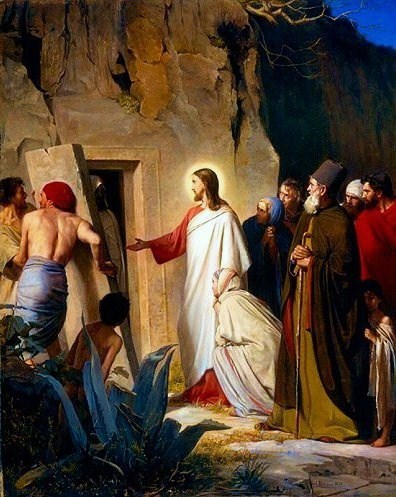
Lazarus (Eleazar) is the brother of Mary Magdalene. Surely she knows her brother has been raised from the dead. Did they have conversations? Did he tell his sisters some amazing things? Did these women talk about his miracle with others, who may have been the wives of the Disciples? If so, why is everyone startled and unbelieving of the second raising of the dead? Peter’s wife was told – for sure!
The strange men, in dazzling robes, fill them in, because, they see the followers of Jesus are not believing – this is possible! They are depicted as angels, later on. But, what if they were mere men, in angel-like clothing? How did mere men come to know all there is to know about the resurrection of the dead? Jesus failed to convince his disciples this was coming. But, there is Lazarus walking with them, traveling by their side! Did Peter and Lazarus talk about what it was like to be dead, then, born again? Did he inquire, thus…….
“Did you see the face of God? Thomas says you saw heaven! Matthew thinks we are dead because we saw angels. He also saw a bunch of sleeping dudes come out of their tombs after the eclipse and earthquake……… and after Jesus gave up the holy ghost. I tried to talk to one of the Sleeping Ones, but the line was too long.”
“What earthquake! There was no earthquake. I did get to talk to one of the Sleeping Ones, but it was all in riddles – too! You’re beginning to trip me out, Peter, with this idea WE are both dead. Are we both one of the Sleeping Ones? If you really listen to what we are saying! I mean, almost everyone in Jerusalem knows you have been talking to a dead man – for over a month!”
“Shut-up already!”
“You started it!”
Something is VERY FISHY! What is really going on?
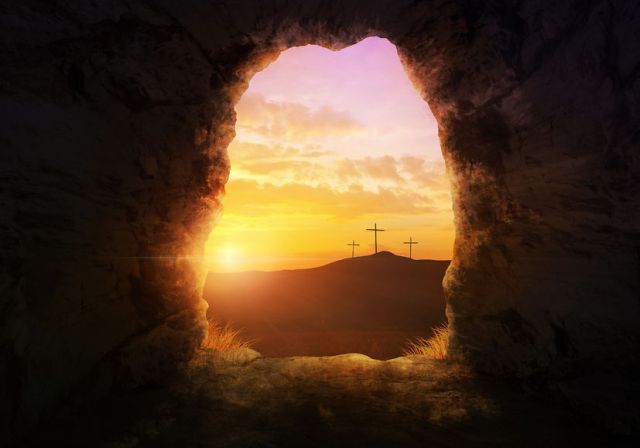
The top photo is the cave at McLure’s Beach where three Seers said I died in 1967.
Jon ‘The Nazarite’
Copyright 2017
24 But on the first day of the week, at early dawn, they came to the tomb, taking the spices that they had prepared. 2 They found the stone rolled away from the tomb, 3 but when they went in, they did not find the body.[a] 4 While they were perplexed about this, suddenly two men in dazzling clothes stood beside them. 5 The women[b] were terrified and bowed their faces to the ground, but the men[c] said to them, “Why do you look for the living among the dead? He is not here, but has risen.[d] 6 Remember how he told you, while he was still in Galilee, 7 that the Son of Man must be handed over to sinners, and be crucified, and on the third day rise again.” 8 Then they remembered his words, 9 and returning from the tomb, they told all this to the eleven and to all the rest. 10 Now it was Mary Magdalene, Joanna, Mary the mother of James, and the other women with them who told this to the apostles. 11 But these words seemed to them an idle tale, and they did not believe them. 12 But Peter got up and ran to the tomb; stooping and looking in, he saw the linen cloths by themselves; then he went home, amazed at what had happened.[
|
https://en.wikipedia.org/wiki/Matthew_27:53


Raising Lazarus, Oil on Copper Plate, 1875, Carl Heinrich Bloch (Hope Gallery, Salt Lake City)
The biblical narrative of the Raising of Lazarus is found in chapter 11 of the Gospel of John.[8] Lazarus is introduced as a follower of Jesus, who lives in the town of Bethany near Jerusalem.[9] He is identified as the brother of the sisters Mary and Martha. The sisters send word to Jesus that Lazarus, “he whom thou lovest,” is ill.[10] Instead of immediately traveling to Bethany, according to the narrator, Jesus intentionally remains where he is for two more days before beginning the journey.
When Jesus arrives in Bethany, he finds that Lazarus is dead and has already been in his tomb for four days. He meets first with Martha and Mary in turn. Martha laments that Jesus did not arrive soon enough to heal her brother and Jesus replies with the well-known statement, “I am the resurrection, and the life: he that believeth in me, though he were dead, yet shall he live: And whosoever liveth and believeth in me shall never die”.[11] Later the narrator here gives the famous simple phrase, “Jesus wept“.[12]
In the presence of a crowd of Jewish mourners, Jesus comes to the tomb. Over the objections of Martha, Jesus has them roll the stone away from the entrance to the tomb and says a prayer. He then calls Lazarus to come out and Lazarus does so, still wrapped in his grave-cloths. Jesus then calls for someone to remove the grave-cloths, and let him go.
The narrative ends with the statement that many of the witnesses to this event “believed in him.” Others are said to report the events to the religious authorities in Jerusalem.
The Gospel of John mentions Lazarus again in chapter 12. Six days before the Passover on which Jesus is crucified, Jesus returns to Bethany and Lazarus attends a supper that Martha, his sister, serves.[13] Jesus and Lazarus together attract the attention of many Jews and the narrator states that the chief priests consider having Lazarus put to death because so many people are believing in Jesus on account of this miracle.[14]
The miracle of the raising of Lazarus, the longest coherent narrative in John aside from the Passion, is the climax of John’s “signs”. It explains the crowds seeking Jesus on Palm Sunday, and leads directly to the decision of Caiaphas and the Sanhedrin to kill Jesus.
It is notable that at John 11:11, Jesus indicates to his disciples that Lazarus has fallen asleep. The disciples thought Jesus meant Lazurus was actually sleeping in verse 12. Then, in verse 14, Jesus speaks plainly and tells them that “Lazurus has died”. This is just one account where death is likened to sleep and a state of unconsciousness.
A resurrection story that is very similar is also found in the controversial Secret Gospel of Mark, although the young man is not named there specifically. Some scholars believe that the Secret Mark version represents an earlier form of the canonical story found in John.[citation needed]
Depictions in art[edit]
 |
Wikimedia Commons has media related to Resurrection of Lazarus. |
The Raising of Lazarus is a popular subject in religious art.[15] Two of the most famous paintings are those of Michelangelo Merisi da Caravaggio (c. 1609) and Sebastiano del Piombo (1516). Among other prominent depictions of Lazarus are works by Rembrandt, Van Gogh, Ivor Williams, and Lazarus Breaking His Fast by Walter Sickert.

 Rosamond Press
Leave a comment