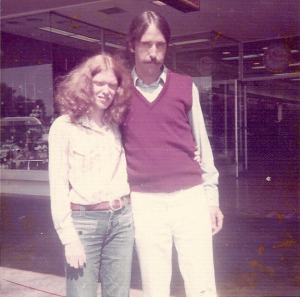
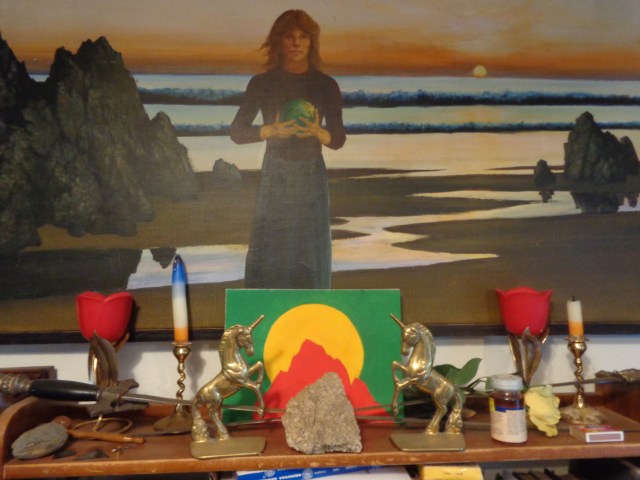
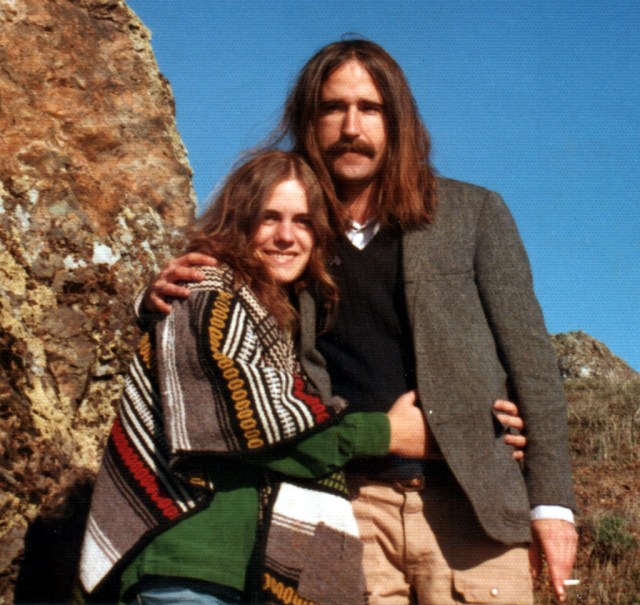

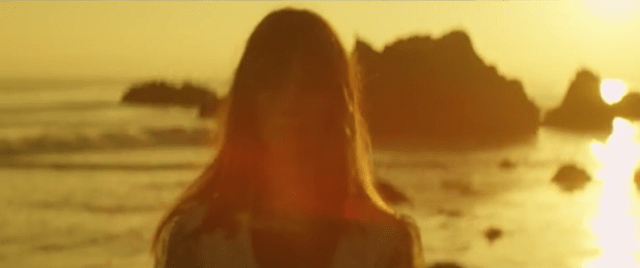
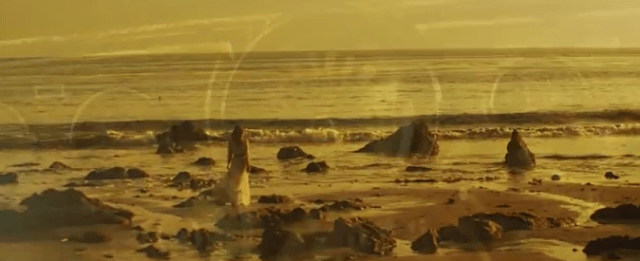


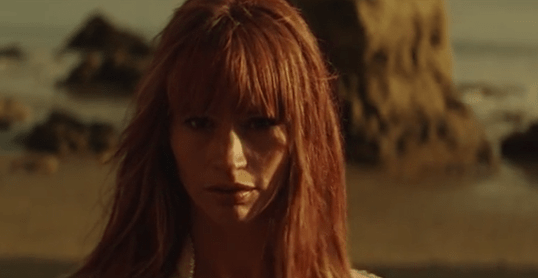
I just found this trailer – for a movie that has not been made yet! What? Above is my painting I did in 1976 when I lived with Gloria. That’s us at my favorite rocks. You can say I worship this un-named woman coming out of the sea! What is going on?
I am dumbfounded! Check out the videos I made over a year ago – after this scene was shot? This light kept visiting me, talking to me. I call her my messenger. Is someone trying to contact me? Is that person alive………..or dead?
My late friend was a good friend of Jim, and was asked to help with Stone’s movie. He declined. Jim and my friend were close friends of the real Beat Poet, Michael McLure, who I met twice. He is the one that encouraged Jim to be a poet. He is ignored in this movie – yet to be!
I’m afraid this is a sign the world is coming to an end. When I saw this cave, how could I ignore the messages. I gave her the face of a Lioness! Her throat chakra is – wide open! She gives me permission to…….speak to you! Note the electrical energy around my head!
Jon Presco
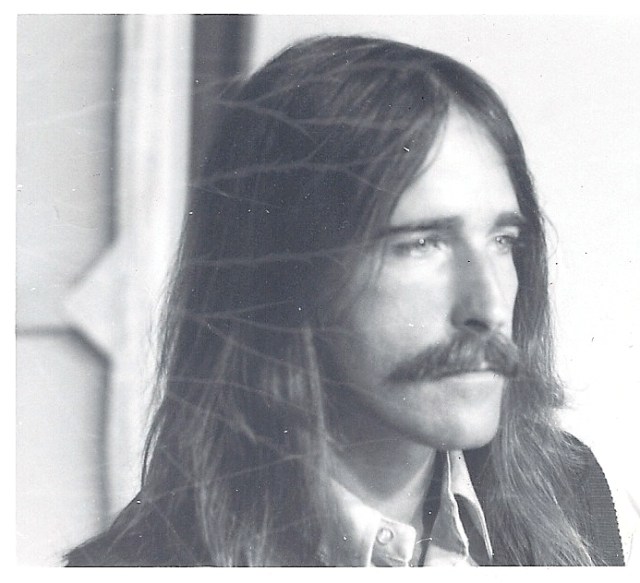
This is probably one of the reasons why Morrison became confrontational with his audience — they weren’t listening to any of the lyrics and didn’t care about what the band was trying to say through their music.
I know Jim loved film and the cinema and of course worked on a version of one of his projects, which we now know as HWY, but I’m not sure how far that desire to actually make films went. For me, it seemed like he really wanted — and really needed — to hide away and sit with himself, and just write, write as much as he could. But sometimes, as we all know, it’s just this premise — the writer confronting the empty page — that can be very frightening, and lead to all sorts of things going through someone’s head, and this is certainly part of what we are trying to explore too.

FC: Where did you grow up? What was family life like for you? What were your aspirations before leaving home?
RS: I grew up in a small town called Castro Valley, which is about 25-30 miles away from San Francisco, in the East Bay. My parents divorced when I was around 4, and I lived most of the time with my mom who, like a lot of single parents, worked a lot to get the bills paid. I went to a school within walking distance of the apartment we lived in, so I had a lot of time to myself particularly when I was in middle school. I was pretty introverted so I was in my head a lot, in there with my imagination, and I’m sure that’s one of the reasons I started seeing movies and film as something I might want to do when I was older.

And this did indeed carry over — I did drama in high school and knew pretty much by the time I was ready for college that I wanted to study filmmaking.
FC: At what age and where were you upon hearing your very first Door’s song?
RS: I have no doubt I heard some of the songs when I was a kid (how can you not!) but it really wasn’t until late high school / college where The Doors really started to speak to me. And looking back, it just feels like it was probably “Break on Through” that really first grabbed me.
RS: Well, like a lot of other fans, of course I love Morrison’s work with the Doors and it’s impossible not to see him in the role of the lead singer/rock star. But I truly adore is poetry and writing. It feels very tied to some of the great American writers I love, most specifically Jack Kerouac. There is a deep curiosity about the mystery of being human in Morrison’s work. And as an artist, there seems to be both a need to remove restrictions and break boundaries, but at the same time someone who was interested in form, who was conscious of working his poetry into different ways on the page — like still the need to make sense of the chaos and burst of images, themes, and ideas that were streaming through his head. And of course, this is the core of what we are doing with “The Last Beat,” to make sure people do see someone like Morrison as a true poet and writer with the ability, like all great writers, to show you something about ourselves we don’t see, or keep ourselves from seeing. So, for me, this is really the James Douglas Morrison I’ve come to identify the most with, not the “T-shirt” version of the man.
FC: Many individuals have proudly confessed to me in prior conversations having gone on complete Jim Morrison ‘binges,’ where they’ve become obsessed with his life, consuming as much information within a short time. Have you witnessed or experienced this?

RS: Oh yes! And of course, I’m just as guilty of that — especially when I was really getting deeper into The Doors in college. At the time I was certainly reading the obligatory bio “No One Here Gets out Alive.” I was also going to college in San Francisco, and this was the 90’s, and there was a great interest in all things 60’s, so Morrison and The Doors were obviously one of the leading bands being listened to, and even a lot of the current music was referencing, including of course, Hendrix and the Grateful Dead. Beyond Pearl Jam, bands like The Brian Jonestown Massacre and The Dandy Warhols were certainly heavily influenced by music from the 60’s, early 70’s. So the environment itself was sort of pushing all this on me, and on others — and Oliver Stone’s film was also getting made at this time, so there was a lot of buzz about that, and looking back, it seems to make sense that it was getting made at that time. And when you’re young and hungry for knowledge, of course, you’re binging on all of this hardcore. When “The Doors” film came to town, my friends and I all signed up to be extras, and that was an amazing experience — when you’re 19 watching a director you admire and in a world you’re kind of obsessed with!

FC: Did you ever experience this same phenomenon with Pamela Courson?
RS: Not so much in college, but now that we are making this film — and we’ve certainly got a character inspired by Pamela — I can see that she resonated with a lot people too. We were lucky enough to have seen Ray Manzarek along with Robby Krieger at a screening for the film based on the making of the album “LA Woman,” and I’m pretty sure it was Ray who called them the “Rock ‘n’ Roll Romeo and Juliet,” which I think really nails it. There is something about the both of them together that is beautiful and tragic — and yes, totally rock ‘n’ roll and iconic — and that can’t help but capture people’s imaginations, and Pam’s spirit shines through all of their photos together. Maybe it is the sense that she was trying to be the light in some of the darkness Morrison seemed to fall into.

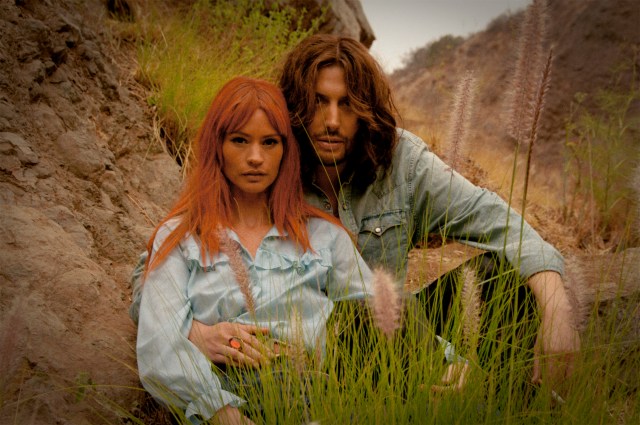
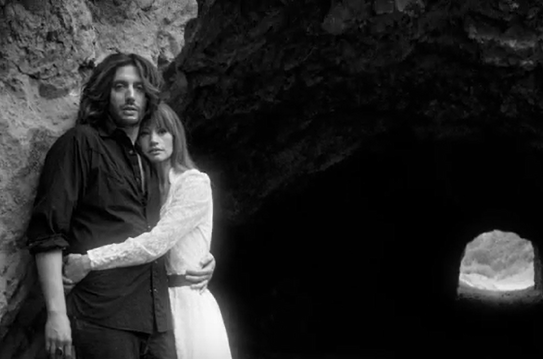
Along with our fictional take on Morrison, we still wanted our female character, whom we call Valerie, to ultimately be a very three dimensional character, so although Pam is certainly a jumping off point, it was important she be a strong character that feels as much “equal” to Jay (our Morrison-inspired character) and not just “the girlfriend.” I think that comes through even in the photos we’ve taken of our two leads, Shawn Andrews and Cameron Richardson, as well as this initial scene we’ve shot, and I think fans of both Morrison and Pamela Courson are hopefully sensing that we want to make sure these characters aren’t caricatures, but still portray the spirit of the real people they are inspired by.

FC: Where were you (physically and in life) when the idea for THE LAST BEAT came to you? How long did you wrestle with the idea?
RS: I think I was still on the festival circuit with my last film, “Godspeed.” This was always a story I have really wanted to tell for a while, but it wasn’t until I met with Shawn Andrews (our lead actor) during this period and he told me that this was the film he wanted to make, and we should make it together — something on the last days of Jim Morrison. We got some coffee, took a walk, and the genesis, including a more fictional approach like what Van Sant did with Cobain in “Last Days,” was the direction we decided to take. We even brainstormed a few scenes and some of the core story elements, which are still in the script.

So, it was really Shawn that lit the fire, sparked me to commit to writing this, and in terms of wrestling with the concept, the script really poured out of me fairly quickly. I was really inspired by this one, and it may sound weird, but this felt like the most personal thing I had ever written in my life.
In terms of where I was in my own life, it was definitely a transition time, and I think for Shawn too — we both just decided we needed to find a project that was something we deep down wanted to make on all levels, and commit to it, period. I think we were so proud of our last films, but disappointed about how hard it was for them to be seen and heard that if we were going to make another film it had to be something very special to our hearts and with people that would give 110% to the production, from the financing to getting the film out there.

To be honest, the real struggle has really been the financing, the struggle to bring this concept and script to life, rather than getting it down on paper.
FC: What about Morrison’s last days in Paris move you?
RS: Well, that’s what this whole film “The Last Beat” really is — the answer to this question!
But it’s most certainly not the morbid facts of how this person might have died, but the psychology of what was going through his head at the time. I feel like Morrison just kind of knew at this point that this was the last act, and there was this deep fatigue for all things in this world that seemed to prevent him from doing the one thing that I think saved his sanity before — writing, writing poetry, and even maybe prevented him from loving the way he wanted. So along with that is the question of how this affected his relationships, most specifically of course, with his long-term girlfriend. This might sound a little mundane, but it’s some of these smaller, intimate moments that we really want to focus on, moments I think are missing in popular culture depictions of Morrison.

As I say in some of the project summaries for the film, you can’t really separate Morrison from the time he lived in, and our characters are certainly affected by all that was happening in the late 60’s, early 70’s, even in France. They are complex events that can’t be simplified into “Right vs. Left,” and I think someone like Morrison was more attuned to that than most, and in the end, people, even on the Left, started to criticize him. This is also something we want to explore by focusing in on these last days in Paris — this notion of the responsibility of an artist, someone who pushes an audience to react and even maybe revolt against authority, the status quo, but then maybe disappears from all of this, walks away from it. I think this was tied to him walking away from the rock star status, wanting to lose the Lizard King identity — it rattled people especially during a time when American society and modern democracy as a whole was really questioning itself, and I think it also shattered, broke something inside of Morrison, knowing full well he was probably just as responsible for creating this image of himself as everyone else.
FC: As you’ve experienced life and the film industry, how have your thoughts evolved on Morrison’s alleged desire to make movies and be taken more seriously? Although deep and introspective, it is said that he wrestled with labels as a ‘heartthrob,’ ‘teen idol,’ or ‘rebellious front man?’
RS: Well, maybe this is tied to the last question, to the idea that Morrison wanted to shed (and maybe shred) the skin of the Lizard King identity. I really do believe he wanted to be taken quite seriously as a writer and artist, but also felt that what he and The Doors did wasn’t just any music, wasn’t just pop music, but also music and art they wanted people to take seriously too. The Doors, at least to me, weren’t just saying “we’re young, let’s have some fun,” it was “we’re young and the world needs to change!” There was an idealism and intelligence to their music that I think was pretty misunderstood at the time and then carried over into how everyone saw and related to its charismatic front man. This is probably one of the reasons why Morrison became confrontational with his audience — they weren’t listening to any of the lyrics and didn’t care about what the band was trying to say through their music.
I know Jim loved film and the cinema and of course worked on a version of one of his projects, which we now know as HWY, but I’m not sure how far that desire to actually make films went. For me, it seemed like he really wanted — and really needed — to hide away and sit with himself, and just write, write as much as he could. But sometimes, as we all know, it’s just this premise — the writer confronting the empty page — that can be very frightening, and lead to all sorts of things going through someone’s head, and this is certainly part of what we are trying to explore too.
 Rosamond Press
Leave a comment