

Ted Cruz is a Demon Deceiver. He graduated at the top of his class at Harvard Law School. He knew about the Southern Strategy, and the trouble Bob Jones got it with the IRS when they made rules against mixed-race couples. He is preying upon the ignorance of young people. He is a predator for King Jesus, who was not against abortion.
https://en.wikipedia.org/wiki/Southern_strategy
In American politics, southern strategy refers to methods the Republican Party used to gain political support in the South by appealing to the racism against African Americans harbored by many southern white voters.[1][2][3]
As the African American Civil Rights Movement and dismantling of Jim Crow laws in the 1950s and 1960s visibly deepened pre-existing racial tensions in much of the Southern United States, Republican politicians such as presidential candidate Richard Nixon and Senator Barry Goldwater developed strategies that successfully contributed to the political realignment of many white, conservative voters in the South to the Republican Party that had traditionally supported the Democratic Party.[4] It also helped push the Republican Party much more right.[4]
My kindred co-founded the Republican Abolitionist Party. Cruz voted for Sessions who is now the Attorney General. He is what the leader of the Radical Republicans proposed when they won the Civil War.
“Stevens was the leader of the Radical Republicans, who had full control of Congress after the 1866 elections. He largely set the course of Reconstruction. He wanted to begin to rebuild the South, using military power to force the South to recognize the equality of Freedmen. When President Johnson resisted, Stevens proposed and passed the resolution for the impeachment of Andrew Johnson in 1868.
Stevens told W. W. Holden, the Republican governor of North Carolina, in December 1866, “It would be best for the South to remain ten years longer under military rule, and that during this time we would have Territorial Governors, with Territorial Legislatures, and the government at Washington would pay our general expenses as territories, and educate our children, white and colored and both.”[8]
https://en.wikipedia.org/wiki/Hutchinson_Family_Singers
http://www.confederateamericanpride.com/LincolnPutsch.html
A forgotten chapter in the history of America is the influence of German communists in the Midwest in the years following 1848. Refugees numbering in the many thousands from the failed communist Revolution of 1848 settled there, bringing with them socialist ideas favoring large central government, land redistribution, and abolitionism.
These people avidly supported the election of Abraham Lincoln in 1860, providing what many believe was the margin of victory. In response to Lincoln’s call for troops, they joined the Union Army in large numbers, forming perhaps one out of eight of all Union troops in the field, a great many of them under German officers, themselves communist veterans. In the civilian sphere, socialists and communists formed a powerful element in the Republican Party, and Lincoln, himself a midwesterner who shared much of their worldview, awarded them with major appointments.
As far as enlisted men were concerned, the number of Germans, most of whom had also seen service in the Revolutionary armies, was, literally, legion. In New York City alone, thousands of Germans volunteered immediately after Fort Sumter. New York state had 10 purely German regiments during the war.
The Revolution of 1848 was in some respects a reverse image of the War for Southern Independence. Germany, which existed as hardly more than an abstraction, was in fact a decentralized collection of autonomous states. In keeping with the Marxist emphasis on the large, omnipotent, central government, these so called “revolutionaries” were actually intent on overthrowing local rule and setting up a totalitarian dictatorship.
An interesting phenomenon in 1860 was the “Wide-Awake Club” movement. Wide-Awake Clubs were paramilitary German and Scandinavian Republican organizations founded to promote the Lincoln cause. A Wide-Awake Club was founded in Washington, DC, and in three days signed up over 50 members, most of whom were German Jews.
https://en.wikipedia.org/wiki/Wide_Awakes
The day after Sen. Elizabeth Warren (D-Mass.) was rebuked while making a speech critical of Sen. Jeff Sessions (R-Ala.), Sen. Ted Cruz blasted Democrats, saying their party is the one rooted in racism.
“The Democrats are the party of the Ku Klux Klan,” Cruz (R-Tex.) said in an interview on Fox News on Wednesday. “You look at the most racist — you look at the Dixiecrats, they were Democrats who imposed segregation, imposed Jim Crow laws, who founded the Klan. The Klan was founded by a great many Democrats.”
Cruz isn’t the first Republican to associate Democrats with the Ku Klux Klan.
In 2013, Virginia state Sen. Stephen Martin said that the Democratic Party created the hate group. Martin later released a statement saying he “regretted the carelessness and inaccuracy of his comments,” according to PolitiFact.
Although there is some historical link between Democrats and the KKK, to say that the hate group was founded by the Democratic Party is misleading, J. Michael Martinez, author of “Carpetbaggers, Cavalry and the KKK,” told PolitiFact. Angry Southern whites during the 1860s and 1870s were Democrats, and some of them joined the KKK, which was more of a grass-roots creation.
Members of the KKK in the South acted as a “strong arm” for Democratic politicians during the Reconstruction Era, and Confederate Gen. Nathan Bedford Forrest, who was associated with the KKK, spoke at the 1868 Democratic National Convention, Carole Emberton, an associate professor of history at the University of Buffalo, told PolitiFact.
But, Emberton also said that the party lines of the 1860s and 1870s “are not the party lines of today.” By the 1960s, the Democratic Party was the party of the civil rights movement.
Similar claims also have been debunked by the Southern Poverty Law Center, an Alabama-based hate watch group.
Last year, David Neiwert, a contributing writer for the group, wrote that describing the KKK as a “leftist” organization is false.
” Yes, in the South of the 1920s, the Klan was a militaristic and terroristic wing of the Jim Crow-loving Democratic Party there, in no shape, form, or fashion was this the ‘leftist’ wing of the Democratic Party. When the members of the Klan were Democrats, as in the 1920s, as well as in the ’40s when they were called ‘Dixiecrats,’ they were conservative Democrats,” he wrote.
Neiwert’s article was in response to CNN conservative analyst Jeffrey Lord’s statement calling the KKK “a leftist terrorist organization.”
The Dixiecrats Cruz referred to was a splinter group of conservative white Southern Democrats who opposed the national party’s growing intervention in race relations. They even ran a rival campaign in the 1948 presidential election, pitting then-South Carolina Gov. Strom Thurmond against the Democratic incumbent, President Harry S. Truman.
The rest of Cruz’s comments on Fox News focused on defending Sessions, whom he called an “honorable, decent person” and who has faced repeated accusations of racism.
“The charges that she was making of Jeff Sessions are demonstrably false. They’re slanderous, they’re ugly,” Cruz said of Warren.
Cruz was referring to Warren’s decision to read statements that figures such as the late senator Edward M. Kennedy (D-Mass.) and the late Coretta Scott King had made in the past against Sessions. The Democrat from Massachusetts was reading a letter written by the wife of slain civil rights leader Martin Luther King Jr. when, in an extraordinarily rare move, Senate Majority Leader Mitch McConnell (R-Ky.) interrupted her, saying she’d violated Senate rules.
The specific rule in question, Rule 19, says senators are not allowed to “directly or indirectly, by any form of words impute to another Senator or to other Senators any conduct or motive unworthy or unbecoming of a Senator.” In a 49-to-43 vote, the Senate upheld the ruling that Warren violated the rarely invoked rule.
The statements from Kennedy and Coretta Scott King were both in opposition to Sessions’s nomination for the federal judgeship in 1986. At that time, Kennedy was a senior member of the Judiciary Committee.
During the debate Tuesday night, Warren read Kennedy’s statement that called Sessions “a disgrace to the Justice Department.”
Warren had just started reading the letter from Coretta Scott King when she was interrupted.
“Mr. Sessions has used the awesome powers of his office in a shabby attempt to intimidate and frighten elderly black voters. For this reprehensible conduct, he should not be rewarded with a federal judgeship,” Coretta Scott King wrote, referring to controversial prosecutions when Sessions was the U.S. attorney for Alabama.
Cruz said what happened Tuesday night demonstrates the Democratic Party’s desperation and anger. He added that the Democrats are not angry at Republicans; they’re mad at the voters because of the outcome of the election.
“When the left doesn’t have any more arguments, they go and just accuse everyone of being a racist,” Cruz said, “and it’s an ugly, ugly part of the modern Democratic Party.”
Democrats have since rallied behind Warren. Some began using #LetLizSpeak on Twitter and posted copies of King’s letter to Facebook. Others criticized McConnell, saying he selectively enforced the more-than-200-year-old rule and pointed out other instances in which it could’ve been used, but wasn’t.
In 2015, for instance, Cruz accused McConnell of lying during a debate over whether to fund the Export-Import Bank, a little-known government agency that helps fund risky investments abroad. Cruz was not found to be in violation of Rule 19 then. Politico congressional reporter Burgess Everett reported that McConnell convinced his colleagues to stand down.
The final vote for Sessions is scheduled for Wednesday evening, a day after the Senate narrowly confirmed Betsy DeVos as education secretary.
Paul Kane, Ed O’Keefe and Amber Phillips contributed to this report.
Radical Republicans Then and Now
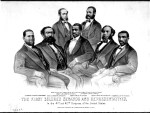


Before the Civil War Radical Republicans were against the systematic rape and breeding of black slaves, anything that looked like Christian family values denied them – along with voter’s rights. Imagine being a fifteen year old black slave who has just been raped by your white master, or the male slave he chose for you to breed with in order to produce a stronger worker. Would you want to abort that baby who will be born a slave – and nearly worked to death? Would your master punish you for even considering not being pro-life? If other black mothers conspired to abort their babies would their slave master try to make this conspiracy against State Law, it now an act of treason to not want to give birth to slaves that the economy of the south depends upon?The greatest moral story in human history exists in the plight of female slaves, who were denied husbands and families, yet, they found Jesus and owned hope that one day they would have what mother’s have all over the world. For any man to thwart, hope arrived, is the demon of all demons.
The Radical Republican Thadeus Stevens knew who and what he was dealing with. He read the evil sermons given in the south by alleged men of God and Jesus. He knew he was dealing with a disease, a anti-Christian plague that was destroying the white and black race. I suspect white female evangelicals are jealous of their black counterpart because their cause does bring them closer to God and Jesus. This is a Cain and Able story amongst evangelical women, and thus they look the other way as white evangelical men conduct a War on Women.
Below is the review of the book ‘Thy kingdom Come’. It reveals how the racist south rose again when they adopted the fake anti-abortion crusade for the purpous of reversing the gains women slaves have made. These neo-Confederates have thrown our nation in reverse, and we are back in the days of Reconstruction heading for another Civil War.
Jon Presco
‘Thy Kingdom Come’
June 23, 2006
President Bush and the Republican Party find strong support among evangelical voters. But in his new book, Thy Kingdom Come, author Randall Balmer says that allegiance is misplaced.
“I don’t find much that I recognize as Christian” in the religious right, says Balmer, a professor of religion at Barnard College, Columbia University and contributing editor to Christianity Today.
He says blind allegiance to the Republican Party has distorted the faith of politically active evangelicals, leading them to misguided positions on issues such as abortion and homosexuality.
“They have taken something that is lovely and redemptive and turned it into something that is ugly and retributive,” Balmer says.
He argues that modern evangelicals have abandoned the spirit of their movement, which was founded in 19th-century activism on issues that helped those on the fringes of society: abolition, women’s suffrage and universal education.
“I don’t find any correlation in the agenda of the religious right today,” Balmer says.
Book Excerpt: ‘Thy Kingdom Come’
by Randall Balmer
In the 1980s, in order to solidify their shift from divorce to abortion, the Religious Right constructed an abortion myth, one accepted by most Americans as true. Simply put, the abortion myth is this: Leaders of the Religious Right would have us believe that their movement began in direct response to the U.S. Supreme Court’s 1973 Roe v. Wade decision. Politically conservative evangelical leaders were so morally outraged by the ruling that they instantly shed their apolitical stupor in order to mobilize politically in defense of the sanctity of life. Most of these leaders did so reluctantly and at great personal sacrifice, risking the obloquy of their congregants and the contempt of liberals and “secular humanists,” who were trying their best to ruin America. But these selfless, courageous leaders of the Religious Right, inspired by the opponents of slavery in the nineteenth century, trudged dutifully into battle in order to defend those innocent unborn children, newly endangered by the Supreme Court’s misguided Roe decision.
It’s a compelling story, no question about it. Except for one thing: It isn’t true.
Although various Roman Catholic groups denounced the ruling, and Christianity Today complained that the Roe decision “runs counter to the moral teachings of Christianity through the ages but also to the moral sense of the American people,” the vast majority of evangelical leaders said virtually nothing about it; many of those who did comment actually applauded the decision. W. Barry Garrett of Baptist Press wrote, “Religious liberty, human equality and justice are advanced by the Supreme Court abortion decision.” Indeed, even before the Roe decision, the messengers (delegates) to the 1971 Southern Baptist Convention gathering in St. Louis, Missouri, adopted a resolution that stated, “we call upon Southern Baptists to work for legislation that will allow the possibility of abortion under such conditions as rape, incest, clear evidence of severe fetal deformity, and carefully ascertained evidence of the likelihood of damage to the emotional, mental, and physical health of the mother.” W.A. Criswell, former president of the Southern Baptist Convention and pastor of First Baptist Church in Dallas, Texas, expressed his satisfaction with the Roe v. Wade ruling. “I have always felt that it was only after a child was born and had a life separate from its mother that it became an individual person,” the redoubtable fundamentalist declared, “and it has always, therefore, seemed to me that what is best for the mother and for the future should be allowed.”
The Religious Right’s self-portrayal as mobilizing in response to the Roe decision was so pervasive among evangelicals that few questioned it. But my attendance at an unusual gathering in Washington, D.C., finally alerted me to the abortion myth. In November
1990, for reasons that I still don’t entirely understand, I was invited to attend a conference in Washington sponsored by the Ethics and Public Policy Center, a Religious Right organization (though I didn’t realize it at the time). I soon found myself in a conference room with a couple of dozen people, including Ralph Reed, then head of the Christian Coalition; Carl F. H. Henry, an evangelical theologian; Tom Minnery of Focus on the Family; Donald Wildmon, head of the American Family Association; Richard Land of the Southern Baptist Convention; and Edward G. Dobson, pastor of an evangelical church in Grand Rapids, Michigan, and formerly one of Jerry Falwell’s acolytes at Moral Majority. Paul M. Weyrich, a longtime conservative activist, head of what is now called the Free Congress Foundation, and one of the architects of the Religious Right in the late 1970s, was also there.
In the course of one of the sessions, Weyrich tried to make a point to his Religious Right brethren (no women attended the conference, as I recall). Let’s remember, he said animatedly, that the Religious Right did not come together in response to the Roe decision. No, Weyrich insisted, what got us going as a political movement was the attempt on the part of the Internal Revenue Service (IRS) to rescind the tax-exempt status of Bob Jones University because of its racially discriminatory policies.
Bob Jones University was one target of a broader attempt by the federal government to enforce the provisions of the Civil Rights Act of 1964. Several agencies, including the Equal Employment Opportunity Commission, had sought to penalize schools for failure to abide by antisegregation provisions. A court case in 1972, Green v. Connally, produced a ruling that any institution that practiced segregation was not, by definition, a charitable institution and, therefore, no longer qualified for tax-exempt standing.
The IRS sought to revoke the tax-exempt status of Bob Jones University in 1975 because the school’s regulations forbade interracial dating; African Americans, in fact, had been denied admission altogether until 1971, and it took another four years before unmarried African Americans were allowed to enroll. The university filed suit to retain its tax-exempt status, although that suit would not reach the Supreme Court until 1983 (at which time, the Reagan administration argued in favor of Bob Jones University).
Initially, I found Weyrich’s admission jarring. He declared, in effect, that the origins of the Religious Right lay in Green v. Connally rather than Roe v. Wade. I quickly concluded, however, that his story made a great deal of sense. When I was growing up within the evangelical subculture, there was an unmistakably defensive cast to evangelicalism. I recall many presidents of colleges or Bible institutes coming through our churches to recruit students and to raise money. One of their recurrent themes was,We don’t accept federal money, so the government can’t tell us how to run our shop—whom to hire or fire or what kind of rules to live by. The IRS attempt to deny tax-exempt status to segregated private schools, then, represented an assault on the evangelical subculture, something that raised an alarm among many evangelical leaders, who mobilized against it.
For his part, Weyrich saw the evangelical discontent over the Bob Jones case as the opening he was looking for to start a new conservative movement using evangelicals as foot soldiers. Although both the Green decision of 1972 and the IRS action against Bob Jones University in 1975 predated Jimmy Carter’s presidency, Weyrich succeeded in blaming Carter for efforts to revoke the taxexempt status of segregated Christian schools. He recruited James Dobson and Jerry Falwell to the cause, the latter of whom complained, “In some states it’s easier to open a massage parlor than to open a Christian school.”
Weyrich, whose conservative activism dates at least as far back as the Barry Goldwater campaign in 1964, had been trying for years to energize evangelical voters over school prayer, abortion, or the proposed equal rights amendment to the Constitution. “I was
trying to get those people interested in those issues and I utterly failed,” he recalled in an interview in the early 1990s. “What changed their mind was Jimmy Carter’s intervention against the Christian schools, trying to deny them tax-exempt status on the basis of so-called de facto segregation.”
During the meeting in Washington, D.C., Weyrich went on to characterize the leaders of the Religious Right as reluctant to take up the abortion cause even close to a decade after the Roe ruling. “I had discussions with all the leading lights of the movement in the late 1970s and early 1980s, post–Roe v. Wade,” he said, “and they were all arguing that that decision was one more reason why Christians had to isolate themselves from the rest of the world.”
“What caused the movement to surface,” Weyrich reiterated,”was the federal government’s moves against Christian schools.” The IRS threat against segregated schools, he said, “enraged the Christian community.” That, not abortion, according to Weyrich, was what galvanized politically conservative evangelicals into the Religious Right and goaded them into action. “It was not the other things,” he said.
Ed Dobson, Falwell’s erstwhile associate, corroborated Weyrich’s account during the ensuing discussion. “The Religious New Right did not start because of a concern about abortion,” Dobson said. “I sat in the non-smoke-filled back room with the Moral Majority, and I frankly do not remember abortion ever being mentioned as a reason why we ought to do something.”
During the following break in the conference proceedings, I cornered Weyrich to make sure I had heard him correctly. He was adamant that, yes, the 1975 action by the IRS against Bob Jones University was responsible for the genesis of the Religious Right in
the late 1970s. What about abortion? After mobilizing to defend Bob Jones University and its racially discriminatory policies, Weyrich said, these evangelical leaders held a conference call to discuss strategy. He recalled that someone suggested that they had
the makings of a broader political movement—something that Weyrich had been pushing for all along—and asked what other issues they might address. Several callers made suggestions, and then, according to Weyrich, a voice on the end of one of the lines said, “How about abortion?” And that is how abortion was cobbled into the political agenda of the Religious Right.
The abortion myth serves as a convenient fiction because it suggests noble and altruistic motives behind the formation of the Religious Right. But it is highly disingenuous and renders absurd the argument of the leaders of Religious Right that, in defending the rights of the unborn, they are the “new abolitionists.” The Religious Right arose as a political movement for the purpose, effectively, of defending racial discrimination at Bob Jones University and at other segregated schools. Whereas evangelical abolitionists of the nineteenth century sought freedom for African Americans, the Religious Right of the late twentieth century organized to perpetuate racial discrimination. Sadly, the Religious Right has no legitimate claim to the mantle of the abolitionist crusaders of the nineteenth century. White evangelicals were conspicuous by their absence in the civil rights movement of the 1950s and 1960s. Where were Pat Robertson and Jerry Falwell and Billy Graham on August 28, 1963, during the March on Washington or on Sunday, March 7, 1965, when Martin Luther King Jr. and religious leaders from other traditions linked arms on the march from Selma to Montgomery, Alabama, to stare down the ugly face of racism?
Falwell and others who eventually became leaders of the Religious Right, in fact, explicitly condemned the civil rights movement.
“Believing the Bible as I do,” Falwell proclaimed in 1965, “I would find it impossible to stop preaching the pure saving gospel of Jesus Christ, and begin doing anything else—including fighting Communism, or participating in civil-rights reforms.”
This makes all the more outrageous the occasional attempts by leaders of the Religious Right to portray themselves as the “new abolitionists” in an effort to link their campaign against abortion to the nineteenth century crusade against slavery.
Radical Republicanism
In July 1861 the Congress passed the Crittenden-Johnson Resolution stating the limited war aim of restoring the Union while preserving slavery; Stevens helped repeal it in December. In August 1861, he supported the first law attacking slavery, the Confiscation Act that said owners would forfeit any slaves they allowed to help the Confederate war effort. By December he was the first Congressional leader pushing for emancipation as a tool to weaken the rebellion. He called for total war on January 22, 1862:
“Let us not be deceived. Those who talk about peace in sixty days are shallow statesmen. The war will not end until the government shall more fully recognize the magnitude of the crisis; until they have discovered that this is an internecine war in which one party or the other must be reduced to hopeless feebleness and the power of further effort shall be utterly annihilated. It is a sad but true alternative. The South can never be reduced to that condition so long as the war is prosecuted on its present principles. The North with all its millions of people and its countless wealth can never conquer the South until a new mode of warfare is adopted. So long as these states are left the means of cultivating their fields through forced labor, you may expend the blood of thousands and billions of money year by year, without being any nearer the end, unless you reach it by your own submission and the ruin of the nation. Slavery gives the South a great advantage in time of war. They need not, and do not, withdraw a single hand from the cultivation of the soil. Every able-bodied white man can be spared for the army. The black man, without lifting a weapon, is the mainstay of the war. How, then, can the war be carried on so as to save the Union and constitutional liberty? Prejudices may be shocked, weak minds startled, weak nerves may tremble, but they must hear and adopt it. Universal emancipation must be proclaimed to all. Those who now furnish the means of war, but who are the natural enemies of slaveholders, must be made our allies. If the slaves no longer raised cotton and rice, tobacco and grain for the rebels, this war would cease in six months, even though the liberated slaves would not raise a hand against their masters. They would no longer produce the means by which they sustain the war.”[7]
Stevens led the Radical Republican faction in their battle against the bankers over the issuance of money during the Civil War. Stevens made various speeches in Congress in favor of President Lincoln and Henry Carey’s “Greenback” system, interest-free currency in the form of fiat government-issued United States Notes that would effectively threaten the bankers’ profits in being able to issue and control the currency through fractional reserve loans. Stevens warned that a debt-based monetary system controlled by for-profit banks would lead to the eventual bankruptcy of the people, saying “the Government and not the banks should have the benefit from creating the medium of exchange,” yet after Lincoln’s assassination the Radical Republicans lost this battle and a National banking monopoly emerged in the years after.
U.S. Reps. John A. Bingham and Thaddeus Stevens before the Senate addressing the impeachment vote on U.S. President Andrew Johnson.
Stevens giving his closing remarks of the impeachment of President Johnson.Stevens was so outspoken in his condemnation of the Confederacy that Major General Jubal Early of the Army of Northern Virginia made a point of burning much of his iron business, at modern-day Caledonia State Park, to the ground during the Gettysburg Campaign. Early claimed that this action was in direct retaliation for Stevens’ perceived support of similar atrocities by the Union Army in the South.
 Rosamond Press
Leave a comment