

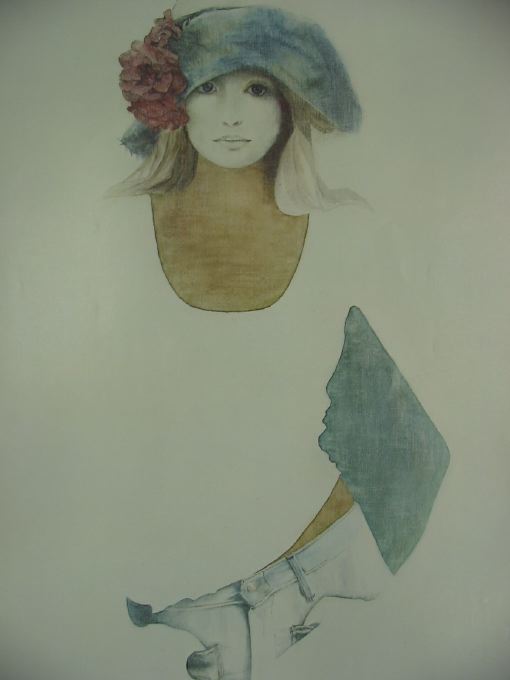


My ancestors on my father’s side were of the Boii tribe who waged war against the slave masters of Rome. These were not brigands and looters. This was a war of Indipendence. The first and sceond painting I did of Rena, depicted her as a Celtic Goddess. I had studied the Celts in 1969, the year before I met her.
My fallout with Marilyn Reed came after I caught her transfering my history, and white history in America, over to her black husband. She got very upset when I told her four of my grandfathers were Turners and Forty-Eighters who fought the King of the Romans and the Pope that blessed their armies. When they lost, and fled to America, they fought for the Unions against THE RED STATE TRAITORS! Black slaves would not have been set free without these Socialists from Germany. I have done my DNA, and my sncestors came from Eastern Europe where the Boii tribe lived.
I have to cut to the chase, because we may have run out of time.
Jon Presco
Etymology and name[edit]
From all the different names of the same Celtic people in literature and inscriptions it is possible to abstract a continental Celtic segment, boio-.[3] There are two major derivations of this segment, both presupposing that it belongs to the family of Indo-European languages: from ‘cow’ and from ‘warrior.’ The Boii would thus be either “the herding people” or “the warrior people.”
The “cow” derivation depends most immediately on the Old Irish legal term for “outsider:” ambue, from Proto-Celtic *ambouios (<*an-bouios), “not a cattle owner.”[4] In a reference to the first known historical Boii, Polybius relates[5] that their wealth consisted of cattle and gold, that they depended on agriculture and war, and that a man’s status depended on the number of associates and assistants he had. The latter were presumably the *ambouii, as opposed to the man of status, who was*bouios, a cattle owner, and the *bouii were originally a class, “the cattle owners.”

Depiction of a soldier wearing a plumed pot helmet, Hallstatt cultureBronze belt plaque from Vače,Slovenia, ca. 400 BC
The “warrior” derivation was adopted by the linguist Julius Pokorny, who presented it as being from Indo-European *bhei(ə)-, *bhī-, “hit;” however, not finding any Celtic names close to it (except for the Boii), he adduces examples somewhat more widely from originals further back in time: phohiio-s-, a Venetic personal name; Boioi, an Illyrian tribe; Boiōtoi, a Greek tribal name (“theBoeotians“) and a few others.[6] Boii would be from the o-grade of *bhei-, which is *bhoi-. Such a connection is possible if the original form of Boii belonged to a tribe of Proto-Indo-European speakers long before the time of the historic Boii. If that is the case, then the Celtic tribe of central Europe must have been a final daughter population of a linguistically diversifying ancestor tribe.
The same wider connections can be hypothesized for the “cow” derivation: the Boeotians have been known for well over a century as a people of kine, which might have been parallel to the meaning of Italy as a “land of calves.” Indo-European reconstructions can be made using *gʷou- “cow” as a basis, such as *gʷowjeh³s.[7]
Contemporary derived words include Boiorix (“king of the Boii”, one of the chieftains of the Cimbri) and Boiodurum (“gate/fort of the Boii”, modern Passau) in Germany. Their memory also survives in the modern regional names of Bohemia (Boiohaemum), a mixed-language form from boio- and Proto-Germanic *haimaz, “home”: “home of the Boii,” and ‘Bayern’, Bavaria, which is derived from the Germanic Baiovarii tribe (Germ. *baja-warjaz: the first component is most plausibly explained as a Germanic version of Boii; the second part is a common formational morpheme of Germanic tribal names, meaning ‘dwellers’, as in Anglo-Saxon -ware);[note 1] this combination “Boii-dwellers” may have meant “those who dwell where the Boii formerly dwelt”.
History[edit]

Roman accounts of movements of the Boii
Settlement in north Italy[edit]
According to the ancient authors, the Boii arrived in northern Italy by crossing the Alps. While of the other tribes who had come to Italy along with the Boii, the Senones, Lingones and Cenomaniare also attested in Gaul at the time of the Roman conquest, there is no such clear evidence for the Boii in Gaul. It remains therefore unclear where exactly the Central European origins of the Boii lay, if somewhere in Gaul, Southern Germany or in Bohemia.
Polybius relates that the Celts were close neighbors of the Etruscan civilization and “cast covetous eyes on their beautiful country.”[5] Invading the Po Valley with a large army, they drove out the Etruscans and resettled it, the Boii taking the right bank in the center of the valley. Straboconfirms that the Boii emigrated from their lands across the Alps[8] and were one of the largest tribes of the Celts.[9] The Boii occupied the old Etruscan settlement of Felsina, which they named Bononia (modern Bologna). Polybius describes the Celtic way of life in Cisalpine Gaul as follows:
They lived in unwalled villages, without any superfluous furniture; for as they slept on beds of leaves and fed on meat and were exclusively occupied with war and agriculture, their lives were very simple, and they had no knowledge whatever of any art or science. Their possessions consisted of cattle and gold, because these were the only things they could carry about with them everywhere according to circumstances and shift where they chose. They treated comradeship as of the greatest importance, those among them being the most feared and most powerful who were thought to have the largest number of attendants and associates.[5]
The archaeological evidence from Bologna and its vicinity contradicts the testimony of Polybius and Livy on some points, who say the Boii expelled the Etruscans and perhaps some were forced to leave. It much rather indicates that the Boii neither destroyed nor depopulated Felsinum, but simply moved in and became part of the population by intermarriage.[10] The cemeteries of the period in Bologna contain La Tène weapons and other artifacts, as well as Etruscan items such as bronze mirrors. At Monte Bibele not far away one grave contained La Tène weapons and a pot with an Etruscan female name scratched on it.
War against Rome[edit]
In the second half of the 3rd century BC, the Boii allied with the other Cisalpine Gauls and the Etruscans against Rome. They also fought alongside Hannibal, killing the Roman general Lucius Postumius Albinus in 216 BC, whose skull was then turned into a sacrificial bowl.[11] A short time earlier, they had been defeated at theBattle of Telamon in 224 BC, and were again at Placentia in 194 BC (modern Piacenza) and Mutina in 193 BC (modern Modena). After the loss of their capital, according to Strabo, a large portion of the Boii left Italy.
Boii on the Danube[edit]
Contrary to the interpretation of the classical writers, the Pannonian Boii attested in later sources are not simply the remnants of those who had fled from Italy, but rather another division of the tribe, which had settled there much earlier. The burial rites of the Italian Boii show many similarities with contemporary Bohemia, such asinhumation, which was uncommon with the other Cisalpine Gauls, or the absence of the typically western Celtic torcs.[12] This makes it much more likely that the Cisalpine Boii had actually originated from Bohemia rather than the other way round.[13] Having migrated to Italy from north of the Alps, some of the defeated Celts simply moved back to their kinsfolk.[note 2]
The Pannonian Boii are mentioned again in the late 2nd century BC when they repelled the Cimbri and Teutones (Strabo VII, 2, 2). Later on, they attacked the city ofNoreia (in modern Austria) shortly before a group of Boii (32,000 according to Julius Caesar – the number is probably an exaggeration) joined the Helvetii in their attempt to settle in western Gaul. After the Helvetian defeat at Bibracte, the influential Aedui tribe allowed the Boii survivors to settle on their territory, where they occupied the oppidum of Gorgobina. Although attacked by Vercingetorix during one phase of the war, they supported him with two thousand troops at the battle ofAlesia (Caes. Bell. Gall., VII, 75).
Again, other parts of the Boii had remained closer to their traditional home, and settled in the Slovak and Hungarian lowlands by the Danube and the Mura, with a centre at Bratislava. Around 60 BC they clashed with the rising power of the Dacians under their king Burebista and were defeated. When the Romans finally conquered Pannonia in 8 AD, the Boii seem not to have opposed them. Their former territory was now called deserta Boiorum (deserta meaning ’empty or sparsely populated lands’).[14] However, the Boii had not been exterminated: There was a civitas Boiorum et Azaliorum (the Azalii being a neighbouring tribe) which was under the jurisdiction of a prefect of the Danube shore (praefectus ripae Danuvii).[15] This civitas, a common Roman administrative term designating both a city and the tribal district around it, was later adjoined to the city of Carnuntum.
The Boii in ancient sources[edit]
Plautus[edit]
Plautus refers to the Boii in Captivi:
- At nunc Siculus non est, Boius est, Boiam terit
- But now he is not a Sicilian — he is a Boius, he has got a Boio woman.
There is a play on words: Boia means “woman of the Boii”, also “convicted criminal’s restraint collar”.[16]
Livy[edit]
In volume 21 of his Ab Urbe Condita Libri, Livy (59 BC – 17 AD) claims that it was a Boio man that offered to show Hannibal the way across the Alps.
When, after the action had thus occurred, his own men returned to each general, Scipio could adopt no fixed plan of proceeding, except that he should form his measures from the plans and undertakings of the enemy: and Hannibal, uncertain whether he should pursue the march he had commenced intoItaly, or fight with the Roman army which had first presented itself, the arrival of ambassadors from the Boii, and of a petty prince called Magalus, diverted from an immediate engagement; who, declaring that they would be the guides of his journey and the companions of his dangers, gave it as their opinion, that Italy ought to be attacked with the entire force of the war, his strength having been nowhere previously impaired.[17]
Inscriptions[edit]
In the first century BC, the Boii living in an oppidum of Bratislava minted Biatecs, high-quality coins with inscriptions (probably the names of kings) in Latin letters. This is the only “written source” provided by the Boii themselves.[citation needed]
 Rosamond Press
Leave a comment