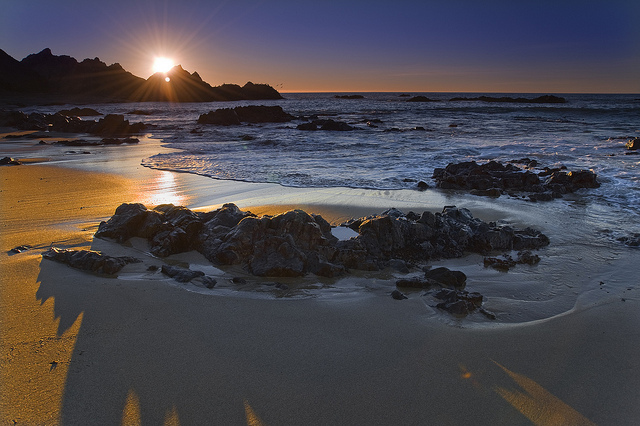
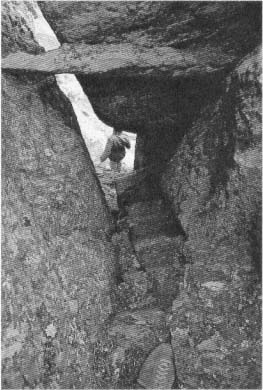
Last night I discovered there exist a passage on Skellig Michael called ‘The Needle’s Eye’. In 1988, I took a photo of the eye in the rock I climbed at Rocky Point. It lie under a narrow bridge to the top. This more than a coincidence. God has – TWO EYES – and SEES the end that is coming. He bids His Seer to speak out, and give a warning!
http://publishing.cdlib.org/ucpressebooks/view?docId=ft1d5nb0gb;chunk.id=0;doc.view=print
Note the two arrows! What more of a SIGN do you need?
Repent!
Jon ‘The Nazarite’
“Smith’s account of the pilgrimage to the island is concerned primarily with the dangers of the South Peak climb. For him one of the terrors of the ascent was the point where pilgrims have to squeeze through a hollow called the Needle’s Eye, which resembles the funnel or shaft of a chimney. After clearing this hurdle and negotiating several other perilous passages.”



William Tirey, Bishop of Cork from 1623 to 1645, records a pilgrimage to Skellig Michael among the events of his life (Foley 1903, 16). Friar O’Sullivan, a Franciscan from Muckross who wrote the Ancient History of the Kingdom of Kerry about 1750, mentions in that work “the great Skelike formerly very much noted for pilgrimage over most part of Europe” (O’Sullivan 1899, 152). Soon after, in 1756, Charles Smith published the first account of the South Peak, describing the ascent of it in detail. The South Peak stations were to be visited after those of the monastery. Smith’s remarks on this part of the pilgrimage suggest that a tradition of long standing was coming to an end: “Many persons about twenty years ago, came from the remotest parts of Ireland to perform these penances, but the zeal of such adventurous devotees, hath been very much cooled of late.”
Smith’s account of the pilgrimage to the island is concerned primarily with the dangers of the South Peak climb. For him one of the terrors of the ascent was the point where pilgrims have to squeeze through a hollow called the Needle’s Eye, which resembles the funnel or shaft of a chimney. After clearing this hurdle and negotiating several other perilous passages.
http://www.ireland.com/en-us/articles/destinations/kerry/star-wars-and-the-skelligs/
The architecture of the monastery of Skellig Michael has been the subject of a number of serious scholarly studies, the best of which were written by Liam de Paor (1955, 186) and Françoise Henry (1957, 127–29). The architectural remains on the South Peak, however, have never been acknowledged to any extent and certainly never systematically investigated.
Typically the South Peak has been written up as an exciting part of the pilgrimage to the island. For centuries Skellig Michael was famous as a place of pilgrimage and penitence. It is not known when pilgrimages to the island started, but they were flourishing in the early sixteenth century when the register of Archbishop Dowdall of Armagh mentions Skellig Michael as one of the main penitential stations in Ireland (Gogarty 1912, 1:248–76; 1913, 2:242–55). Pilgrims continued to visit Skellig Michael even after it came under the jurisdiction of the Ballinskelligs monks. Nothing is known about the monks’ connection with the pilgrimages, however, nor is it known whether the sixteenth-century pilgrims sought only the monastery or the South Peak as well.

 Rosamond Press
Leave a comment