
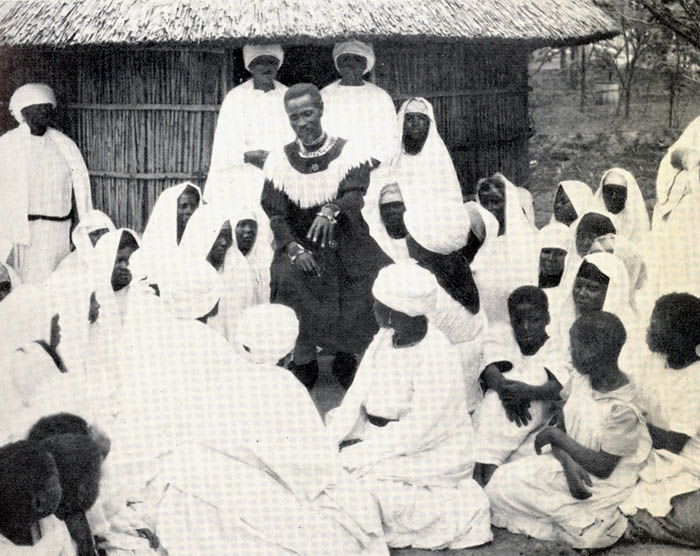
When Marilyn Reed became my adversary, she was very covert. She spoke in riddles about copyrights. Samson was a riddle maker and solver. She said I was contaminating her Choir. This great split between old friends, is a sign that God is moving His chess pieces, and we are His pawns. A power greater then ourselves is moving upon the waters. I posted about Shembe on the facebook of the President and Director of Inspitional Gospel Sounds Choir, four months before I heard of the African Culture event at the Hult.
When Trump was invited to come contaminate the African-American Church by a minister committing the great sin of Religious Vanity, then God sent His Nazarite, and His Nararites, to purify that Church that is now a part of African Initiated Church – that I have prepared the way for!
I was named after John the Baptist because I was born three days after Yom Kippur, during an amazing Star Shower. I have been filled with the Holy Spirit most of my life.
I am looking for funds to go to the Land of the Zulu in order to bring the Good News.
Jon
‘The Nazarite’
Nazareth Baptist Church (Alternatively called “The Nazarite Church” “iBandla lamaNazaretha”) is an African Initiated Church founded by Isaiah Shembe 1910.[1]
It has approximately 4 million members.[2] The religion bans smoking, drinking, adultery and fornicating.[3] It reveres Shembe as a prophet sent by God to restore the teachings of Moses, the prophets, and Jesus.
It was divided into two groups after the 1976 death of Johannes Galilee Shembe. The larger group was led by Bishop Amos Shembe until his death in 1995, while Rev. Londa Shembe led the smaller group.[4]
As of 2009 it was divided into three factions in KwaZulu-Natal and one in Gauteng.[5]
The religion uses endangered leopard skins as part of their ceremonies, which some activists are trying to stop or replace with synthetic leopard skin.[
Pilgrimages[edit]
The Shembe begin each year with a Holy pilgrimage to iNhlangakazi or Khenana Mountain, on the first Sunday of the New Year. It is said that Isaiah Shembe was drawn to the area where the Holy Spirit told him to start the Church.[7]
They also hold a month-long celebration in Judea near Eshowe every year in October, where members gather to receive the blessings of Shembe.[7]
World Cup legal challenge[edit]
In early 2010 the Nazareth Baptist Church claimed that the vuvuzela horn, used by fans attending football matches in South Africa, actually belongs to their church. They threatened to pursue legal action to stop supporters from playing the vuvuzela at the South African World Cup,[8] but no legal proceedings were initiated.
kA variety of overlapping terms exist for these forms of Christianity: African initiated churches, African independent churches, African indigenous churches and African instituted churches. The abbreviation AIC covers them all. The differences in names correspond to the aspect that a researcher wishes to emphasize. Those who wish to point out that AICs exhibit African cultural forms, describe them as “indigenous,” and so on. These terms have largely been imposed upon such groups, and may not be the way they would describe themselves.
Some scholars argue that independent churches or religious movements demonstrate syncretism or partial integration between aspects of Christian belief and African traditional religion, but the degree to which this happens varies, and has often been exaggerated. Often these churches have resulted from a process of acculturation between traditional African beliefs and Protestant Christianity, and have split from their parent churches.
The charge of syncretism suggests an ‘impure’ and superficial form of Christianity used to maintain older cultural practices and beliefs.[citation needed] More recently, academic opinion has shifted towards recognizing that all forms of Christianity entail some adaptation to ethnic or regional cultural systems.[citation needed] Bengt Sundkler, one of the most prominent pioneers of research on African independent churches in South Africa, initially argued that AICs were bridges back to a pre-industrial culture.[3] Later, he recognized instead that AICs helped their affiliates to adapt to a modernizing world that was hostile to their cultural beliefs.[citation needed]
While the term “African” is appropriate, given that these Christian groupings formed in Africa, AICs differ from one another. Not all African cultural systems are the same: regional variations occur among West, East, and Southern Africans, and the AICs will reflect these. Africans tend to have in common a belief that ancestral spirits interact with the living (a belief also shared by many Asian peoples). As the discussion of classification below shows, the various AICs also differ widely in their organisational forms. Some resemble western Christian denominations (Ethiopian-types), while others may not (Zionist-types). Some have large numbers of affiliates located all over a country (the Zion Christian Church of South Africa), while others may consist only of an extended family and their acquaintances meeting in a house or out of doors.
Recently, the idea that AICs are indigenous to Africa has had to be surrendered, as AICs can now be found in Europe (e.g. Germany, Britain) and the United States. In such cases, the term “African” suggests the continent of origin, rather than of location.
Location[edit]
African Initiated Churches are found across Africa; they are particularly well-documented in southern Africa and West Africa. Pauw suggests that at least 36% of the population of Africa belong to an African Initiated Church.[citation needed]
Origins[edit]
During the colonial period, many black converts to Christianity were unable fully to reconcile their beliefs with the teachings of their church leaders, and split from their parent churches. The reasons for these splits were usually either:
- Political – an effort to escape white control;
- Historical – many of the parent churches, particularly those from a Protestant tradition, had themselves emerged from a process of schism and synthesis; and
- Cultural – the result of trying to accommodate Christian belief within an African world view.
Classification and taxonomy[edit]
There are thousands of African Initiated Churches (more than 10,000 in South Africa alone) and each one has its own characteristics. Ecclesiologists, missiologists, sociologists and others have tried to group them according to common characteristics, though disagreements have arisen about which characteristics are most significant, and which taxonomy is most accurate. Though it is possible to distinguish groups of denominations with common features, there is also much overlap, with some denominations sharing the characteristics of two or more groups.
Many AICs share traditions with Christians from other parts of the Christian world, and these can also be used in classifying them. So there are AICs which share some beliefs or practices with Anglican, Methodist, Roman Catholic, Pentecostal and Orthodox traditions. Some are Sabbatarian, some are Zionist, and so on.
Ethiopian churches[edit]
Ethiopian churches generally retain the Christian doctrines of their mother church in an unreformed state. Ethiopian African Initiated Churches, which are recently formed Protestant congregations, mostly in southern Africa, arose from the Ethiopian movement of the late nineteenth century, which taught that African Christian churches should be under the control of black people. They should not be confused with the Ethiopian Orthodox Tewahedo Church or Coptic Orthodox Church, which have a much longer and an utterly distinct doctrinal history. Some denominations that arose from the Ethiopian movement have united with these earlier denominations.
Zionist churches[edit]
Zionist churches, such as the Zion Christian Church, trace their origins to the Christian Catholic Apostolic Church in Zion, founded by John Alexander Dowie, with its headquarters at Zion City, near Chicago in the USA. They are found chiefly in Southern Africa. In the early 1900s, Zionist missionaries went to South Africa from the USA, and established congregations. They emphasised divine healing, abstention from pork, and the wearing of white robes.
The Zionist missionaries were followed by Pentecostal ones, whose teaching was concentrated on spiritual gifts and baptism in the Holy Spirit, with speaking in tongues as the initial evidence of this. The predominantly white Apostolic Faith Mission of South Africa arose out of this missionary effort and emphasises the Pentecostal teaching.
The black Zionists retained much of the original Zionist tradition. The Zionists split into several different denominations, although the reason for this was more the rapid growth of the movement than divisions. A split in the Zionist movement in the USA meant that after 1908 few missionaries came to southern Africa. The movement in southern Africa and its growth has been the result of black leadership and initiative. As time passed some Zionist groups began to mix aspects of traditional African beliefs, such as ancestor veneration, with Christian doctrine. Many Zionists stress faith-healing and revelation, and in many congregations the leader is viewed as a prophet.
Messianic churches[edit]
Some AICs with strong leadership have been described by some researchers as Messianic, but opinions also changed. The churches that have been calledMessianic focus on the power and sanctity of their leaders; often the leaders are thought by their followers to possess Christ-like characteristics. Denominations described as Messianic include the Kimbanguist Church in the Democratic Republic of Congo; the Nazareth Baptist Church of Isaiah Shembe in KwaZulu-Natal, South Africa; and the Zion Christian Church of Engenas Lekganyane with headquarters in South Africa’s Limpopo province.
Apostolic churches[edit]
Some denominations call themselves “apostolic churches”; they are similar to Zionist congregations but often place more emphasis on formal theological training.
Aladura Pentecostal churches[edit]
The Aladura Pentecostal churches originated in Nigeria. They rely on the power of prayer and in all effects of the baptism of the Holy Spirit. Today such churches include Christ Apostolic Church, Cherubim and Seraphim, Celestial Church of Christ and Church of the Lord (Aladura). The first Aladura Movement was started atIjebu-Ode, Nigeria in 1918 by Sophia Odunlami, a school teacher, and Joseph Sadare, a goldsmith. They both attended St. Saviour’s Anglican Church. They rejected infant baptism and all forms of medicine, whether western or traditional. In consequence, they initiated the “Prayer Band”, popularly called Egbe Aladura. Joseph Sadare was compelled to give up his post in the Synod and others were forced to resign their jobs and to withdraw their children from the Anglican School. The Aladura began as a renewal movement in search of true spirituality.
A revival took place during the 1918 influenza epidemic. The group used prayer to save many lives affected by the influenza epidemic.[citation needed] This consolidated the formation of the prayer group and the group was named “Precious Stone” and later the “Diamond Society”. By 1920, the Diamond Society had grown tremendously and had started to form branches around the Western region of Nigeria. In particular, David Odubanjo went to start the Lagos branch. The group emphasized divine healing, Holiness, and All Sufficiency of God, which form the three cardinal beliefs of the Church today. For this reason, the group had association with Faith Tabernacle of Philadelphia and changed its name to “Faith Tabernacle of Nigeria”.
The GREAT REVIVAL in Nigeria started in 1930 where the Leaders of the Cherubim & Seraphim, The Church of the Lord (Aladura) and the Faith Tabernacle played important roles. Some people[who?] think that these leaders – Joseph Sadare of “Egbe Aladura”, David Odubanjo of “Diamond Society”, Moses Orimolade of “Cherubim & Seraphim”, and Josiah Ositelu of “The Church of the Lord (Aladura)” performed several miracles. The revival started in Ibadan in the South-West of Nigeria and later spread to other parts of the country.
The Revival group went through several name changes until, after 24 years of its formation, it finally adopted the name Christ Apostolic Church (CAC) in 1942. Today, CAC has spread worldwide and is the precursor of Aladura Pentecostal Churches in Nigeria. The Church has established several schools at all levels, includingJoseph Ayo Babalola University.
 Rosamond Press
Leave a comment