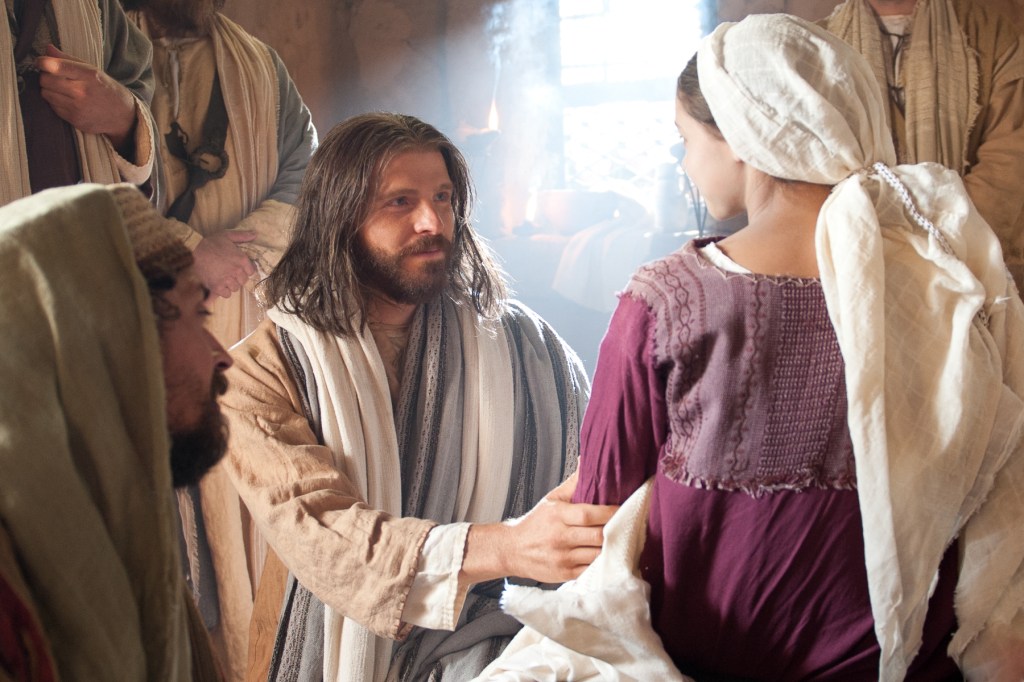
Jesus was a Nazarite and thus could not get near a dead body. Thus, he did not enter the tomb of Lazarus, or the house of the daughter. He raises them from afar!
“While Jesus was still speaking, some people came from the house of Jairus, the synagogue leader. “Your daughter is dead,” they said. “Why bother the teacher anymore?”
Jesus waits till Lazarus is dead, then, raises him from where he is.
(Now Jesus loved Martha and her sister and Lazarus.) 6 So, when he heard that Lazarus was ill, he stayed two days longer in the place where he was. 7 Then after this he said to the disciples, “Let us go to Judea again.”
I told Marilyn Reed I am being called to Oakland. I told her there is a mass healing I am bid to perform as this is my hometown. The day I found Darryl Aikens, it was announced the test for cancer was negative.
After Jesus died and gave up the Holy Spirit he raised the dead from – where he be!
The tombs broke open, and the bodies of many saints who had fallen asleep were raised. 53After Jesus’ resurrection, when they had come out of the tombs, they entered the holy city and appeared to many people.54 When the centurion and those with him guarding Jesus saw the earthquake and all that had happened, they were terrified and said, “Truly this was the Son of God.”…
Jesus tells the official his son is dead. But, he will raise him from afar.
“Sir,” The official said, “come down before my child dies.”
“Go,” said Jesus, “your son will live.”
Your son is already dead. But, as we speak, he has been raised from the dead.
I speak of Mattie Aikens in the same breath I speak of Jesus’ descent from Ruth and Boez. She never stop believing her property would be returned to her. Jesus was their Go’el Redeemer restoring property that was taken from them .Mattie’s house is in the middle of a greater and more divine place. She never stopped believing her home would be restored, and God’s Justice will be done, on earth, as it is in Heaven. Mattie has seen God. Darryl has seen God, This is a very blessed family. Happy Birthday Darryl!
Jon Presco
The Nazarite
Copyright 2016
43After two days, Jesus left for Galilee. 44Now He Himself had testified that a prophet has no honor in his own country. 45Yet when He arrived, the Galileans welcomed Him. They had seen all the great things He had done in Jerusalem at the feast, for they had gone there as well.
46So once again He came to Cana in Galilee, where He had turned the water into wine. And there was a royal official whose son lay sick at Capernaum. 47When he heard that Jesus had come from Judea to Galilee, he went and begged Him to come down and heal his son, who was about to die.
48Jesus said to him, “Unless you people see signs and wonders, you will never believe.”
49“Sir,” The official said, “come down before my child dies.”
50“Go,” said Jesus, “your son will live.”
The man believed the word that Jesus had given him and went on his way. 51While he was still on the way, his servants met him with the news that his boy was alive.
52So he inquired as to the hour when his son had recovered, and they told him, “The fever left him yesterday at the seventh hour.”
53Then the father realized that this was the very hour in which Jesus had told him, “Your son will live.” And he and all his household believed.
54This was now the second sign that Jesus performed after coming from Judea into Galilee.
Mark 5:21-43New International Version (NIV)
Jesus Raises a Dead Girl and Heals a Sick Woman
21 When Jesus had again crossed over by boat to the other side of the lake, a large crowd gathered around him while he was by the lake.22 Then one of the synagogue leaders, named Jairus, came, and when he saw Jesus, he fell at his feet. 23 He pleaded earnestly with him, “My little daughter is dying. Please come and put your hands on her so that she will be healed and live.” 24 So Jesus went with him.
A large crowd followed and pressed around him. 25 And a woman was there who had been subject to bleeding for twelve years. 26 She had suffered a great deal under the care of many doctors and had spent all she had, yet instead of getting better she grew worse. 27 When she heard about Jesus, she came up behind him in the crowd and touched his cloak, 28 because she thought, “If I just touch his clothes, I will be healed.” 29 Immediately her bleeding stopped and she felt in her body that she was freed from her suffering.
30 At once Jesus realized that power had gone out from him. He turned around in the crowd and asked, “Who touched my clothes?”
31 “You see the people crowding against you,” his disciples answered, “and yet you can ask, ‘Who touched me?’ ”
32 But Jesus kept looking around to see who had done it. 33 Then the woman, knowing what had happened to her, came and fell at his feet and, trembling with fear, told him the whole truth. 34 He said to her,“Daughter, your faith has healed you. Go in peace and be freed from your suffering.”
35 While Jesus was still speaking, some people came from the house of Jairus, the synagogue leader. “Your daughter is dead,” they said. “Why bother the teacher anymore?”
36 Overhearing[a] what they said, Jesus told him, “Don’t be afraid; just believe.”
37 He did not let anyone follow him except Peter, James and John the brother of James. 38 When they came to the home of the synagogue leader, Jesus saw a commotion, with people crying and wailing loudly.39 He went in and said to them, “Why all this commotion and wailing? The child is not dead but asleep.” 40 But they laughed at him.
After he put them all out, he took the child’s father and mother and the disciples who were with him, and went in where the child was. 41 He took her by the hand and said to her, “Talitha koum!” (which means “Little girl, I say to you, get up!”). 42 Immediately the girl stood up and began to walk around (she was twelve years old). At this they were completely astonished. 43 He gave strict orders not to let anyone know about this,and told them to give her something to eat.
http://www.jrtalks.com/john/john11v1to44.html
I am going to look at the three problems posed by John’s graphic account of the great miracle at Bethany. Stated concisely they are: the delay, the distress and the dialogue. Why did Jesus delay in responding to his friend’s cry for help? What was the cause of Christ’s great distress prior to raising Lazarus from the dead? How do we explain the perplexing dialogue between Jesus and down to earth Martha?
3 So the sisters sent to him, saying, “Lord, he whom you love is ill.” 4 But when Jesus heard it he said, “This illness does not lead to death. It is for the glory of God, so that the Son of God may be glorified through it.”
There are remarkable parallels here with between the raising of Lazarus and the healing of the man who was blind from birth. In one case light is given and in the other case, life. Interestingly enough both themes are the major themes alluded to in John 1:4: “4 In him was life, and the life was the light of men. 5 The light shines in the darkness, and the darkness has not overcome it.” Also, the reason for both Lazarus’ death and the man’s blindness was for God’s glory (John 9:2-3 and John 11:4).
5 (Now Jesus loved Martha and her sister and Lazarus.) 6 So, when he heard that Lazarus was ill, he stayed two days longer in the place where he was. 7 Then after this he said to the disciples, “Let us go to Judea again.”
If we read vss. 5-6 they make little sense (since Jesus loved them, why didn’t he come immediately). If we read the text carefully, we will quickly realize that verse 5 is a parenthetical comment inserted between vss. 4 and 6. This means verse 6 (“So when he heard…”) continues as the end of vs.4 (“it is for the glory of God, so that the Son of God may be glorified through it”.) So no one would think Jesus did not truly love the family, the parenthetical comment was added – “Now (you must know) Jesus loved Martha and her sister and Lazarus”.
8 The disciples said to him, “Rabbi, the Jews were just now seeking to stone you, and are you going there again?”9 Jesus answered, “Are there not twelve hours in the day? If anyone walks in the day, he does not stumble, because he sees the light of this world. 10 But if anyone walks in the night, he stumbles, because the light is not in him.”
If we attempt to understand the Jews here as being the Jewish people, the sentence would sound completely ridiculous. Clearly, the Jerusalemite authorities who were seeking Jesus’ life are in view here. We must continue to remember John’s statement in the prologue that summed up Jesus life, death and resurrection: “The light shines in the darkness, and the darkness has not overcome it.” (John 1:5) Jesus is referring to the light that illuminates the world. Remember, in John the world does not always mean humanity at large, sometimes it means Judea and its inhabitants.(John 7:3).
11 After saying these things, he said to them, “Our friend Lazarus has fallen asleep, but I go to awaken him.” 12 The disciples said to him, “Lord, if he has fallen asleep, he will recover.” 13 Now Jesus had spoken of his death, but they thought that he meant taking rest in sleep. 14 Then Jesus told them plainly, “Lazarus has died, 15 and for your sake I am glad that I was not there, so that you may believe. But let us go to him.” 16 So Thomas, called the Twin, said to his fellow disciples, “Let us also go, that we may die with him.” 17 Now when Jesus came, he found that Lazarus had already been in the tomb four days.
Jesus clarifies for his disciples that his close friend Lazarus had died. What is important in vs.17 is John’s statement that when Jesus arrived in Bethany it was already the fourth day. This explains why after hearing the news that Lazarus was very sick “he stayed two days longer in the place where he was.” (John 11:6) Jesus knew how long it would take to travel to Bethany. He was determined to arrive, not only after Lazarus’ death, but when, according to popular Jewish belief, resurrection was no longer possible – on the fourth day!
http://jewishstudies.eteacherbiblical.com/resurrection-lazarus-jewish-tradition-john-121-44/
In the New Testament[edit]
See also: Historical Jesus
The practice of a nazirite vow is part of the ambiguity of the Greek term “Nazarene“[37] that appears in the New Testament; the sacrifice of a lamb and the offering of bread does suggest a relationship with Christian symbolism (then again, these are the two most frequent offerings prescribed in Leviticus, so no definitive conclusions can be drawn). While a saying in (Matthew 11:18–19 and Luke 7:33–35) attributed to Jesus makes it doubtful that he, reported to be “a winebibber”, was a nazirite during his ministry, the verse ends with the curious statement, “But wisdom is justified of all her children”. The advocation of the ritual consumption of wine as part of thePassover, the tevilah in Mark 14:22–25 indicated he kept this aspect of the nazirite vow when Jesus said, “Verily I say unto you, I will drink no more of the fruit of the vine, until that day that I drink it new in the kingdom of God.” The ritual with which Jesus commenced his ministry (recorded via Greek as “Baptism“) and his vow inMark 14:25 and Luke 22:15–18 at the end of his ministry, do respectively reflect the final and initial steps (purification by immersion in water and abstaining from wine) inherent in a Nazirite vow. These passages may indicate that Jesus intended to identify himself as a Nazirite (“not drinking the fruit of vine”) before his crucifixion.[38]
Luke the Evangelist clearly was aware that wine was forbidden in this practice, for the angel (Luke 1:13–15) that announces the birth of John the Baptist foretells that “he shall be great in the sight of the Lord, and shall drink neither wine nor strong drink; and he shall be filled with the Holy Ghost, even from his mother’s womb”, in other words, a nazirite from birth, the implication being that John had taken a lifelong nazirite vow.[39]
Acts of the Apostles is also attributed to Luke (see Luke-Acts) and in Acts 18:18 it is reported that the apostle Paul cut off his hair “because of a vow he had taken”.[40] From Acts 21:23-24Acts we learn that the early Jewish Christians occasionally took the temporary Nazarite vow, and it is probable that the vow of St. Paul mentioned in Acts 18:18, was of a similar nature, although the shaving of his head in Cenchrea, outside of Palestine, was not in conformity with the rules laid down in the sixth chapter of Numbers, nor with the interpretation of them by the Rabbinical schools of that era.[41] If we are to believe the legend of Hegesippus quoted by Eusebius,[42] St. James the Less, Bishop of Jerusalem, was a Nazarite, and performed with rigorous exactness all the practices enjoined by that rule of life. In Acts 21:20–24 Paul was advised to counter the claims made by some Judaizers (that he encouraged a revolt against the Mosaic Law). He showed the “believers there” (believers in Jesus, i.e. the Jewish Christians) in Jerusalem otherwise by purifying himself and accompanying four men to the temple who had taken nazaritic vows[43](so as to refute the naysayers).[44]
This stratagem only delayed the inevitable mob assault on him. This event brought about the accusation[citation needed] in Acts 24:5–18 that Paul was the “ringleader of the sect of the Nazarenes”, and thus provides further verification that the term Nazarene was a mistranslation of the term Nazirite.[citation needed] In any case, the relationship of Paul of Tarsus and Judaism is still disputed.
What is curious is that Luke does not here mention the apostle James the Just as taking nazirite vows, although later Christian historians (e.g. Epiphanius Panarion29.4) believed he had, and the vow of a nazirite would explain the asceticism Eusebius of Caesarea ascribed to James[45] (something the Jewish Nazarite Vow was never intended to do), a claim that gave James the title “James the Just”.

 Rosamond Press
Leave a comment