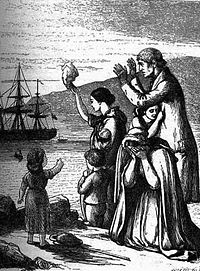
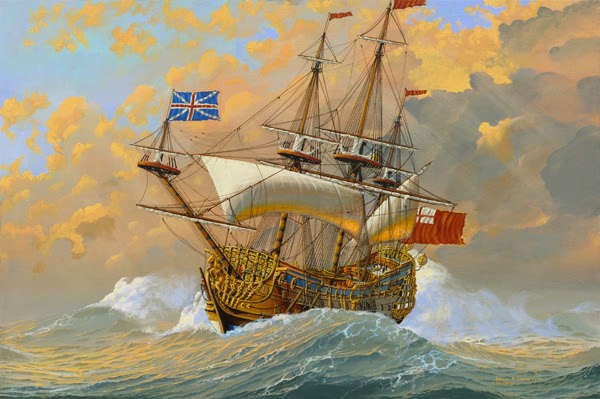
Protestant England has long wanted to get rid of their Irish Catholic Problem. There was an attempt to dump them on the West Coast.
Jon Presco
When writing his memoirs the General was again in Washington for
the conveniences of records. Those of Mr. Bancroft were precious,
and we were together constantly. There is not place here for all
that belongs to that wonderfully interesting episode, but Mr. Bancroft
became so re-awakened to its dramatic interest that he resolved
to write a monograph on the taking of California. And in his 87th
year he made the long travel to Nashville to consult the private papers
of President Polk ; Mrs. Polk giving him fullest permission to copy and
use all he needed. Hence the Polk diary,* now in the Lenox library
of New York, which bought all of Mr. Bancroft’s library and papers.
“Our Oregon question was, in 1845, unsettled and angry ; Mexico was
preparing for war with us. She owed a huge debt to England, and an
English protectorate of California, with the Bay of San Francisco as an
English harbor, would be held as security. To make assurance doubly
sure, a colonization scheme was accepted by Mexico ; nominally re-
ligious, but to be made up from England’s treasury of fighting material,
Irishmen ; these, in thousands with their families, were to have a
grant of the San Joaquin valley from San Gabriel to San Francisco.f
This and much more was known, ofiicially, and also through ex-
ceptional information, from London and Mexico City ; and this is
what President Polk had to meet in March, 1845.
No ” weak nation trying to copy our Republic,^” but a formidable com-
bination in which the power of England and the religious zeal of the
Catholic church had also governing parts.
To meet this, at once and with the utmost secrecy possible, Bancroft
sent his orders of June 24, 1845, repeated in August and October, to Com-
modore Sloat, then commanding our Pacific squadron. J
Earlier, and with greater silence (because oral instructions could be
given) Fremont says, ” In 1845 I was sent out at the head of a third and
stronger expedition with instructions to foil England by carrying the
imminent war with Mexico into their territory of California. At the
fitting moment that territory was seized, and held, by the United States.”
Silence is essential to military success — Mexico had not proclaimed her
combinations, though we learned them through exceptional channels ; as
she learned all that could be known or inferred of ours, partly through
a woman in society, who was employed by the English Legation.
For the sake of her family, Mr. Buchanan, always kind-natured and
hating a fuss, made no exposure, but thereafter he opened his own mail;
and brought all his Mexican correspondence and newspapers to our
house for reading and translation, as he knew no Spanish. My father
did, also General Dix of New York, and these two as Chairman and
member of the Senate Military Committee were necessarily in active
consultation with the President. In the security of my father’s library
these Spanish letters would be read to Mr. Buchanan — discussed, and (by
my sister and myself) translations made of points to be laid before the
President and Cabinet. In this way I can speak with authority of the
councils I saw held, and the results hoped for from Mr. Fremont’s
third expedition. It was all planned — leaving details of time^ place
and circumstance to his own discretion. If possible, he was to be
 Rosamond Press
Leave a comment