


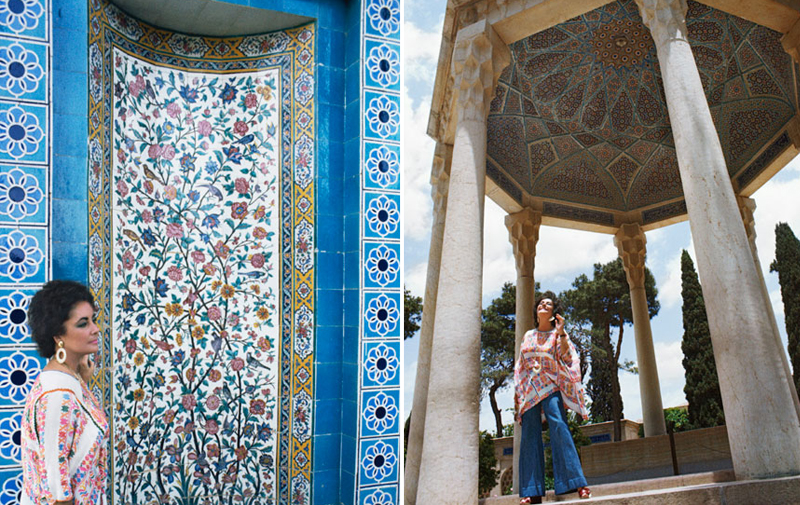


My kindred, Elizabeth Rosemond Taylor, went to Iran for a photo-shoot. Was she inspired by Talitha Getty who did a famous shoot in Morocco?
Tlaitha is related to Peter and Ian Fleming, and my kin, Liz Taylor, who descends from the Dutch families of Rover and Rosemondt. We are looking at a modern-day Dutch Bohemian Renaissance!
Ian Fleming’s novels generated more money from his books made into movies than Dan Brown, and was a real spy working with real codes.
Note how Garth Benton’s mural blends with Talitha’s shoot at the Getty mansion, where this photo of the world famous artist ‘Rosamond’ was taken.
Talitha was a Libra, a Bohemian Venus and lover to famous Rock Stars. She was a wild Bohemian woman, and is in my Family Tree.
I am kin to the Getty family. Christopher Wilding, the son of my kindred, Elizabeth Rosemond Taylor, was married to Aileen Getty.
Garth Benton sued his friend, Gordon Getty, for painting over a mural he did in the Getty home, where Christine Rosamond Benton spent the night. Christine’s partner in the Crossroads gallery, Lawrence Chazen, was a financial advisor for the Getty family, and their partner in Plumpjack. That is Chazen at the Rosamond gallery, and Christine at the Getty home.
Princess Diana, my possible kin, met Aileen at a foundation for AIDS victims. Aileen was stricken with AIDS and spent her fortune fighting this disease. This is key because I sent letters to Judges and Congressman objecting to my family’s Legacy of Recovery that could save many lives, being sold to, and then mishandled by lovers of money.
The Getty children were hippies and abusers of drugs, as were the Presco children. Christine’s funeral fell on her first sober birthday. I had seven years of sobriety.
After I forbid Tom Snyder to use my family recovery in his terrible book, and after he promised me he would not, he went against his word and made it a theme of ‘When You Close Your Eyes’ he pretending he knew about 12 Step programs.
Garth and Shannon Rosamond did the murals at the Getty Villa. His kindred, Aileen Getty, was an artist, a talented human being found in my family tree. Alan C. Fox has his people, I have mine. Why can’t there be a merger?
The Getty family has started many foundations and amassed one of the world’s largest art collections. Both the Getty and Fox family give grants to folks to do the research I have done. I have connected my family to great people while the un-gifted members of my family lured my seventeen year old daughter into their camp, dangling the Rosamond limelight before her – and the hint of Wealth! I don’t have a price, and thus I am a threat.
Then there is Liz’s art collection which I will post on next.
What is truly exciting is that I am kin to the fashion Model, Talitha Getty, who was married John P. Getty Jr. who amassed the world’s largest art collection. Talitha is still the Bohemian Fashion Muse that influenced the first work of my late sister, the world artist, Christine Rosamond Benton, who husband rendered murals at the Getty mansions. Lawrence Chazen owns several high class restaurants and is a partner in the PlumpJack Wineries along with members of the Getty, Newsom, and Pelosi family. Add to this the political Benton and Fremont family, ad you have California Bohemian Royalty.
My ex-wife, Mary Ann Tharaldsen, any my two Models and Muses, Marilyn Reed, and Rena Victoria Easton, have played a huge role in bringing together the world’s foremost Creative Dynasty that is a New Renaissance in America! Rosemary, Christine, Marilyn, and Gloria Ehlers made their own clothes. Gloria made me the blue shirt you see in photo with Rosemary and my aunt Lillian. These Rosamond sisters did not know we were related to Elizabeth Rosemond Taylor. Nor did my daughter, Heather Hanson.
A real biography of a famous artist is going to begin with a genealogy because creative people or usually born in a creative family tree, and marry people who also have creative ancestors. Heather had no interest in our family, and backed the outsiders (along with her mother) who hired a ghost writer who mentioned one of our ancestors – but got it wrong! Edwin Milton Royle is not Rosemary’s father – and thus not Liz Taylor’s kindred.
Also, the outsiders disappeared Christine’s 276 page autobiography lest the Heirs claim copyright to any book or movie they push – like drug dealers! Liz was victim to this outsider abuse all her life – and after she is dead!
In the worst biography ever written – that they can not sell – it is revealed Rosamond put images from fashion magazine, such as Vogue, in a projector and traced beautiful women on to a canvas. To reveal that the world famous Talitha is my kin goes with how Christine became successful, because Talitha appeared on the cover of Vogue. This is artistic justice because Talitha was married to John D. Rockefeller Jr. who had the world’s largest, and finest art collection found outside the Louvre and the Hermitage. She was John’s Muse. The three sisters of my Muse, Rena Victoria Easton were models that appeared on the cover of fashion magazines. If Rena came to California to be discovered and find fame, fame has found her – alas! Not but five minutes after we met, my two sisters are beholding her beauty.
Jon Presco
Talitha Getty is probably best remembered for an iconic photograph taken on a roof-top in Marrakesh, Morocco in January 1969 by Patrick Lichfield (1939–2005).[15] With her hooded husband in the background, this image (now part of the collection of the National Portrait Gallery in London) portrayed her in a slightly anxious, crouching pose, wearing a multi-coloured kaftan, white harem pants and white and cream boots.
The look seemed stylishly to typify the hippie fashion of the time and became a model over the years for what, more recently, has been referred to variously as “hippie chic“, “boho-chic” and even “Talitha Getty chic”.[16] Although, in her lifetime, Talitha Getty, who was only thirty when she died, was not much known to a wider public, fashion gurus of the late 20th and early 21st centuries have often written of her and Marrakesh (a major destination for hippies in the late 1960s, as illustrated by the 1969 song, “Marrakesh Express” byCrosby, Stills, Nash and Young) as virtually synonymous.
http://asiasociety.org/blog/asia/elizabeth-taylors-1976-trip-iran-pictures
http://www.cnn.com/videos/tv/2016/03/30/intv-amanpour-firooz-zahedi-elizabeth-taylor-iran.cnn
https://rosamondpress.com/2015/09/18/capturing-the-boho-wild-woman/
https://rosamondpress.com/2013/11/25/the-taylor-getty-and-rosamond-children/
From Vanity Fair to Glamour to Time, Firooz Zahedi‘s photography has graced some of the world’s most prominent magazines. His portfolio of portrait subjects has been equally extensive. Uma Thurman (and her iconic bed photo in Pulp Fiction), Diana Ross, Angelina Jolie, Leonardo DiCaprio and John Travolta are a few of the many Hollywood celebrities to pose for Zahedi.
Born in Iran in 1949, Zahedi grew up in England and moved to America in 1969 to study at Georgetown University’s School of Foreign Service. However, he had a deep passion for the arts. After graduating he served as a diplomat, but eventually enrolled at the Corcoran School of Art in Washington, DC to pursue his passion. It was there that Zahedi met Andy Warhol, whom he later photographed for Interview magazine.
In the mid-’70s Zahedi also became friendly with actress Elizabeth Taylor when she was involved with his cousin, Iranian Ambassador to the United States Ardeshir Zahedi. Hired to photograph her on her film sets, Zahedi also accompanied Taylor on her 1976 trip to Iran. As they visited some of the country’s most famous (and photogenic) landmarks, Zahedi documented their travels through photographs. The resulting images captured a carefree and whimsical side of Taylor, away from movie sets and crowds.
Earlier this fall, a print of one of Zahedi’s Taylor photographs was auctioned at an Asia Society benefit gala held in celebration of Asia Society Museum’s Iran Modern exhibition. Asia Blog subsequently reached out to Zahedi to find out more about his trip to Iran with an internationally famous film actress.
When your photographs of Elizabeth Taylor in Iran were exhibited publicly in 2011, were you aware of any reaction from other Iranian expatriates in this country?
I had a lot of positive reaction from the Iranian community regarding my photographs of Elizabeth Taylor in Iran when the exhibition opened at LACMA in Los Angeles. Every time I visited the museum, there were quite a few Iranians there. Once in a while I would be recognized because of the (LACMA) Youtube video [below] and they would come up to me and say how much they liked the photos and what great memories they brought back for them. Some had brought along their children who had never been to Iran and they wanted them to see the photos.
I was very moved, as that trip with Elizabeth in 1976 was the last time I went to Iran. To feel responsible for the joy that the images were giving these visitors made me miss Iran — despite the fact I had stopped considering it home, having left as a young boy and only visiting the country three times since 1959.
Do you know if word of the exhibition got back to Iran?
Both BBC Iran and Voice of America did filmed interviews with me and therefore I am sure people in Iran were made aware of the exhibit. I got quite a few emails from people I knew in Iran who informed me that they had seen the images on those sites.
In an interview you did with LACMA in 2011, you mention that very few people in the cities you visited would have recognized Taylor as a major Western movie star. Do you think that helps to account for why she was willing to pose so freely in public spaces for you?
When Elizabeth and I (and her assistant) explored the various cities and sites she chose to dress very simply and wore minimum makeup, which made her unrecognizable and did not attract attention, which made it easy for us to move around.
In regard to the photos of her in the chador and the tribal outfit, you must remember that she was an actress and when it came to posing in costumes she could assume a role and therefore lose any inhibition.
Last but not least, if you could shoot in Iran again today, what would you most like to photograph?
If I could go back to take photographs I would like to revisit the sites I explored with Elizabeth, not only for sentimental reasons but also because they are the most awesome buildings and structures that the Iranian culture has produced. I really have no desire to visit that which is considered modern in Iran as the influence seems to be from the West. I would like to go deeper into finding other ancient sites and exploring everything I missed on that rare visit.
Video: Zahedi discusses his Taylor photos at his 2011 LACMA exhibition

 Rosamond Press
Leave a comment